What Is Binance Coin (BNB)?
BNB, or Binance Coin, is the native asset of the BNB ecosystem. It serves as the primary fuel for on-chain transactions (gas fees) and supports settlement and fee deduction across multiple use cases. Classified as a "platform token," BNB is designed to provide utility and value within a specific ecosystem. Its supply is capped and gradually decreases through a burn mechanism.
From an on-chain perspective, BNB is the foundational asset of both the BNB Smart Chain and related blockchains. It is used to pay for smart contract execution fees, transaction costs, and plays a crucial role in staking and voting for validators and governance activities. Because its functions are concentrated within the ecosystem, BNB’s main value derives from supporting on-chain activities and applications.
Current BNB Price, Market Cap, and Circulating Supply
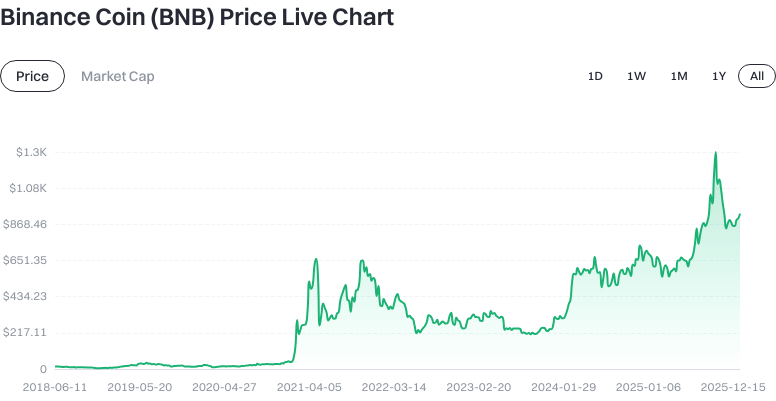
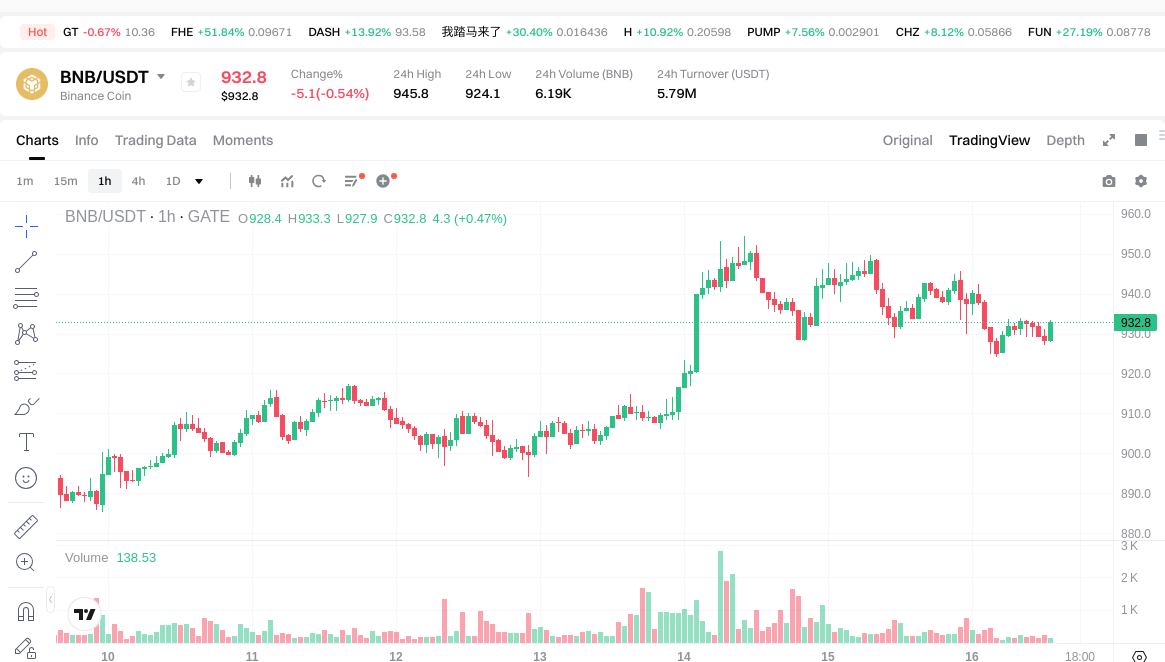
As of January 16, 2026 (source: submitted market data), the price of BNB is approximately $931.00. The circulating supply stands at around 136,361,274.53 BNB, with a circulating market capitalization of about $126,952,346,587.43. The fully diluted market cap is also approximately $126,952,346,587.43, representing about 3.76% of total market share. The 24-hour trading volume is about $5,806,461.07. Short-term performance includes a 1-hour change of +0.31%, 24-hour change of -0.56%, 7-day change of +4.00%, and 30-day change of +8.43%.
View the latest BNB price data
Glossary: Market cap = price × circulating supply; fully diluted market cap is typically approximated as price × total (or max) supply; market cap share represents its percentage in the overall market; trading volume indicates transaction value within a given period. BNB’s maximum supply is set at 200 million, which gradually decreases due to its burn mechanism. The current total and circulating supplies are close, reflecting tokens already burned or locked.
Who Created Binance Coin (BNB) and When?
BNB launched in 2017, initially issued as an Ethereum ERC-20 token before migrating to its own blockchain architecture (BNB Beacon Chain and BNB Smart Chain). This evolution transformed BNB from “a token on another chain” to “the native asset of its own chain,” optimizing its use for ecosystem transactions, contracts, and applications. (See: BNB Chain Docs, as of January 2024)
How Does Binance Coin (BNB) Work?
BNB’s core mechanisms consist of two layers:
First, on-chain execution: BNB Smart Chain is EVM-compatible, allowing developers to deploy smart contracts using languages like Solidity. All transactions and contract executions require gas fees paid in BNB.
Second, consensus and validation: BNB Smart Chain utilizes PoSA (Proof of Staked Authority), a consensus mechanism where validators must stake BNB and are selected by the community to produce blocks. This approach aims to balance performance and security. (See: BNB Chain Docs, as of January 2024)
Additionally, BNB features a burn mechanism to reduce supply over time. Beyond quarterly burns in its early phase, the ecosystem now uses an Auto-Burn model that adjusts the amount burned based on on-chain activity and market data, with a long-term target supply of 100 million BNB. (See: BNB Chain announcements and Docs, as of January 2024)
Token standards: BEP20 is the token standard for BNB Smart Chain; BEP2 is used on BNB Beacon Chain. These standards facilitate issuance of various application tokens and together form the ecosystem’s asset layer alongside BNB.
What Can You Do With Binance Coin (BNB)?
Key use cases for BNB include:
On-chain payments: Pay gas fees when transferring funds on BNB Smart Chain, interacting with DeFi protocols, or minting/trading NFTs.
Application settlement: Serve as a settlement asset for DApps in gaming, social media, or payments—enabling fast micro-payments and contract settlements.
Ecosystem fee discounts: Use BNB to offset trading fees or access preferential rates within supported platform scenarios (subject to specific rules).
Staking and governance: Stake BNB to participate in validator selection or community governance processes, enhancing network security and user engagement.
Key Risks and Regulatory Considerations for Binance Coin (BNB)
Concentration and governance risk: PoSA consensus features a limited validator set; ongoing attention is needed for centralization and governance arrangements.
Regulatory uncertainty: Platform-associated assets may face changing policies in different jurisdictions, including compliance obligations, security classification, and user protection rules. Always understand local regulations before investing or using.
Smart contract and DApp risks: Vulnerabilities or exploits in smart contracts and protocols can lead to asset loss; choose audited applications and manage exposure carefully.
Cross-chain/network selection risks: BEP20 and BEP2 are distinct networks—mistakes in network selection or Memo omission may result in unrecoverable assets. Always verify network type and address format before transferring.
Custody and private key safety: Exchange accounts carry platform/account security risks; self-custody means loss or exposure of mnemonic phrases or private keys can make assets unrecoverable. Enable two-factor authentication, multi-tier authorization, and offline backups.
What Is the Long-Term Value Proposition of Binance Coin (BNB)?
Supply & burn mechanism: Capped supply combined with automated burning promotes long-term supply contraction, but actual impact depends on network activity and burn parameters.
Ecosystem demand: EVM compatibility and low fees drive developer adoption and user migration; ongoing expansion in DeFi, gaming, NFTs boosts gas demand and BNB utilization.
View BNB USDT price
Performance & cost: PoSA delivers high throughput and low transaction fees—ideal for high-frequency interactions—supporting broader app adoption and user growth.
External factors: Regulatory environment, developer activity, cross-chain interoperability, and security incidents all affect value realization; ongoing assessment and risk diversification are recommended.
How Do I Buy and Securely Store Binance Coin (BNB) on Gate?
Step 1: Register and complete KYC.
Go to gate.com to create an account. Follow prompts for email/phone verification and identity verification (KYC). Enable two-factor authentication for extra account security.
Step 2: Deposit funds.
Navigate to “Assets” to deposit fiat or crypto. If depositing crypto assets, confirm matching network/address to prevent loss from sending to the wrong chain.
Step 3: Search for BNB and place a buy order.
Go to “Trade,” select “Spot,” then search “BNB.” You can set a limit order at your desired price or use a market order to buy at current rates. Before placing an order, confirm the trading pair and amount—pay attention to fees and slippage.
Step 4: Withdraw to your personal wallet.
In “Withdraw,” select BNB and choose the correct network:
- For BNB Smart Chain, select BEP20 network with its corresponding address.
- For BNB Beacon Chain, select BEP2 network and enter the correct Memo (tag).
Mistakes in network selection or Memo omission can result in unrecoverable assets.
Step 5: Safely store and back up.
Use hardware wallets or trusted software wallets for asset management. Write down your mnemonic phrase offline and store it securely—never photograph or upload it online. Enable two-factor authentication for both your wallet and Gate account; periodically review authorization/signature records.
How Does Binance Coin (BNB) Differ From Ethereum (ETH)?
Positioning & ecosystem: Both are native assets of their respective blockchains used for gas fees. BNB primarily serves platform-specific applications within its own ecosystem; ETH acts as infrastructure for broader development and financial activities.
Consensus & decentralization: BNB Smart Chain uses PoSA, with fewer validators delivering high performance but greater concentration concerns; Ethereum uses Proof of Stake with a large validator set focusing on security and decentralization—though this often results in higher fees under heavy load.
Compatibility & development: Both support EVM for easy developer migration. Ethereum is home to most original innovations; BNB emphasizes low costs and high throughput for mass users/applications.
Supply & burn: BNB has an auto-burn mechanism targeting a supply of 100 million; ETH introduced base fee burning via EIP-1559—net issuance depends on network usage/staking parameters. Their supply dynamics/economic models differ significantly.
Fees & performance: BNB generally offers lower fees/faster confirmations; Ethereum mainnet is more costly but prioritizes robust security/stability. Selection depends on specific application requirements/cost priorities.
Summary of Binance Coin (BNB)
BNB is the native asset powering the BNB ecosystem—serving functions such as gas payments, settlement, and fee deduction. Its capped supply combined with auto-burn enables potential long-term supply contraction. As of January 16, 2026, data shows significant market cap and activity levels—but value realization ultimately depends on ecosystem demand, regulatory landscape, and ongoing security performance. If planning to buy BNB on Gate, follow KYC procedures carefully, verify networks/Memo details, use trusted wallets, and securely back up private keys/mnemonics. For portfolio management, control position size, diversify risk, monitor on-chain activity/policy changes regularly to ensure safe and resilient use/investment.
FAQ
What Are the Main Uses of BNB?
BNB is Binance’s ecosystem token—its primary use is paying trading fees on Binance Exchange at discounted rates. It also powers various applications within the Binance ecosystem such as participating in IEOs or covering service fees. Its value closely tracks the growth of the Binance platform.
What Risks Should I Be Aware Of When Holding BNB?
BNB’s price fluctuates based on Binance’s operational performance—if the platform faces regulatory or operational issues, BNB’s value could be affected. Crypto assets are highly volatile; only invest what you can afford to lose.
How Should Beginners Buy and Store BNB?
Register on major exchanges like Gate to purchase BNB. For long-term holding, transfer it to a secure wallet (e.g., hardware wallet) rather than keeping it on an exchange. For short-term trading needs, temporarily storing it on the platform is acceptable.
How Is BNB Different From Regular Cryptocurrencies?
BNB is an ecosystem token linked to a specific platform (Binance), while Bitcoin or Ethereum are native assets of independent blockchains. BNB’s core value comes from platform utility/discounts—not standalone technology innovation—meaning its risk profile is more tightly bound to platform health.
What Drives Price Fluctuations in BNB?
BNB’s price responds primarily to Binance platform developments, overall crypto market trends, macroeconomic factors, and regulatory changes. New features or increased trading volumes tend to boost demand/prices; declines follow negative trends or platform setbacks. It also correlates with major cryptocurrencies like Bitcoin or Ethereum.
- Binance Smart Chain: Main ecosystem supporting smart contract deployment/DeFi applications for BNB.
- Gas Fees: Fees paid in BNB for executing transactions/contracts on BSC.
- Staking: Locking up BNB to participate in network validation or liquidity mining for rewards.
- Cross-chain bridging: Technology enabling transfers of BNB/other assets across different blockchains.
- Validator node: Participants maintaining the BSC network/processing transactions—must stake BNB for rewards.
- Token burn: Binance periodically destroys portions of BNB supply to reduce circulation/increase token value.
Binance Coin (BNB) Reference & Further Reading
-
Official Site / Whitepaper:
-
Development / Documentation:
-
Authoritative Media / Research: