What Is ChainGPT?
ChainGPT is an AI-powered project and utility token (CGPT) designed specifically for blockchain and crypto applications. The platform leverages artificial intelligence to explain blockchain concepts, assist in smart contract drafting and review, conduct market analysis, and facilitate Q&A interactions. The CGPT token is used to pay for and access these AI features, while also incentivizing developer and user participation within the ecosystem.
Current Price, Market Cap, and Circulating Supply of ChainGPT (CGPT)
As of January 16, 2026 (data sourced from user reference), CGPT is priced at approximately $0.034630 with a circulating market cap of around $34,552,651.
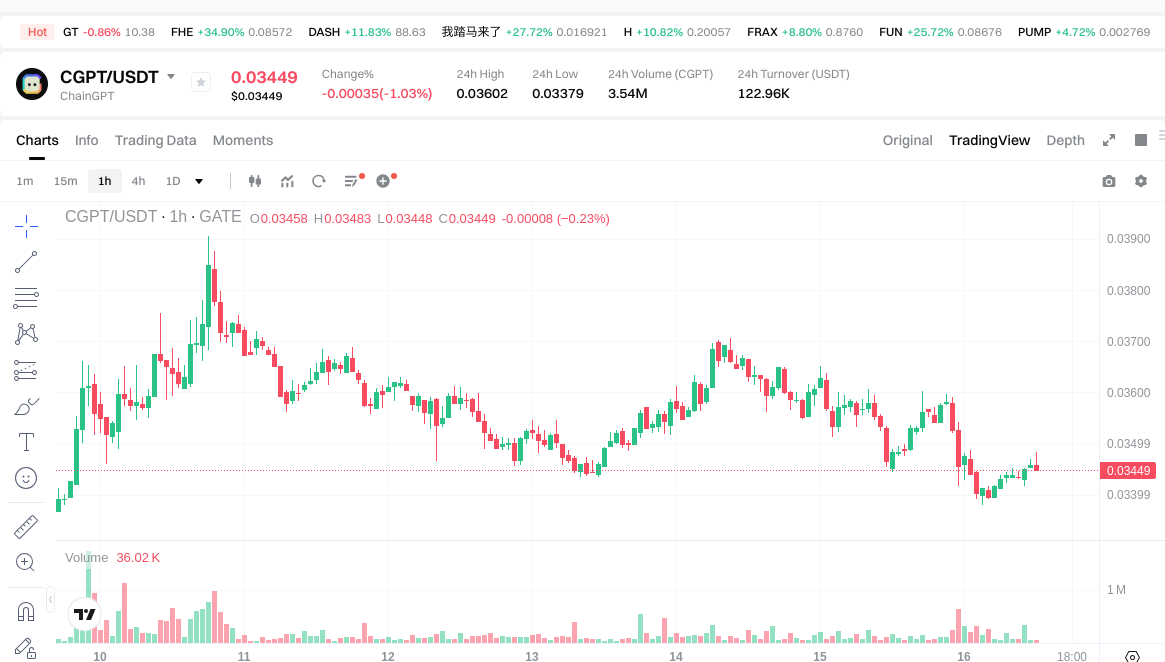
Click to view CGPT USDT Price
Market cap is calculated as “price × circulating supply” and serves as a metric for the token’s overall market size. CGPT’s market cap accounts for approximately 0.001% of the total crypto market.
Circulating supply is about 875,768,718 tokens, with a total supply of approximately 997,766,421 and a maximum supply capped at 1,000,000,000 tokens. “Circulating supply” refers to the number of tokens available for trading on the market, “total supply” represents all tokens issued (not all necessarily in circulation), and “maximum supply” is the hard cap defined by the project. Fully diluted market cap (FDV) is estimated at $34,552,651, calculated as “price × maximum supply,” indicating potential valuation if all tokens are released.
Short-term price changes: 1 hour -0.06%, 24 hours -0.63%, 7 days +1.47%, 30 days +11.25%.
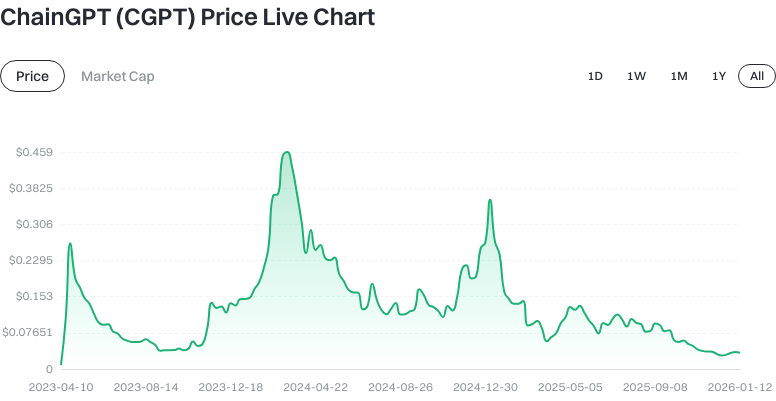
Click to view Latest CGPT Price Chart
24-hour trading volume stands at approximately $122,826, indicating recent trading activity. The “active status: no” data field suggests readers should verify the latest project status through official channels.
Who Created ChainGPT (CGPT) and When?
ChainGPT was launched on April 9, 2023 by the ChainGPT team. Its aim is to integrate general-purpose artificial intelligence into crypto and blockchain workflows—such as smart contract drafting/review, market and on-chain data analysis, educational tools, and Q&A interfaces. The project is positioned primarily as an AI assistant for crypto users and developers.
How Does ChainGPT (CGPT) Work?
ChainGPT utilizes AI models to deliver modules for end-users and developers—including contract analysis, code generation, and market interpretation. The CGPT utility token is used to settle access fees and unlock premium features, forming a closed loop: “use → pay → service.”
Key token concepts include:
- Billing & Access: Pay with CGPT to access AI services or higher quotas.
- Supply Constraint: Maximum supply is 1 billion tokens—finite rather than unlimited—which helps define dilution boundaries.
- Ecosystem Incentives: Tokens may be distributed as rewards to contributors and partners to promote content creation and tool development.
Economic details such as burning, buybacks, or staking depend on official documentation; common practices involve allocating revenue for ecosystem development or rewarding holders, but always refer to the latest disclosures.
What Can You Do With ChainGPT (CGPT)?
The primary utility of CGPT is as a payment and access medium for:
- Learning & Research: Ask AI about blockchain mechanisms, receive developer/investor-focused explanations and examples.
- Smart Contract Workflows: Generate drafts, review potential risks—helping developers boost productivity.
- Market Analysis & Data Insights: Use models for compliant market research and on-chain metric reporting.
- Customer Support & Knowledge Base: Provide Q&A services for projects or communities, lowering informational barriers.
- Ecosystem Incentives: Reward or settle tasks within the community, content creation efforts, or third-party integrations.
Wallets and Extensions in the ChainGPT (CGPT) Ecosystem
Wallets are essential for storing and managing tokens. Popular types include:
- Hot Wallets: Browser extensions or mobile apps for daily transactions; private keys are stored on internet-connected devices—convenient but require caution against phishing and device security risks.
- Cold Wallets: Hardware wallets keep private keys offline for higher security—ideal for long-term holding or large assets.
Usage tips:
- Contract Address Verification: Always confirm CGPT’s contract address via the project website or reputable sources to avoid counterfeit tokens.
- Network & Gas Fees: Transferring across networks requires paying gas fees (transaction fees). Double-check network and fee details before withdrawals or transfers.
- Backup & Recovery: Securely store mnemonic phrases (for wallet recovery) and private keys (for signing/control); never upload or screenshot these to cloud storage.
Main Risks and Regulatory Considerations of ChainGPT (CGPT)
- Market Volatility: Prices may fluctuate with trends in both the crypto sector and AI narratives—manage positions and liquidity accordingly.
Click to view Latest CGPT Price Chart
- Liquidity Risk: Low trading volumes can cause slippage; consider splitting orders.
- Smart Contract & Security: Vulnerabilities in contracts or integrations can lead to asset loss; beware of phishing sites and fake contract addresses.
- AI Output Bias: AI-generated content may be inaccurate—always verify with manual review and multiple sources.
- Regulation & Compliance: Crypto assets and AI services are regulated differently by region; registration and trading on Gate require KYC (identity verification) and compliance with local laws.
- Project Activity: Status marked “inactive”; confirm ongoing development via the website, GitHub, and social media before engaging.
How to Buy and Safely Store ChainGPT (CGPT) on Gate
Step 1: Register & Verify. Visit gate.com, create an account, complete KYC (identity verification), and enable two-factor authentication for enhanced security.
Step 2: Fund Your Account. Purchase fiat or deposit USDT/stablecoins; ensure sufficient balance and be aware of potential transaction fees.
Step 3: Search & Place Order. Find “CGPT” in spot markets—choose your trading pair (e.g., CGPT/USDT). Execute a market order (instant buy at current price) or limit order (set your own price).
Step 4: View Holdings. After purchase, check your CGPT balance on the “Funds” or “Assets” page; set price alerts or manage risk as needed.
Step 5: Withdraw & Self-Custody. For long-term holding, transfer CGPT to your personal wallet. Add the correct contract address first; try a small test transfer before moving larger amounts. Safeguard your private key and mnemonic phrase; hardware wallets are recommended for extended storage.
Step 6: Ongoing Security Management. Regularly review account security settings; watch out for phishing links. Before transferring assets, double-check recipient addresses, networks, and ensure sufficient gas fees.
ChainGPT (CGPT) vs Fetch.ai
Positioning & Purpose: ChainGPT focuses on providing “AI assistant tools for crypto/blockchain users”—such as contract auditing, market analysis, and knowledge Q&A—while Fetch.ai aims to build autonomous agents and AI infrastructure for broader use cases like IoT, data exchange, and DeFi.
Technology & Ecosystem: ChainGPT centers on AI models and application interfaces; its token mainly functions for access/payment. Fetch.ai emphasizes agent networks and protocol-layer architecture with a more diverse ecosystem.
Token Utility & Economics: CGPT is primarily used for paying AI services and ecosystem incentives; FET enables network participation and governance (refer to official documentation). Both tokens’ value depends on supply/demand/adoption but mechanisms differ.
Investment Considerations: Assess actual product usage data, development pace, partnerships, and compliance progress for each project. Choose based on whether you prefer a “tool-based AI assistant” or “agent network/infrastructure” approach—avoid single-narrative decision-making.
Summary of ChainGPT (CGPT)
ChainGPT (CGPT) positions itself as an AI toolkit and utility token tailored for crypto/blockchain use cases. Its core value lies in leveraging AI for smarter contract management and research efficiency while enabling seamless access/payments via its token. With a capped supply of 1 billion tokens, latest data shows price, market cap, and circulation remain within observable ranges. Participation should be grounded in real product usage and ecosystem growth; always verify project activity status and contract addresses. Choose hot/cold wallets for secure self-custody. On Gate, follow compliant account setup, staggered orders, and risk controls. Strategically monitor changes in economic models, regulations, and market cycles—diversifying positions and setting stop-losses to manage uncertainty.
FAQ
CGPT (ChainGPT) is an independent blockchain project with no direct connection to OpenAI’s ChatGPT. ChainGPT is purpose-built for blockchain and crypto ecosystems—helping users analyze smart contracts, predict markets, optimize trading strategies. Although both involve AI technology, their use cases and issuing entities are entirely separate—do not confuse them.
What Benefits Do CGPT Holders Get?
Holding CGPT can earn rewards through staking programs while unlocking access or discounts on in-platform AI tools. After buying CGPT on Gate or similar exchanges, you may participate in staking by locking up your tokens for a period. Additionally, holding more tokens grants greater voting power in platform governance decisions—but actual yields depend on real-time official announcements.
On Which Blockchains Is CGPT Tradable?
CGPT is deployed mainly on Ethereum and BNB Chain. Each network has its own contract address. Exchanges like Gate usually provide integrated cross-chain liquidity so you don’t need manual switching. For independent cross-chain transfers, use official bridging tools—always verify contract addresses to avoid asset loss.
What Can ChainGPT’s AI Functions Do?
ChainGPT’s AI features include smart contract auditing, trade signal generation, market data analytics, and natural-language blockchain queries. For example: you can quickly review new contract code for risks or generate personalized trading suggestions. However, remember that AI predictions have limitations—all decisions should be self-evaluated; do not rely solely on AI outputs.
How Can Beginners Safely Buy & Store CGPT?
For newcomers, purchasing CGPT directly on Gate is straightforward with strong security safeguards. If holding long-term, transfer funds to a self-custody wallet (like MetaMask), securely store your private key or mnemonic phrase—never share them with anyone. For small test transactions you may keep assets on exchanges at first; move out after gaining confidence. Always enable two-factor authentication and routinely backup wallet info for added protection.
CGPT (CGPT) Key Terminology Overview
- Token Supply: Includes circulating supply, total supply, and maximum supply—reflecting scarcity and inflation expectations.
- Market Cap: Product of token price × circulating supply; measures project’s market size/investor confidence.
- Fully Diluted Market Cap (FDV): Market cap calculated at maximum supply; represents theoretical value if all tokens are unlocked.
- Trading Volume: Total transaction amount over 24 hours; indicates liquidity/activity.
- Price Change (%): Token’s price movement over specific periods—used to assess short/mid-term trends.
- Market Cap Share: Proportion of this token’s market cap within the total crypto market—showing its industry position.
CGPT (CGPT) References & Further Reading