What Is TerraLunaClassic?
TerraLunaClassic (LUNC) is the native token of the original Terra blockchain, now referred to as Terra Classic. It was initially designed to support the issuance and price stability of algorithmic stablecoins, while also serving as the backbone for network governance and security. LUNC operates on a Proof of Stake (PoS) chain that utilizes Tendermint consensus. Holders can participate in staking by delegating their tokens to validators, contributing to network security and voting on governance proposals.
Proof of Stake (PoS) is a consensus mechanism where participants who hold and stake tokens help validate transactions and produce blocks in exchange for on-chain rewards. Tendermint is a Byzantine Fault Tolerant consensus engine that enables fast transaction finality. Algorithmic stablecoins, in this context, are designed to maintain their target price through protocol-driven conversion and arbitrage mechanisms between tokens.
What Are the Latest Price, Market Cap, and Circulating Supply of TerraLunaClassic (LUNC)?
As of 2026-01-16:
- Price: approximately $0.000042
- Circulating supply: about 5,471,860,711,794.862305 tokens
- Total supply: about 6,470,640,916,988.725586 tokens
- Market cap: approximately $268,790,423.691712
- Fully diluted market cap: approximately $268,790,423.691712
- Market dominance: about 0.007900%
- 24h trading volume: about $146,326.231890
- 1h change: +0.13%, 24h change: -3.68%, 7d change: -4.85%, 30d change: +3.80%
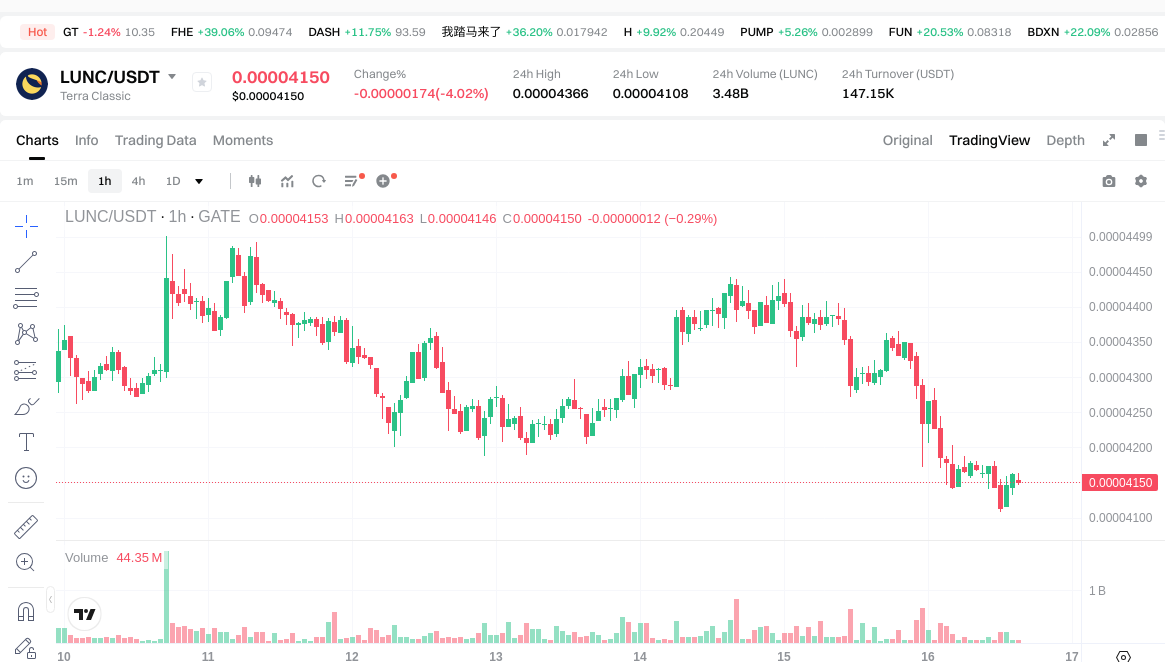
Click to view LUNC USDT price
Market capitalization is calculated as "price × circulating supply," reflecting the current market valuation of tokens in circulation. Fully diluted market cap uses "price × total supply," estimating potential value if all tokens were in circulation. Note that the data field “maximum supply: ∞” versus “unlimited supply: No” shows an inconsistency—there is no fixed hard cap, and actual supply may change based on community governance decisions regarding inflation or burning mechanisms.
Who Created TerraLunaClassic (LUNC) and When?
The Terra Classic chain (original Terra chain), which hosts LUNC, was launched by Terraform Labs with its mainnet going live on July 25, 2019 (source: Terra Docs, 2019). In May 2022, the depegging of algorithmic stablecoin TerraUSD (UST) triggered extreme market volatility and massive token inflation on the original chain. In response, the community and team launched a new chain called “Terra (LUNA),” while the original network was rebranded as “Terra Classic,” retaining LUNC as its native token under community-led maintenance (sources: CoinDesk, May–June 2022; Terra Announcement, June 2022).
Currently, technical upkeep and economic parameters of TerraLunaClassic are largely managed through community governance proposals and validator coordination (source: TerraClassic Governance Forum, 2023–2025).
How Does TerraLunaClassic (LUNC) Work?
In its classic design, the original Terra chain enabled protocol-based conversion between its algorithmic stablecoin and LUNA:
- When the stablecoin price dropped below its peg, users could buy the stablecoin at a discount and swap it for an equivalent value of LUNA via the protocol for arbitrage gains.
- When the price exceeded the peg, users could mint new stablecoins by burning LUNA and sell them for profit.
Arbitrage refers to profiting from price discrepancies through trading.
On-chain operations use PoS and Tendermint consensus, with validators producing blocks. Token holders stake LUNC with validators to share block rewards and participate in governance. Governance voting determines parameters such as tax rates, inflation, or community fund allocations. Burn tax (where a portion of transaction fees is destroyed to reduce supply) and other economic parameters are adjusted via proposals; the community has repeatedly modified tax rates in recent years (source: TerraClassic Governance Forum, 2022–2025).
What Can You Do With TerraLunaClassic (LUNC)?
Currently, LUNC’s primary uses include:
- Staking and governance: Delegate LUNC to validators to enhance network security and vote on on-chain proposals.
- Value transfer and trading: Trade LUNC on supported exchanges or transfer between on-chain accounts.
- Ecosystem participation: Community projects may attract users through airdrops, task-based incentives, or grants from the community pool.
Example: By staking a certain amount of LUNC, users receive periodic block rewards; those participating in governance votes can express their stance on proposals such as tax rates or fund allocation. Unstaking typically involves an “unbonding period,” during which assets cannot be transferred (source: Terra Docs, 2020).
What Wallets and Expansion Solutions Exist in the TerraLunaClassic (LUNC) Ecosystem?
Key categories include:
- Official and community wallets: For example, TerraStationClassic offers account management, staking, and voting features.
- Browser extension or mobile wallets: Facilitate DApp interactions—ensure compatibility with the TerraClassic network.
- Custodial wallets: Exchange accounts are custodial; suitable for active trading but private keys are not user-controlled.
- Block explorers and tools: For tracking transactions, addresses, and governance activity.
When choosing a wallet, always verify you are using the correct network (TerraClassic—not the new Terra chain), securely back up your mnemonic phrase or private key offline.
What Are the Main Risks and Regulatory Considerations of TerraLunaClassic (LUNC)?
- Mechanism and historical risks: The collapse of algorithmic stablecoins has revealed structural risks in price stabilization mechanisms; LUNC has experienced hyperinflation and severe price shocks (source: CoinDesk, May 2022).
- Supply and parameter uncertainty: Tax rates, inflation, or burning are determined by governance and may affect token supply/demand dynamics and rewards.
- Validator and staking risks: If a validator acts maliciously or breaks rules, delegators may be subject to “slashing” penalties—choose reputable validators and diversify delegations.
- Technical and ecosystem activity risk: Data suggests “active status: No,” indicating potentially weak development or ecosystem growth—monitor real on-chain activity and code maintenance.
- Compliance risk: Certain jurisdictions strictly regulate algorithmic stablecoins, crypto trading, or taxation—always understand local laws before participating.
- Custody and private key safety: Exchange accounts carry risks of hacking or freezing; self-custody wallets require secure storage of private keys—lost keys are typically unrecoverable.
How Can I Buy and Securely Store TerraLunaClassic (LUNC) on Gate?
Step 1: Register and complete KYC.
Sign up at gate.com, complete email or mobile verification as prompted, and pass identity verification (KYC) to increase account security and transaction limits.
Step 2: Deposit or purchase USDT.
On your asset page, deposit fiat or crypto; if needed, quickly buy USDT with fiat for subsequent spot purchases of LUNC.
Step 3: Search for LUNC on the spot market and place an order.
Go to “Spot” trading, search for “LUNC,” select a pair such as LUNC/USDT, then place a limit or market order as needed. Check price, quantity, trading fees, 24h volume, and recent volatility before placing orders.
Step 4: Withdraw tokens for secure storage.
For long-term holding, withdraw LUNC from Gate to a self-custody wallet compatible with TerraClassic (e.g., TerraStationClassic). Double-check that you’re withdrawing on the correct network (TerraClassic) to the correct address—note that on-chain transactions may incur burn tax and fees; ensure your balance covers these costs. Back up your mnemonic phrase/private key offline; for large holdings, spread assets across multiple addresses and enable wallet security features.
How Does TerraLunaClassic (LUNC) Differ From Terra (LUNA)?
- Blockchain & history: LUNC is native to the legacy TerraClassic chain; LUNA is native to the new Terra chain created after the 2022 fork (source: Terra Announcement, June 2022).
- Stablecoin relationship: TerraClassic retains the legacy of its association with algorithmic stablecoins; the new Terra chain does not implement the same stablecoin mechanism.
- Supply & economic parameters: LUNC has a massive post-collapse supply managed via community governance for burning and parameter changes; LUNA’s supply model is distinct and defined by new chain governance.
- Ecosystem activity: Each chain has different levels of development activity—review DApp counts and governance frequency separately.
- Trading & risk: Token symbols differ (LUNC vs. LUNA); each faces unique risk factors and market expectations—be sure to distinguish networks and addresses when investing or transacting.
Summary of TerraLunaClassic (LUNC)
TerraLunaClassic (LUNC) is the native token of the legacy Terra chain, carrying forward both the mechanisms and history from the algorithmic stablecoin era. Currently maintained by community governance and validator collaboration, its main uses are trading, staking, and governance participation. Recent data highlights its vast supply size alongside continued volatility and uncertainty; ecosystem activity should be closely monitored. Prospective participants should understand how PoS and governance impact supply/demand dynamics and rewards, assess personal risk tolerance carefully, diversify holdings with proper storage strategies, follow Gate’s standard purchasing/withdrawal procedures, track community proposals closely, and stay informed about regulatory developments to adjust strategies accordingly.
FAQ
Are LUNC and LUNA the Same Token?
No. LUNC is the native coin of the Terra Classic chain; LUNA is native to the new Terra chain. After the collapse of the original ecosystem in 2022, the community continued operations on the original chain under LUNC. Despite similar names, they are entirely different blockchain projects with significant differences in investment value and technical foundations.
What Is the Total Supply of LUNC?
The total supply of LUNC is extremely large—over 570 billion tokens—which keeps its unit price low. The community has promoted burning initiatives to reduce supply but progress is slow. New investors should be aware that this high supply could limit price appreciation potential.
Where Can I Buy LUNC?
Major crypto exchanges like Gate support trading in LUNC. Register an account, complete identity verification, deposit fiat or crypto funds, then search for LUNC in the spot trading section to buy or sell. It is recommended to use reputable exchanges for security rather than smaller platforms with higher risk.
Is LUNC Suitable for Long-Term Holding?
Whether LUNC suits long-term holding depends on individual risk tolerance. As a revival project post-collapse, it carries high risk but also potential for ecosystem rebuilding. Newcomers should not treat it as a core holding—consider allocating only a small portion for diversification and prepare for significant price fluctuations.
Is the LUNC Blockchain Network Secure?
The Terra Classic network is still maintained by validators with its core security mechanisms intact. However, due to past crises and reduced development resources compared to major projects, it’s safer to store assets in hardware wallets or official wallets after purchasing on Gate rather than leaving them on exchanges long-term.
Luna Classic (LUNC) Key Terminology Table
- Terra Ecosystem: The blockchain ecosystem where LUNC operates—previously home to algorithmic stablecoin UST.
- Algorithmic Stablecoin: A cryptocurrency that maintains price stability through smart contract mechanisms rather than traditional asset collateralization.
- Staking: Users lock up LUNC to participate in network validation, earn rewards, and help secure the blockchain.
- Validator: Network participants who run nodes to verify transactions and produce blocks; earn rewards via staking.
- Burn Mechanism: The process of destroying a portion of LUNC tokens to reduce circulating supply and potentially increase token value.
- On-chain Governance: The process where LUNC holders vote on protocol upgrades or ecosystem decisions.
Luna Classic (LUNC) Further Reading