What Is Bittensor?
Bittensor is a decentralized artificial intelligence network designed to create an open marketplace for “models and intelligence” on the blockchain. Within this ecosystem, model providers contribute inference or training capabilities, while validators assess the usefulness of these results and score them accordingly. TAO, Bittensor’s native token, is distributed based on each participant’s contribution. Decentralization here means no single company controls the rules or incentives, allowing any compliant participant to join.
Bittensor (TAO): Current Price, Market Cap, and Circulating Supply
As of January 19, 2026, the latest available data shows:
- Price: approximately $250.40 per TAO
- Circulating supply: around 9,597,491 TAO
- Total/Max supply: both capped at 21,000,000 TAO
- Reported “circulating market cap” and “fully diluted market cap” are both about $5.2584 billion, representing roughly 0.16% of the overall market
- Price change: 1 hour -0.83%, 24 hours -8.25%, 7 days -13.70%, 30 days +9.89%
- 24-hour trading volume: approximately $2.5167 million
For reference, circulating market cap can be roughly estimated as price × circulating supply: $250.40 × 9,597,491 ≈ $2.403 billion. Any differences from the official “circulating market cap” may be due to varying calculation methods or data sources—always defer to the platform’s official disclosures.
Key terms:
- Circulating Market Cap: The number of tokens actively available in the market multiplied by the unit price; indicates current scale.
- Fully Diluted Market Cap (FDV): A theoretical valuation based on max supply × unit price, assuming all tokens have been issued.
Who Created Bittensor (TAO), and When?
According to public information, Bittensor was initiated by Jacob Steeves and Ala Shaabana, among others. The mainnet was launched gradually around 2023, with ongoing iterations in subnet structure and incentive mechanisms (Sources: Bittensor Docs/community records, accessed January 19, 2026). The project began as a developer- and validator-driven open-source community emphasizing self-governance.
How Does Bittensor (TAO) Work?
Bittensor leverages blockchain technology for accounting and settlement, organizing tasks into “subnets.” A subnet is an independent track for a specific AI workload—such as general conversation, vector retrieval, or multimodal inference. Within each subnet:
- Model providers (often called “miners”) connect via interfaces to submit inference results or training contributions.
- Validators score and rank these outputs; higher scores indicate greater utility.
- TAO rewards are allocated based on these contribution scores—creating a “utility-driven incentive” system.
To enhance resistance against Sybil attacks and score manipulation, the network usually requires staking. Staking involves locking tokens in the network to earn participation rights and potential rewards while exposing participants to penalties for misconduct. This economic design aims to reward “long-term, genuine, and useful” contributors with more stable incentives.
What Can You Do With Bittensor (TAO)?
- Incentivize Useful Models: Developers can connect language models, retrieval systems, or multimodal capabilities to the network and earn TAO based on validated performance.
- Unified Settlement Layer: On-chain settlements transparently record contributions and rewards for auditability and fair pricing.
- Collaboration and Reuse: Downstream applications can leverage subnet capabilities without retraining from scratch—saving time and computational costs.
- Governance and Parameter Adjustment: Holders participate in governance related to network rules—such as subnet weights or incentive ratios—via voting (mechanisms subject to official updates).
Example: A team integrates a vector retrieval model into a specific subnet; validators score its real-world retrieval quality. Consistently high-performing models earn TAO rewards for their creators.
Main Risks and Regulatory Considerations for Bittensor (TAO)
- Market Volatility: TAO price fluctuates with supply-demand dynamics and broader sentiment—short-term swings may be significant.
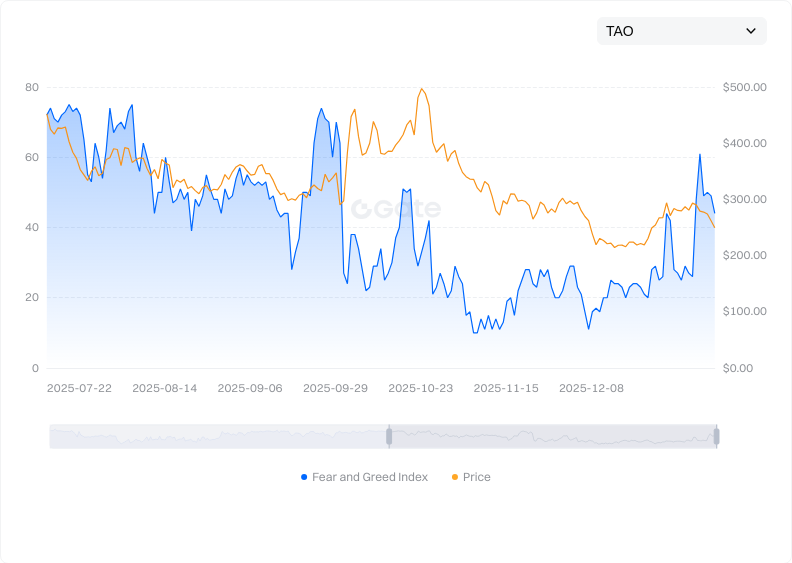
Click to view TAO Fear & Greed Index
- Technical and Model Quality Risks: Poorly designed scoring mechanisms or subnet governance can destabilize incentives and harm long-term utility.
- Regulatory Uncertainty: Crypto assets and AI services are subject to varying regulations across jurisdictions; compliance requirements may change.
- Network & Key Security: Private keys prove asset ownership; loss or exposure makes recovery nearly impossible. Node operators face potential attacks.
- Data Discrepancies: Platforms may use different methodologies for market cap or trading volume—interpret with care and verify as needed.
What Drives Long-Term Value in Bittensor (TAO)?
- Demand Side: Growing AI adoption increases demand for “reusable model capabilities,” boosting network effects.
- Supply Side: If subnet mechanisms reliably surface the “most useful” models and distribute rewards stably, overall network quality and retention improve.
- Tokenomics: A fixed supply cap (21 million tokens) and balanced incentives impact long-term supply-demand and participant behavior.
- Ecosystem Synergy: Rich toolchains, SDKs, and downstream applications determine accessibility and commercial potential.
Key metrics to monitor: subnet activity levels, ratio of high-quality models, validator decentralization, transparency of incentive adjustments, compliance progress.
How Do I Buy and Securely Store Bittensor (TAO) on Gate?
Step 1: Register and complete identity verification. Visit Gate’s website or app to create an account; follow instructions for KYC to enhance limits and security.
Step 2: Prepare funds. Choose between fiat purchase or crypto deposit. For fiat purchases, select your payment method and currency; for deposits, verify chain name/address and start with a small test transfer before sending larger amounts.
Step 3: Find the trading pair. Search for “TAO” on the spot trading page; select your preferred pair (e.g., TAO/USDT). Review price, quantity, and order type (limit or market) before placing your order.
Step 4: Enable security protections. Activate two-factor authentication (2FA), trading password, and withdrawal whitelist under “Account Security” to reduce account theft risks.
Step 5: Withdraw to a self-custody wallet (optional). If you opt for self-custody, carefully follow Gate’s withdrawal page instructions regarding network/address rules—test with a small amount first. Different networks have different requirements; always confirm details with Gate to avoid irreversible mistakes.
Step 6: Safeguard your private key and recovery phrase. Store offline—never screenshot or save in the cloud. Use distributed backups and perform regular security checks.
Risk warning: Both trading and withdrawals may encounter blockchain congestion, address errors, or network maintenance—always double-check your orders and address information.
How Does Bittensor (TAO) Compare With Render (RNDR)?
- Network Goals: Bittensor incentivizes the usefulness of models/intelligence; Render focuses on decentralized rendering/power distribution for compute tasks.
- Participant Roles: Bittensor’s incentives are determined by both model providers and validators; Render centers around compute providers and content owners within rendering workflows.
- Value Measurement: Bittensor prioritizes validated model quality/usefulness; Render values completed rendering power/task fulfillment.
- Use Cases: Bittensor supports NLP, retrieval, multimodal reasoning for AI capability reuse; Render serves graphics rendering and content production.
These are complementary rather than mutually exclusive approaches—Bittensor incentivizes high-quality models on the “intelligence supply side,” while Render coordinates GPU resources on the “compute supply side,” both contributing to the broader decentralized AI/computation ecosystem.
Summary of Bittensor (TAO)
Bittensor brings “useful AI models” onto blockchain-based incentive and settlement systems. Through subnets, validator scoring, and staking mechanisms, TAO is allocated to contributors within an open intelligence marketplace. As of January 19, 2026, price, supply, and market cap are substantial—but estimates vary by methodology. To understand the project:
- Monitor whether subnets consistently produce high-quality capabilities;
- Observe if incentives/governance suppress score manipulation and short-term gaming;
- Track compliance status and toolchain maturity.
Participants should first learn wallet/private key safety before deciding to buy or hold TAO; developers should focus on interfaces, validation standards, and reward stability. Always combine official disclosures with your own risk tolerance before making decisions.
FAQ
What Are the Differences Between TAO Token and Bitcoin?
TAO is the governance token of the Bittensor network used primarily to incentivize AI model training and data contributions. Bitcoin is a digital currency designed as a store of value and payment tool. TAO focuses on building a decentralized AI ecosystem; Bitcoin is centered on payments and asset protection. Their design goals, application scenarios, and technical architectures are entirely different.
Where Can You Buy TAO Tokens?
TAO can be purchased on leading crypto exchanges including Gate. Buying TAO on Gate is straightforward—you can use fiat deposits or crypto-to-crypto trades. After purchase, it’s recommended to transfer TAO into a hardware wallet or exchange-secured wallet rather than leaving it in a trading account long-term.
Is TAO’s Supply Fixed?
TAO started with an initial supply of 12 million tokens but has an inflationary mechanism—new TAO is continually generated through validator/miner contributions with an annual inflation rate of about 5%-10%. This encourages ongoing participation in contributing compute resources and AI capabilities for active network operation.
Can Non-Developers Participate in TAO Mining?
Mining TAO directly requires technical expertise—running nodes and providing compute resources is challenging for general users. However, you can earn rewards through Delegation by holding TAO tokens and delegating them to validators, allowing you to share in network rewards without technical setup.
Is TAO’s Price Highly Volatile? What Factors Affect It?
As an emerging AI ecosystem token, TAO experiences significant price volatility influenced by several factors: AI market hype, progress in Bittensor’s ecosystem development, trends in major cryptocurrencies like Bitcoin, macro policy shifts, etc. Investors should assess risks carefully—not invest more than they can afford nor make decisions based solely on short-term price movements.
- Decentralized AI Network: Tao is an AI-powered blockchain project that trains and validates artificial intelligence models through a distributed network.
- Staking Mining: Participants stake TAO tokens to gain validation rights within the network and receive mining rewards.
- Validator: A node in Tao responsible for verifying AI tasks and maintaining network security.
- Tokenomics: TAO maintains long-term sustainability via a capped supply (21 million tokens) and incentive-driven design.
- Smart Contract: Self-executing programs on Tao that manage AI model training and data validation processes.
- Cross-chain Interoperability: Tao’s mechanism for connecting with other blockchains to enable cross-network asset/data flows.
Tao (TAO) Reference & Further Reading