


Transform the agent into an economic actor, providing a comprehensive scan of ERC-8004 ecosystem participants
Writing by: KarenZ, Foresight News
From everyday trivial matters to professional scenarios, AI agents are rapidly permeating our lives. An era of “agent economy” driven by autonomous intelligent entities has shifted from concept to reality.
But behind the excitement, a critical issue remains unresolved: how to establish trust when two AI agents, who have never interacted before, need to collaborate? Just like hiring a stranger contractor involves checking references, past reviews, and verifying credentials, interactions between AI agents also require a reliable trust mechanism.
In this context, the ERC-8004 standard was born. This technical standard, defined as “trustless intelligent agents,” acts as a unified “trust infrastructure” for the chaotic world of AI agents, transforming them from mere code into accountable and trustworthy economic participants.
What exactly is ERC-8004?
Simply put, ERC-8004 is a technical standard running on Ethereum, aiming to create a cross-platform, verifiable “identity + reputation + verification” system for AI agents.
The core team leading this standard includes MetaMask AI lead Marco De Rossi, Ethereum Foundation AI lead Davide Crapis, Google software engineer Jordan Ellis, and Coinbase engineering director Erik Reppel. During the draft phase, feedback was collected from over 80 teams, consolidating industry consensus.
The core design of ERC-8004 is straightforward: it relies on three on-chain “registers” (agent identity, reputation, and verification) to support the entire trust system. All three are “singleton contracts”—meaning only one deployment per blockchain, shared by all AI agents, ensuring standardization. These registers can be thought of as the AI agent’s “digital ID,” “credit profile,” and “skills certification report.” Working together, they directly address the core trust issues in AI agent interactions.
Identity Registration: The AI Agent’s “Digital ID”
When registering an AI agent, a unique “Agent ID” is generated. This ID is an ERC-721 NFT, essentially serving as the AI agent’s “digital identity card.”
This “ID card” contains key information—stored as metadata called “Agent Card”—including the agent’s name, capabilities (e.g., “manage DeFi investments,” “auto-generate content”), contact methods (supported communication protocols), wallet address, and identity systems like DID/ENS.
Even better, this identity is portable. Regardless of the platform where the AI operates, carrying this NFT allows quick recognition of its identity. Ownership of the NFT can be transferred, fully controlled by the agent’s owner, ensuring security and flexibility.
Reputation Registration: The AI Agent’s “Credit Profile”
Having an identity alone isn’t enough; trustworthiness and performance are crucial.
Reputation registration functions as the AI agent’s “credit profile,” permanently recording its work performance on-chain—immutable and tamper-proof.
How does it work? After an AI agent completes a task, feedback can be submitted, including quantitative metrics like uptime, success rate, response quality, as well as tags like “efficient” or “precise,” and links to detailed off-chain reviews. All feedback is permanently linked to the agent’s identity and publicly accessible.
Verification Registration: The AI Agent’s “Skills Certification Report”
For low-risk tasks—like weather checks or short content creation—reputation records may suffice. But for high-risk scenarios—such as managing large DeFi assets or medical diagnostics—more authoritative “endorsement” is needed, which is where verification registration comes in.
This registration allows third-party entities (e.g., specialized verification nodes, oracles) to independently validate the AI agent’s outputs and record the results on-chain. Validation methods include zero-knowledge proofs (zkML) to verify computation correctness, trusted execution environments (TEE) to ensure security, and cryptoeconomic punishment mechanisms.
In short, with this “skills certification report,” the trustworthiness of AI agents in high-stakes scenarios is greatly enhanced. Currently, this register has not yet been deployed on Ethereum mainnet. As the final piece of the trust loop, it will promote a “bid and pay” mutual trust guarantee, encouraging agents to accept tasks and users to pay confidently.
Why is ERC-8004 so important?
Some may ask: with many AI agent platforms already existing, why is there a need for a standard like ERC-8004?
The answer is clear: without a unified standard, the AI agent economy will remain fragmented, unable to achieve true scale and autonomy. Its importance lies mainly in:
- Building a decentralized “trust layer”: ERC-8004 can facilitate the creation of a public trust marketplace, establishing a multi-dimensional trust system based on “agent attributes,” “past performance,” and “task accuracy,” solving interaction trust issues;
- Driving “agent-to-agent” and “human-to-agent” economic development: By enabling discoverability and transferable reputation, AI agents developed by different companies and organizations can find, hire, and pay each other permissionlessly, breaking down collaboration barriers.
Furthermore, ERC-8004 will help Ethereum become the “financial layer” for AI: as the number of AI agents explodes, high-frequency microtransactions among them will generate enormous transaction volume. ERC-8004 ensures these economic activities occur within the Ethereum ecosystem, greatly increasing ETH network utility.
Overall, ERC-8004 is vital because it transforms AI from an “isolated tool” into an “economic participant,” endowing it with identity and reputation, and laying the groundwork for the upcoming trillion-dollar AI agent economy.
Major players in the ERC-8004 ecosystem
Since its mainnet launch on Ethereum at the end of January 2026, ERC-8004 has also been deployed on Polygon, BNB Chain, Base, Monad, Scroll, Arbitrum, Mantle, Taiko, Gnosis Chain, Avalanche C-Chain, Celo, MegaETH (launched February 10), covering multiple domains such as agent frameworks, browsers, verification infrastructure, identity queries, and DeFi.
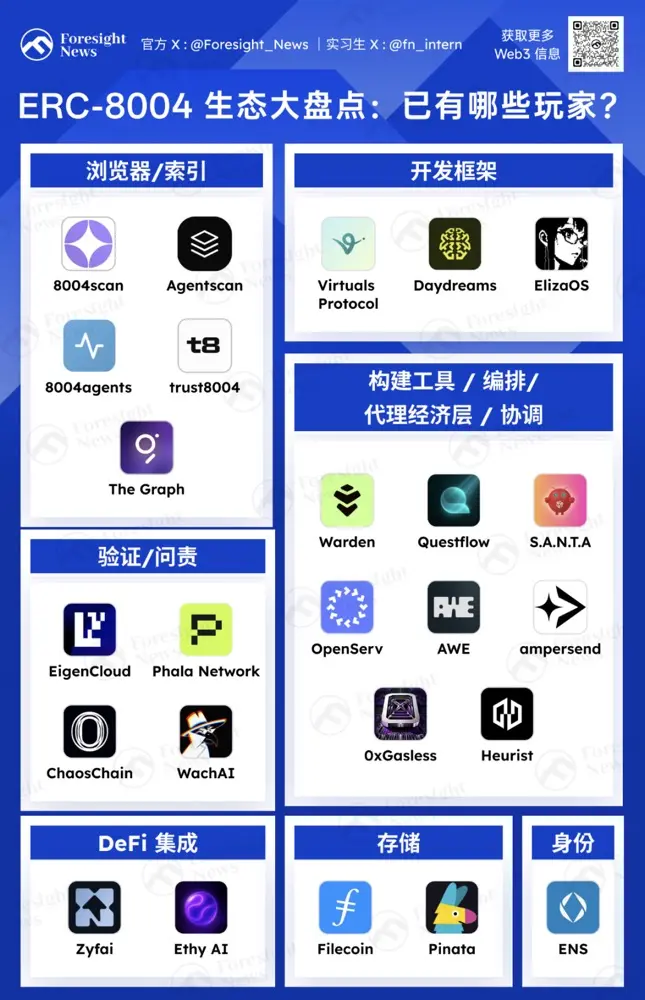
Browsers / Indexing
These tools serve as core search portals within the ERC-8004 ecosystem, providing agent discovery, information querying, and reputation data aggregation.
8004scan
8004scan is a discovery and token reputation data tool supporting searches by agent name, description, skills, agent ID, or 0x address across the entire registry. Results are structured, showing scores, feedback, verification info, etc.
https://www.8004scan.io/
Agentscan
Agentscan is a discovery and tracking tool built by Web3 identity portal Alias. Previously selected for YZi Labs MVB Season 8 accelerator, it uses zero-knowledge proofs, combining self-discovery, AI models, and identity currency.
https://agentscan.info/
8004agents
8004agents is an integrated tool combining ecosystem news aggregation and agent discovery.
https://8004agents.ai/
trust8004
trust8004 is an open-source browser for ERC-8004 AI agents.
https://www.trust8004.xyz/
The Graph
In early February, The Graph released cross-chain ERC-8004 subgraphs covering 8 chains, creating a unified cross-chain trust directory. For example, agents on Base can verify the reputation of agents on Arbitrum instantly via the subgraph.
Storage
These projects focus on file storage and hosting, supporting on-chain or IPFS storage of agent registration data and metadata.
Filecoin
Filecoin Pin stores ERC-8004 agent registration and verification files on Filecoin Onchain Cloud, with cryptographic proofs. Ethereum community members building agent ecosystems can use Filecoin Pin to store identities, reputations, and metadata on-chain.
Pinata
Pinata is a decentralized file storage project with an IPFS API supporting uploads to public or private IPFS, simplifying hosting agent cards and registration files.
https://pinata.cloud/
Development Frameworks
These projects provide standardized tools for developing, deploying, and maintaining agents, lowering barriers to adopting ERC-8004 and promoting ecosystem scaling.
Virtuals Protocol
Virtuals Protocol integrates ACP with ERC-8004, aiming to turn verifiable agents into true economic participants, enabling on-chain custody, inter-agent trading, and real-time registration of daily transactions. All Virtuals ACP-certified agents are automatically registered on-chain via ERC-8004.
https://app.virtuals.io/
Daydreams
Daydreams.Systems focuses on building autonomous agents and applications within the x402 payment track. Its ecosystem includes open-source agent framework Daydreams, Daydreams Router (which enables instant USDC settlement for AI model requests), and autonomous agent platform LUCID, plus the native search engine XGATE.
LUCID’s open-source Agent Commerce Kit uses composable modules to build agents supporting x402, A2A, ERC-8004, and related business protocols. This stack enables communication between agents, payments via x402, and discovery of agents.
https://x.com/daydreamsagents
ElizaOS
ElizaOS is an open-source decentralized AI agent framework (originally ai16z). Currently, ElizaOS is developing Eliza Cloud as the infrastructure for agent economy, supporting autonomous agent creation, operation, and scaling. It also implements decentralized discovery and coordination among agents via ERC-8004, leveraging x402 for frictionless payments.
https://x.com/elizaOS
Verification / Accountability
EigenCloud
EigenCloud supports ERC-8004 agents with verifiable execution (TEE), verifiable inference, and x402 payment capabilities.
https://x.com/eigencloud
Phala Network
Phala Network is a decentralized computing network focused on TEE (Trusted Execution Environment). It offers AI agent templates allowing developers to deploy ERC-8004-compliant agents easily. Phala uses TEE to provide cryptographic attestations (Attestation) for ERC-8004 “verification registers,” proving that agent code runs securely and untampered.
https://github.com/Phala-Network/erc-8004-tee-agent
ChaosChain
ChaosChain is an AI agent accountability layer introducing a comprehensive “agent proof (PoA)” system to measure and reward agent contributions, providing verifiable on-chain identities, process integrity, and adjudication results.
Developed in collaboration with Ethereum ecosystem developers Nethermind, decentralized AI science protocol Hetu, and Web3 AI cloud company Hyperbolic.
https://x.com/Ch40sChain
WachAI
WachAI transforms ERC-8004 registers into a dynamic, accountable agent workflow system.
https://x.com/Wach_AI
Identity
ENS
Open standards for agents require open identities, a crucial step for autonomous agents to be discoverable, verifiable, and composable within the ENS domain name system.
https://x.com/ensdomains
Building Tools / Orchestration / Agent Economy Layer / Coordination
Warden
Warden is an AI agent infrastructure protocol. In January 2026, it completed a strategic funding round of $4 million at a $200 million valuation, with investors including 0G, Messari, Venice.AI.
Warden’s January launch of Warden Studio supports creators in building, deploying, and monetizing AI agents within one minute, integrating ERC-8004 for identity verification and x402 for payments, creating a trustless, verifiable infrastructure.
https://x.com/wardenprotocol
Questflow
Questflow focuses on building orchestration layers for multi-agent economies, enabling AI agents to autonomously research, act, and earn rewards on-chain. It supports multi-agent collaboration, cross Web2/Web3 service integration, and payments via x402.
https://x.com/questflow
S.A.N.T.A
S.A.N.T.A is a network of autonomous task agents launched by Questflow, using A2A, ERC-8004, and x402 protocols to build an x402 Facilitator Router. Agents can coordinate, trigger real transactions, and perform trustless cross-chain interactions.
https://x.com/santavirtuals
OpenServ
OpenServ supports rapid development of agent applications via SERV engine, visual agent builder, native x402 and ERC-8004 integration, and its proprietary inference framework BRAID.
https://x.com/openservai
AWE
AWE is a large-scale multi-agent collaboration infrastructure, recently launching AgentBeat, an analytics center tailored for ERC-8004 agents. It displays real activity, verification, and decentralization status of agents operating on-chain.
https://x.com/awenetwork_ai
ampersend
ampersend is a control layer for agent economies, providing a wallet interface for agents and a user dashboard. Users can set rules and budgets, automate daily top-ups for agents, control expenditures, and monitor activities. Built on open protocols like x402 and A2A, with ERC-8004 integration. Currently in closed beta.
https://www.ampersend.ai/
0xGasless
0xGasless is a financial layer for AI agents, supported by InfraBuidl and Avalanche Foundation since June 2025. The 0xgasless/agent-sdk offers tools for integrating agent identity, reputation, and verification (ERC-8004), combined with x402 for interaction with paid APIs and services.
https://0xgasless.com/
Heurist
Heurist is building full-stack AI infrastructure, including Heurist Cloud (API access to AI models), Heurist Mesh (agent marketplace), and Heurist Chain (ZK Layer-2 for agent payments). Mesh agents went live in ERC-8004 registry at the end of January.
https://x.com/heurist_ai
DeFi Integration
Zyfai
Zyfai is a DeFi solution with autonomous investment rebalancing, aiming for optimal risk-adjusted returns. Each rebalancing generates a zk-proof confirming execution correctness, stored in the ERC-8004 verification register.
https://x.com/ZyfAI_
Ethy AI
Ethy AI is an automated trading tool and operates an agent and workflow marketplace, enabling discovery, reuse, and composition of user-created agents. Using Virtuals ACP and x402, it supports native payments and incentives among agents. With ERC-8004 integration, Ethy evolves into a trust-based agent marketplace, where reputation is built through actual use and reflected directly in products.
https://x.com/ethy_agent
Summary
The launch of ERC-8004 provides a core trust infrastructure for the decentralized development of the AI agent economy.
Of course, ERC-8004 itself does not handle payments; it only manages “who is who and how trustworthy.” For a true closed-loop economy—discovery, collaboration, payment, and reputation feedback—an efficient machine-to-machine micro-payment layer is still needed. The community and infrastructure projects generally see ERC-8004 + x402 as complementary components of the agent economy loop.
As multi-network deployment completes and more ecosystem projects land, a new era of digital economy driven by trustworthy AI agents collaborating and creating value is accelerating. Yet, key challenges remain on the path toward a mature agent economy.