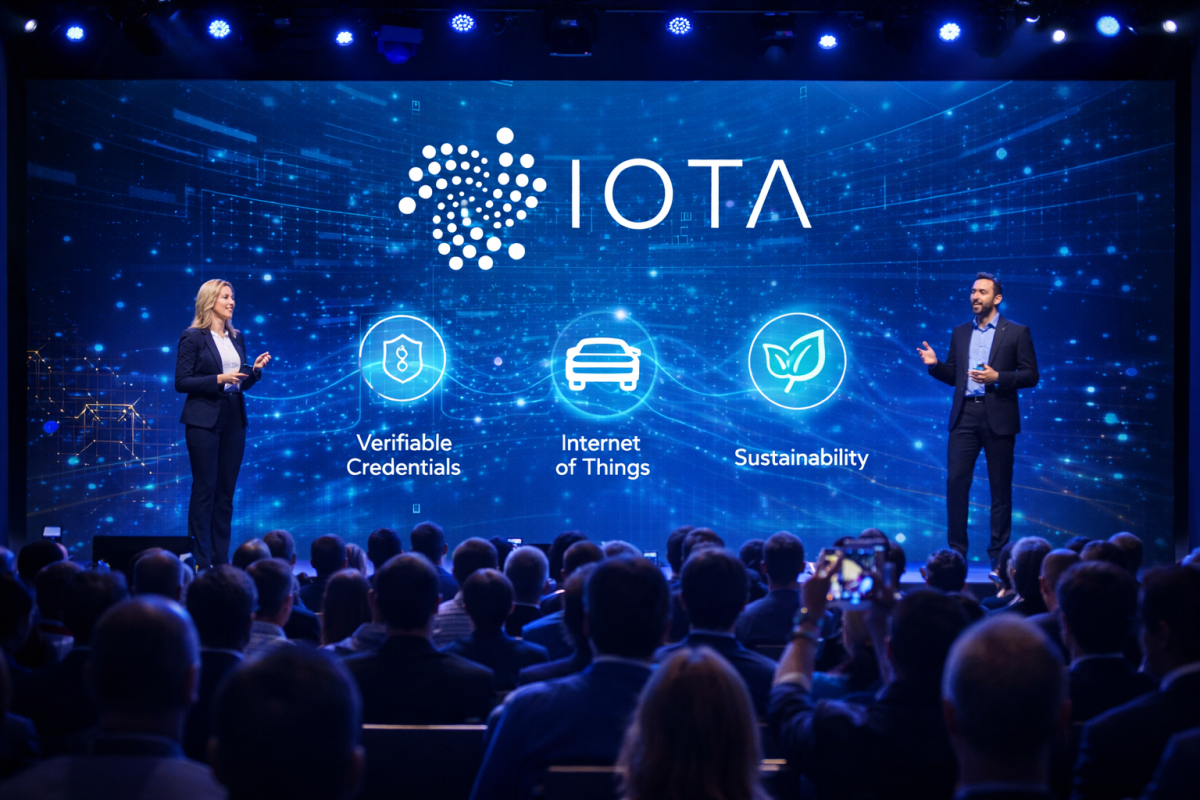
- Turing Space will be the Dutch representative at the InCyber Forum, where it will showcase its IOTA-powered verifiable credentials.
- The company’s credentials and digital identity provide verifiable trust to global organizations such as the UNHCR, the World Health Organization, and the European Union.
At the end of March, thousands will gather at Forum InCyber, one of the world’s largest cybersecurity and digital trust events globally. IOTA will be represented at the event by Turing Space, a startup that uses the network to offer verifiable credentials and digital identity.
Turing Space CEO Jeff Hu revealed that his company had been selected as one of the companies to represent the Netherlands at the event, which runs from March 31 to April 2. The Dutch Embassy in France picked 14 startups to showcase innovative cybersecurity solutions and “demonstrate the strength of the Dutch cyber ecosystem.”
Excited to announce that Turing Certs will represent the Netherlands at the Forum InCyber in Lille 🇫🇷!
Established our EU HQ, @turing_certs is now strengthening eID & Verifiable Credentials across the EU, with @iota powering secure decentralized identity. #TechForTrust pic.twitter.com/Duwjybf6hB
— Jeff Hu (@thejeffhu) March 4, 2026
Turing Space will be joined by other Dutch startups like Passguard, which scans criminal marketplaces for infostealers, and the Quantum Gateway Foundation, which helps companies implement post-quantum security systems.
Hu said the selection is a big step for Turing Space in its European expansion journey, coming after it established its EU headquarters. The company is “now strengthening eID and verifiable credentials across the EU, with IOTA powering secure decentralized identity,” he added.
The Forum InCyber is Europe’s largest cybersecurity event. Founded in 2007, it’s held annually in Lille, France, and brings in over 20,000 participants from 100 countries.
Verifiable Credentials on IOTA
Turing Space expanded to IOTA last year as part of the network’s Business Innovation Program, as CNF reported. The company was founded in 2020 and has offices in Japan, Taiwan, the US and the Netherlands, offering digital identity and trust solutions. It aims to solve the trust challenge in an increasingly digital world whose growth is undermined by data manipulation, identity fraud and insufficient verification processes. The company’s digital credential verification platform is known as Turing Certs.
Turing Certs enables users to issue, manage and verify e-credentials for any industry, from academic certificates to ownership records. It has been used by the WHO to issue digital certificates to volunteers in 150 countries, while in Taiwan, it has been used authenticate over three million renewable energy certificates. While trust is the main offering, Turing Certs also reduces the time required to verify records by up to 80% and slashes costs by 50%.
All this happens on IOTA. Explaining why he selected the network, co-founder Henry Hang stated:
IOTA’s low-cost transaction fee model, combined with sponsored transactions, allows us to deliver a better experience for end users while scaling credential issuance affordably for large-scale enterprise.
Turing Space capitalizes on most of the network’s tech stack, from the IOTA Identity for decentralized ID solutions to IOTA Notarization for on-chain hashed credentials. The network’s Explorer allows anyone to verify any ledger entry in a transparent manner.
The company intends to venture into quantum-resistant encryption in the future, which aligns with the network’s Identity 1.7 Beta, which launched last year for post-quantum signatures, as CNF reported.
Disclaimer: The information on this page may come from third parties and does not represent the views or opinions of Gate. The content displayed on this page is for reference only and does not constitute any financial, investment, or legal advice. Gate does not guarantee the accuracy or completeness of the information and shall not be liable for any losses arising from the use of this information. Virtual asset investments carry high risks and are subject to significant price volatility. You may lose all of your invested principal. Please fully understand the relevant risks and make prudent decisions based on your own financial situation and risk tolerance. For details, please refer to
Disclaimer.


