Author: Amelia, Denise I Biteye Content Team
The Lantern Festival just passed, and the Tongyi Qianwen team experienced a major shake-up: the head of technology, Lin Junyang, resigned. He was joined by three other key members: Qwen Post-Training Lead Yu Bowen, Qwen Code Lead Hui Binyuan, and core contributor Li Kaixin for Qwen 3.5 & VL & Coder.
This was not an ordinary departure of a CTO but a systemic conflict involving organizational structure, resource allocation, and open-source strategy. Biteye aims to reveal the full picture of this personnel upheaval and ask a more fundamental question: in the AI era, how should big companies position their technological ideals?
1. A Night of Blood Loss: Collective Departure of Core Staff
Less than 24 hours after the release of Qwen 3.5, a small model praised by Elon Musk for its “astonishing intelligence density,” Alibaba’s Tongyi Qianwen CTO Lin Junyang posted a brief farewell on X:
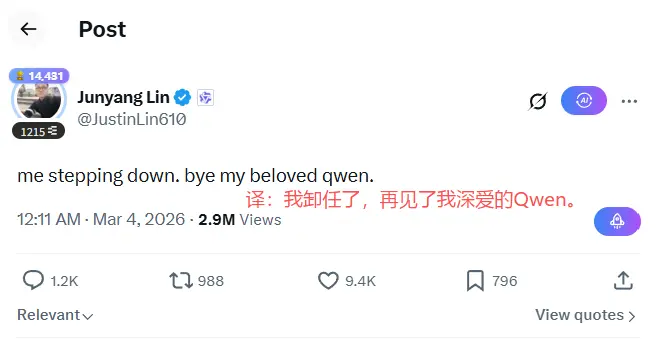
As of press time, this post has received over 11,000 likes and 4.5 million views, with a sea of heartbroken comments.
Alibaba’s youngest P10 tech expert, 32-year-old Lin Junyang, has left.
His background exemplifies a new generation of Chinese AI talent:
- Cross-disciplinary: born in 1993, undergraduate in Computer Science at Peking University, but chose a master’s in Linguistics. Perhaps this unconventional path gave him an intuitive edge in multimodal and semantic understanding.
- Rapid rise at Alibaba: joined DAMO Academy in 2019, led the development of OFA and Chinese CLIP.
- Leading Qwen: appointed head of Tongyi Qianwen in 2022, and at 32, became Alibaba’s youngest P10 in 2025.
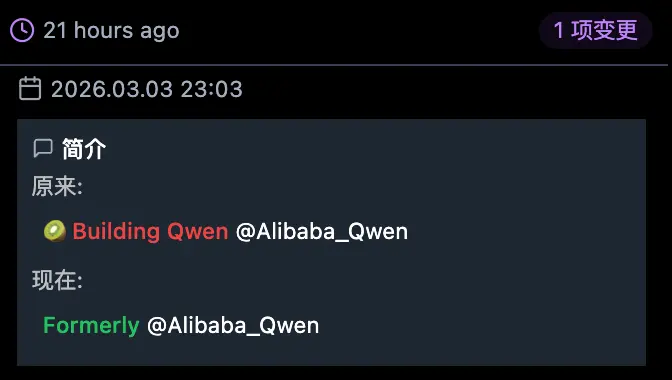
He was followed by three others. Yu Bowen, head of Qwen Post-Training, also resigned simultaneously. Hours later, Hui Binyuan, head of Qwen Code, posted “me too” and changed his profile to “former Qwen.”
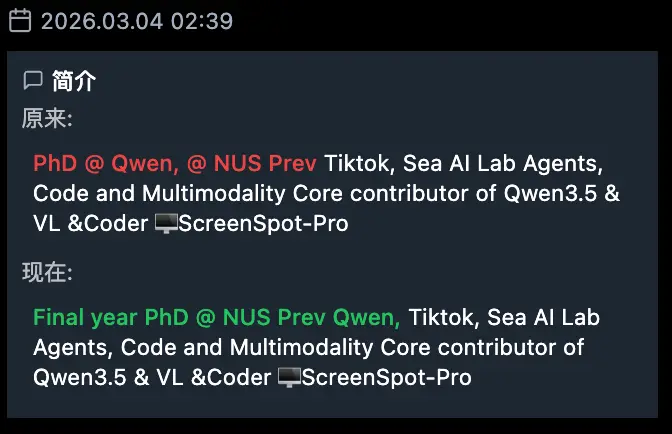
A few hours later, Kaixin Li, a core contributor to Qwen 3.5, VL, and Coder, also announced his departure, updating his Twitter profile to “Pre Qwen.”
This star team, which created a globally downloaded model exceeding 1 billion times, with over 200,000 derivative models, and consistently ranked top in open-source large models, appears to be disintegrating at an observable speed.
2. Underlying Causes: The Struggle Between Individuals and Big Tech in the AI Era
A tweet from Qwen team member @cherry_cc12 sheds some light on this upheaval. As internal meeting details gradually leak, we piece together the full picture of this collective exit. 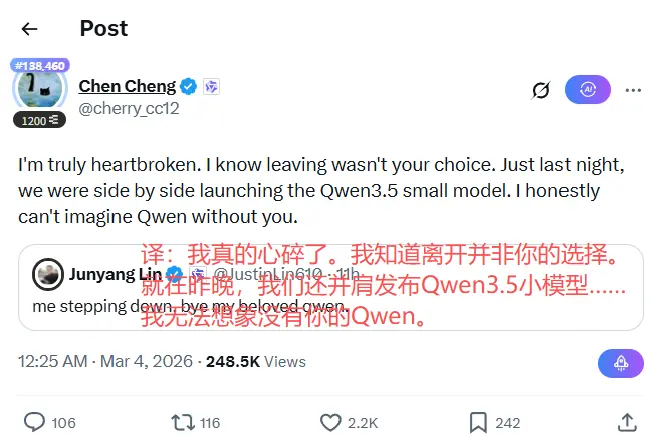
2.1 Organizational Dilemmas: From Elite Special Forces to Assembly Line
Speculation suggests that the original Qwen Lab was a team of tech enthusiasts, all multi-skilled specialists—like a sharp spearhead of elite soldiers. Lin Junyang was like a squad leader, leading the charge. But rumors indicate plans to split the team, transforming from a vertically integrated system covering different training processes and modalities into separate horizontal teams focused on pre-training, post-training, text, and multimodal tasks.
This is a traditional internet company approach. I guess Alibaba’s thinking was: the early Qwen Lab was an internal incubator project. After a year, it’s time to scale up applications. How to improve efficiency? Break down each process into SOPs, optimize each step, and overall efficiency will rise.
But this mindset is outdated. Just look at OpenClaw, which has achieved massive scale with a single person—showing that the game in AI has fundamentally changed.
2.2 Resource Dilemmas: Do They Exist or Not?
On one side, “Qwen is the company’s top priority,” on the other, Wu Ma says “resources are hard to satisfy everyone.” This contradiction resembles leadership making empty promises without follow-through. Statements like “Qwen is the highest priority,” “we’ve done our best as Chinese CEOs,” and “resource bottlenecks are due to communication issues” are all hollow.
Who are they fooling? There are only two possibilities:
First: Top management doesn’t truly prioritize Qwen; their investment is driven by AI FOMO.
Second: There are two factions within leadership—one values Qwen highly, the other doesn’t. The neglecting faction starts to block resources.
In short, some top executives only pay lip service. So, even the product line claimed to be the top priority can’t secure basic resources.
2.3 The Battle Between Individuals and Platforms: Who Can Overrule the Organization?
The most heartbreaking internal message was HR’s statement: “Cannot elevate anyone to a divine status; the company cannot accept irrational demands and will not pay any price to retain.”
Is this right? The AI talent war is already fierce: in 2024, Qwen’s key early contributor Zhou Chang left to start his own venture, then quietly joined ByteDance’s Seed team, which offered a 4-2 level + eight-figure annual salary “sky-high offer.” In 2025, Meta offered $200 million in compensation to poach Pang Ruoming from Apple, including high-value stock and milestone-linked incentives. Does HR do competitor research?
Is this wrong? It seems to reflect a centuries-old Chinese philosophy: individuals cannot surpass the organization.
2.4 Political Struggles: Who Do You Belong To?
Internally, it’s said “no political considerations were involved,” but also “it’s necessary to consider where Zhou Hao should be placed for maximum efficiency.” This hints at a hidden message: Zhou Hao must be integrated into the organization; the question is only where.
Anyone familiar with palace intrigues knows, who can get things done isn’t as important as who obeys. A harsh workplace truth: for most managers, whether someone can solve real problems or threatens their position is equally important. In startups, you can jump as high as you can; in big companies, upper management’s sense of security often outweighs individual ability.
Think about it.
2.5 Mismatch Between Open Source and Commercial Strategy
Deeper tensions stem from the dissonance between open source and commercial paths. Qwen has built a significant reputation in the global open-source community—downloads, derivative models, international recognition. 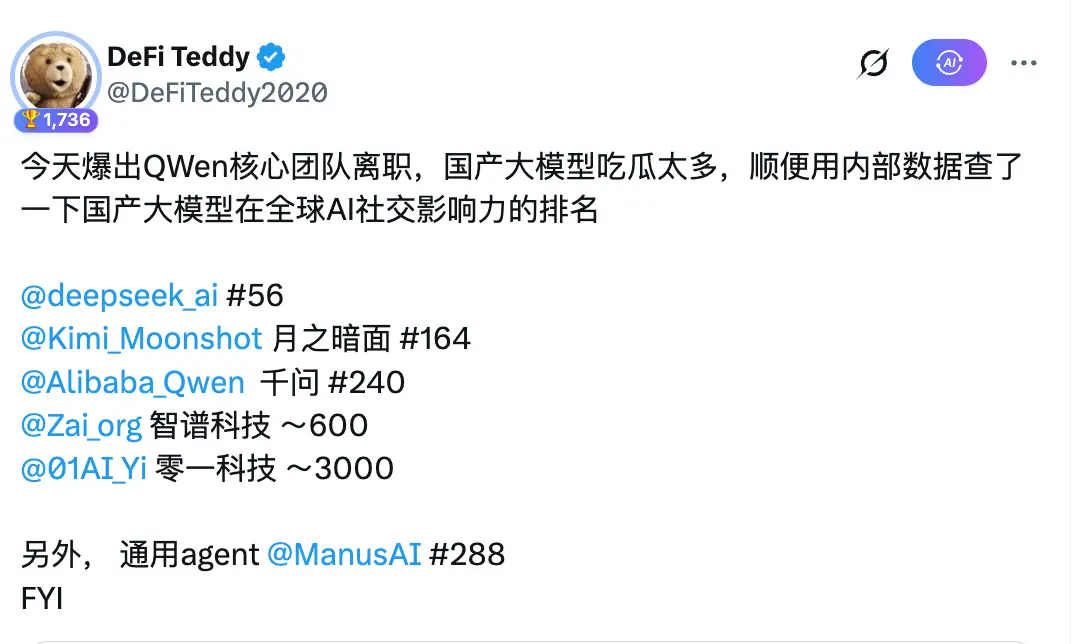
But open source doesn’t necessarily translate into users or revenue. As Qwen grows, the group naturally asks: I’ve invested so much, shouldn’t I get some return?
3. Reflection: The Dilemma of Big Tech in AI
This incident happening at Alibaba doesn’t surprise me at all. Have you watched “The Annual Meeting Can’t Stop”? It’s based on Alibaba’s scenario. A classic line: “If you can’t solve the problem, just solve the person raising it.”
Alibaba’s logic seems to be: no matter who leaves, Qwen will keep running.
That “We’re doing something grand; over 100 people aren’t enough, we need expansion” line shows Alibaba no longer just doesn’t understand AI; AI no longer understands Alibaba. Even the neighboring Web3 community is amused.
In the internet age, platforms empower individuals, pursuing standardized, process-driven, replicable organizational structures. Individuals depend on platforms, which define the rules.
But in the AI era, the trend is evolving toward super-individuals with stronger bargaining power, even reversing the platform’s dominance. AI innovation relies on small teams, high-density, rapid iteration—like a “special forces” model.
When big companies try to manage AI creativity with internet-era organizational logic, conflict is inevitable. Behind these organizational struggles lies a collective confusion about how to manage geniuses.
When HR asks employees “What do you think your value is,” those truly capable of shaping the future have already voted with their feet.


