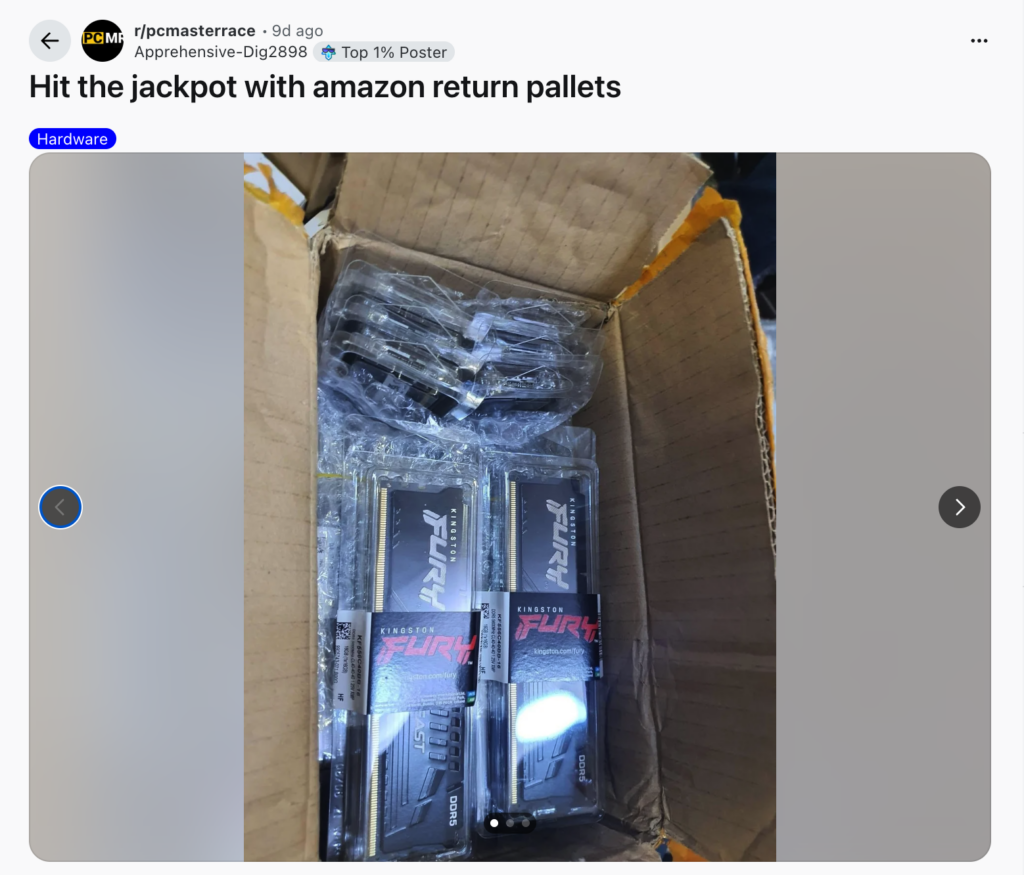
A Reddit user spent $100 to buy a 25-kilogram Amazon return pallet and unexpectedly found 40 Kingston Fury DDR5 16GB memory modules, with a market value of about $7,000.
(Background: Memory prices are too high: the global smartphone market may shrink 13% this year, with budget brands like OPPO, vivo, Xiaomi raising prices)
(Additional context: Would you rather sell a kidney than sell Bitcoin? Is Michael Saylor a genius or a complete scammer?)
Table of Contents
Toggle
- What is a return pallet?
- DDR5 appears when it shouldn’t be cheap
- The blind spots in Amazon’s system
A user on the U.S. forum Reddit recently shared a very lucky story: he spent $100 to buy a 25-kilogram Amazon return pallet (priced at $4 per kilogram).
When he opened the box, he was surprised to find 40 Kingston Fury 16GB DDR5 memory modules, each valued at about $175. Totaling around $7,000, with a return on investment of 70 times.
What is a return pallet?
Amazon handles about 1.2 billion returns annually, roughly 13 million per week. These returns go through a complex sorting system: good condition items are restocked, damaged or outdated items are discounted for sale, and unusable items are sent for clearance. The final form of clearance is packing returned goods onto pallets and selling them to secondhand middlemen or individuals at 10% to 30% of retail price.
These return pallets can contain “anything,” and sellers usually don’t provide detailed lists. Buyers accept the uncertainty, like opening a blind box.
The entire clearance industry surpassed $644 billion in 2022, and as Amazon’s return volume continues to grow, the market is still expanding.
DDR5 appears when it shouldn’t be cheap
What excites the discoverer about this memory is partly due to timing.
The DDR5 market in 2026 is experiencing a rare supply-demand crunch. AI data centers’ demand for high-performance memory is soaring, forcing major manufacturers like Samsung, SK Hynix, and Micron to shift capacity from consumer DDR5 to server DDR5 and HBM (High Bandwidth Memory), which offer higher profits.
As a result: consumer DDR5 supply shrinks, prices rise. Some analysts predict that retail prices for 32GB DDR5 kits could peak at $550–$600 in the first half of 2026, with the imbalance expected to persist into late 2027 or beyond.
In other words, those 40 memory modules are among the most scarce consumer products in the current memory market.
The blind spots in Amazon’s system
While in a normally functioning distribution system, such items are almost impossible to end up in clearance pallets, they have appeared there — and this has happened more than once on Amazon.
After all, Amazon’s return processing system is designed for speed, not precision. With 13 million returns flooding into warehouses weekly, staff must quickly decide each item’s fate: restock, discount, clearance, recycle, or destroy. How did 40 DDR5 modules end up in a $100 pallet? The answer might be “misclassification,” but more honestly: at this scale, precision is a luxury.
It’s also worth noting that return fraud is a common issue. Investigations show about 14% of returns are fraudulent, such as package swapping (replacing old or counterfeit items in original packaging). This means the contents of a pallet can’t be guaranteed: good luck might mean DDR5, bad luck might mean an empty box filled with weight.
A certain essence of consumerism is condensed in this pallet: products are produced, bought, returned, repackaged, sold cheaply, opened… and then, occasionally, someone opens a box and finds the system more chaotic — and more generous — than they expected.

Disclaimer: The information on this page may come from third parties and does not represent the views or opinions of Gate. The content displayed on this page is for reference only and does not constitute any financial, investment, or legal advice. Gate does not guarantee the accuracy or completeness of the information and shall not be liable for any losses arising from the use of this information. Virtual asset investments carry high risks and are subject to significant price volatility. You may lose all of your invested principal. Please fully understand the relevant risks and make prudent decisions based on your own financial situation and risk tolerance. For details, please refer to
Disclaimer.


