
U.S. federal prosecutor Jay Clayton filed a motion on March 10th with a Southern District of New York judge to reschedule the review of Tornado Cash developer Roman Storm to October 5th or 12th. This review concerns the first and third conspiracy charges in the superseding indictment, which together could result in a maximum of 40 years in prison.
Background of the Rescheduling: Jury Disagreement and Pending Motions of Not Guilty
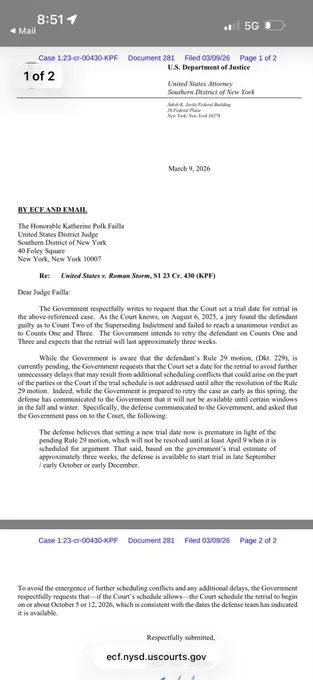 (Source: Amanda Tuminelli)
In the August 2025 trial, the jury found Storm guilty of conspiracy to operate an unlicensed remittance business, but disagreements arose on the two core conspiracy charges, which are now the focus of the rescheduling. Judge Allen urged the jury to continue deliberations, but ultimately no unanimous verdict was reached.
The motion for a new trial faces a procedural hurdle: before any new trial can be scheduled, the court must rule on Storm’s Rule 29 Motion, which requests a judgment of acquittal based on legal grounds. A hearing for this motion is scheduled for April 9, 2026. Storm’s defense attorneys stated that it is “premature” to set a new trial date before this motion is resolved.
After the letter was made public, Roman Storm posted on X: “If I can’t raise funds for my defense, they might as well consider me acquitted. If you care about financial privacy, if you write code and believe that code is speech — now is the time.”
Policy Contradictions in Washington: Three conflicting signals simultaneously
The timing of this rescheduling request coincides with conflicting internal U.S. government policies on privacy tools:
Department of the Treasury report (released the same day): The U.S. Treasury submitted a report to Congress stating that “digital asset users can utilize mixers to achieve financial privacy on public blockchains,” while warning that such tools could be used to conceal illegal funds.
Department of Justice stance (same day application): The federal prosecutors continue to push for criminal review of mixer developers, despite clear disagreements among jurors on the core charges.
Sanctions history: In August 2022, the Treasury listed Tornado Cash on the sanctions list for laundering $7 billion (including North Korean Lazarus Group). An appeals court later questioned whether the Treasury had the authority to sanction open-source smart contracts, ruling the sanctions unlawful and lifting them.
Cybercrime expert David Sehyeon Baek commented directly: “On one hand, the Treasury finally admits that mixers and privacy tools are fully legal; on the other hand, the Department of Justice persists with aggressive criminal prosecutions despite the jury’s clear doubts.”
Industry Reactions: Legislative Proposals and Policy Context of Related Cases
Miller Whitehouse-Levine, CEO of the Solana Policy Institute, called this move “frustrating,” emphasizing that it makes the Blockchain Regulatory Certainty Act “more critical.” The bill, reintroduced in January 2026 by Senators Cynthia Lummis and Ron Wyden, explicitly prohibits non-custodial developers from being classified as money transmitters if they cannot transfer user funds. The Solana Policy Institute had previously pledged to provide Storm with $500,000 in legal defense funds, jointly sharing costs with Alexey Pertsev, co-developer of Tornado Cash.
Additionally, former President Trump indicated in December last year that he would “consider” pardoning Samourai Wallet developer Keonne Rodriguez, who was sentenced to five years federal prison for developing non-custodial Bitcoin privacy tools. Rodriguez is currently serving time at Morgantown Federal Prison. The simultaneous developments have prompted widespread industry scrutiny of the White House’s actual policy stance.
FAQs
What are the specific rescheduling charges against Roman Storm in the Tornado Cash case?
The Department of Justice’s motion for a new trial involves the first and third conspiracy charges in the superseding indictment, which could total up to 40 years in prison. The original jury in August 2025 found Storm guilty of a lesser charge, but disagreements remained on the two more serious conspiracy counts.
What procedural hurdles remain before the October trial?
Before the trial begins, the court must decide on Storm’s Rule 29 Motion, which requests a judgment of acquittal on legal grounds. A hearing is scheduled for April 9, 2026. Storm’s defense team considers it “premature” to set a trial date before this motion is resolved.
Why do the Treasury report and DOJ prosecution appear to conflict?
The Treasury’s report explicitly recognizes that digital asset users can use mixers for financial privacy, yet the DOJ continues to pursue criminal charges against mixer developers. Cybercrime expert David Sehyeon Baek pointed out that this contradiction reflects the deep confusion in U.S. cryptocurrency policy—regulators acknowledge legitimate uses while maintaining aggressive criminal enforcement.
Disclaimer: The information on this page may come from third parties and does not represent the views or opinions of Gate. The content displayed on this page is for reference only and does not constitute any financial, investment, or legal advice. Gate does not guarantee the accuracy or completeness of the information and shall not be liable for any losses arising from the use of this information. Virtual asset investments carry high risks and are subject to significant price volatility. You may lose all of your invested principal. Please fully understand the relevant risks and make prudent decisions based on your own financial situation and risk tolerance. For details, please refer to
Disclaimer.


