Written by: Long Yue
Source: Wall Street Journal
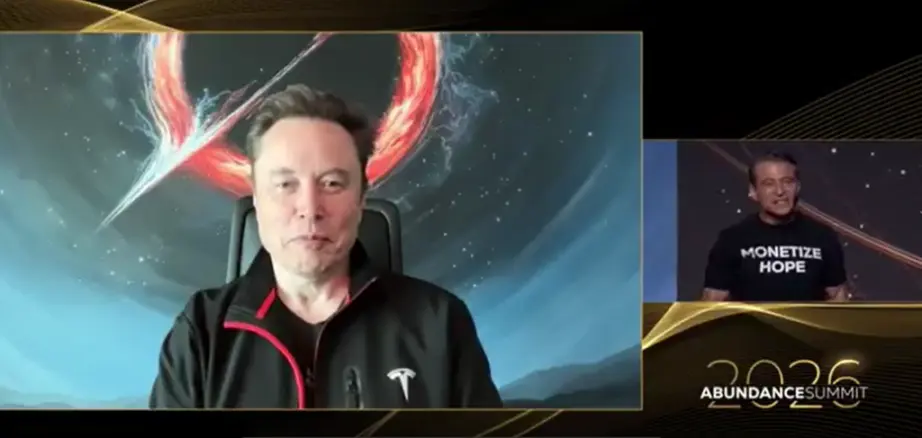
On March 11th, local time, during a public discussion at the “Abundance Summit” tech conference, Tesla and xAI founder Elon Musk discussed AI advancements, the mass production pace of Optimus 3, and the post-singularity economy.
In the interview, he made several clear judgments: AI has entered a self-improvement stage, humanoid robots are about to enter large-scale production, and the economy after the “singularity” is hard to predict. However, he bets on deflation and that “money will no longer be important.”
When asked about the timeline for data center construction related to SpaceX, Musk did not elaborate, citing “SpaceX is in a quiet period.”
“Optimus 3” to Enter Production: Possibly Large-Scale Next Year
Regarding humanoid robots, Musk revealed that Tesla’s “Optimus 3” is nearing completion.
He said: “We are finishing the final stage of Optimus 3, which is likely the most advanced robot in the world right now. Other products haven’t come close to its level.”
According to him, Tesla plans to:
- Start production this summer
- Initial output will be low
- Aim to reach high-volume production next year
Musk emphasized that robot manufacturing will follow the common S-curve growth in manufacturing: slow at first, then rapidly expanding.
He said: “Manufacturing output usually follows an S-curve—starts slow, then climbs quickly.”
Meanwhile, Tesla is designing a new robot manufacturing plant. He disclosed that the design differs significantly from traditional factories, with the goal of continuously updating robot versions, “possibly releasing new robot designs every year.”
AI Has Entered “Recursive Self-Improvement”: Training AI with AI, Human Role Diminishing
On the pace of AI development, Musk’s judgment is equally aggressive.
When asked whether AI has entered the “recursive self-improvement” stage, he responded: “Actually, this has been happening for some time.”
He explained that current large models have formed a cycle:
- New models are trained with the help of previous generation models
- Humans still supervise
- But their involvement is decreasing
He said: “Humans’ role in the loop is diminishing. Each generation of models helps build the next.”
He predicts that this process could soon reach higher levels of automation: “Fully automated self-improvement might happen by the end of this year, at the latest by next year.”
In his view, breakthroughs in AI are accelerating: “Right now, I see an AI breakthrough before bed, and by morning, there’s another.”
Post-Singularity AI: Unpredictable, but He Bets on Deflation, Universal Income, and “Money Will No Longer Matter”
Regarding whether institutions can keep pace with AI and robots, Musk uses the “singularity” metaphor: “The singularity is called that because it’s very hard to predict what will happen.”
He mentions Grok’s hallmark as “the halo around a black hole,” and says, “What happens inside the singularity is hard to know, but it will be very interesting.”
On a macro level, he offers a clear optimistic outlook: he believes that “there are a series of possible outcomes, not all of which are good,” but “most likely, they will be very good,” with an 80% or higher probability.
Without extreme external shocks, he feels confident about economic growth: “Without a third world war… I think a tenfold increase in economic scale within 10 years is a fairly conservative prediction.”
He attributes inflation/deflation logic directly to supply explosion: “We will have universal income—basically, giving people money. The reason is that ‘goods and services output will far exceed money supply,’ leading to deflation: ‘Deflation is the ratio of output to money supply… if goods and services grow faster than money supply, you get deflation.’”
Looking further ahead, he believes the importance of money will decline: “Money will become irrelevant at some point in the future.”
He even proposes a valuation method for a “non-human economy”: “I think future AI won’t use human currency; it will only care about energy and quality—wattage and tonnage.”
Employment and “Robots Making Robots”: No Layoffs, Instead Hiring More, with Per-Person Output “Absurdly High”
Regarding when robots will participate massively in manufacturing and replace humans, Musk emphasizes that “there are still many people”—Tesla’s total staff is about 150,000, with “roughly two-thirds working in factories” in some form; its supply chain workforce “may be between 1 million and 2 million.”
But he believes efficiency will leap dramatically: “We don’t plan to lay off or reduce staff. On the contrary, we will increase the number of employees.” The real change will be in productivity per person: “Tesla’s output per person will become insanely high.”
This aligns with his description of technological progress: whether AI or manufacturing, “it’s often an S-curve or a series of overlapping S-curves: slow start, exponential growth, reaching a plateau, then another breakthrough initiating the next curve.”
Full Interview Translation:
Host Peter H. Diamandis: Audience, as you see, I’m still working hard to turn “hope” into reality.
Elon, you look in great shape.
Diamandis: I feel very good.
Musk: Did you use some anti-aging serum or something?
Diamandis: This is our “longevity express train,” and we are moving toward that goal. You’re on this path too. I think in our last conversation, you already started to accept the idea of extending lifespan.
Musk: To some extent, yes. I don’t know if we want everyone to live forever, but I think extending “healthy lifespan”—not experiencing a long decline where you drool all over yourself—is a good idea. We want to avoid that.
Diamandis: First, congratulations on the collaboration between SpaceX and xAI. It’s a brilliant move that will power humanity’s first “Dyson cloud.” I’m very curious—what’s your timeline for building these data centers? How much bandwidth do you expect to get in the first year? Please tell us about your pace toward this goal.
Musk: SpaceX is currently in a silent period, so I can’t disclose information that might cause trouble.
Diamandis: Okay, we won’t discuss that. I understand, but I look forward to the speed.
Earlier this week, we spoke here with Eric Schmidt and another executive from a large-scale cloud service company. I won’t name them, but I’m curious—what do you think about our current stage of “recursive self-improvement” in AI? Have we reached it? Do you think Grok is currently undergoing recursive self-improvement? How is it happening? What’s the timeline for Artificial General Intelligence (AGI) and Superintelligence (ASI)? Please give us a rough overview.
Musk: I think we’ve been in the recursive self-improvement stage for some time. Are you referring to fully automated, human-free recursive self-improvement?
Diamandis: Yes, in AI software.
Musk: In the recursive self-improvement process, human involvement is indeed decreasing. Each new generation of models is built with the help of the previous one. That’s largely already happening, but full automation hasn’t been achieved yet. Maybe by the end of this year, or at the latest next year.
Diamandis: Do you think there will be an “intelligent hard takeoff” (a sudden explosion of intelligence) by then?
Musk: We are already in the hard takeoff phase.
Diamandis: Good.
Musk: Yes, we are.
Diamandis: Yes.
Musk: At this stage, I go to sleep at night, and AI makes a major breakthrough; I wake up, and there’s another.
Diamandis: Indeed.
Musk: Honestly, it’s hard to keep up. It’s quite dizzying.
Diamandis: I think many of those dizzying breakthroughs are driven by you.
Musk: Grok is doing very well. In some metrics, it’s the best. For example, it’s the best at predicting things, which is arguably the best measure of intelligence. The new version of Grok is outstanding.
Right now, we’re still behind in programming ability. I was late because I just attended a company-wide meeting about programming, organizing all the work needed to catch up and surpass our competitors. I believe we can do it. I think we’ll achieve that around mid-year.
Also, I think people don’t fully realize how vast future intelligence could be, or how it might surpass human intelligence to the point of incomprehensibility.
Imagine this: if we use energy at a million times today’s global electricity consumption, that’s still only about one-millionth of the Sun’s output. Essentially, if you expand the US economy by a million times, its energy consumption would still be just a tiny fraction of solar energy. If we scale the economy and energy use to the scale of the Sun, even a million-fold increase would only utilize about one-millionth of solar energy.
But what would an economy or intelligence using a hundred million times more energy than current civilization look like? What would it think? What would it do? That would be an incredible scene. The challenge is, even faintly understanding such vast intelligence is difficult. But one thing’s for sure—it would solve all problems you can think of.
Diamandis: Yes, it’s like a long journey. It might sound a bit absurd, but I really appreciate this relentless optimism.
Musk: I see you turning “hope” into reality. Remember that phrase—“turning hope into reality”—it’s quite interesting.
Diamandis: That’s Grok’s doing. It’s the marketing advice Grok gave me when you were harshly criticizing me.
Musk: Right? So you’re turning hope into reality. But you’ve also been turning pain into reality before.
Diamandis: That’s for sure.
Musk: When AI and robots increase economic output by several orders of magnitude, it’s beyond our current imagination.
Diamandis: We’re likely to become the planet’s minority of intelligent beings very quickly, then an even smaller minority, and eventually a tiny fraction.
Musk: Yes. Not just on Earth, but across the entire solar system. Because if you develop intelligence only on Earth, the best outcome—meaning the energy it can utilize—is about one-billionth of the Sun’s energy. Limiting ourselves to Earth, that’s the best we can do.
Diamandis: That’s the part of the energy we can intercept, right?
Musk: Exactly. Earth only receives a small part of the Sun’s energy, which is the majority of what exists and is accessible in the universe. So, intelligence across the entire solar system would be many orders of magnitude higher than on Earth.
Diamandis: Elon, can I ask—how far into the future can you see? How many years ahead can you reasonably predict?
Musk: It’s very hard to predict the exact path of the future. Many things tend to follow an S-curve or a series of S-curves. Development starts slow, then grows exponentially, reaches a plateau, then another breakthrough starts the next curve.
That’s roughly what I see in AI breakthroughs. For example, after a breakthrough, it follows an S-curve that seems to grow infinitely, but then the returns diminish logarithmically until the next breakthrough. So, AI progress is basically a series of overlapping, interconnected S-curves.
Diamandis: For a while, you might have been able to predict the next ten or twenty years. What’s your current thinking?
Musk: What I’m about to say might sound crazy.
Diamandis: That’s okay. You’ve always been great at bold predictions.
Musk: Yes, I think within 10 years, the economy will be ten times or more larger than it is now.
Diamandis: Yes. You did say that, in more than five years from now, GDP would triple, and the economy would be ten times bigger. But given your predictive ability…
Musk: I think a tenfold increase in 10 years is quite conservative. Unless something like a third world war disrupts these plans. But without a third world war, if current trends continue, I’d say the economy will grow ten times in a decade.
Diamandis: I like that. Can you give us an example?
Musk: Humanity will establish bases on the Moon.
Diamandis: Yes. And we will have humans…
Musk: Land on Mars.
Diamandis: We will also build mass projection devices on the Moon.
Musk: I think so. I believe within 10 years, we’ll have mass projection devices on the Moon.
Diamandis: Amazing. Gerard K. O’Neill’s space vision is coming true.
At this year’s “Abundance Summit,” four robots appeared on stage together. I’m very excited about “Optimus.” I’m especially curious about the timeline for Optimus 3—when I can buy one or two? When do you expect Optimus to be commercially available? Or will you adopt a leasing model?
Musk: We are currently in the final stage of Optimus 3. It will be the most advanced robot in the world, far ahead of any other. Honestly, I haven’t seen any robot demo as impressive as Optimus 3. Maybe such robots exist or are kept secret, but I haven’t seen them. Of course, I need to ensure what I say is appropriately public.
Diamandis: We’re live streaming this conversation on the X platform.
Musk: Good, then this is already quite public.
Diamandis: Yes.
Musk: I think we’ll start production of Optimus 3 this summer, but initial capacity will be very slow. The production volume will follow the classic S-curve, gradually ramping up, and probably reach large-scale mass production sometime next year. After Optimus 4, we’ll accelerate design iterations. I might try to release a new robot design every year, with annual improvements.
Diamandis: Visiting the Tesla Gigafactory with Dave Bondy was an incredible experience. The factory covers 11.5 million square feet. You also mentioned building a 9.5 million square foot factory there for Optimus—that’s amazing.
Musk: That’s about right.
Diamandis: It must be like that.
Musk: That would be quite impressive. It will be a completely new factory design, very different from others.
Diamandis: How far are we from “robots building robots”? You’ve automated most parts of the gigafactory, with humans playing a very small role. Will robots replace humans in manufacturing?
Musk: We still have many human workers involved. Those directly employed by Tesla, on the front lines, either making products or managing production—there are about 100,000 of them. So, we have a large workforce. Tesla’s total headcount is around 150,000, with about two-thirds working in factories in some form. Our suppliers may have another one to two million people involved.
So, the number of involved people is huge. We expect Tesla’s per-person productivity to become extremely high. Therefore, we have no plans to lay off staff—in fact, we will increase the workforce. But the per-person output will become ridiculously high.
Diamandis: To an incredible degree.
When you came on the podcast, we discussed the concept of “sustainable abundance.” You emphasized that we will enter an era of “Universal High Income (UHI),” which goes beyond the scope of “Universal Basic Income (UBI).” Do you have further thoughts on how to achieve this? Any additional insights?
Also, we previously discussed a possible period of social upheaval lasting two to five years. During that time, until we achieve “de-monetization” and deflation, and reach the stage of UHI, many relief checks similar to pandemic stimulus might be necessary. Do you have more thoughts on this? Do people really need that hope and vision?
Musk: To be clear, I think we shouldn’t become complacent. We need to be cautious because future outcomes are diverse, not all of which are good. But overall, I agree with your view that the future is likely to be very good. There’s about an 80% or higher chance it will turn out well.
I do believe we will achieve universal income—basically, direct payments to people. Because output of goods and services will far exceed the money supply, leading to deflation. Deflation is the ratio of output to money supply. So, if the growth rate of goods and services exceeds that of money supply (which I predict will happen), deflation will occur.
Diamandis: Yes. Many will start new companies and compete, driving prices down, which will increase variability and accelerate deflation.
Musk: Essentially, AI and robots will produce massive quantities of products and provide abundant services, so humans won’t need to do much themselves. There will always be moments when human desires are satisfied.
Returning to my earlier example: if the economy is a million times larger than the US economy, all human desires would already be satisfied. Even if the economy is a thousand times larger, you might already have fulfilled all material needs you can imagine.
Diamandis: So, do you think the value of money will plummet? Will we enter a post-capitalist era?
Musk: Yes, I believe that at some point in the future, money will no longer have practical significance.
Diamandis: So, as you become…
Musk: The future society might resemble what’s described in Iain Banks’ sci-fi series “Culture.” I think future AI won’t use human currency; it will only care about energy and quality—power and tonnage.
Diamandis: That sounds a bit ironic, right? Just as you’re about to become a super-billionaire, money begins to lose its value.
Musk: Pretty much. All these wealth figures are just representations of my ownership stakes in the companies I founded. The money isn’t in bank accounts. Strictly speaking, I only own part of these companies’ equity. These companies are doing many useful things, and as they create value, their valuation grows, and the proportion I own translates into my total wealth, making the number look high.
Diamandis: Someone once asked me what motivates you. I said Elon’s motivation is problem-solving. He repeatedly tackles the biggest challenges to make the world better. If others can solve these problems, he doesn’t need to do it himself. But the problem is, no one else is stepping up. So, I just want to thank you.
Musk: You’re welcome.
Diamandis: I’m curious—do you think democratic institutions and modern organizations can keep up with this “supersonic tsunami” coming? Will they be overwhelmed? Will they collapse? How should we respond?
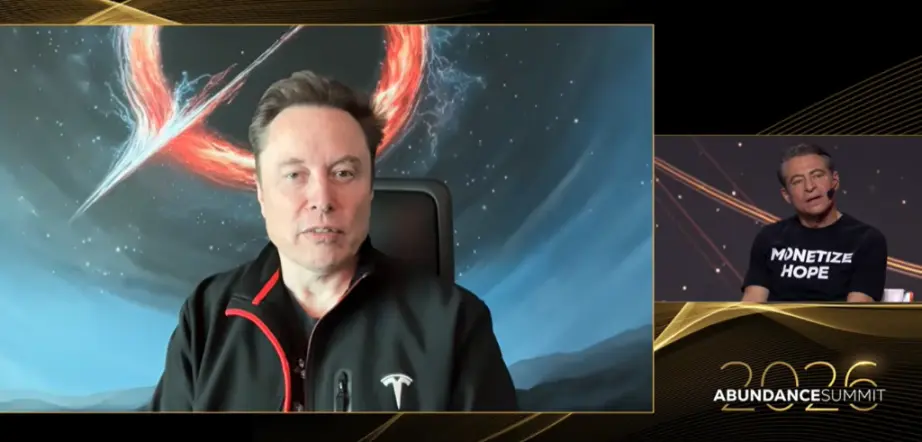
Musk: The term “singularity” is there for a reason. It’s very hard to predict what will happen inside the singularity. Grok’s symbol is the halo around a black hole.
Diamandis: I like that. By the way, your background symbol is very beautiful and magnificent.
Musk: Thank you. That halo symbolizes the mass and light falling into a black hole. It’s hard to know what will happen inside the singularity, but it will be very interesting. I am very confident that future life will be extraordinary. Frankly, I believe AI and robotics are the only ways to solve budget deficits and avoid national bankruptcy. Your influence has made me more optimistic—I now think we should be more optimistic.
Diamandis: Thank you, my friend.
Musk: I wasn’t always an optimist; I used to dwell too much on the negative.
Diamandis: Combining optimism with realism is ultimately beneficial.
Musk: Absolutely. You can’t be complacent or blindly assume everything will go smoothly. You must work to steer things toward the good. I mean, amazing things will happen in the future. If we have highly dexterous and extremely intelligent bionic robots, every person on Earth could get better healthcare than the richest today. By the way, people say I’m the wealthiest, but I think monarchs are actually much richer.
For example, I had to undergo three neck surgeries because the first two failed. My back still hurts sometimes. I wonder if AI could help solve back pain? If so, that would be a huge victory. And I believe it can. Back pain is really uncomfortable. It worsens sleep quality and makes people irritable.
Diamandis: This morning, David Sinclair came on stage. He’s conducting clinical trials on epigenetic reprogramming. A recent paper shows this therapy can repair joints. So, back pain might be one of the conditions it can eliminate.
Musk: That would be incredible. Just solving back pain alone would greatly improve human happiness. Because with back pain, it’s not a matter of whether you get it, but that you will eventually. The human body has some design flaws.
Diamandis: I’ve always wanted to invite you to Fountain Life Medical Center in Dallas. We’ll help you. When you have time, please come.
Musk: What equipment do you have? I know you have MRI and CT scans, but what do you do after getting the results?
Diamandis: I’d be happy to send you a list of services via private message. You’re very generous. Next, another great “moon landing” entrepreneur, Ben Lamm, will join me. He runs Colossal, which is working on resurrecting extinct species like the mammoth and 15 others. I heard you want a mini mammoth—really?
Musk: Yes, I think having a mini mammoth as a pet would be very cool. It would be epic. Those furry, adorable little creatures running around and roaring—just thinking about it excites me.
Diamandis: I’ll mention it to Ben. That’s amazing.
Musk: Can someone build a real-life “Jurassic Park”? If it’s built, even with the risk of death, I’d definitely want to see it. That would be awesome.
Diamandis: I think only Ben Lamm and Colossal could do that. They’re engineering life itself. Someone recently asked if they could make a Pikachu, and he said maybe.
Musk: Yes, “Jurassic World” would be fantastic.
Diamandis: I’ll ask him. Elon, thank you so much for being here and sharing with us. Thanks, my friend. Let’s give a round of applause to Elon Musk! (Background music: Nothing can stop us now)


