The SEC and CFTC release a 68-page joint guidance, establishing five major token categories and clarifying the classification of mining and airdrops, ending a decade of regulatory gray areas.
Decade-long regulatory fog clears as SEC and CFTC establish new token classification rules
The U.S. Securities and Exchange Commission (SEC) and the Commodity Futures Trading Commission (CFTC) issued a comprehensive 68-page joint interpretive guidance yesterday (3/17), marking a new milestone in U.S. cryptocurrency regulation. SEC Chair Paul S. Atkins officially announced this framework at the DC Blockchain Summit in Washington, aiming to end over ten years of legal uncertainty in the market.
The guidance was approved at the commission level, clearly defining how federal securities laws apply to various digital assets and related transactions. Chairman Atkins emphasized that this move reflects the regulatory agencies’ duty to set clear legal boundaries in plain language. The new rules align with industry demands over the years and openly acknowledge that most digital assets themselves are not securities.
Chairman Atkins bluntly states that the SEC is no longer the “Securities and Everything Commission.” The agency’s core mission has returned to protecting investors in securities transactions, stopping indiscriminate enforcement across the entire crypto ecosystem.
This shift contrasts sharply with former Chairman Gary Gensler’s “enforcement over regulation” approach, reflecting a more accommodating attitude toward innovative technologies under the Trump administration.

Image source: Bloomberg SEC Chairman Paul S. Atkins announces new regulatory framework at the DC Blockchain Summit in Washington
Establishing five major asset categories to define the boundary between digital tokens and securities
This landmark interpretive guidance categorizes crypto assets into five core classes, providing market participants with an official “Token Taxonomy.”
- “Digital Commodities”: Defined as value derived from functional cryptosystems’ programmed operation and market supply and demand dynamics. This category excludes assets influenced by others’ necessary management efforts. Bitcoin ($BTC), Ethereum ($ETH), Ripple ($XRP), and Dogecoin ($DOGE) are explicitly listed as non-securities assets.
- “Digital Collectibles”: Cover assets related to art, music, videos, trading cards, or in-game items, including meme coins (e.g., $WIF), fan tokens, and various NFTs.
- “Digital Tools”: Such as membership rights, tickets, certificates, ownership tools, and identity badges (e.g., ENS), also classified as non-securities.
- Stablecoins: The guidance clearly states that payment stablecoins compliant with the GENIUS Act are not securities; other stablecoins will be evaluated based on specific facts.
- “Digital Securities”: Refers to traditional financial instruments represented on the blockchain (e.g., tokenized stocks or government bonds), which remain under strict federal securities law jurisdiction.
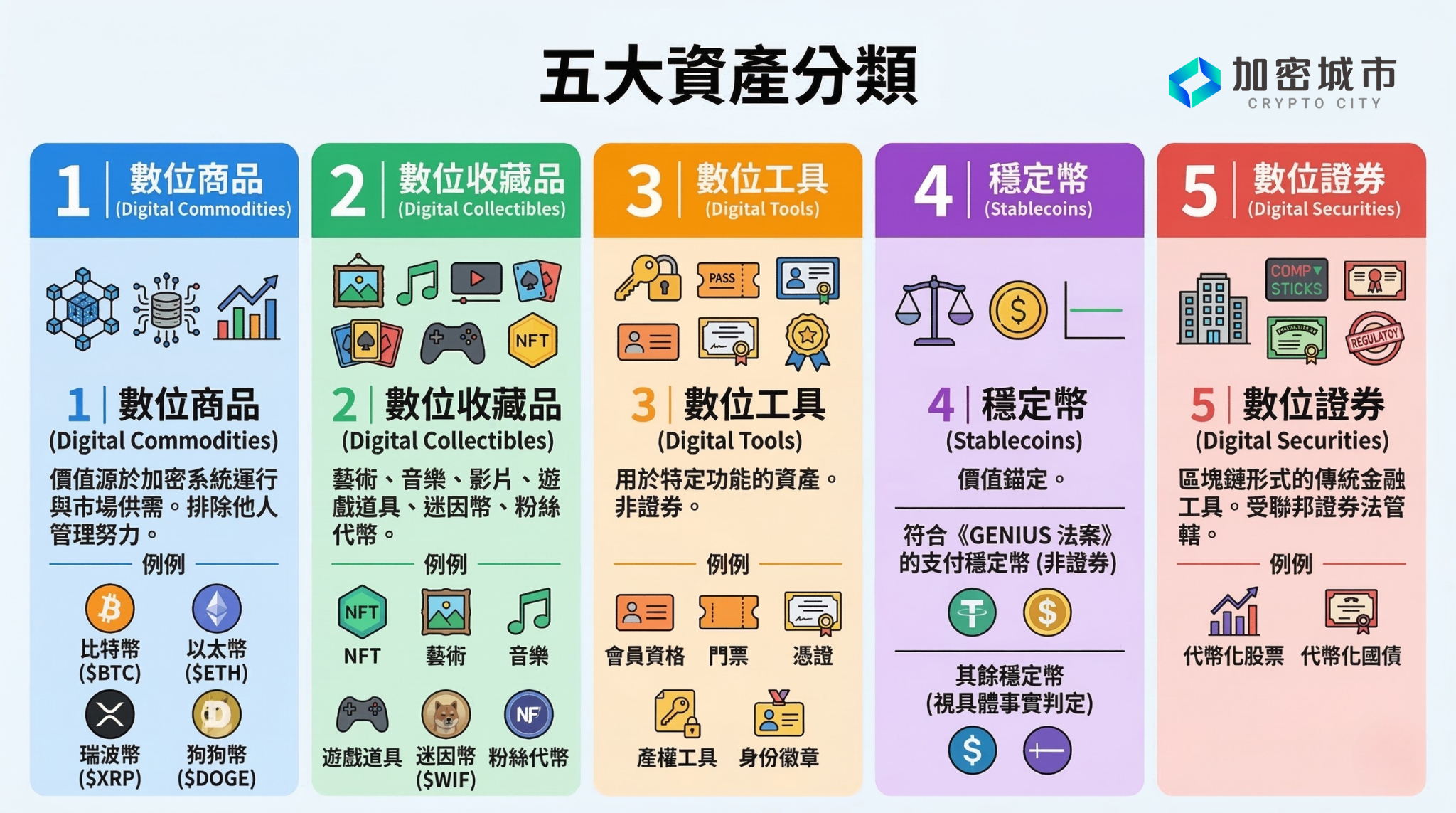
Image source: Crypto City chart illustrating the five major asset categories provided by SEC for the crypto industry
Clarifying operational details: mining, staking, and airdrops are no longer considered securities offerings
Beyond the overall token classification, this guidance also addresses long-standing operational legal classifications. Regarding protocol mining and protocol staking, both the SEC and CFTC state that in most cases these activities do not involve the issuance or sale of securities. For example, in proof-of-stake (PoS) networks, the SEC views node operators’ activities as administrative or regulatory functions to maintain network security. Rewards earned are considered service compensation, not investment profits derived from others’ management efforts.
As for crypto airdrops, the guidance states that if recipients do not provide money, goods, services, or other consideration, then the activity does not meet the “investment of money” element of the Howey Test and thus does not require registration under securities laws. For wrapped tokens, if the wrapped version is merely a non-securities asset exchange receipt, it does not constitute a security; however, if the underlying asset is a digital security or tied to an investment contract, the wrapped version retains its security status. These detailed clarifications effectively eliminate the legal gray areas faced by DeFi projects and blockchain developers, providing a rational “traffic rule” framework.
The dynamic lifecycle of investment contracts and token status transition mechanisms
One of the most innovative aspects of this framework is the SEC’s interpretation of the termination mechanism for investment contracts.
The guidance states that while non-securities assets may temporarily be associated with an investment contract due to management commitments at the time of sale, this security status is not permanent. When the issuer has fulfilled its commitments or can no longer perform related management efforts, and buyers no longer reasonably expect to profit from others’ efforts, the token will detach from the investment contract and revert to its non-security nature.
This “investment contract termination” perspective fundamentally changes the previous market view that tokens, once classified as securities, would remain in legal limbo indefinitely. However, the SEC also warns that the post-termination status of tokens does not have retroactive legal effect. If illegal unregistered issuance occurred initially, the issuer remains liable.
Chairman Atkins emphasizes that project teams must clearly disclose statements and promises related to their efforts, enabling investors to understand precisely what rights they are purchasing. This regulation shifts the debate from “whether a token is a security” to “what specific promises are made” and “who makes them.”
Launching an innovation exemption plan aligned with future congressional legislation
Alongside the release of the guidance, Chairman Atkins also previewed a broader regulatory vision called the “Crypto Asset Regulation” plan. This includes several exemption proposals aimed at providing compliant funding pathways for U.S. developers.
- The “Startup Exemption” proposes allowing developers to raise up to $5 million over a maximum of four years as a regulatory runway for their technology development.
- The “Fundraising Exemption” plans to permit companies to raise up to $75 million within 12 months, provided they submit relevant disclosures including financials and principles.
Chairman Atkins specifically thanked Commissioner Hester Peirce, often called the “Crypto Mom,” noting that these proposals are heavily influenced by her 2020 “Token Safe Harbor” framework. While SEC plans to submit these proposals for public comment in the coming weeks, Atkins emphasized that only comprehensive market structure legislation like the Congress’s “CLARITY Act” can ensure long-term regulatory stability. The joint action with CFTC strengthens regulatory coordination between the two agencies and lays a solid foundation for the U.S. to regain leadership in the global digital finance race.
Disclaimer: The information on this page may come from third parties and does not represent the views or opinions of Gate. The content displayed on this page is for reference only and does not constitute any financial, investment, or legal advice. Gate does not guarantee the accuracy or completeness of the information and shall not be liable for any losses arising from the use of this information. Virtual asset investments carry high risks and are subject to significant price volatility. You may lose all of your invested principal. Please fully understand the relevant risks and make prudent decisions based on your own financial situation and risk tolerance. For details, please refer to
Disclaimer.


