


Polymarket Hits $478M Daily Volume as Iran Contracts Surge While Kalshi Faces Backlash
 Polymarket recorded a single-day notional trading volume of $478 million on February 28, 2026, with political event contracts representing approximately $220 million of total activity, following the United States and Israel’s coordinated strikes on Iran.
Rival prediction platform Kalshi faced user criticism over its settlement process for a contract titled “Ali Khamenei out as Supreme Leader?” after Iranian state television confirmed the leader’s death, with CEO Tarek Mansour announcing that post-death positions would be fully reimbursed while pre-death positions would settle at last-traded prices. The events highlight prediction markets’ increasing role in geopolitical forecasting while intensifying scrutiny over insider trading allegations and regulatory jurisdiction disputes between federal authorities and state gaming commissions.
Polymarket Sets Historic Record Amid Geopolitical Tensions
Polymarket achieved its highest single-day trading volume on February 28, reaching $478 million in notional value. Political markets alone contributed $220 million, accounting for nearly half of total daily platform activity.
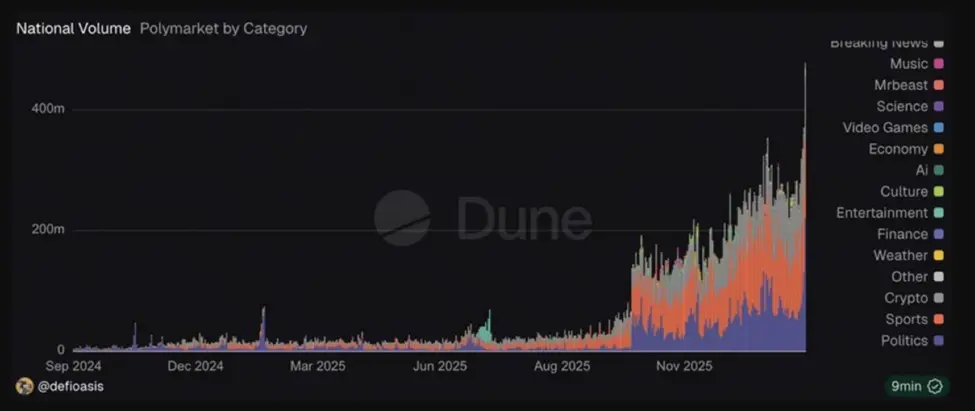 (Source: Defioasis)
The surge coincided directly with the United States and Israel launching coordinated strikes on Iran. Polymarket rapidly deployed more than a dozen event contracts related to the conflict, covering topics including ceasefire timing, potential succession of Iran’s Supreme Leadership, and the possibility of U.S. ground forces entering Iran.
The contract “When will the U.S. strike Iran?” had accumulated approximately $529 million in total volume since its launch on December 22, 2025. On February 28 alone, this contract recorded $89.6 million in single-day trading volume.
Following confirmation of Ayatollah Ali Khamenei’s death via Iranian state television, the contract “Will Khamenei lose his position as Supreme Leader of Iran before March 31?” settled at 100%, with total trading volume reaching $45 million. The largest winning position generated approximately $757,000 in profits, while four additional traders realized six-figure gains.
Subsequent market data indicated traders broadly anticipated a phased resolution to the conflict. As of March 1, the probability of a U.S.-Iran ceasefire before March 2 stood at 4%, increasing to 15% before March 6, 61% before March 31, and 78% before April 30.
Insider Trading Allegations Emerge Following Iran Contract Surge
The rapid accumulation of trading volume attracted scrutiny regarding potential information advantages. Blockchain analytics firms identified at least six wallet addresses that collectively profited approximately $1.2 million from bets accurately predicting the timing of strikes against Iran.
These wallets established positions before the February 28 airstrikes, raising concerns about whether traders possessed non-public information regarding military actions. The allegations intensified broader discussions about insider trading risks in prediction markets, particularly when contracts involve sensitive geopolitical events.
Kalshi Faces User Backlash Over Khamenei Contract Settlement
Kalshi, a U.S.-regulated prediction market operating as a designated contract market under Commodity Futures Trading Commission oversight, encountered significant user criticism regarding its handling of the contract “Ali Khamenei out as Supreme Leader?”
The contract had accumulated over $50 million in total volume, with approximately $20 million traded on February 28 alone, coinciding with the strikes and subsequent confirmation of Khamenei’s death.
CEO Tarek Mansour addressed the backlash via social media, outlining the platform’s settlement approach. All positions established before Khamenei’s death would settle at pre-death last-traded prices, consistent with contract terms filed with the CFTC. Positions opened after death confirmation would receive full reimbursement, including all trading fees.
Mansour defended the market’s design as compliant with U.S. regulations, emphasizing that leadership changes in Iran carry substantial geopolitical, economic, and national security implications. He stated that such markets provide legitimate information about political outcomes rather than directly incentivizing speculation on mortality.
Despite the settlement explanation, many users expressed dissatisfaction on social media platforms, characterizing the outcome as unfavorable to their positions.
Regulatory Landscape Intensifies as Federal and State Authorities Clash
The trading surge occurred against a backdrop of escalating legal battles between prediction market platforms and state gaming regulators. The CFTC, under current leadership, has actively asserted exclusive federal jurisdiction over event contracts as swaps under the Commodity Exchange Act.
In February 2026, the CFTC filed an amicus brief in the Ninth U.S. Circuit Court of Appeals supporting Crypto.com in its dispute with the Nevada Gaming Control Board. The CFTC has taken the position that it will not tolerate state governments undermining federal jurisdiction over these markets.
Multiple states, including Nevada, Massachusetts, and Connecticut, have pursued enforcement actions against prediction platforms, arguing that event contracts—particularly those involving sports—constitute unlicensed gambling subject to state regulation. The Nevada Gaming Control Board filed actions against both Kalshi and Polymarket, alleging operation of unlicensed sports betting operations.
A Tennessee federal judge granted Kalshi a preliminary injunction blocking state enforcement, while a Massachusetts judge delayed that state’s injunction pending appeal. Nevada simultaneously brought an enforcement action against Kalshi in state court.
The legal uncertainty has affected market positioning. Kalshi processed approximately $9.1 billion in trading volume during January 2026, with 91.1% tied to sports event contracts. Polymarket recorded approximately $7.5 billion during the same period. Meta-markets on prediction platforms reflected shifting sentiment, giving Polymarket a 47% chance of finishing 2026 as the top platform by volume, with Kalshi at 34%.
President Trump’s son, Donald Trump Jr., has invested in Polymarket through his venture capital firm and serves as a strategic advisor for Kalshi, adding political dimensions to the regulatory disputes.
FAQ: Prediction Markets and Recent Developments
What caused Polymarket’s record $478 million daily volume?
The February 28, 2026 trading surge was driven primarily by U.S. and Israeli strikes on Iran. Polymarket launched over a dozen Iran-related contracts, with the “When will the U.S. strike Iran?” contract alone accounting for approximately $89.6 million in single-day volume.
How did Kalshi handle the Khamenei contract controversy?
Kalshi settled pre-death positions at last-traded prices and fully reimbursed post-death positions, including all trading fees. CEO Tarek Mansour defended the approach as consistent with CFTC-filed contract terms and necessary to avoid creating a “death market.”
What is the current regulatory dispute between prediction markets and states?
The CFTC asserts exclusive jurisdiction over event contracts as federally regulated swaps, preempting state gambling laws. Multiple states, including Nevada and Massachusetts, argue these platforms operate unlicensed sports betting operations subject to state oversight. Several federal court cases are ongoing.