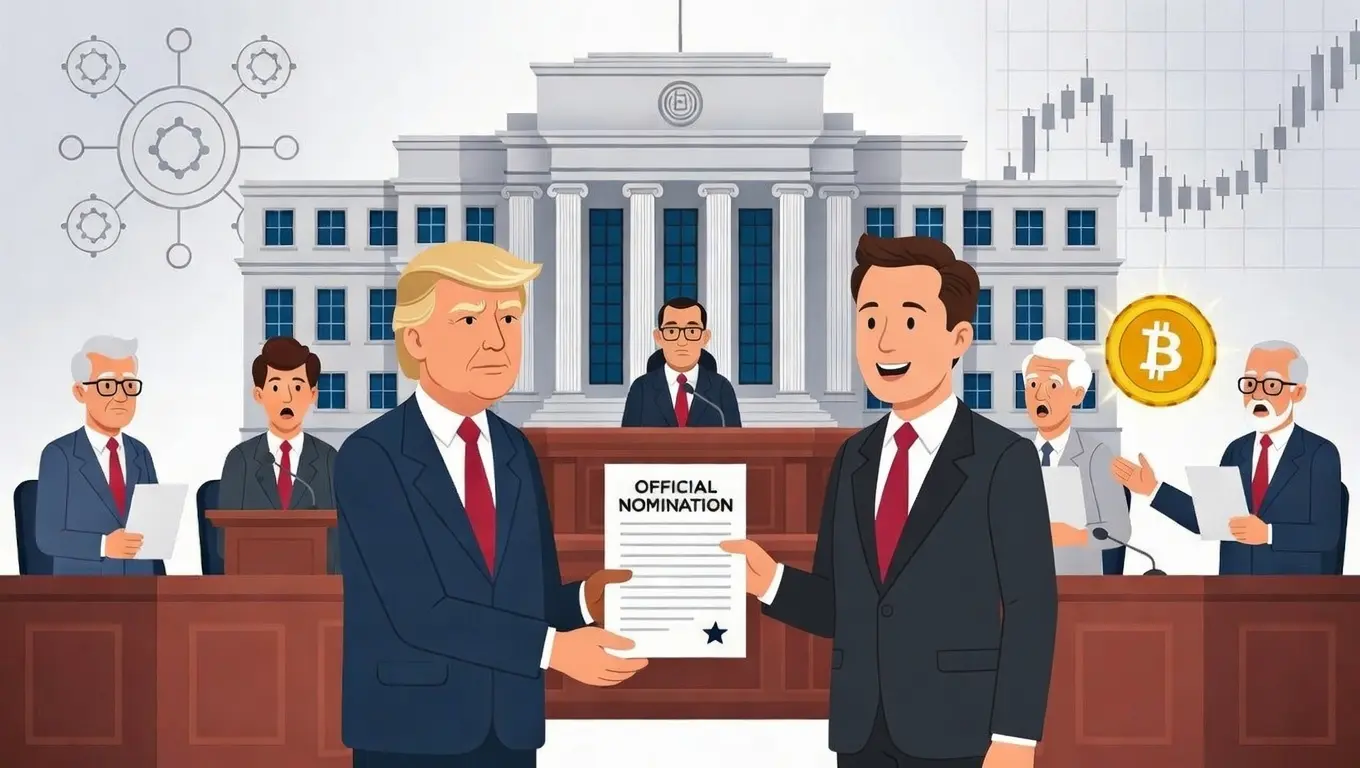
 President Donald Trump has formally transmitted the nomination of Kevin Warsh to serve as the next Chair of the Federal Reserve to the U.S. Senate, setting the stage for a confirmation battle over the successor to Jerome Powell.
The White House official action, taken on March 4, 2026, advances a nominee who has historically characterized Bitcoin as a potential store of value and a signaling mechanism for policymakers, though his confirmation faces hurdles from both Republican and Democratic senators amid an ongoing criminal investigation into the current Fed chair.
Nomination Details and Timeline
The White House officially sent Warsh’s nomination to the Senate on Wednesday, designating him for a four-year term as Chairman of the Board of Governors of the Federal Reserve System and a concurrent 14-year term as a Fed governor effective February 1, 2026. This formal transmission follows Trump’s initial social media announcement on January 30, 2026, naming Warsh as his preferred candidate to replace Powell, whose chairmanship concludes on May 15.
Warsh, 55, previously served as a Federal Reserve governor from 2006 to 2011 under Presidents George W. Bush and Barack Obama. He currently holds positions as the Shepard Family Distinguished Visiting Fellow in Economics at Stanford University’s Hoover Institution and a lecturer at the Stanford Graduate School of Business.
Senate Confirmation Path and Political Obstacles
Tillis Hold Over DOJ Investigation
The nomination faces immediate procedural resistance. Republican Senator Thom Tillis of North Carolina has stated he will block any Federal Reserve nominee from advancing until the Department of Justice investigation into current Chair Jerome Powell is resolved. The investigation concerns Powell’s testimony regarding a $2.5 billion renovation project at the Fed’s Washington headquarters, with Tillis characterizing the probe as a threat to the central bank’s political independence.
“My position has not changed: I will oppose the confirmation of any Federal Reserve nominee, including for the position of Chairman, until the DOJ’s inquiry into Chairman Powell is fully and transparently resolved,” Tillis stated in January.
Democratic Opposition
Minority Leader Chuck Schumer signaled in January that Republican lawmakers “must not move Mr. Warsh’s nomination forward,” citing Trump’s attempts to “cannibalize the Federal Reserve to eliminate its independence.” Senator Elizabeth Warren, the Banking Committee’s top Democrat, characterized Warsh as “nothing more than Donald Trump’s sock puppet at the Fed.”
Cook Litigation Precedent
The confirmation process unfolds against the backdrop of ongoing litigation involving Fed Governor Lisa Cook, whom Trump attempted to remove last summer. Cook, who sided with Powell on interest rate decisions, challenged her termination in court. The Supreme Court heard oral arguments in the case during January 2026 but has not yet issued a ruling, creating uncertainty regarding the scope of presidential authority over Fed governors.
Warsh’s Stance on Bitcoin and Digital Assets
Bitcoin as “Store of Value,” Not Currency
The nominee has articulated nuanced views on cryptocurrency that distinguish between its functional roles. In a January 2021 CNBC interview, Warsh stated, “If Bitcoin never existed, gold would be rallying even more right now, but I guess if you are under forty, bitcoin is your new gold.”
However, a review of Warsh’s public statements reveals a more complex position. In a 2018 Wall Street Journal op-ed titled “The Meaning of Bitcoin Volatility,” he opened with the assertion, “Contrary to its name, Bitcoin is not a currency,” citing excessive volatility as failing to meet the basic requirement of a stable medium of exchange. He nonetheless assessed that over time, Bitcoin could establish itself as a store of value similar to gold.
Signaling Function for Policymakers
Warsh has consistently emphasized Bitcoin’s utility as an indicator for monetary authorities. In a 2025 Hoover Institution interview, he stated that cryptocurrency “could provide market discipline, or could tell the world that things need to be fixed.” He elaborated, “Bitcoin does not make me nervous… I think of it as an important asset that can help inform policymakers when they’re doing things right and wrong.”
Dollar Hegemony and Digital Dollar Strategy
The nominee’s writings prioritize preserving U.S. dollar dominance over cryptocurrency promotion. In a 2022 WSJ op-ed, Warsh characterized cryptocurrencies as “software” rather than money, warning that most private cryptocurrencies circulating while masquerading as currency are “scams or worthless.” He has advocated for an American-style digital dollar strategy focused on international remittances and wholesale settlements to counter China’s digital yuan initiative.
Regulatory Context: CFTC Leadership Vacancies
While the Fed nomination advances, the Commodity Futures Trading Commission remains understaffed. Michael Selig, confirmed as CFTC chair in December 2025, currently serves as the sole leader of the five-commissioner financial regulator. No additional nominations have been transmitted to the Senate, despite expectations that the agency will receive expanded oversight authority over digital assets should pending market structure legislation become law.
Market and Policy Implications
Interest Rate Outlook
Warsh has indicated that productivity growth driven by artificial intelligence could create opportunities for reducing interest rates without stoking inflation. However, recent geopolitical developments, including conflict involving Iran that has elevated oil prices, introduce new inflationary pressures that may constrain any Fed chair’s ability to deliver rate cuts.
Market pricing reflects expectations of continued rate stability. According to the CME FedWatch tool, there is a 97.3% probability the Fed will maintain its benchmark rate within the current 3.50% to 3.75% range at the March 17-18 FOMC meeting.
Fed Independence Considerations
Multiple policymakers have emphasized that Warsh, if confirmed, would hold only one vote on the Federal Open Market Committee and would need to build consensus among colleagues who have expressed caution regarding inflation. Minneapolis Fed President Neel Kashkari recently noted that sustained inflation following five years of elevated price increases requires “highly vigilant” monitoring.
FAQ: Kevin Warsh Nomination and Federal Reserve Transition
Q: When will the Senate vote on Kevin Warsh’s nomination?
A: No specific date has been set. The Senate Banking Committee must first hold a confirmation hearing and vote to advance the nomination to the full Senate. Senator Tillis’s hold over the DOJ investigation into Jerome Powell currently blocks committee consideration.
Q: What is the status of the investigation into Jerome Powell?
A: The U.S. Attorney’s office in Washington, D.C., is conducting a criminal investigation into Powell’s testimony regarding a $2.5 billion Federal Reserve headquarters renovation project. Powell has stated that “the threat of criminal charges” relates to his and other governors’ refusal to accelerate interest rate cuts demanded by Trump.
Q: How might Kevin Warsh’s appointment affect cryptocurrency regulation?
A: Warsh views Bitcoin primarily as a store of value and signaling mechanism rather than currency, but prioritizes maintaining dollar hegemony through digital dollar infrastructure development. His approach suggests continued Fed focus on wholesale CBDC applications while treating private cryptocurrencies as software-based assets that inform monetary policy assessment.
Q: What happens to Jerome Powell after May 2026?
A: Powell’s term as Fed Chair ends May 15, 2026, but his term as a Fed governor continues until January 31, 2028. He has not specified whether he will remain as a governor following the leadership transition.


