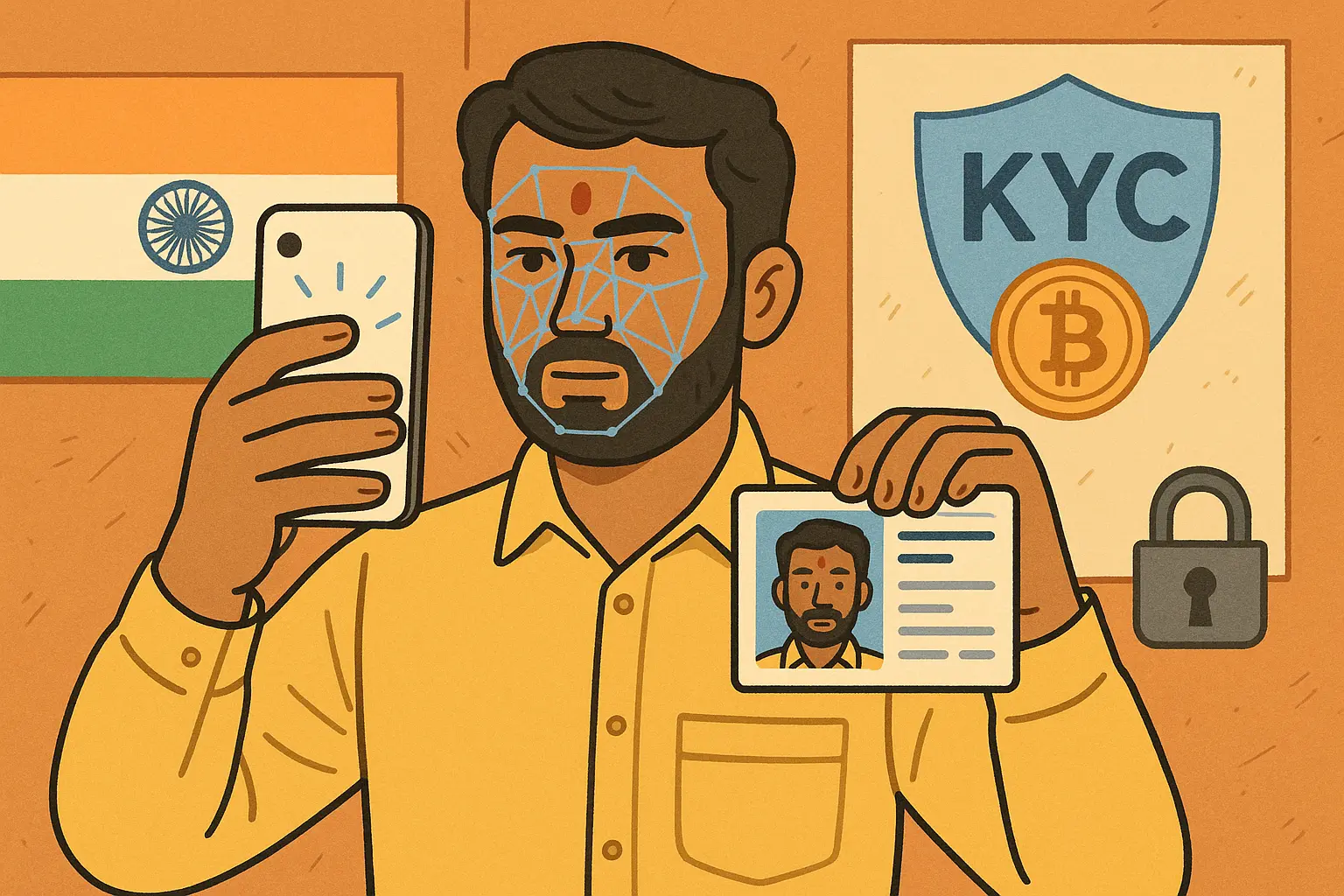
India’s Financial Intelligence Unit (FIU) has released new guidelines mandating crypto exchanges to verify user identity through real-time selfies and geolocation verification, using eye-tracking software to prevent AI deepfakes from bypassing KYC processes. This reflects India’s strict regulatory stance toward its 1.4 billion population market, which currently imposes a 30% tax rate on crypto gains with no allowance for tax loss deductions.
Why India is Suddenly Tightening KYC Regulations
The Financial Intelligence Unit (FIU), as the regulatory body responsible for formulating anti-money laundering and KYC regulations, is not suddenly tightening policy but rather continuing a long-term regulatory trend. With over 1.4 billion people, India is one of the world’s largest potential cryptocurrency markets. The cryptocurrency usage trends in this massive market could bring a new wave of investment to the entire sector, but it also keeps regulators highly vigilant.
Officials from India’s Income Tax Department (ITD) made clear during a meeting with parliamentarians on Wednesday that cryptocurrencies and decentralized finance platforms will undermine tax enforcement. Tax department officials argue that decentralized crypto exchanges, anonymous wallets, and the cross-border nature of cryptocurrencies make taxation extremely difficult. Adding to the complexity is that tax regulations vary by jurisdiction, making effective collection of crypto taxes even more complicated.
Under Indian income tax law, gains from cryptocurrency sales are taxed at a 30% rate, with users only able to deduct cost basis from gains. Even more stringent is that Indian crypto traders cannot benefit from tax loss deductions, meaning they cannot offset gains from different transactions using losses from other cryptocurrency sales. This tax structure has already frustrated many traders, while the new KYC requirements further strengthen the regulatory net.
The logic of Indian regulators is clear: permissionless blockchain technology disrupts tax collection, and therefore must be countered through stricter identity verification to track every transaction and every user. This regulatory approach aligns with India’s central bank’s strategy of promoting central bank digital currency (CBDC) rather than stablecoins, with the goal of placing digital assets within a controllable regulatory framework.
Specific New Requirements: From Selfies to Bank Verification
Six KYC Verification Gates
Real-time Selfie Verification: Live detection through software tracking eye and head movements to prevent AI deepfakes
Geolocation Tracking: Mandatory collection of geolocation and IP address during account creation to establish user behavior mapping
Timestamp Recording: Recording precise time of account creation for subsequent tax audits and compliance tracking
Bank Account Verification: Sending small transactions to user bank accounts to verify authenticity
Dual Identity Proof: Submitting additional government-issued photo identification
Multi-channel Verification: Verifying email and phone numbers to ensure contact information is genuine and valid
The most technically sophisticated of these requirements is the real-time selfie verification system. According to The Times of India, this system tracks users’ eye and head movements to determine whether it is a real person rather than an AI-generated deepfake image. As AI technology develops, instances of using generative AI to create fake identities to bypass KYC verification have already appeared, and Indian regulators clearly want to stay ahead and close this loophole.
The collection of geolocation and IP address is designed to establish user behavior profiles. Regulators can use this data to track whether users open accounts at multiple exchanges, whether they use VPNs to hide their true location, and whether there are unusual cross-border transaction behaviors. Timestamp recording may seem simple, but during tax audits it can precisely determine asset holding periods, which is crucial for calculating capital gains tax.
Bank account verification is the core component of anti-money laundering (AML) requirements. By sending small transactions to user bank accounts (typically a few rupees), exchanges can confirm that users actually control that bank account. This practice has become standard in traditional finance and is now being introduced into cryptocurrency regulation. Dual identity proof and multi-channel verification are designed to increase the cost of identity fraud, making it more difficult to register accounts using others’ identities.
Comparison with Global KYC Standards
Where do India’s new KYC requirements stand globally? Compared to the EU’s Anti-Money Laundering Directive (AMLD) and the US’s Bank Secrecy Act (BSA), India’s requirements are in some respects stricter. Although the EU also requires KYC for crypto exchanges, it has not yet mandated real-time selfies and geolocation tracking. US requirements vary by state, with federal-level oversight primarily conducted by FinCEN (Financial Crimes Enforcement Network), but the technical measures are not as detailed as India’s regulations.
China has completely banned cryptocurrency trading, so there is no KYC issue. Japan and South Korea have KYC requirements similar to India’s, but are more lenient on bank account verification. Singapore, as Asia’s cryptocurrency hub, has adopted a relatively balanced regulatory approach, requiring KYC but without excessive privacy intrusion. India’s approach clearly leans toward stricter regulation, which may be related to its large population base and relatively weak financial regulatory infrastructure.
Notably, the Reserve Bank of India has urged countries to prioritize developing central bank digital currencies (CBDC) rather than stablecoins. This position suggests India hopes to use CBDC to replace privately-issued stablecoins, thereby bringing digital payments completely under regulatory scope. If this strategy succeeds, India could become the first major economy to widely promote CBDC while simultaneously strictly limiting private cryptocurrencies.
Actual Impact on the Crypto Market
For Indian cryptocurrency exchanges, new regulations mean significantly increased technical investment and compliance costs. Deploying eye-tracking and liveness detection systems requires collaboration with professional biometric technology providers, and licensing fees and maintenance costs for these systems are substantial. Smaller exchanges may be forced to exit the market due to inability to afford these costs, leading to increased market concentration.
For users, stricter KYC requirements mean further loss of privacy. While regulators claim these measures are to combat money laundering and tax evasion, they also raise concerns about data security. India’s legislative progress on data protection law has been relatively slow, and if exchanges suffer hacking attacks, users’ biometric data, geolocation information, and bank account details could be compromised.
From a market size perspective, a 1.4 billion population market is crucial to the global cryptocurrency sector. If India’s strict regulations lead users to turn to underground trading or decentralized exchanges, regulatory objectives may backfire. Decentralized exchanges are not subject to KYC requirements, and while India can block their websites, tech-savvy users can still access them through VPNs and other means. This could lead to the formation of a dual-track market: compliant centralized exchanges serving regular users, while decentralized platforms attract privacy-seeking users.
إخلاء المسؤولية: قد تكون المعلومات الواردة في هذه الصفحة من مصادر خارجية ولا تمثل آراء أو مواقف Gate. المحتوى المعروض في هذه الصفحة هو لأغراض مرجعية فقط ولا يشكّل أي نصيحة مالية أو استثمارية أو قانونية. لا تضمن Gate دقة أو اكتمال المعلومات، ولا تتحمّل أي مسؤولية عن أي خسائر ناتجة عن استخدام هذه المعلومات. تنطوي الاستثمارات في الأصول الافتراضية على مخاطر عالية وتخضع لتقلبات سعرية كبيرة. قد تخسر كامل رأس المال المستثمر. يرجى فهم المخاطر ذات الصلة فهمًا كاملًا واتخاذ قرارات مدروسة بناءً على وضعك المالي وقدرتك على تحمّل المخاطر. للتفاصيل، يرجى الرجوع إلى
إخلاء المسؤولية.


