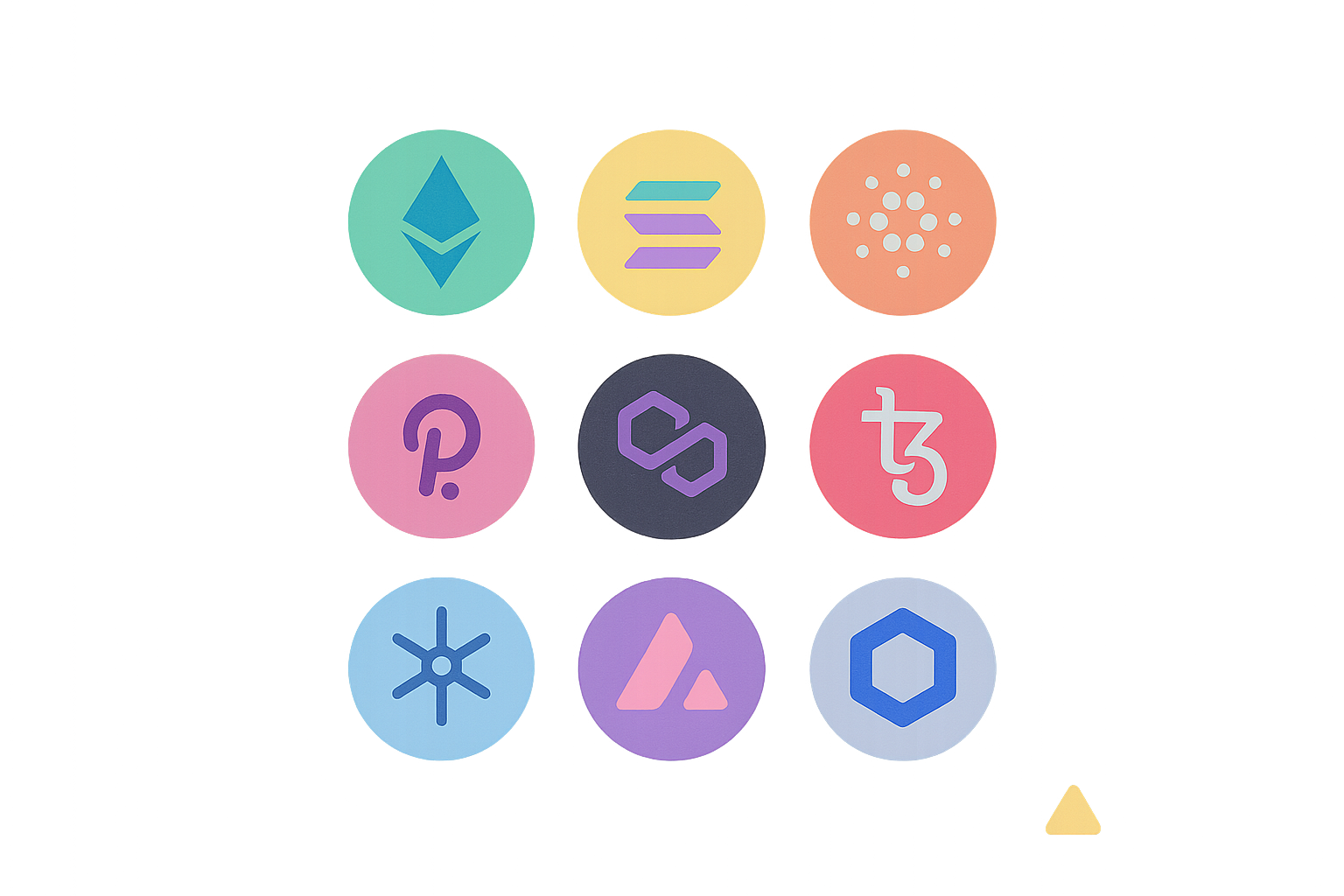
2024 Proof-of-Stake Token Rankings: In-Depth Analysis! Explore detailed comparisons of nine major PoS tokens—including Ethereum 2.0, Cardano, Solana, and Polkadot—covering staking yields from 5–20%, key technical attributes, and ecosystem growth. Discover how to generate passive income by staking through platforms like Gate, and gain expert insights into PoS token investment selection and risk management strategies.
Overview of the Proof of Stake (PoS) Consensus Mechanism
Proof of Stake (PoS) is a consensus algorithm used in blockchain networks to validate transactions and create new blocks. Unlike Proof of Work (PoW), PoS selects block validators based on the amount of cryptocurrency they hold, rather than requiring nodes to solve complex mathematical puzzles. This makes PoS more energy-efficient, cost-effective, and lowers the barrier to entry compared to PoW.
In practice, PoS allows token holders to participate in maintaining the network by staking their tokens. Validators earn staking rewards in return. This incentive model not only secures the network but also offers investors passive income opportunities. As environmental awareness grows and energy costs rise, PoS tokens have attracted significant market attention for their efficiency and attractive staking yields.
With intensifying competition in the crypto market, investors must evaluate a project's technical strength, ecosystem growth, and staking returns across multiple dimensions to select the most suitable PoS tokens for investment.
Mainstream PoS Cryptocurrencies in Recent Years: In-Depth Analysis of 9 Leading Proof of Stake Tokens
PoS Cryptocurrency (1): BitDAO
BitDAO (BIT) is an innovative decentralized finance (DeFi) project recognized as a high-quality Proof of Stake token for its unique DAO governance model and growth potential. As a decentralized autonomous organization, BitDAO is dedicated to advancing the DeFi ecosystem through a decentralized and tokenized economic system.
BitDAO receives strong support from notable investors such as Peter Thiel and Pantera Capital, ensuring robust funding and resources for long-term development. The project emphasizes community governance, adopting a community-driven approach that lets token holders participate in key decisions, ensuring transparency and accountability.
BitDAO offers validators competitive staking rewards. For those seeking passive income in DeFi through staking, BitDAO presents a high-potential investment opportunity. Its tokenomics are well-designed to incentivize validators while maintaining stable token value.
PoS Cryptocurrency (2): Cardano
Cardano (ADA) is a third-generation blockchain platform leveraging Proof of Stake, known for its innovations in scalability, security, and sustainability. The platform is built for developing and deploying decentralized applications (dApps) and smart contracts, providing a secure and reliable environment for developers.
Cardano distinguishes itself with a research-driven development process, using scientific rigor and peer review for all protocol updates. This approach ensures security, scalability, and long-term viability, setting Cardano apart among public blockchains.
Cardano’s PoS algorithm, Ouroboros, is the first academically validated Proof of Stake protocol. Validators who secure the network and validate transactions can earn up to 5.5% staking rewards, with a simple process allowing holders to join or exit staking at any time. Ouroboros is extremely energy-efficient, consuming over 99% less energy than PoW, making it a sustainable solution.
Cardano has launched the Hydra protocol, a Layer 2 scaling solution designed for high-throughput transactions and cross-chain communication, enhancing the platform’s utility and interoperability.
PoS Cryptocurrency (3): Solana
Solana (SOL) is a high-performance Proof of Stake blockchain platform, widely recognized for its speed, low costs, and scalability. Solana is optimized for decentralized applications (dApps) and smart contracts requiring high throughput.
Solana’s key advantages are its exceptional processing speed and scalability. By integrating the innovative Proof of History (PoH) timestamp mechanism with PoS, Solana can process up to 65,000 transactions per second (TPS), making it one of the fastest blockchain networks globally. This high performance is ideal for decentralized exchanges, NFT markets, GameFi, and other applications needing rapid transaction confirmation.
Solana’s PoS consensus offers attractive staking rewards. Validators who help secure the network and validate transactions can earn up to 7.5% annualized yield. Token holders may run their own validator nodes or delegate tokens to existing validators, with flexible staking lowering entry barriers.
Low transaction costs are another major advantage, with average fees just a few cents. This makes micro and high-frequency transactions economically viable and supports DeFi ecosystem growth.
PoS Cryptocurrency (4): Algorand
Algorand is a top-tier Proof of Stake token known for its innovations in security, scalability, and decentralization. Founded by Turing Award winner Professor Silvio Micali, Algorand boasts a strong academic foundation.
Algorand uses a Pure Proof of Stake algorithm, eliminating reliance on central authorities or mining pools. This ensures true decentralization and security. Unlike other PoS systems, Algorand’s Pure PoS prevents wealth concentration from becoming power concentration—any holder can participate in consensus.
Algorand’s Binary Byzantine Agreement (BA) consensus enables up to 1,000 TPS with rapid finality, usually achieved in seconds. This efficiency makes Algorand well-suited for a wide range of decentralized applications.
Investors can stake ALGO tokens to validate the network and earn staking rewards. Algorand’s validator selection uses a fair, transparent random draw, ensuring equal opportunity. Holders can stake without locking tokens, preserving liquidity—an advantage over other PoS projects.
PoS Cryptocurrency (5): Polkadot
Polkadot (DOT) is an innovative multi-chain Proof of Stake blockchain platform designed to deliver scalable, interoperable, and secure infrastructure for decentralized applications and services. Created by Ethereum co-founder Dr. Gavin Wood, Polkadot represents a major step forward in blockchain technology.
Polkadot’s core design enables cross-chain communication and interoperability, allowing different blockchains to securely exchange data and value. Its relay chain and parachain architecture build a multi-chain ecosystem, letting each chain maintain its unique features while connecting with others.
Polkadot’s sharding mechanism allows multiple blockchains (parachains) to process transactions and data in parallel, vastly increasing throughput and scalability. Each parachain can be optimized for specific use cases without impacting others, providing a flexible environment for innovation.
Polkadot’s PoS consensus, NPoS (Nominated Proof of Stake), offers validators up to 12% staking rewards—among the highest in the market. Holders can become validators or nominators; nominators delegate tokens to trusted validators, sharing in rewards and balancing security with ease of participation.
PoS Cryptocurrency (6): Tezos
Tezos (XTZ) is a self-amending blockchain platform using Proof of Stake, designed for decentralized applications and smart contracts. Tezos features unique on-chain governance and self-upgrading capability.
Tezos allows stakeholders to vote on protocol upgrades, avoiding hard forks and preventing community splits, ensuring continuous evolution and stability. Token holders vote on proposals and updates, achieving genuine decentralized governance.
Tezos prioritizes formal verification, a mathematical technique to prove smart contract correctness—critical for secure financial applications, reducing vulnerability risks. This focus on security makes Tezos ideal for enterprise use.
Tezos uses Liquid Proof of Stake, with validators (“bakers”) earning up to 6% staking rewards for securing the network. Token holders may run their own nodes or delegate tokens to bakers; delegation is simple, tokens remain liquid, and can be moved or used at any time.
PoS Cryptocurrency (7): Polygon
Polygon (MATIC) is a Layer 2 scaling solution using Proof of Stake, focused on building and connecting scalable Ethereum-compatible blockchains. As an Ethereum extension platform, Polygon provides high-performance infrastructure to solve scalability and high-fee issues.
Polygon’s core value is its focus on interoperability. It supports EVM-compatible applications and offers multiple scaling solutions—Plasma, Optimistic Rollups, zkRollups—allowing developers to choose the best fit. This flexibility makes Polygon one of Ethereum’s leading scaling solutions.
The Polygon network offers fast, low-cost transactions, with confirmations in seconds and fees reduced over 99% compared to Ethereum mainnet. This makes DeFi, NFT, and GameFi high-frequency trading economically viable on Polygon.
Polygon’s PoS consensus gives validators highly attractive rewards. Validators can earn up to 17% staking yields, among the market’s highest. Token holders can stake through major exchanges or DeFi platforms, with low barriers for all investor sizes.
PoS Cryptocurrency (8): Leading Exchange Platform Token (BNB)
The platform token (BNB) of a major exchange is a Proof of Stake cryptocurrency, created and operated by a globally renowned crypto exchange. BNB is not just a trading medium but the core of the platform ecosystem.
The platform’s blockchain network provides a comprehensive environment for trading, exchanging, and investing in crypto and digital assets. It uses PoS to ensure efficient processing, low costs, security, and decentralization.
BNB’s unique value is its multi-purpose utility within the ecosystem. Holders use BNB for discounted trading fees, participate in new token launches, and access various DeFi applications. This wide utility supports BNB’s intrinsic value.
The platform’s PoS consensus offers some of the most competitive staking rewards, up to 20% for validators. The platform provides flexible and fixed-term staking products, accommodating different risk preferences.
The ecosystem’s ongoing expansion—NFT markets, GameFi, metaverse projects—creates more demand and use cases for BNB, supporting its long-term value.
PoS Cryptocurrency (9): Ethereum 2.0 (ETH)
Ethereum 2.0 (ETH) is one of the most popular and promising cryptocurrencies. Ethereum is the second-largest crypto by market cap, behind only Bitcoin, and leads the industry in both influence and scale.
Ethereum’s transition from Proof of Work to Proof of Stake, known as “The Merge,” was a landmark technical upgrade. It reduced energy consumption by 99.95% and paved the way for future scalability, marking progress toward a more sustainable and efficient network.
To stake independently on Ethereum 2.0, investors need at least 32 ETH—a high threshold for most, but alternatives like staking pools, major exchange services, or DeFi protocols (e.g., Lido, Rocket Pool) lower the entry barrier and offer greater flexibility.
Over $12 billion in ETH is already staked, reflecting market confidence in Ethereum’s PoS mechanism. Validators earn staking rewards, with annual yields adjusted dynamically based on participation—typically 4–7%.
Ethereum has the largest and most active developer community. Its smart contract platform supports thousands of dApps, spanning DeFi, NFT, DAO, and more. This powerful ecosystem and network effect make ETH one of the most valuable PoS tokens for long-term investment.
PoS Cryptocurrencies: Driving More Sustainable and Efficient Blockchain Applications
PoS cryptocurrencies offer promising opportunities for investors interested in decentralized applications and services. Compared to traditional Proof of Work, PoS is more sustainable and cost-effective, playing a key role in blockchain’s long-term growth.
Environmentally, PoS dramatically reduces energy consumption, lowering operational costs and aligning with global carbon neutrality goals. Economically, staking rewards provide passive income for holders and incentivize network participation, creating a healthy economic cycle.
Leading PoS tokens like Ethereum 2.0, Polkadot, Cardano, and Solana feature unique technologies and use cases, making them ideal platforms for building next-generation decentralized applications. Their innovations in scalability, interoperability, and security are moving the blockchain industry forward.
When choosing PoS tokens, investors should assess factors including technical strength, team background, ecosystem growth, staking yields, and tokenomics. Given the high volatility and uncertainty of the crypto market, thorough research and risk assessment are essential. Diversifying among top PoS projects helps balance risk and reward—focus on long-term potential, not just short-term price movements.
FAQ
What is Proof of Stake (PoS)? How does it differ from Proof of Work (PoW)?
PoS validates transactions by staking tokens, while PoW relies on mining via computing power competition. PoS is more energy-efficient and lowers participation barriers; PoW consumes more electricity. PoS rewards stakers, PoW rewards miners. PoS is now the mainstream consensus mechanism.
Which PoS cryptocurrencies are worth watching in 2024?
Ethereum, Solana, Cardano, Polkadot, and Cosmos lead with strong ecosystems and stable returns. They have high trading volumes and attractive staking rewards, making them prime choices for PoS deployment.
How do you stake cryptocurrencies? What are the steps and process?
Staking process: 1. Choose a project and wallet that support staking; 2. Transfer the required tokens; 3. Select the staking period; 4. Confirm and sign the transaction; 5. Tokens are locked, rewards are earned per cycle. Steps may vary—refer to official guides for details.
What is the typical annual yield for staking PoS tokens? How is it calculated?
PoS token staking yields usually range from 5–20%, with some new tokens reaching 30% or higher. Formula: Annual yield = staked amount × yield rate. Returns depend on token price, number of stakers, and network difficulty, and fluctuate dynamically.
What risks should you consider when staking cryptocurrencies?
Main risks include price volatility during lock-up, yield fluctuations, smart contract security, and validator slashing. Choose secure platforms and diversify to mitigate risk.
Ethereum 2.0, Cardano, and Polkadot: PoS Token Features and Yield Comparison
Ethereum 2.0: 8–12% annual yield, highest security; Cardano: 4–6%, lowest energy use; Polkadot: 12–20%, strongest cross-chain capability. All support staking; yields and risks are proportional.
How can beginners choose suitable PoS tokens for staking?
Consider four aspects: 1. Select tokens with high market cap and reputation for reliability; 2. Compare annual yields and choose projects with stable returns; 3. Assess trading volume and liquidity; 4. Research the team and project outlook, prioritizing long-term value.
Is staking cryptocurrencies safe? Will assets be frozen?
Staking is a secure mainstream method. Assets aren’t frozen—they’re locked in smart contracts to earn rewards. Using reputable platforms and tokens keeps risks very low. You can end staking at any time; assets remain fully yours.
Can you withdraw assets at any time during staking? How long is the unlock period?
Rules vary. Most PoS tokens support flexible staking with instant withdrawals; unlock periods are typically 0–7 days. Some require a lock-up period before redemption. Review each token’s protocol for details.
What’s the difference between exchange staking and running your own node? Which is more cost-effective?
Exchange staking is easier and automatic, with low entry barriers; running your own node requires technical expertise and higher costs but offers better returns. If you have sufficient funds and know-how, self-hosted nodes are more profitable long term; for convenience and stability, exchange staking is preferable.
* The information is not intended to be and does not constitute financial advice or any other recommendation of any sort offered or endorsed by Gate.