This comprehensive guide compares AEVO and IMX, two distinct Layer-2 platforms serving different cryptocurrency markets. AEVO operates as a decentralized derivatives exchange launched in March 2023, specializing in options and perpetual trading on the OP Stack-based Ethereum rollup. IMX functions as an established Layer-2 NFT scaling solution offering zero gas fees and instant transactions. Both assets faced significant bearish pressure, with AEVO declining 87.16% and IMX dropping 78.89% year-over-year as of January 2026. IMX demonstrates superior liquidity with 4x higher trading volume, making it suitable for conservative investors seeking established market positioning. AEVO attracts risk-tolerant traders targeting emerging DeFi infrastructure. The article analyzes historical price trends, provides 2026-2031 price forecasts, recommends portfolio allocation strategies, evaluates technical and regulatory risks, and addresses key investment questions through detailed FAQ sections to help investors determine op
Introduction: AEVO vs IMX Investment Comparison
In the cryptocurrency market, the comparison between AEVO and IMX continues to be a topic of significant interest among investors. Both assets exhibit notable differences in market capitalization ranking, application scenarios, and price performance, representing distinct positioning within the crypto asset landscape.
Aevo (AEVO): Launched in March 2023, this project positions itself as a decentralized derivatives exchange focused on options and perpetual trading, operating on Aevo L2, an Ethereum rollup based on the OP Stack.
Immutable (IMX): Since its establishment, IMX has been recognized as a Layer-2 scaling solution for NFTs on Ethereum, offering instant transactions, massive scalability, and zero gas fees for minting and trading without compromising user or asset security.
This article will provide a comprehensive analysis of the AEVO vs IMX investment value comparison, examining historical price trends, supply mechanisms, institutional adoption, technical ecosystems, and future projections, attempting to address the question investors care about most:
"Which is the better buy right now?"
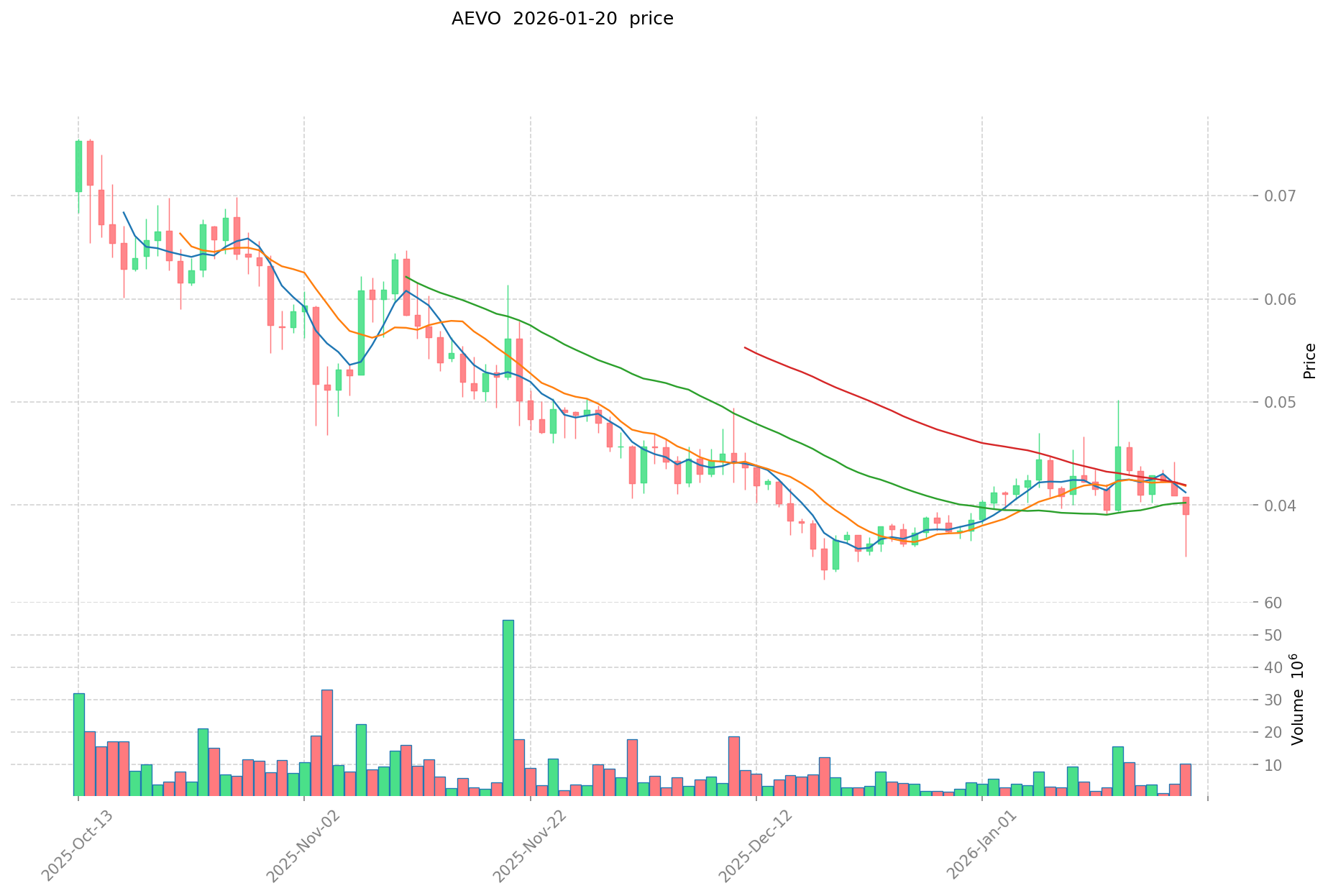
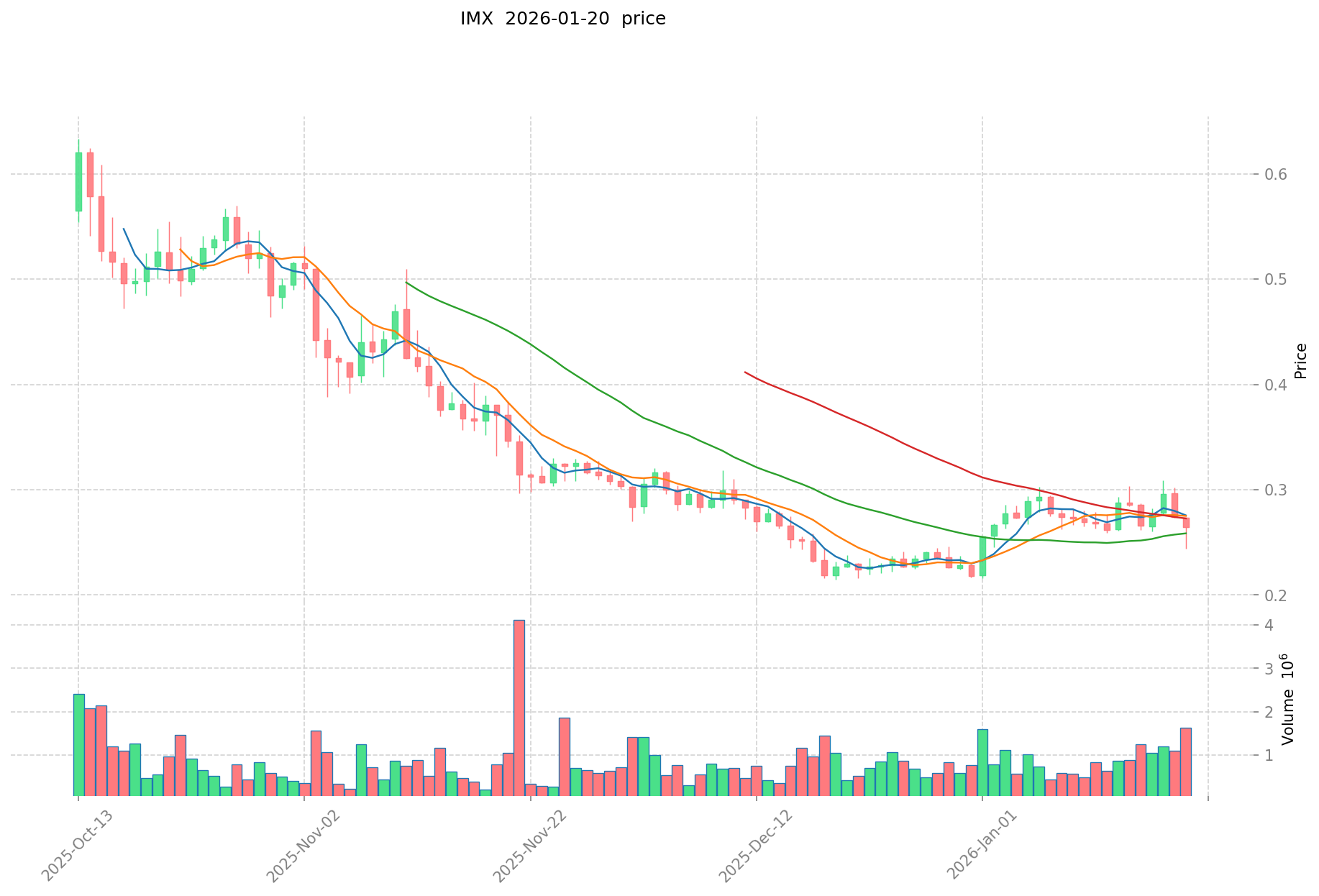
I. Historical Price Comparison and Current Market Status
- 2021: IMX experienced significant price movement, reaching a peak of 9.52 on November 26, 2021, influenced by its launch as a Layer 2 scaling solution for Ethereum NFTs.
- 2024: AEVO recorded a historical high of 4 on March 13, 2024, reflecting initial market enthusiasm for its decentralized derivatives exchange platform.
- 2025: Both assets faced downward pressure, with AEVO declining to its historical low of 0.01711 on October 10, 2025, and IMX reaching 0.215226 on December 19, 2025.
- Comparative Analysis: During the recent market cycle, AEVO dropped from its peak of 4 to 0.01711, representing a substantial decline. IMX similarly decreased from 9.52 to 0.215226, demonstrating vulnerability to broader market conditions.
Current Market Status (January 21, 2026)
- AEVO current price: 0.03694
- IMX current price: 0.2468
- 24-hour trading volume: AEVO recorded 89,396.98 compared to IMX's 356,020.06
- Market sentiment index (Fear & Greed Index): 32 (Fear)
- Recent price changes: AEVO decreased 5.5% over 24 hours, while IMX declined 5.04% in the same period
- Weekly performance: AEVO fell 13.65% over 7 days, with IMX showing a 13.16% decline
- Monthly trend: AEVO gained 5.51% over 30 days, while IMX increased 11.93%
- Annual performance: AEVO declined 87.16% year-over-year, with IMX decreasing 78.89%
View real-time prices:
II. Core Factors Affecting AEVO vs IMX Investment Value
Supply Mechanism Comparison (Tokenomics)
Due to insufficient data in the provided materials regarding the specific supply mechanisms of AEVO and IMX, this section cannot be completed with verified information.
Institutional Adoption and Market Application
Institutional Holdings: Current data does not provide sufficient information to compare institutional preference between AEVO and IMX.
Enterprise Adoption: Information regarding the application of AEVO and IMX in cross-border payments, settlements, and investment portfolios is not available in the provided materials.
National Policies: Specific regulatory attitudes of different countries toward AEVO and IMX are not covered in the reference materials.
Technical Development and Ecosystem Construction
AEVO Technical Upgrades: Detailed information about AEVO's technical upgrades and their potential impact is not available in the provided materials.
IMX Technical Development: Specific details regarding IMX's technical development and potential implications are not included in the reference materials.
Ecosystem Comparison: Comparative data on DeFi, NFT, payment solutions, and smart contract implementation for both AEVO and IMX is not available in the provided materials.
Macroeconomic Environment and Market Cycles
Performance in Inflationary Environment: The reference materials do not contain sufficient data to determine which asset demonstrates stronger anti-inflation characteristics.
Macroeconomic Monetary Policy: Specific analysis of how interest rates and the US Dollar Index affect AEVO and IMX is not available in the provided materials.
Geopolitical Factors: Information regarding cross-border transaction demand and international geopolitical influences on both assets is not included in the reference materials.
III. 2026-2031 Price Prediction: AEVO vs IMX
Short-term Forecast (2026)
- AEVO: Conservative $0.0189-$0.0370 | Optimistic $0.0370-$0.0526
- IMX: Conservative $0.168-$0.247 | Optimistic $0.247-$0.318
Medium-term Forecast (2028-2029)
- AEVO may enter a consolidation phase with estimated price range of $0.038-$0.075
- IMX may enter a growth phase with estimated price range of $0.253-$0.447
- Key drivers: institutional capital inflows, ETF developments, ecosystem expansion
Long-term Forecast (2030-2031)
- AEVO: Baseline scenario $0.035-$0.064 | Optimistic scenario $0.069-$0.101
- IMX: Baseline scenario $0.215-$0.520 | Optimistic scenario $0.447-$0.619
View detailed price predictions for AEVO and IMX
Disclaimer
AEVO:
| Year |
Predicted High Price |
Predicted Average Price |
Predicted Low Price |
Price Change |
| 2026 |
0.0525542 |
0.03701 |
0.0188751 |
0 |
| 2027 |
0.060903656 |
0.0447821 |
0.040751711 |
21 |
| 2028 |
0.05442816434 |
0.052842878 |
0.03804687216 |
43 |
| 2029 |
0.075089729638 |
0.05363552117 |
0.0423720617243 |
45 |
| 2030 |
0.07337339296056 |
0.064362625404 |
0.05342097908532 |
74 |
| 2031 |
0.100547293406128 |
0.06886800918228 |
0.035122684682962 |
86 |
IMX:
| Year |
Predicted High Price |
Predicted Average Price |
Predicted Low Price |
Price Change |
| 2026 |
0.318114 |
0.2466 |
0.167688 |
0 |
| 2027 |
0.42071193 |
0.282357 |
0.24000345 |
14 |
| 2028 |
0.43941808125 |
0.351534465 |
0.2531048148 |
42 |
| 2029 |
0.44688818863125 |
0.395476273125 |
0.3163810185 |
60 |
| 2030 |
0.619137879390843 |
0.421182230878125 |
0.214802937747843 |
70 |
| 2031 |
0.613788865058691 |
0.520160055134484 |
0.447337647415656 |
110 |
IV. Investment Strategy Comparison: AEVO vs IMX
Long-term vs Short-term Investment Strategies
- AEVO: May suit investors focused on decentralized derivatives trading platforms and emerging DeFi infrastructure, particularly those with higher risk tolerance given the asset's recent volatility and lower market capitalization positioning.
- IMX: May appeal to investors interested in NFT infrastructure and Layer-2 scaling solutions on Ethereum, particularly those seeking exposure to digital collectibles and gaming ecosystems with established market presence.
Risk Management and Asset Allocation
- Conservative investors: AEVO 20-30% vs IMX 70-80%
- Aggressive investors: AEVO 40-50% vs IMX 50-60%
- Hedging instruments: stablecoin allocation, options strategies, cross-asset portfolio diversification
V. Potential Risk Comparison
Market Risk
- AEVO: Faces substantial volatility risk as evidenced by an 87.16% year-over-year decline, with lower trading volumes potentially amplifying price movements during periods of market stress.
- IMX: Demonstrates correlation with broader market conditions, having experienced a 78.89% year-over-year decline, with price performance closely tied to NFT market sentiment and Ethereum ecosystem developments.
Technical Risk
- AEVO: Scalability considerations related to its Layer-2 infrastructure, network stability requirements for derivatives trading operations.
- IMX: Network congestion potential, security considerations inherent in Layer-2 solutions, dependency on Ethereum mainnet performance.
Regulatory Risk
- Global regulatory frameworks may impact both assets differently, with AEVO potentially facing scrutiny related to derivatives trading platforms, while IMX could be affected by regulations concerning NFT marketplaces and digital asset securities classifications.
VI. Conclusion: Which Is the Better Buy?
📌 Investment Value Summary:
- AEVO advantages: Positioned in the derivatives trading segment with potential for growth as decentralized finance infrastructure develops, currently trading at substantially lower price levels compared to historical peaks.
- IMX advantages: Established presence in NFT infrastructure with recognized Layer-2 scaling capabilities, relatively higher trading volumes indicating sustained market interest, demonstrated ecosystem partnerships.
✅ Investment Recommendations:
- New investors: Consider IMX for initial exposure given its more established market position and higher liquidity, while limiting allocation to 5-10% of overall crypto portfolio.
- Experienced investors: May explore a balanced approach with 30-40% IMX and 10-20% AEVO allocation within their crypto holdings, depending on risk appetite and conviction in respective sectors.
- Institutional investors: Conduct thorough due diligence on both assets' technical infrastructure, regulatory compliance frameworks, and ecosystem development roadmaps before considering allocation as part of diversified digital asset strategies.
⚠️ Risk Warning: The cryptocurrency market exhibits extreme volatility. This article does not constitute investment advice.
VII. FAQ
Q1: Which asset has better liquidity - AEVO or IMX?
IMX demonstrates superior liquidity. As of January 21, 2026, IMX records a 24-hour trading volume of $356,020.06 compared to AEVO's $89,396.98, representing approximately 4x higher trading activity. This higher liquidity indicates greater ease of entering and exiting positions with minimal price impact, making IMX more suitable for investors who prioritize trade execution efficiency and lower slippage costs.
Q2: What are the primary use cases that differentiate AEVO from IMX?
AEVO functions as a decentralized derivatives exchange specializing in options and perpetual trading, targeting sophisticated traders seeking leveraged exposure and hedging instruments. IMX operates as a Layer-2 scaling solution specifically designed for NFT minting and trading on Ethereum, offering instant transactions with zero gas fees. The fundamental difference lies in AEVO serving the derivatives trading market while IMX addresses NFT infrastructure scalability challenges.
Q3: How have AEVO and IMX performed during the recent market downturn?
Both assets experienced significant declines, though with different magnitudes. AEVO declined 87.16% year-over-year, dropping from its March 2024 peak of $4 to a historical low of $0.01711 in October 2025. IMX decreased 78.89% year-over-year, falling from its November 2021 high of $9.52 to $0.215226 in December 2025. While both assets remain vulnerable to broader market conditions, IMX has demonstrated relatively stronger price resilience compared to AEVO during this bearish cycle.
Q4: What is the recommended portfolio allocation strategy for AEVO vs IMX?
Conservative investors should consider a 20-30% AEVO and 70-80% IMX allocation within their cryptocurrency holdings, given IMX's more established market position and higher liquidity. Aggressive investors with higher risk tolerance may explore a 40-50% AEVO and 50-60% IMX split. However, both assets should represent only a portion of a diversified crypto portfolio (5-10% for beginners, up to 30-40% for experienced investors), with the remainder allocated to more established cryptocurrencies and stablecoins for risk management purposes.
Q5: Which asset offers better long-term growth potential through 2031?
IMX demonstrates more favorable long-term projections based on price forecasts. The optimistic scenario for IMX suggests potential growth to $0.520-$0.619 by 2031 (approximately 110% increase from current levels), while AEVO's optimistic forecast indicates $0.069-$0.101 (approximately 86% increase). IMX's advantage stems from its established ecosystem within the growing NFT and gaming sectors, higher trading volumes, and proven Layer-2 infrastructure, whereas AEVO remains in an earlier developmental stage within the derivatives trading segment.
Q6: What are the major risk factors investors should consider for each asset?
AEVO faces substantial volatility risk due to lower liquidity, with an 87.16% year-over-year decline demonstrating extreme price fluctuations. Technical risks include scalability challenges in its Layer-2 derivatives infrastructure and potential regulatory scrutiny of decentralized derivatives platforms. IMX encounters market risk through high correlation with NFT market sentiment and Ethereum ecosystem performance, demonstrated by its 78.89% annual decline. Technical considerations include potential network congestion and security vulnerabilities inherent in Layer-2 solutions, alongside regulatory uncertainty surrounding NFT marketplaces and digital asset classification.
Q7: How does the current market sentiment (Fear & Greed Index at 32) affect investment decisions for AEVO and IMX?
The Fear & Greed Index reading of 32 indicates "Fear" conditions in the cryptocurrency market, historically associated with potential accumulation opportunities for long-term investors. Both AEVO and IMX have experienced short-term declines (5.5% and 5.04% respectively over 24 hours), reflecting this fearful sentiment. Contrarian investors may view current conditions as favorable entry points, particularly for IMX given its more established market position. However, fearful market conditions also increase downside risk, making proper position sizing and risk management essential. Dollar-cost averaging strategies may be more appropriate than lump-sum investments during such periods of elevated market uncertainty.
* The information is not intended to be and does not constitute financial advice or any other recommendation of any sort offered or endorsed by Gate.