# Article Overview: ASI vs SOL - Blockchain Networks Comparison
This comprehensive guide compares Sender AI (ASI) and Solana (SOL), two major cryptocurrency assets with distinct market positions and investment profiles. The article analyzes historical price performance, tokenomics, institutional adoption, and technological ecosystems to address the critical question: "Which is the better buy?" Through detailed price forecasts through 2031, risk assessments, and tailored investment strategies, this resource serves investors of all experience levels—from beginners seeking stable exposure through SOL to experienced traders exploring ASI's high-growth potential. Whether evaluating DeFi infrastructure maturity against emerging AI-blockchain integration, readers gain actionable insights on portfolio allocation, risk management, and long-term value drivers. Access real-time pricing data and market analysis on Gate to support informed investment decisions in these dynamic blockchain ecosystems.
Introduction: ASI vs SOL Investment Comparison
In the cryptocurrency market, the comparison between Sender AI (ASI) and Solana (SOL) is an important consideration for investors. The two assets differ significantly in market capitalization ranking, application scenarios, and price performance, representing different positioning within the crypto asset landscape.
Sender AI (ASI): Launched in late 2024, it has gained market recognition by focusing on building an AI and Web3 integrated, AI-centric decentralized transaction execution network that bridges AI Agents into the blockchain ecosystem architecture.
Solana (SOL): Since its founding at the end of 2017 by former engineers from Qualcomm, Intel and Dropbox, it has been recognized as a high-performance blockchain protocol that emphasizes scalability without compromising decentralization or security, establishing itself as one of the most actively traded cryptocurrencies globally.
This article will conduct a comprehensive analysis of ASI vs SOL through historical price performance, supply mechanics, market adoption, technical ecosystems and future outlook, addressing the key question that concerns investors most:
"Which is the better buy right now?"
I. Price History Comparison and Current Market Status
Sender AI (ASI) and Solana (SOL) Historical Price Trends
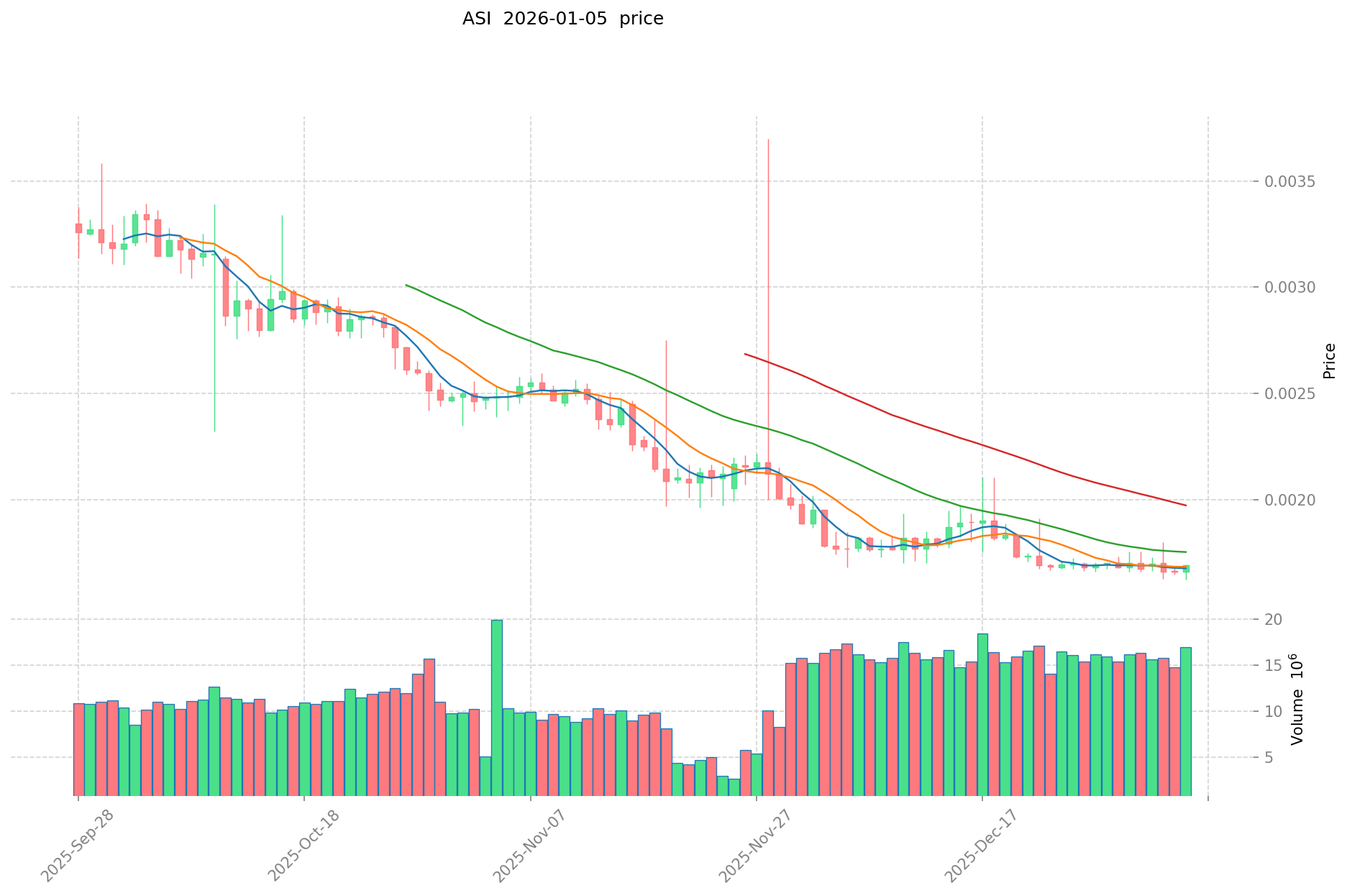
- November 2024: ASI reached its all-time high of $0.16461 on November 21, 2024, driven by market enthusiasm for AI-integrated blockchain projects.
- January 2026: ASI hit its all-time low of $0.001622 on January 4, 2026, reflecting significant market correction in the AI narrative segment.
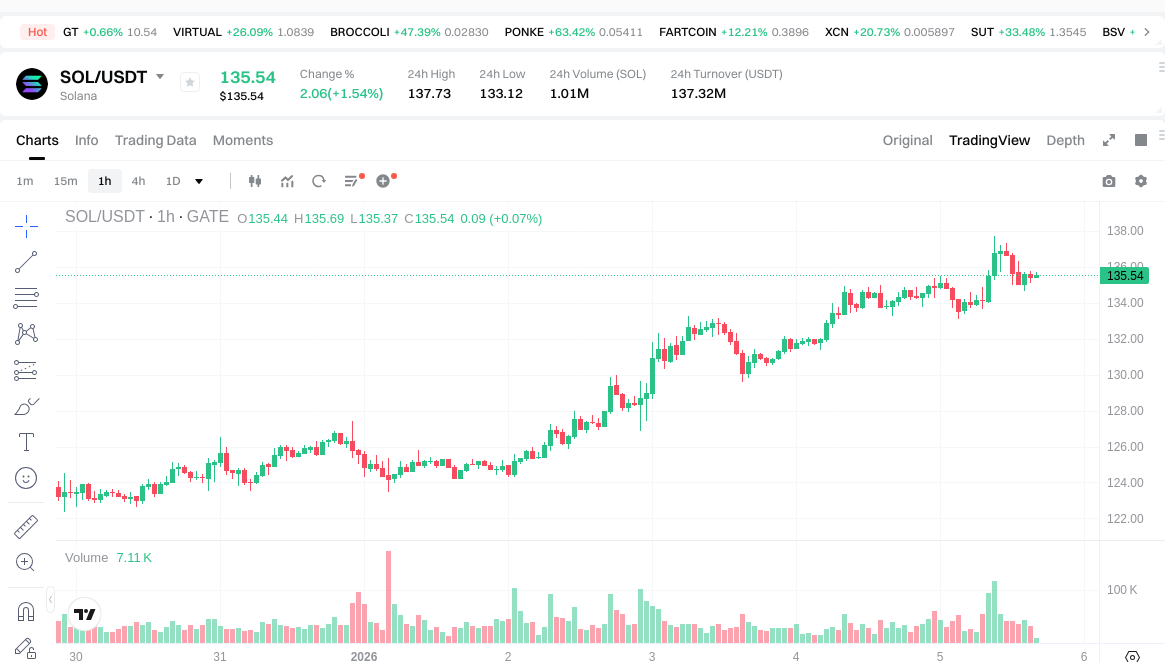
- January 2026: SOL reached its all-time high of $293.31 on January 19, 2025, demonstrating strong institutional adoption and ecosystem development.
- Comparative Analysis: In the past 12 months, ASI declined 97.55% from its peak, while SOL experienced a -37.38% yearly change, indicating substantially greater volatility in ASI compared to the more established Solana network.
Current Market Status (January 5, 2026)
- ASI current price: $0.001665
- SOL current price: $135.49
- 24-hour trading volume: ASI $27,449.20 vs SOL $137,419,711.42
- Market Sentiment Index (Fear & Greed Index): 26 (Fear)
Click to view real-time prices:
二、影响 ASI vs SOL 投资价值的核心因素
I. Supply Mechanism Comparison (Tokenomics)
-
SOL: Solana's native token features a dynamic inflation model with annual inflation rate declining over time. The network implements a deflationary mechanism through transaction fee burning, which contributes to supply reduction. SOL plays critical roles in transaction fees, security, and governance while supporting various dApps and service platforms.
-
ASI: Sender AI Network integrates AI with Web3 seamlessly, focusing on building an AI-driven decentralized trading execution network. ASI represents the pioneering application of AI agents within blockchain ecosystem architecture, though specific tokenomic details regarding supply mechanisms are limited in current market documentation.
-
📌 Historical patterns: Supply mechanisms influence price cycles through the balance between inflation dilution and deflationary mechanisms, with network utility directly affecting long-term token value trajectories.
II. Institutional Adoption and Market Application
-
Institutional holdings: SOL has established stronger institutional recognition within the decentralized finance ecosystem, with growing acceptance among traditional investment managers. ASI, as an emerging AI-focused token, represents a newer entry with evolving institutional interest tied to AI infrastructure expansion.
-
Enterprise adoption: SOL's ecosystem supports extensive dApp integration, payment processing, and settlement mechanisms through low transaction costs and high throughput. ASI targets AI agent execution and autonomous trading infrastructure, focusing on institutional-grade trading execution rather than traditional payment channels.
-
Regulatory stance: SOL has established regulatory frameworks across multiple jurisdictions given its maturity and market presence. ASI operates within evolving regulatory environments specific to AI-driven financial infrastructure, with regulatory clarity continuing to develop as decentralized AI platforms mature.
III. Technology Development and Ecosystem Construction
-
SOL technical development: Solana maintains focus on transaction throughput optimization and network stability improvements. The ecosystem continues expanding DeFi protocols, NFT marketplaces, and developer infrastructure. Solana's annual conference planned for September 2026 signals continued ecosystem momentum.
-
ASI technical advancement: Sender AI Network emphasizes AI agent integration with blockchain execution layers, enabling autonomous trading and decentralized decision-making at infrastructure level. The ASI coalition framework represents collaborative development among multiple AI and crypto projects.
-
Ecosystem comparison: SOL demonstrates mature development across DeFi, gaming, NFTs, and payment solutions with established developer communities. ASI operates within an emerging ecosystem focused on AI agent coordination, autonomous trading execution, and decentralized AI infrastructure development.
IV. Macroeconomic Environment and Market Cycles
-
Inflation environment performance: SOL exhibits characteristics as a productive digital asset with network utility that increases during periods of monetary expansion. ASI's value proposition centers on AI infrastructure adoption, which may benefit from technological investment cycles independent of traditional inflation dynamics.
-
Monetary policy implications: SOL's network activity and transaction demand remain sensitive to interest rate environments and risk sentiment shifts. Higher rates typically increase opportunity costs for speculative assets, while ASI's performance may correlate more directly with enterprise software and infrastructure spending patterns.
-
Geopolitical factors: SOL's decentralized nature supports cross-border transactions with reduced regulatory friction, offering value during periods of international capital mobility restrictions. ASI's AI infrastructure focus positions it for adoption in jurisdictions emphasizing technological sovereignty and domestic AI development initiatives.
III. 2026-2031 Price Forecast: ASI vs SOL
Short-term Forecast (2026)
- ASI: Conservative $0.000984-$0.001668 | Optimistic $0.001668-$0.002202
- SOL: Conservative $119.39-$135.67 | Optimistic $135.67-$185.87
Mid-term Forecast (2027-2029)
- ASI may enter growth consolidation phase, with projected price range of $0.001529-$0.003409
- SOL may enter moderate expansion phase, with projected price range of $86.82-$234.73
- Key drivers: institutional capital inflows, ETF adoption, ecosystem development
Long-term Forecast (2030-2031)
- ASI: Base case $0.001833-$0.003222 | Optimistic scenario $0.003580-$0.004414
- SOL: Base case $189.63-$237.60 | Optimistic scenario $252.10-$316.01
View detailed price forecasts for ASI and SOL
ASI:
| 年份 |
预测最高价 |
预测平均价格 |
预测最低价 |
涨跌幅 |
| 2026 |
0.00220176 |
0.001668 |
0.00098412 |
0 |
| 2027 |
0.0023799024 |
0.00193488 |
0.0015285552 |
16 |
| 2028 |
0.00248099988 |
0.0021573912 |
0.002006373816 |
29 |
| 2029 |
0.0034092174438 |
0.00231919554 |
0.0016002449226 |
39 |
| 2030 |
0.003580258114875 |
0.0028642064919 |
0.001833092154816 |
72 |
| 2031 |
0.00441445825564 |
0.003222232303387 |
0.002610008165743 |
93 |
SOL:
| 年份 |
预测最高价 |
预测平均价格 |
预测最低价 |
涨跌幅 |
| 2026 |
185.8679 |
135.67 |
119.3896 |
0 |
| 2027 |
196.138119 |
160.76895 |
86.815233 |
18 |
| 2028 |
244.481342265 |
178.4535345 |
164.17725174 |
31 |
| 2029 |
234.728856604575 |
211.4674383825 |
124.765788645675 |
56 |
| 2030 |
252.100906667697375 |
223.0981474935375 |
189.633425369506875 |
64 |
| 2031 |
316.007371017221191 |
237.599527080617437 |
199.583602747718647 |
75 |
四、投资策略对比:ASI vs SOL
长期 vs 短期投资策略
- ASI:适合关注AI基础设施发展、寻求高风险高收益的投资者,以及对区块链与人工智能融合应用持乐观态度的参与者
- SOL:适合寻求相对稳定收益、看好高性能公链生态发展、关注DeFi和支付场景应用的投资者
风险管理与资产配置
- 保守型投资者:ASI 5% vs SOL 95%
- 激进型投资者:ASI 30% vs SOL 70%
- 对冲工具:稳定币配置占总资产20-30%、期权组合用于下行保护、跨币种组合分散单一资产风险
五、潜在风险对比
市场风险
- ASI:作为新兴项目,历史价格波动剧烈(12个月跌幅97.55%),市场流动性相对较低(日交易量约2.7万美元),存在极高的价格波动风险和流动性风险
- SOL:市场认可度更高,但同样受加密资产市场周期影响,12个月跌幅37.38%,机构持仓集中可能导致价格剧烈波动
技术风险
- ASI:AI与区块链融合技术仍处早期阶段,AI agent执行机制的安全性和稳定性需要进一步验证,生态发展不成熟
- SOL:网络稳定性已得到市场验证,但历史上曾出现过网络中断事件,需持续关注验证者节点集中度问题
监管风险
- ASI:作为AI驱动的金融基础设施,面临多个司法管辖区对去中心化自主交易执行的监管不确定性,规制框架仍在演变过程中
- SOL:已在多个主要司法管辖区建立较完善的监管框架,但仍需关注全球加密资产监管政策变化及其对高性能公链的具体影响
六、结论:Which Is the Better Buy?
📌 投资价值总结:
- ASI优势:代表AI与Web3融合的新兴方向,市场渗透空间广阔;预测收益率高(2031年相对2026年上涨93%);处于极早期阶段,具有潜在的风险-收益极值特征
- SOL优势:拥有成熟的生态体系和制度化机构认可;DeFi、NFT、支付等应用场景已充分验证;相对稳定的价格表现和充足的市场流动性;2031年预测收益率达75%,同时风险更可控
✅ 投资建议:
- 新手投资者:优先配置SOL为主(占比85-95%),若有风险承受能力可小额配置ASI(占比5-15%)作为高风险敞口
- 有经验投资者:根据对AI基础设施前景的判断灵活配置,建议ASI与SOL比例为20:80至40:60,配合稳定币进行定期风险管理和再平衡
- 机构投资者:SOL作为配置主线(占比70-80%),ASI作为战略性押注(占比10-20%),并通过衍生品工具进行对冲,密切监测AI规制政策动向
⚠️ 风险提示:加密货币市场波动性极高,本文不构成投资建议。
FAQ
ASI和SOL分别是什么?各自的主要用途是什么?
ASI是人工超级智能代币,代表超越人类智能的AI系统,用于AI生态激励。SOL是Solana网络原生代币,主要用于支付交易费、质押获得奖励及治理投票。两者分别代表AI和区块链领域的核心资产。
ASI和SOL在技术架构和性能上有什么区别?
ASI侧重于去中心化AI基础设施和代理互操作性,采用uAgents框架和即将推出的高性能ASI链;SOL则在Solana生态上构建AI代理应用。ASI强调开放标准和跨链兼容性,SOL专注于链上自主代理的可扩展性和速度。两者都推进区块链AI融合,但ASI更强调基础设施层,SOL更聚焦应用层。
ASI和SOL的生态应用场景分别有哪些?
ASI主要应用于人工智能训练和数据处理领域。SOL生态涵盖DeFi交易、DEX、借贷、游戏、NFT、预言机、去中心化存储等多个应用场景,生态项目丰富完整。
从投资角度看,ASI和SOL哪个更值得关注?
ASI市值排名靠前,长期潜力突出;SOL生态应用广泛,交易额活跃。ASI未上主流交易所存风险,SOL基础扎实增长稳健。根据风险偏好选择,或两者配置。
ASI和SOL各自面临的主要风险是什么?
ASI主要风险是市场接受度有限、技术迭代竞争激烈。SOL主要风险包括价格波动剧烈、网络拥堵问题、生态项目风险等。两者都面临监管政策变化的不确定性。
ASI和SOL的市场流动性和交易额对比如何?
ASI和SOL市场流动性均较高,交易对众多。SOL市场活跃度更强,交易额庞大。ASI交易工具完善,稳定性优异,流动性进出快速,经过长期压力测试验证。两者各具优势,SOL注重活跃度,ASI强调稳定性。
ASI和SOL未来的发展前景分别是什么?
ASI有望通过去中心化AI基础设施建设实现增长,赋能人工智能应用。SOL则在区块链扩展和生态应用中持续进展,前景广阔。两者各具竞争力。
* The information is not intended to be and does not constitute financial advice or any other recommendation of any sort offered or endorsed by Gate.