This comprehensive Bitcoin price forecast analyzes BTC's current $91,400 level amid competing liquidity risks and constructive technical signals. The article examines Robert Kiyosaki's warnings about a global financial reset driven by yen carry trade unwinding, which mechanically removes liquidity from risk assets including Bitcoin. Despite macro headwinds from Japan's policy shift and US funding market tightening, Bitcoin's technical structure shows encouraging recovery patterns from the $81,028 support level. Key resistance at the 20-day EMA ($92,800) and Fibonacci targets at $98,279, $103,574, and $108,753 provide actionable trading levels. The analysis suggests Bitcoin faces near-term deleveraging pressure but maintains long-term opportunity as a non-sovereign alternative asset during potential financial instability. Traders should respect risk management while positioning for potential recovery with clear invalidation levels below $86,000.
Bitcoin Price Prediction
Bitcoin has demonstrated notable resilience in recent trading sessions, with prices hovering around the $91,400 level, marking an increase of over 0.80% in recent price action. This recovery comes as traders carefully evaluate two competing forces: renewed liquidity risks spreading across global financial markets and increasingly constructive technical signals emerging from the charts.
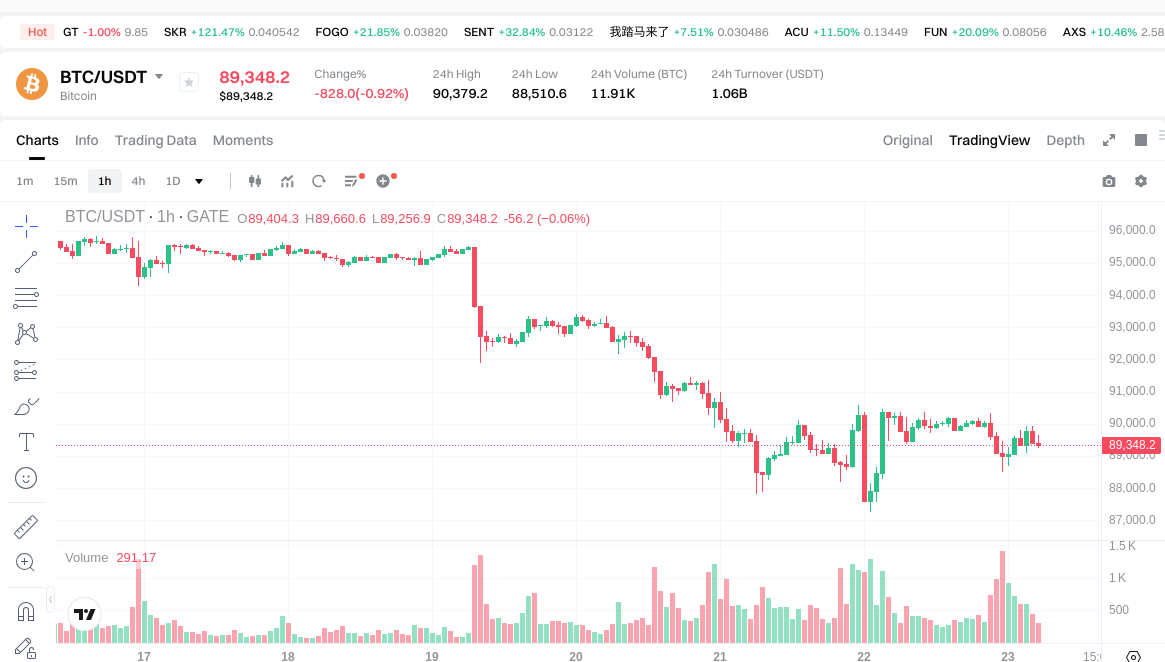
With a market capitalization standing at approximately $1.82 trillion and nearly 20 million BTC currently in circulation, Bitcoin remains firmly positioned at the center of macroeconomic debate. The digital asset's role as both a risk asset and potential safe haven has drawn renewed attention, particularly following fresh warnings from prominent financial commentator Robert Kiyosaki about an impending financial reset.
The current market environment presents a complex picture for Bitcoin investors. On one hand, improving technical indicators suggest the worst of the recent correction may be behind us. On the other hand, structural liquidity challenges in traditional markets—particularly stemming from Japan's shifting monetary policy and tightening conditions in US funding markets—continue to cast uncertainty over risk assets broadly. This tension between technical recovery and macro headwinds makes the current juncture particularly critical for Bitcoin's near-term trajectory.
Kiyosaki Flags Liquidity Shock
Robert Kiyosaki, the bestselling author of "Rich Dad Poor Dad" and longtime advocate for alternative assets, has once again issued stark warnings about what he perceives as a brewing global financial crisis. His latest alert arrives at a particularly sensitive moment, as financial markets worldwide grapple with what analysts have termed a "two-front liquidity squeeze"—pressure emanating simultaneously from Japan's evolving fiscal stance and increasingly restrictive conditions in US money markets.
Kiyosaki has built his reputation on advocating for Bitcoin and precious metals as hedges against monetary debasement and fiscal mismanagement. However, his current warnings carry added weight because the forces now pressuring risk assets extend beyond philosophical concerns about currency devaluation. Instead, they reflect mechanical processes actively draining liquidity from the global financial system.
The author's perspective resonates with a growing chorus of market observers who note that this liquidity withdrawal differs fundamentally from previous cycles. Rather than resulting primarily from central bank policy tightening, the current pressure stems from structural unwinding of leveraged positions built up over years of ultra-loose monetary conditions. This distinction matters because mechanical deleveraging tends to be more abrupt and less responsive to policy interventions than traditional monetary tightening.
For Bitcoin specifically, Kiyosaki's framework suggests the asset faces a near-term challenge but potentially significant long-term opportunity. In the immediate term, any broad-based liquidity crunch typically pressures all risk assets, including cryptocurrencies. However, if the crisis deepens as Kiyosaki anticipates, Bitcoin's characteristics as a decentralized, non-sovereign asset could position it as an attractive alternative to traditional stores of value.
Yen Unwind Creates Global Pressure
Japan's recent policy pivot represents one of the most significant shifts in global monetary conditions in years, with far-reaching implications for markets worldwide, including Bitcoin. After decades of ultra-accommodative policy, Japanese authorities have begun allowing government bond yields to rise while simultaneously increasing fiscal spending. This combination has accelerated yen weakness and triggered a cascade of consequences across international markets.
The mechanism driving this pressure centers on the unwinding of yen carry trades—a strategy that has been a cornerstone of global finance for over a decade. In these trades, investors borrowed yen at near-zero interest rates, converted the funds to other currencies, and invested in higher-yielding assets worldwide. This flow of capital helped inflate valuations across equities, bonds, real estate, and cryptocurrencies globally. Estimates suggest hundreds of billions of dollars were deployed through these strategies at their peak.
As the yen weakens and Japanese yields rise, these carry trades become increasingly untenable. Investors must now reverse their positions: selling foreign assets, buying back yen to repay loans, and accepting losses on currency movements. This unwinding process mechanically removes liquidity from global markets, regardless of fundamental conditions in individual assets or sectors. The pressure is particularly acute for leveraged positions, which face margin calls and forced liquidations.
For Bitcoin, this dynamic presents a complex picture. In the near term, the liquidity drain creates headwinds as leveraged crypto positions face pressure alongside other risk assets. Trading volumes thin, volatility spikes, and prices can decline even absent any Bitcoin-specific negative news. However, the longer-term implications may be more constructive. As the unwind exposes vulnerabilities in traditional financial structures and sovereign debt sustainability, Bitcoin's proposition as a decentralized alternative strengthens.
Historically, Bitcoin has shown resilience after initial liquidity shocks, often recovering more quickly than traditional assets once the acute deleveraging phase passes. The current situation may follow a similar pattern: near-term pressure as positions unwind, followed by renewed interest as investors seek assets outside the traditional financial system. The key question is whether Bitcoin can maintain critical support levels during the deleveraging phase.
Bitcoin Technical Outlook Turns Constructive
Despite the challenging macroeconomic backdrop, Bitcoin's technical structure has shown encouraging signs of stabilization and potential recovery. The most significant development has been the strong bounce from the $81,028 support level, an area that has consistently served as a higher-timeframe demand zone since mid-2024. This level's repeated defense suggests substantial buying interest and accumulation in this price range.
The daily chart reveals a textbook bullish reaction pattern at this support zone. Long lower wicks on candlesticks indicate strong rejection of lower prices, while follow-through buying in subsequent sessions confirms genuine demand rather than mere short-covering. This price action represents the first meaningful structural improvement in several weeks and suggests the correction that began in November may be reaching exhaustion.
Bitcoin is currently testing a critical resistance level at the 20-day Exponential Moving Average (EMA), positioned around $92,800. This moving average, which previously acted as dynamic support during the uptrend, shifted to resistance following November's breakdown. A decisive close above this level—ideally accompanied by strong volume—would mark an important shift in market structure and potentially trigger additional buying from momentum traders and systematic strategies.
Momentum indicators are also showing improvement. The Relative Strength Index (RSI) has climbed from oversold territory at 32 to a more neutral 41, consistent with early-stage recovery dynamics. This movement suggests selling pressure has diminished without yet reaching overbought conditions that might indicate an unsustainable rally. The RSI's trajectory suggests room for further upside before momentum becomes stretched.
The broader chart structure hints at a potential "rounded retest" pattern developing. In this scenario, Bitcoin would pull back modestly from current levels toward the $88,000-$89,000 range, establish a higher low above the recent $81,028 bottom, and then launch a more sustained rally. This pattern would confirm that the recent low represents a genuine bottom rather than a temporary pause in a larger downtrend.
Key Fibonacci retracement levels provide additional guidance for potential price targets. The 0.382 retracement of the recent decline sits at $98,279, representing the first major resistance zone. A reclaim of this level would open the door to the 0.5 retracement at $103,574 and the 0.618 retracement at $108,753. These levels align with previous support-turned-resistance zones and likely areas of supply.
A breakout above $108,753 would carry particularly significant implications, as it would represent a complete reversal of the recent correction and flip the broader trend from bearish to bullish. Such a move would likely trigger stops from remaining short positions and attract fresh capital from momentum strategies, potentially setting up a run toward psychological resistance at $115,000 in the coming months.
Bitcoin Outlook and Trade Setup
For traders and investors looking to position for Bitcoin's potential recovery, the current technical setup offers relatively clear entry and risk parameters. The cleanest setup appears to be a confirmed daily close above the 20-day EMA at $92,800, ideally supported by the formation of a higher low in the $88,000-$89,500 range. This structure would confirm both improved momentum and a shift in market structure.
Risk management remains crucial in the current environment. A logical invalidation level sits below $86,000, just under the recent swing low. A break below this level would suggest the bounce from $81,028 was merely a lower high in an ongoing downtrend rather than the start of a new rally. Position sizing should account for this downside risk while allowing for meaningful participation in potential upside.
Upside targets extend toward the Fibonacci retracement levels outlined earlier: $98,279 as the initial target, followed by $103,574 and $108,753 as the correction fully retraces. These levels provide natural profit-taking zones and areas to reassess the strength of the recovery. Traders might consider scaling out of positions at these levels while maintaining core exposure for a potential run toward $115,000.
Beyond Bitcoin itself, improving sentiment in the flagship cryptocurrency often spills over into the broader digital asset ecosystem. Alternative cryptocurrencies and emerging blockchain projects tend to outperform during the later stages of Bitcoin rallies, as investors rotate profits into higher-risk, higher-potential-return opportunities. However, selectivity remains important—projects with genuine utility, strong communities, and clear value propositions are likely to outperform those based purely on speculation.
The current juncture represents a critical decision point for Bitcoin. The technical setup suggests potential for a meaningful rally if key resistance levels can be reclaimed. However, macro headwinds from the yen unwind and broader liquidity concerns mean this recovery is far from guaranteed. Traders should remain flexible, respect their risk parameters, and be prepared to adjust positions as the situation evolves. The coming weeks will likely determine whether Bitcoin's bounce from $81,028 marks the start of a new leg higher or merely a pause before further downside.
FAQ
What is Robert Kiyosaki's rationale for warning of a Bitcoin price crash?
Robert Kiyosaki's crash warning centers on the Japanese Yen unwind potentially triggering a major liquidity event. He argues that unwinding carry trades funded in Yen could force forced liquidations across markets, including Bitcoin, creating downward pressure on BTC prices as investors deleveraged positions.
What is the Yen Unwind and how does it impact Bitcoin and the cryptocurrency market?
Yen Unwind refers to unwinding carry trades funded in Japanese yen. When yen strengthens, traders close positions, triggering liquidity events. This volatility can spike Bitcoin and crypto prices as investors seek alternative assets during market dislocations and currency fluctuations.
Will the yen appreciation event bring liquidity opportunities for Bitcoin? Why?
Yes. Yen appreciation typically triggers carry trade unwinding, forcing investors to liquidate assets globally. This creates significant Bitcoin buying opportunities as liquidity floods into safe-haven digital assets, potentially driving substantial price appreciation.
How important are macroeconomic factors (such as exchange rate changes and interest rate adjustments) in Bitcoin price predictions?
Macroeconomic factors are critically important for BTC price movements. Currency fluctuations, particularly yen unwinding, directly impact liquidity flows. Interest rate adjustments affect capital allocation and risk appetite. These factors create major volatility catalysts, making them essential indicators for predicting Bitcoin price trends and market cycles.
What are the major global liquidity events in history that significantly impacted Bitcoin price?
2008 financial crisis sparked Bitcoin's creation. 2020 COVID crash caused BTC volatility before recovery. 2022 Fed rate hikes triggered crypto downturn. Yen unwinding events create sudden market liquidity shifts affecting BTC valuations significantly.
* The information is not intended to be and does not constitute financial advice or any other recommendation of any sort offered or endorsed by Gate.