This comprehensive analysis compares ELA and KAVA, two emerging blockchain platforms with distinct market positioning. ELA, launched in 2018, focuses on Web 3.0 infrastructure and decentralized SmartWeb development, while KAVA, since 2019, operates as a cross-chain DeFi platform providing collateralized lending and stablecoin services. The article examines historical price trends, current market status on Gate, tokenomics, institutional adoption, and technical ecosystems to evaluate investment value. Price forecasts for 2026-2031 suggest differentiated growth trajectories for both assets, with ELA potentially reaching $1.827 and KAVA $0.145 by 2031 under optimistic scenarios. Investment strategies vary by risk tolerance: conservative investors may allocate 30% ELA and 20% KAVA, while aggressive investors explore higher exposure ratios. Both assets present distinct risks including market volatility, technical complexity, and regulatory uncertainty, requiring careful due diligence before investment decisions.
Introduction: Investment Comparison Between ELA and KAVA
In the cryptocurrency market, the comparison between ELA vs KAVA has consistently been a focal point for investors. These two assets differ significantly in market capitalization ranking, application scenarios, and price performance, representing distinct positioning within the crypto asset landscape.
Elastos (ELA): Launched in 2018, it has garnered market recognition through its positioning as a next-generation Web 3.0 platform focused on building a decentralized intelligent SmartWeb based on blockchain technology.
Kava (KAVA): Since its debut in 2019, it has been recognized as a cross-chain decentralized financial platform providing collateralized lending and stablecoin services for mainstream digital assets, establishing itself as one of the notable DeFi infrastructure projects.
This article will comprehensively analyze the investment value comparison of ELA vs KAVA through historical price trends, supply mechanisms, institutional adoption, technical ecosystems, and future predictions, attempting to address the question investors care about most:
"Which is the better buy right now?"
I. Price History Comparison and Market Status
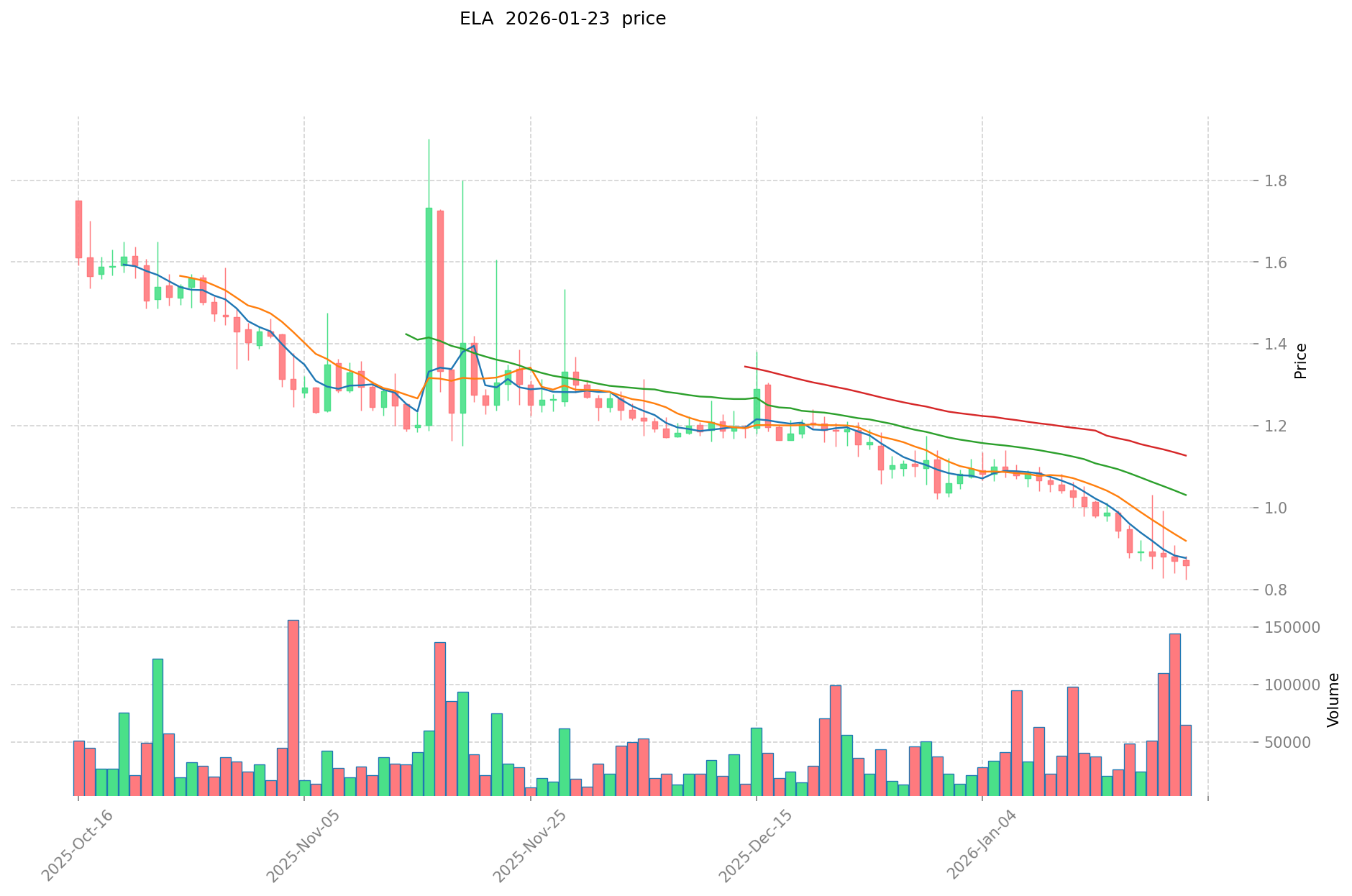
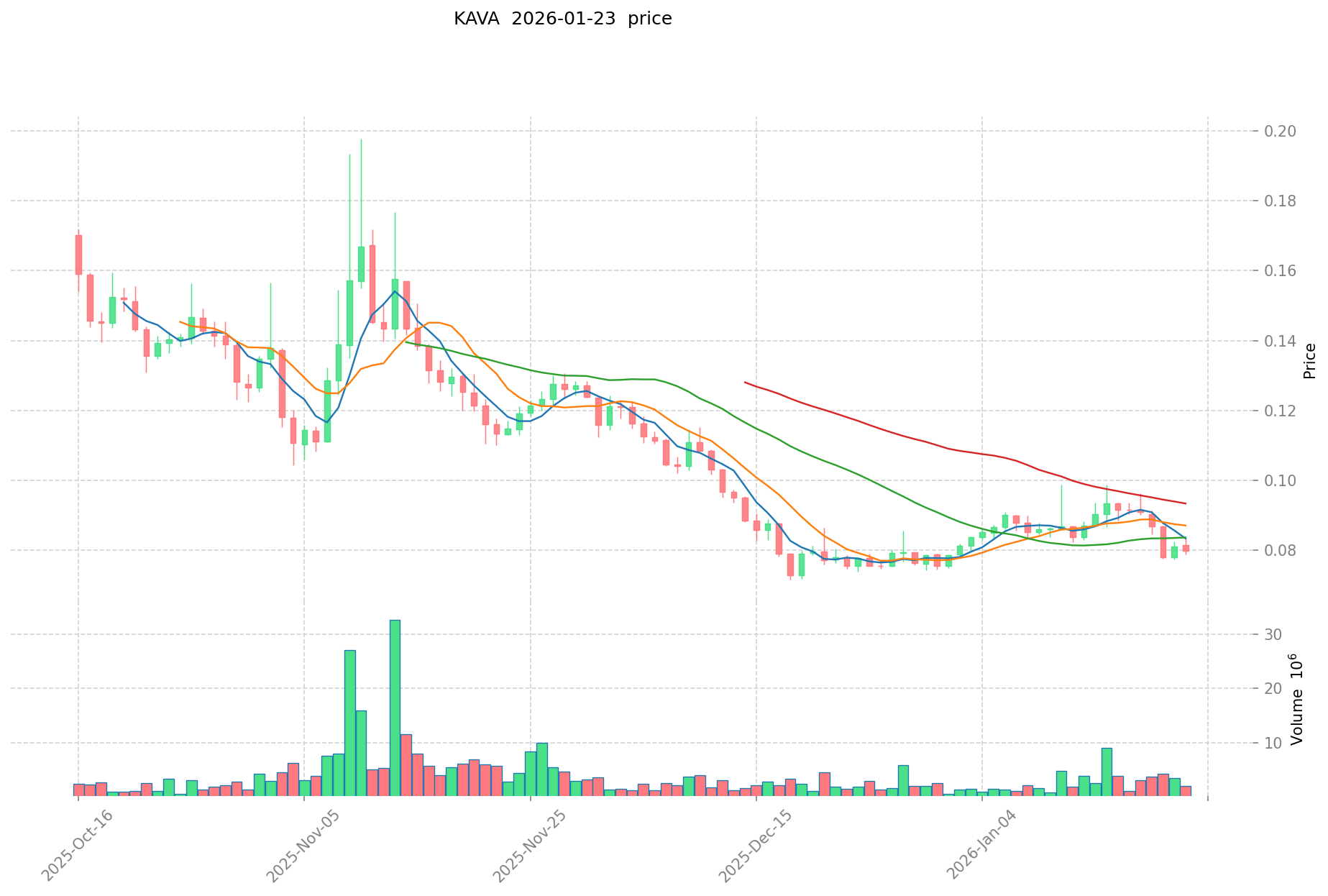
Historical Price Trends of ELA (Coin A) and KAVA (Coin B)
- 2018: ELA reached a notable price level of $89.14 on February 24, experiencing significant volatility during this period.
- 2021: KAVA attained a peak price of $9.12 on August 30, reflecting strong market interest in cross-chain DeFi infrastructure.
- 2023: ELA recorded a low point of $0.793867 on January 8, representing a substantial decline from previous levels.
- 2025: KAVA established a low point of $0.071579 on December 19, marking a notable decrease in valuation.
- Comparative analysis: Over the market cycle, ELA declined from $89.14 to $0.793867, while KAVA decreased from $9.12 to $0.071579, with both assets experiencing considerable downward pressure.
Current Market Status (January 23, 2026)
- ELA current price: $0.859
- KAVA current price: $0.08076
- 24-hour trading volume: ELA $55,175.06 vs KAVA $159,068.49
- Market sentiment index (Fear & Greed Index): 24 (Extreme Fear)
View real-time prices:
II. Core Factors Influencing ELA vs KAVA Investment Value
Supply Mechanism Comparison (Tokenomics)
Due to the absence of detailed supply mechanism information in the provided materials, a comprehensive comparison of the tokenomics models for ELA and KAVA cannot be established at this time.
Institutional Adoption and Market Application
Without specific data on institutional holdings, enterprise adoption patterns, or regulatory stances across different jurisdictions for either ELA or KAVA, a substantive analysis of their comparative market positioning cannot be provided.
Technology Development and Ecosystem Building
The provided materials do not contain sufficient information regarding technical upgrades, ecosystem developments, or comparative analysis of DeFi, NFT, payment systems, or smart contract implementations for either project.
Macroeconomic Conditions and Market Cycles
In the absence of historical performance data under various macroeconomic conditions, comparative analysis of inflation-hedging properties, responses to monetary policy shifts, or geopolitical factors for ELA and KAVA cannot be conclusively determined.
III. 2026-2031 Price Forecast: ELA vs KAVA
Short-term Forecast (2026)
- ELA: Conservative $0.627-$0.859 | Optimistic $0.859-$1.100
- KAVA: Conservative $0.050-$0.081 | Optimistic $0.081-$0.091
Mid-term Forecast (2028-2029)
- ELA may enter a growth phase with projected price range of $0.945-$1.360 in 2028, potentially reaching $1.091-$1.775 by 2029
- KAVA may experience moderate expansion with projected price range of $0.082-$0.146 in 2028, and $0.098-$0.143 by 2029
- Key drivers: institutional capital flows, ETF developments, ecosystem expansion
Long-term Forecast (2030-2031)
- ELA: Baseline scenario $1.100-$1.487 (2030) | Optimistic scenario $1.287-$1.827 (2031)
- KAVA: Baseline scenario $0.110-$0.134 (2030) | Optimistic scenario $0.070-$0.145 (2031)
View detailed price predictions for ELA and KAVA
Disclaimer: Price forecasts are based on historical data analysis and market trend modeling. Cryptocurrency markets are highly volatile and subject to numerous unpredictable factors. These projections should not be considered as investment advice, and actual prices may differ significantly from predictions.
ELA:
| Year |
Predicted High Price |
Predicted Average Price |
Predicted Low Price |
Price Change |
| 2026 |
1.099776 |
0.8592 |
0.627216 |
0 |
| 2027 |
1.09702656 |
0.979488 |
0.62687232 |
13 |
| 2028 |
1.3601170368 |
1.03825728 |
0.9448141248 |
20 |
| 2029 |
1.774796994432 |
1.1991871584 |
1.091260314144 |
39 |
| 2030 |
1.99256938239744 |
1.486992076416 |
1.10037413654784 |
72 |
| 2031 |
1.826769765877056 |
1.73978072940672 |
1.287437739760972 |
102 |
KAVA:
| Year |
Predicted High Price |
Predicted Average Price |
Predicted Low Price |
Price Change |
| 2026 |
0.0910667 |
0.08059 |
0.0499658 |
0 |
| 2027 |
0.12015969 |
0.08582835 |
0.0678043965 |
6 |
| 2028 |
0.1462515084 |
0.10299402 |
0.082395216 |
27 |
| 2029 |
0.14331617883 |
0.1246227642 |
0.098451983718 |
54 |
| 2030 |
0.1420076398059 |
0.133969471515 |
0.1098549666423 |
65 |
| 2031 |
0.144887983443472 |
0.13798855566045 |
0.070374163386829 |
70 |
IV. Investment Strategy Comparison: ELA vs KAVA
Long-term vs Short-term Investment Strategies
- ELA: May appeal to investors interested in Web 3.0 infrastructure development and decentralized internet ecosystem potential, with mid-to-long-term holding strategies potentially benefiting from technological maturation cycles
- KAVA: May suit investors focusing on cross-chain DeFi infrastructure and collateralized lending mechanisms, with strategies potentially aligned with DeFi sector growth patterns
Risk Management and Asset Allocation
- Conservative investors: Consider allocation models such as ELA 30% vs KAVA 20%, with remaining portfolio in stablecoin positions to manage volatility exposure
- Aggressive investors: May explore allocation models such as ELA 50% vs KAVA 40%, accepting higher volatility in exchange for potential growth opportunities
- Hedging instruments: Stablecoin allocations for liquidity management, options strategies where available, and cross-asset diversification to mitigate concentration risk
V. Potential Risk Comparison
Market Risks
- ELA: Subject to general cryptocurrency market volatility, with price movements influenced by broader Web 3.0 sector sentiment and adoption patterns
- KAVA: Exposed to DeFi sector-specific volatility, with performance potentially correlated to overall decentralized finance market conditions and cross-chain infrastructure demand
Technical Risks
- ELA: Considerations include network scalability as ecosystem adoption progresses and operational stability during periods of increased transaction volume
- KAVA: Cross-chain infrastructure complexity introduces technical considerations regarding interoperability protocols, smart contract security, and multi-chain coordination mechanisms
Regulatory Risks
- Evolving global regulatory frameworks may impact both assets differently, with Web 3.0 platforms and DeFi protocols potentially subject to distinct regulatory treatments across various jurisdictions
VI. Conclusion: Which Is the Better Buy?
📌 Investment Value Summary:
- ELA strengths: Positioning within emerging Web 3.0 infrastructure sector, focus on decentralized internet architecture with potential long-term ecosystem development trajectory
- KAVA strengths: Established presence in cross-chain DeFi infrastructure, providing collateralized lending and stablecoin services across multiple blockchain networks
✅ Investment Recommendations:
- Novice investors: Consider starting with smaller position sizes in either asset, prioritizing education about Web 3.0 and DeFi fundamentals, and maintaining significant stablecoin reserves for risk management
- Experienced investors: May evaluate portfolio allocation based on sector exposure preferences, technical analysis of price patterns, and personal risk tolerance, potentially incorporating both assets for diversification
- Institutional investors: Conduct thorough due diligence on regulatory compliance, liquidity conditions, and operational infrastructure before establishing positions, with consideration for hedging strategies and long-term sector allocation models
⚠️ Risk Disclosure: Cryptocurrency markets exhibit extreme volatility. This content does not constitute investment advice. Investors should conduct independent research and consult qualified financial advisors before making investment decisions.
VII. FAQ
Q1: What are the main differences between ELA and KAVA in terms of their core technology and use cases?
ELA (Elastos) focuses on building a decentralized Web 3.0 platform and SmartWeb infrastructure, while KAVA operates as a cross-chain DeFi platform providing collateralized lending and stablecoin services. ELA's primary value proposition lies in creating a decentralized internet ecosystem with blockchain-based architecture, positioning itself within the broader Web 3.0 infrastructure sector. KAVA, on the other hand, concentrates on decentralized financial services, enabling users to collateralize mainstream digital assets for lending purposes and stablecoin issuance across multiple blockchain networks. These fundamental differences reflect distinct market positioning: ELA targets the infrastructure layer of the decentralized internet, while KAVA addresses the financial services layer within the DeFi ecosystem.
Q2: Which asset has shown better historical price performance, ELA or KAVA?
Both assets have experienced significant price declines from their historical peaks, making direct comparison complex. ELA reached a notable high of $89.14 in February 2018 but declined to $0.793867 by January 2023, representing a substantial decrease over the cycle. KAVA peaked at $9.12 in August 2021 and dropped to $0.071579 by December 2025, also experiencing considerable downward pressure. As of January 23, 2026, ELA trades at $0.859 while KAVA trades at $0.08076. In percentage terms relative to their respective all-time highs, both assets have undergone similar magnitude corrections, reflecting broader cryptocurrency market cycles and sector-specific challenges. Historical performance alone does not predict future returns, and investors should consider multiple factors including ecosystem development, adoption patterns, and market positioning.
Q3: What are the price projections for ELA and KAVA through 2031?
Price forecasts suggest differentiated trajectories for both assets. For ELA, conservative 2026 projections range from $0.627-$0.859, with optimistic scenarios reaching $0.859-$1.100. By 2031, baseline scenarios project $1.287-$1.827, representing potential growth from current levels. KAVA's conservative 2026 forecast ranges from $0.050-$0.081, with optimistic scenarios at $0.081-$0.091, and 2031 projections suggesting $0.070-$0.145 under optimistic conditions. Mid-term projections for 2028-2029 indicate ELA may experience stronger percentage growth compared to KAVA, though absolute price levels remain significantly different. These forecasts incorporate historical data analysis and market trend modeling, but cryptocurrency markets remain highly volatile and subject to numerous unpredictable factors including technological developments, regulatory changes, and macroeconomic conditions.
Q4: How should investors approach asset allocation between ELA and KAVA?
Asset allocation depends significantly on investor risk tolerance and investment objectives. Conservative investors might consider allocation models such as ELA 30% and KAVA 20%, with remaining portfolio positions in stablecoins to manage volatility exposure and maintain liquidity. Aggressive investors accepting higher volatility in exchange for potential growth opportunities may explore allocations such as ELA 50% and KAVA 40%, though this approach carries substantially greater risk. For portfolio diversification, investors might consider both assets simultaneously to gain exposure to different sectors: Web 3.0 infrastructure through ELA and cross-chain DeFi through KAVA. Regardless of chosen allocation, maintaining adequate stablecoin reserves for liquidity management, implementing stop-loss mechanisms where appropriate, and regular portfolio rebalancing based on market conditions constitute prudent risk management practices.
Q5: What are the primary risks associated with investing in ELA versus KAVA?
Both assets face distinct risk profiles reflecting their technological positioning. ELA's primary risks include Web 3.0 sector adoption uncertainty, network scalability challenges as ecosystem usage increases, and competitive pressures from alternative decentralized internet infrastructure projects. KAVA's risk factors encompass DeFi sector-specific volatility, cross-chain infrastructure technical complexity including interoperability protocol stability, smart contract security vulnerabilities, and potential liquidation cascades in lending protocols during extreme market conditions. Both assets share exposure to broader cryptocurrency market volatility, regulatory uncertainty as global frameworks evolve, and liquidity risks particularly during periods of market stress. Market sentiment significantly influences short-term price movements for both assets, with the current Fear & Greed Index at 24 (Extreme Fear) indicating heightened risk aversion across the cryptocurrency market.
Q6: Which asset is more suitable for novice cryptocurrency investors?
Neither ELA nor KAVA represents an ideal entry point for novice cryptocurrency investors without proper education and risk management preparation. Both assets exhibit significant volatility, operate in technically complex sectors (Web 3.0 and DeFi respectively), and have experienced substantial price declines from historical peaks. Novice investors considering exposure to either asset should start with smaller position sizes representing only a minor percentage of overall investment portfolio, prioritize comprehensive education about blockchain technology fundamentals, Web 3.0 concepts, and DeFi mechanisms before investing, maintain substantial stablecoin reserves (typically 50% or more of crypto allocation) for risk management and learning opportunities, and consider dollar-cost averaging strategies to mitigate timing risk. Beginning investors might benefit from gaining experience with more established cryptocurrency assets before exploring specialized infrastructure tokens like ELA or sector-specific platforms like KAVA.
Q7: How do current trading volumes compare between ELA and KAVA, and what does this indicate?
As of January 23, 2026, KAVA demonstrates higher 24-hour trading volume at $159,068.49 compared to ELA's $55,175.06, suggesting relatively greater market liquidity and trading activity for KAVA. Higher trading volume generally indicates stronger market interest, potentially easier entry and exit for positions, and reduced slippage for larger trades. However, both assets show relatively modest trading volumes compared to major cryptocurrency assets, indicating they occupy specialized market niches rather than mainstream trading positions. Lower liquidity environments can lead to increased price volatility during significant buy or sell orders, wider bid-ask spreads increasing transaction costs, and potential difficulty executing large positions without substantial price impact. Investors should consider liquidity profiles when planning position sizing and exit strategies, particularly for larger allocations.
Q8: What role does the current market sentiment play in evaluating ELA vs KAVA investment opportunities?
The current Fear & Greed Index reading of 24 (Extreme Fear) indicates significant risk aversion across the cryptocurrency market, which affects both ELA and KAVA investment considerations. Extreme fear conditions historically have preceded both extended bear markets and potential buying opportunities for long-term investors with appropriate risk tolerance. During such periods, both assets may experience: heightened price volatility with potential for sharp movements in either direction, reduced trading volumes as participants withdraw from markets, increased correlation with broader cryptocurrency market movements rather than project-specific fundamentals, and potential capitulation events creating lower entry points for patient investors. Contrarian investors might view extreme fear as potential accumulation opportunities, while risk-averse investors may prefer waiting for sentiment improvement and market stabilization before establishing positions. Regardless of market sentiment, fundamental analysis of project development progress, ecosystem growth, and technological advancement remains crucial for long-term investment decisions.
* The information is not intended to be and does not constitute financial advice or any other recommendation of any sort offered or endorsed by Gate.