This comprehensive analysis compares GUSD and XLM, two distinct cryptocurrency assets serving different investment objectives. GUSD, launched in 2025, functions as a principal-protected stablecoin maintaining a $1.00 peg while distributing daily yields from Gate ecosystem revenue and tokenized treasuries. XLM operates as a cross-border payment infrastructure token backed by institutional partnerships with Mastercard, IBM, and Paxos, featuring the Soroban smart contract platform for DeFi applications. The article evaluates price performance, tokenomics, market positioning, and risk factors to guide investment decisions. GUSD demonstrates price stability between $0.9826-$1.06, appealing to conservative investors seeking capital preservation with modest yields. XLM exhibits higher volatility with significant growth potential but faces market cycle risks. Suitable allocation strategies range from conservative (70-80% GUSD) to aggressive (70-80% XLM) based on risk tolerance. The analysis provides detailed risk ass
Introduction: GUSD Investment Value, Price Prediction, and Risk Analysis
In the cryptocurrency market, stablecoins and yield-bearing assets have become increasingly important components of digital asset portfolios. GUSD (GUSD), launched in 2025, represents a unique approach to stablecoin products, combining principal protection with yield generation.
GUSD is a flexible, principal-protected investment product that distributes rewards daily. Its returns are sourced from the Gate ecosystem's revenue, tokenized treasuries or other RWA, and stablecoin-backed yield assets—designed to provide relatively stable yields in both bullish and bearish market conditions. Additionally, GUSD is fully tradable and can be used as collateral.
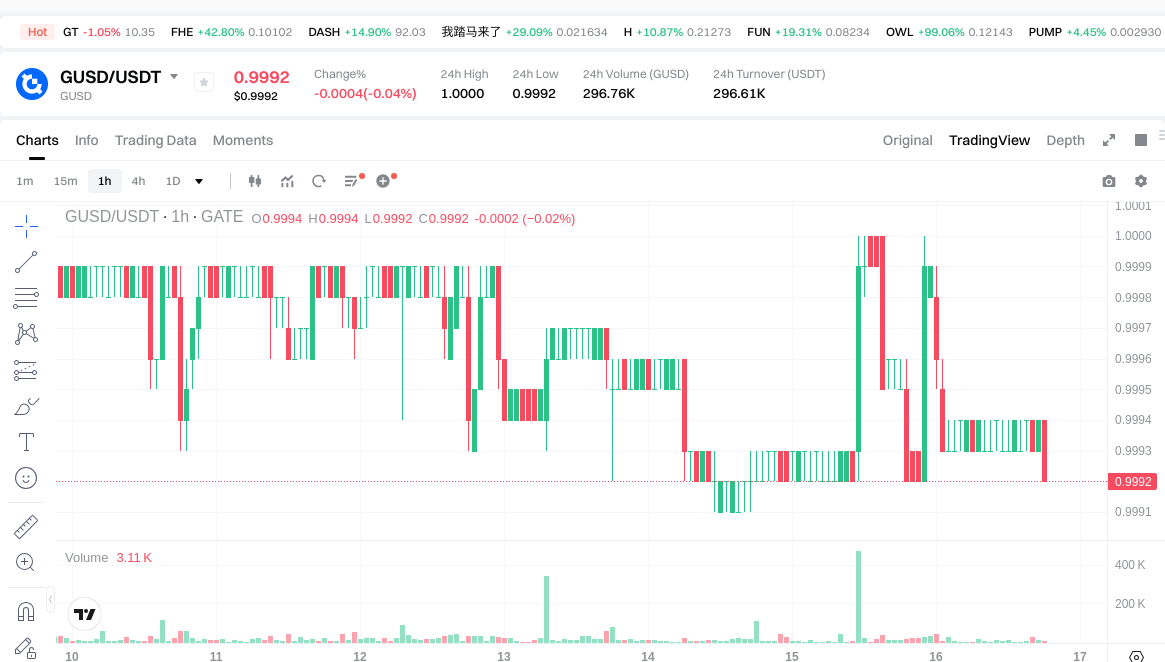
As of January 16, 2026, GUSD is ranked 289 by market capitalization, with a current price of approximately $0.9993. The token has a circulating supply of 146,070,295 GUSD out of a maximum supply of 320,000,000 GUSD, representing a circulation ratio of approximately 45.65%. With a market capitalization of around $145.97 million and a fully diluted valuation of $319.78 million, GUSD maintains a relatively modest presence in the cryptocurrency market.
This article will provide a comprehensive analysis of GUSD's investment value, focusing on:
I. Price trends and historical performance
II. Token supply mechanics and distribution
III. Product mechanism and yield sources
IV. Market positioning and competitive landscape
V. Risk factors and considerations
Through this analysis, we aim to help investors better understand GUSD's characteristics and assess whether it aligns with their investment objectives.
I. Historical Price Comparison and Current Market Status
GUSD and XLM Historical Price Trends
-
2025: GUSD launched in September 2025, maintaining a relatively stable price range around $1.00. The token experienced minor volatility with a historical high of $1.06 in September 2025 and a historical low of $0.9826 in October 2025.
-
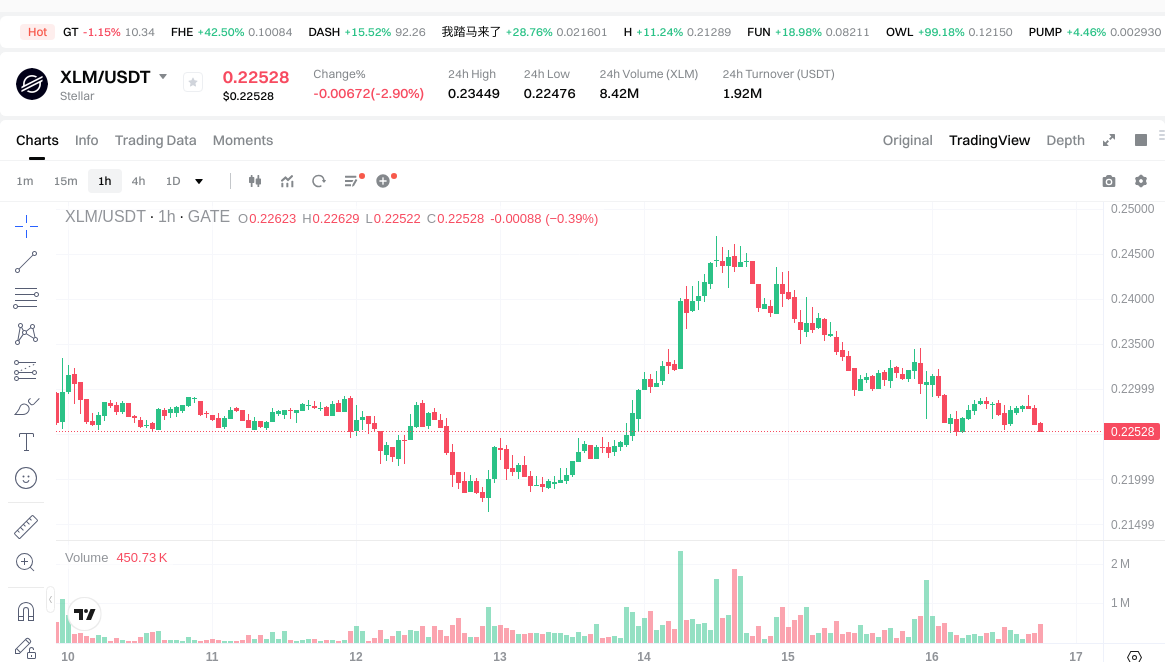
2018-2025: XLM reached its historical high of $0.875563 in January 2018 during the cryptocurrency bull market. However, it experienced significant price corrections over subsequent years, recording a historical low of $0.00047612 in March 2015. Throughout 2025, XLM showed fluctuating price movements.
-
Comparative Analysis: During recent market cycles, GUSD maintained a narrow price range between $0.9826 and $1.06, demonstrating price stability characteristic of yield-bearing stablecoin products. In contrast, XLM exhibited greater volatility, with its price declining by approximately 53.82% over the past year.
Current Market Status (2026-01-16)
- GUSD current price: $0.9993
- XLM current price: $0.22587
- 24-hour trading volume: GUSD $295,906.99 vs XLM $1,858,572.02
- Market sentiment index (Fear & Greed Index): 49 (Neutral)
View real-time prices:
II. Core Factors Influencing GUSD vs XLM Investment Value
Supply Mechanism Comparison (Tokenomics)
-
XLM: XLM has an initial total supply of 100 billion tokens. The distribution structure includes 50% allocated through airdrop programs to individual users, 25% to non-profit organizations and educational institutions, 20% for airdrops to Bitcoin and Ripple holders, and 5% retained by the Stellar Development Foundation for operational expenses. XLM features a built-in inflation mechanism with an annual 1% token increase, distributed to network participants through a voting system to encourage active participation in network governance.
-
GUSD: GUSD is a stablecoin backed by the US dollar, maintaining a 1:1 peg with the dollar. Its supply mechanism is fundamentally different from XLM, as GUSD is issued based on dollar reserves held by the issuer, with supply expanding or contracting according to market demand for dollar-backed digital assets.
-
📌 Historical Pattern: XLM's supply mechanism, particularly its annual 1% inflation and distribution model, creates different value dynamics compared to GUSD's fixed peg. While XLM's price fluctuates based on network adoption and market cycles, GUSD maintains relative stability as a dollar-backed asset.
Institutional Adoption and Market Applications
-
Institutional Holdings: XLM has established partnerships with multiple financial institutions and remittance companies, including IBM and MoneyGram. These collaborations have enabled Stellar technology to be applied in practical financial services. The network's focus on cross-border payments and financial inclusion has attracted institutional interest in utilizing XLM for settlement purposes.
-
Enterprise Adoption: XLM demonstrates applications in cross-border payments, where it serves as a bridge currency between different fiat currencies. The Stellar network enables users to easily convert one currency to another without multiple intermediaries, significantly reducing remittance costs and time. Transaction confirmations occur within 3-5 seconds, offering substantial advantages over traditional banking systems that require days for cross-border transfers. GUSD, as a dollar-backed stablecoin, provides stability for enterprises seeking to minimize exposure to cryptocurrency volatility while accessing digital asset infrastructure.
-
National Policies: Regulatory clarity from major economies such as the United States and the European Union regarding cryptocurrency policies may enhance institutional confidence in the Stellar ecosystem. Given Stellar's focus on fiat-to-crypto exchange scenarios, its positioning could become more attractive in a compliant regulatory environment, potentially contributing to XLM's medium to long-term value appreciation.
Technical Development and Ecosystem Building
-
XLM Technical Upgrades: In early 2024, Stellar launched the Soroban smart contract platform, introducing programmable capabilities to its network. This enables developers to build decentralized finance (DeFi) applications and non-fungible tokens (NFTs). The Soroban platform entered testing in 2023 and was officially launched in early 2024, attracting more developers and increasing on-chain activity, which has helped drive market demand for XLM. The platform utilizes the unique Stellar Consensus Protocol (SCP), a federated Byzantine agreement that allows the network to reach consensus quickly in a decentralized environment, processing transactions within 3-5 seconds with minimal energy consumption.
-
GUSD Technical Development: As a regulated stablecoin, GUSD's technical development focuses on maintaining its dollar peg, ensuring regulatory compliance, and integrating with various blockchain networks and financial systems to facilitate seamless digital dollar transfers.
-
Ecosystem Comparison: XLM features a built-in decentralized exchange function, allowing users to directly trade various assets on the network, including fiat currencies, cryptocurrencies, and other digital tokens, without relying on third-party trading platforms. The introduction of Soroban has expanded Stellar's use cases in DeFi and NFT applications. In October 2024, Stellar announced partnerships with Mastercard and Paxos, further enhancing its ecosystem and market exposure.
Macroeconomic Factors and Market Cycles
-
Performance in Inflationary Environments: GUSD, being pegged to the US dollar, does not possess independent anti-inflation properties; its value moves in line with the dollar. XLM's performance in inflationary environments depends on its adoption as a cross-border payment solution and network usage growth, rather than functioning as an inflation hedge.
-
Macroeconomic Monetary Policy: Interest rates and the US dollar index influence both assets differently. GUSD maintains its dollar peg regardless of market conditions, while XLM's price may be affected by broader cryptocurrency market sentiment, which is influenced by monetary policy changes. During market downturns, such as the 2022 cycle, XLM experienced sustained price weakness despite continued ecosystem development, as overall market sentiment remained subdued and trading activity declined.
-
Geopolitical Factors: Cross-border transaction demand and international situations impact both assets. XLM's core mission of simplifying cross-border payment processes positions it to benefit from increased global remittance needs. Strategic partnerships with mainstream financial institutions help enhance Stellar's credibility and attract new users, forming positive price support for XLM. GUSD serves as a stable digital dollar alternative for cross-border transactions, particularly in regions with currency instability.
III. 2026-2031 Price Prediction: GUSD vs XLM
Short-term Forecast (2026)
- GUSD: Conservative $1.00 | Optimistic $1.00
- XLM: Conservative $0.12-$0.23 | Optimistic $0.23-$0.27
Medium-term Forecast (2028-2029)
- GUSD may maintain its stable peg structure, with projected price remaining at $1.00
- XLM may enter a gradual growth phase, with projected price range of $0.19-$0.42
- Key drivers: institutional capital inflows, ETF developments, ecosystem expansion
Long-term Forecast (2030-2031)
- GUSD: Baseline scenario $1.00 | Optimistic scenario $1.00
- XLM: Baseline scenario $0.33-$0.38 | Optimistic scenario $0.38-$0.52
View detailed price predictions for GUSD and XLM
Disclaimer
GUSD:
| Year |
Predicted High Price |
Predicted Average Price |
Predicted Low Price |
Price Change |
| 2026 |
1 |
1 |
1 |
0 |
| 2027 |
1 |
1 |
1 |
0 |
| 2028 |
1 |
1 |
1 |
0 |
| 2029 |
1 |
1 |
1 |
0 |
| 2030 |
1 |
1 |
1 |
0 |
| 2031 |
1 |
1 |
1 |
0 |
XLM:
| Year |
Predicted High Price |
Predicted Average Price |
Predicted Low Price |
Price Change |
| 2026 |
0.2684045 |
0.22555 |
0.121797 |
0 |
| 2027 |
0.2840238375 |
0.24697725 |
0.1951120275 |
9 |
| 2028 |
0.30798063075 |
0.26550054375 |
0.1911603915 |
17 |
| 2029 |
0.4157738515125 |
0.28674058725 |
0.2666687461425 |
26 |
| 2030 |
0.403945802288437 |
0.35125721938125 |
0.326669214024562 |
55 |
| 2031 |
0.521090084952084 |
0.377601510834843 |
0.347393389968056 |
67 |
IV. Investment Strategy Comparison: GUSD vs XLM
Long-term vs Short-term Investment Strategies
-
GUSD: Suitable for investors seeking principal protection and stable yields. The asset is designed for conservative market participants who prioritize capital preservation while generating modest returns from the Gate ecosystem's revenue and tokenized treasuries. GUSD's daily reward distribution mechanism makes it appropriate for both short-term liquidity needs and longer-term stable yield strategies. Its tradability and collateral functionality provide additional flexibility for investors managing diversified portfolios.
-
XLM: Suitable for investors focusing on cross-border payment infrastructure and ecosystem growth potential. Given XLM's partnerships with financial institutions and its expanding Soroban smart contract platform, the asset may appeal to those with a medium to long-term investment horizon who can tolerate higher volatility. Short-term traders may find opportunities in XLM's price fluctuations, though historical data shows significant volatility with a 53.82% decline over the past year.
Risk Management and Asset Allocation
-
Conservative Investors: GUSD 70-80% vs XLM 20-30%. This allocation prioritizes capital stability through GUSD's dollar-backed structure while maintaining limited exposure to XLM's growth potential in cross-border payment adoption.
-
Aggressive Investors: GUSD 20-30% vs XLM 70-80%. This allocation emphasizes XLM's potential appreciation driven by ecosystem expansion, institutional partnerships, and Soroban platform development, while maintaining a stability buffer through GUSD holdings.
-
Hedging Tools: Stablecoin allocation for volatility mitigation, options strategies for downside protection, and cross-asset portfolio combinations balancing dollar-pegged stability with growth-oriented digital assets.
V. Potential Risk Comparison
Market Risks
-
GUSD: While designed to maintain a stable $1.00 peg, GUSD faces market risks related to the performance of its underlying yield sources, including Gate ecosystem revenue and tokenized treasury products. Changes in overall cryptocurrency market conditions may affect the sustainability of daily reward distributions. The token's relatively modest trading volume of $295,906.99 could present liquidity constraints during periods of significant redemption demand.
-
XLM: XLM demonstrates substantial price volatility, with historical fluctuations ranging from $0.00047612 to $0.875563. The token experienced a 53.82% price decline over the past year, reflecting its sensitivity to broader cryptocurrency market sentiment. Market cycles significantly impact XLM's price performance, as evidenced by sustained weakness during the 2022 downturn despite continued ecosystem development. The current Fear & Greed Index reading of 49 (Neutral) suggests moderate market sentiment uncertainty.
Technical Risks
-
GUSD: As a relatively new product launched in September 2025, GUSD's technical infrastructure requires continued monitoring for operational stability and security. The asset's dependence on multiple yield sources creates exposure to technical risks across different platforms and protocols. Integration challenges with various blockchain networks and financial systems may affect seamless functionality.
-
XLM: Network scalability and stability considerations exist as the Stellar ecosystem expands through the Soroban smart contract platform. While the Stellar Consensus Protocol enables 3-5 second transaction confirmations with minimal energy consumption, increased network activity from DeFi and NFT applications may test infrastructure capacity. The Soroban platform's recent launch in early 2024 means its long-term stability and security profile continues to develop.
Regulatory Risks
- Global regulatory policies affect both assets differently based on their distinct characteristics. GUSD, as a dollar-backed stablecoin, faces regulatory scrutiny similar to other stablecoins, with compliance requirements varying across jurisdictions. XLM's positioning in cross-border payments and financial services may benefit from regulatory clarity in major economies, though changes in cryptocurrency regulations could impact its operational framework. The Stellar network's partnerships with mainstream financial institutions like Mastercard and Paxos may provide some regulatory advantages, though evolving compliance requirements across different regions create ongoing uncertainty.
VI. Conclusion: Which Is the Better Buy?
📌 Investment Value Summary:
-
GUSD Advantages: Principal protection combined with daily yield distribution provides a relatively stable return profile in varying market conditions. The asset's full tradability and collateral functionality offer portfolio flexibility, while its backing by Gate ecosystem revenue and tokenized treasuries creates diversified yield sources. With a current price of $0.9993 and maintenance of a narrow historical price range between $0.9826 and $1.06, GUSD demonstrates stability characteristics appropriate for conservative capital management.
-
XLM Advantages: Strategic partnerships with established financial institutions including IBM, MoneyGram, Mastercard, and Paxos position XLM within practical financial services infrastructure. The Soroban smart contract platform expansion enables DeFi and NFT application development, potentially broadening ecosystem utility. XLM's core function in cross-border payments addresses real-world remittance needs, with 3-5 second transaction confirmations offering advantages over traditional banking systems. The built-in decentralized exchange functionality provides additional network utility.
✅ Investment Recommendations:
-
Beginner Investors: Consider prioritizing GUSD for its principal protection and stable yield characteristics, which align with capital preservation objectives while providing exposure to digital asset infrastructure. Limited XLM allocation may be appropriate for those seeking measured exposure to cross-border payment ecosystem growth.
-
Experienced Investors: Evaluate a balanced allocation strategy based on individual risk tolerance and market outlook. GUSD provides portfolio stability and consistent yields, while XLM offers growth potential tied to ecosystem expansion and institutional adoption. Consider market cycle positioning when determining allocation ratios between stable yield generation and appreciation potential.
-
Institutional Investors: Assess GUSD for treasury management applications requiring capital stability with yield generation, particularly suitable for managing operational reserves or short-term liquidity needs. XLM may warrant consideration for strategic allocations focused on cross-border payment infrastructure development and regulated blockchain network exposure, especially given partnerships with mainstream financial institutions.
⚠️ Risk Disclosure: The cryptocurrency market exhibits high volatility characteristics. This analysis does not constitute investment advice. Investors should conduct independent research and consider their financial circumstances, risk tolerance, and investment objectives before making any investment decisions.
VII. FAQ
Q1: What is GUSD and how does it differ from traditional stablecoins?
GUSD is a flexible, principal-protected investment product launched in September 2025 that distributes daily rewards while maintaining a stable $1.00 peg. Unlike traditional stablecoins that simply maintain dollar parity, GUSD generates yields sourced from the Gate ecosystem's revenue, tokenized treasuries, and stablecoin-backed yield assets. The token is fully tradable and can be used as collateral, combining capital preservation with yield generation. As of January 16, 2026, GUSD maintains a price of $0.9993 with a market capitalization of approximately $145.97 million and a circulating supply of 146,070,295 tokens out of a maximum supply of 320,000,000.
Q2: How does XLM's price volatility compare to GUSD's stability?
XLM demonstrates substantially higher price volatility than GUSD, with historical fluctuations ranging from $0.00047612 to $0.875563, including a 53.82% decline over the past year. In contrast, GUSD maintains a narrow price range between $0.9826 and $1.06 since its September 2025 launch. While XLM's current price of $0.22587 reflects its sensitivity to broader cryptocurrency market sentiment and adoption cycles, GUSD's design prioritizes price stability around $1.00, making it suitable for conservative investors seeking capital preservation with modest yields rather than price appreciation potential.
Q3: What are the main yield sources for GUSD's daily reward distributions?
GUSD's daily rewards are sourced from three primary channels: Gate ecosystem revenue, tokenized treasuries or other Real World Assets (RWA), and stablecoin-backed yield assets. This diversified yield structure is designed to provide relatively stable returns in both bullish and bearish market conditions. The combination of these revenue streams aims to reduce dependency on any single source while maintaining principal protection. However, investors should note that the sustainability of these yields depends on the performance of underlying sources and overall cryptocurrency market conditions, which may affect distribution consistency.
Q4: How do XLM's institutional partnerships impact its investment value?
XLM has established strategic partnerships with major financial institutions including IBM, MoneyGram, Mastercard, and Paxos, positioning it within practical financial services infrastructure. These collaborations enable Stellar technology to be applied in cross-border payments and remittance services, where XLM serves as a bridge currency between different fiat currencies. Transaction confirmations occur within 3-5 seconds, offering substantial advantages over traditional banking systems. In October 2024, the announced partnerships with Mastercard and Paxos further enhanced ecosystem exposure. These institutional relationships enhance XLM's credibility and potentially drive network adoption, though they do not eliminate price volatility risks inherent in cryptocurrency markets.
Q5: What allocation strategy should investors consider between GUSD and XLM?
Allocation strategies should align with individual risk tolerance and investment objectives. Conservative investors may consider a 70-80% GUSD allocation versus 20-30% XLM, prioritizing capital stability through dollar-backed structure while maintaining limited exposure to cross-border payment ecosystem growth. Aggressive investors might reverse this ratio to 20-30% GUSD versus 70-80% XLM, emphasizing appreciation potential from ecosystem expansion and institutional partnerships while maintaining a stability buffer. The choice depends on whether an investor prioritizes principal protection and stable yields (GUSD) or growth potential tied to cross-border payment infrastructure development (XLM), recognizing XLM's significantly higher volatility profile.
Q6: What are the primary risks associated with investing in GUSD?
GUSD faces several key risks despite its principal protection design. Market risks include exposure to the performance of underlying yield sources such as Gate ecosystem revenue and tokenized treasury products, which may affect the sustainability of daily reward distributions. With a 24-hour trading volume of $295,906.99, liquidity constraints could arise during significant redemption periods. As a product launched in September 2025, GUSD's technical infrastructure requires continued monitoring for operational stability and security. Regulatory risks similar to other stablecoins exist, with compliance requirements varying across jurisdictions. The dependence on multiple yield sources creates exposure to technical risks across different platforms and protocols.
Q7: How does the Soroban smart contract platform affect XLM's future potential?
The Soroban smart contract platform, launched in early 2024, introduces programmable capabilities to the Stellar network, enabling developers to build decentralized finance (DeFi) applications and non-fungible tokens (NFTs). This expansion broadens XLM's use cases beyond its traditional cross-border payment focus, potentially attracting more developers and increasing on-chain activity. The platform utilizes the Stellar Consensus Protocol (SCP), processing transactions within 3-5 seconds with minimal energy consumption. However, as a recently launched platform, Soroban's long-term stability and security profile continues to develop. Increased network activity from DeFi and NFT applications may test infrastructure capacity, presenting both growth opportunities and technical scaling considerations.
Q8: What is the price outlook for GUSD and XLM through 2031?
GUSD is projected to maintain its stable $1.00 peg structure across all forecast periods from 2026 through 2031, reflecting its design as a principal-protected product. XLM shows more varied price predictions: short-term (2026) conservative estimates range from $0.12-$0.23 with optimistic scenarios reaching $0.23-$0.27; medium-term (2028-2029) projections suggest a gradual growth phase with prices between $0.19-$0.42; long-term (2030-2031) baseline scenarios estimate $0.33-$0.38 with optimistic scenarios reaching $0.38-$0.52. These projections depend on institutional capital inflows, ETF developments, ecosystem expansion, and broader market conditions. However, given XLM's historical volatility and 53.82% decline over the past year, these forecasts carry significant uncertainty and should not be considered guaranteed outcomes.
* The information is not intended to be and does not constitute financial advice or any other recommendation of any sort offered or endorsed by Gate.