This comprehensive article analyzes AAVE (AAVE) as an investment opportunity, examining its position as a decentralized lending protocol with a $2.62 billion market cap and current price of $172.60. The analysis covers AAVE's price history from 2020 to 2026, key investment factors including fixed supply mechanism, institutional adoption across 164,140 holders, and technological infrastructure. Mid-term price forecasts suggest $176-$210 for 2027 and $193-$275 for 2028, while long-term scenarios range from $225-$400 (baseline) to $450-$670 (optimistic). The article provides investment strategies including long-term holding and active trading approaches, alongside risk management techniques covering market volatility, regulatory uncertainty, and technical vulnerabilities. Essential storage solutions on Gate and security protocols are detailed to guide investor decision-making in the DeFi lending sector.
Introduction: Aave (AAVE) Investment Status and Market Outlook
AAVE is a significant asset in the cryptocurrency sector. As an open-source decentralized lending protocol, it provides users with deposit and borrowing services. Through the improvement proposal (AIP1) on October 3, 2020 (block height 10978863), the platform token LEND was converted to AAVE at a ratio of 100:1. As of January 14, 2026, AAVE has a market capitalization of approximately $2.62 billion, with a circulating supply of around 15.18 million tokens, and the current price is maintained at approximately $172.6. With its position in the decentralized finance (DeFi) sector, AAVE has gradually become a focal point for investors discussing "Is AAVE a good investment?" The token ranks 42nd in the overall cryptocurrency market, with a market dominance of 0.082%. This article will comprehensively analyze AAVE's investment value, historical trends, future price predictions, and investment risks to provide reference for investors.
I. AAVE Price History Review and Current Investment Value
- 2020: Token migration from LEND to AAVE at a 100:1 ratio (October 3, 2020, block height 10978863) → Initial conversion price around $1.7
- 2021: DeFi summer expansion and institutional attention → Price experienced significant growth during the broader DeFi market rally
- 2021: Market peak period (May 2021) → AAVE reached notable price levels as DeFi TVL expanded to $86.05 billion across the sector
- 2022: Market contraction following Terra/Luna collapse (May) and FTX bankruptcy (November) → Price declined alongside broader DeFi sector downturn
- 2023-2024: Gradual recovery phase → Market stabilization with Layer 2 solutions maturation and institutional participation increase
Current AAVE Investment Market Status (January 2026)
- Current Price: $172.60
- 24-Hour Trading Volume: Approximately $763.29 million
- Market Capitalization: $2.62 billion
- Circulating Supply: 15.18 million AAVE (94.91% of maximum supply)
- Recent Price Movement: +5.4% (24h), +0.25% (7d), -9.56% (30d)
- Holders: 164,140 addresses
- Exchange Listings: Available on 65 exchanges
Click to view real-time AAVE market price
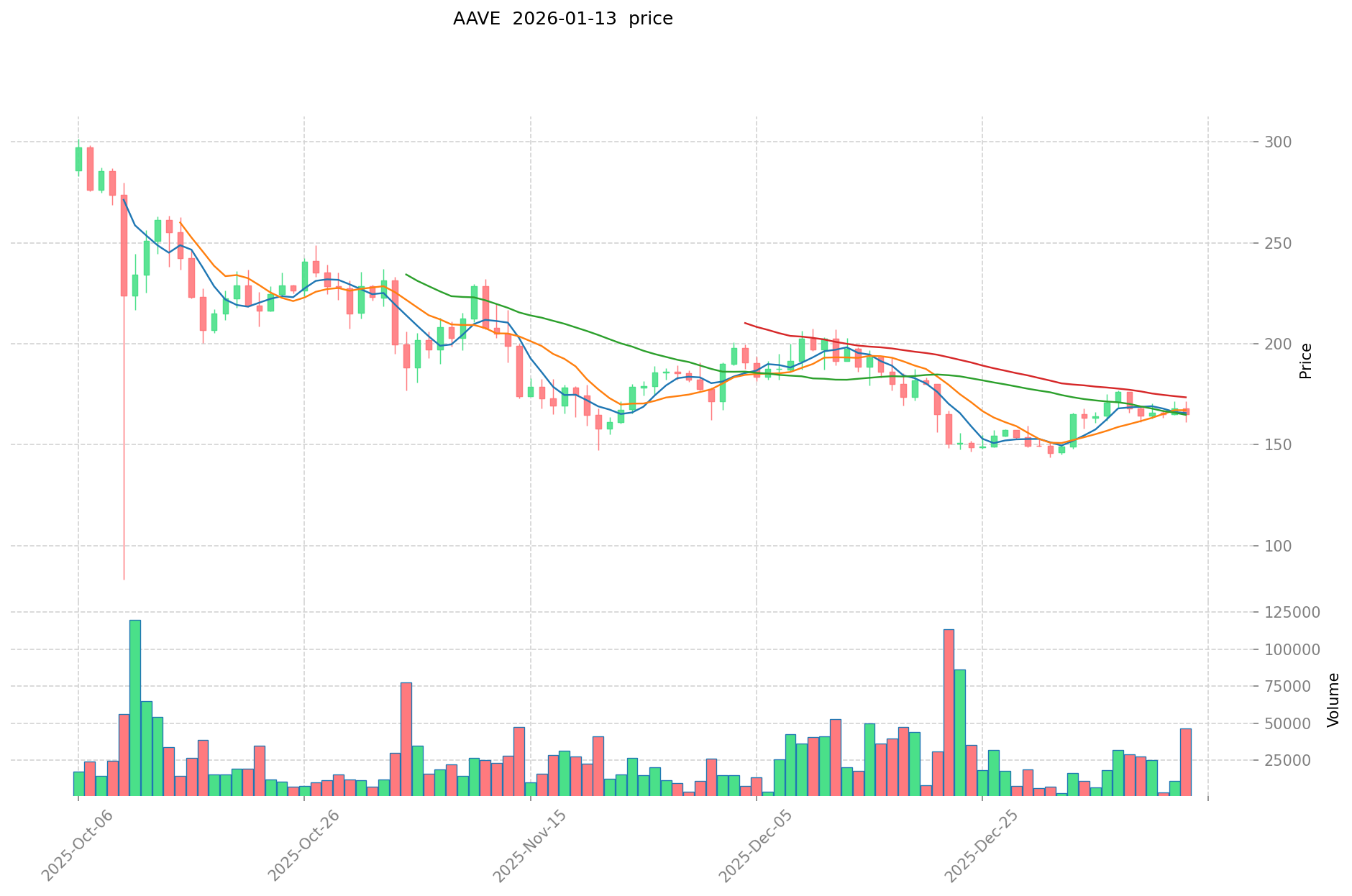
II. Core Factors Influencing Whether AAVE is a Good Investment
Supply Mechanism and Scarcity (AAVE Investment Scarcity)
- Fixed Supply Model → AAVE has a maximum supply of 16,000,000 tokens with approximately 15,184,828 tokens currently in circulation (94.91% of total supply), creating a relatively scarce supply structure that may influence long-term value preservation.
- Token Conversion History → Through improvement proposal (AIP1) on October 3, 2020 (block height 10978863), the platform converted LEND tokens to AAVE at a 100:1 ratio, establishing the current supply framework.
- Investment Significance → The near-complete circulation of tokens (94.91% circulating) reduces future dilution risk, which may be relevant for long-term investment considerations.
Institutional Investment and Mainstream Adoption (Institutional Investment in AAVE)
- Holder Base → As of January 2026, AAVE has approximately 164,140 token holders, indicating a broad distribution across the market.
- Exchange Availability → Listed on 65 cryptocurrency exchanges, providing accessibility for institutional and retail participants.
- DeFi Protocol Positioning → Aave functions as an open-source decentralized lending protocol, offering deposit and lending services with algorithmically determined interest rates based on platform supply and demand dynamics.
Macroeconomic Environment Impact on AAVE Investment
- DeFi Market Conditions → As a decentralized lending protocol, AAVE's investment appeal correlates with broader DeFi adoption trends and regulatory developments affecting decentralized finance platforms.
- Market Volatility → The token has experienced significant price fluctuations, with historical trading between $26.02 and $661.69, reflecting sensitivity to broader cryptocurrency market conditions.
- Interest Rate Environment → Changes in traditional finance interest rates may influence demand for DeFi lending protocols, potentially affecting AAVE's utility and investment characteristics.
Technology and Ecosystem Development (Technology & Ecosystem for AAVE Investment)
- Oracle Integration → The platform utilizes Chainlink's oracle system to maintain collateral price integrity, contributing to protocol reliability and risk management.
- Lending Protocol Infrastructure → Algorithmic calculation of deposit and loan interest rates based on platform borrowing and deposit volumes provides a systematic approach to yield generation.
- DeFi Ecosystem Role → As a lending protocol within the broader DeFi landscape, AAVE's long-term value proposition connects to continued adoption of decentralized financial services and lending applications.
III. AAVE Future Investment Forecast and Price Outlook (Is AAVE worth investing in 2026-2031)
Short-term Investment Forecast (2026, short-term AAVE investment outlook)
Based on available market analysis and technical indicators, AAVE presents varying scenarios for 2026:
- Conservative Forecast: $162.29 - $168.79
- Neutral Forecast: $172.65 - $181.28
- Optimistic Forecast: $196.18 - $241.32
The short-term outlook reflects AAVE's position within a consolidation phase. Technical analysis suggests the token is trading near support levels around $200, with immediate resistance at $298. The protocol's fundamentals, including record Total Value Locked (TVL) exceeding $25-30 billion and expanding multi-chain deployment, provide underlying support for price stability.
Mid-term Investment Outlook (2027-2028, mid-term AAVE investment forecast)
-
Market Stage Expectation: AAVE may enter a growth acceleration phase driven by DeFi adoption expansion and protocol upgrades, particularly the anticipated Aave V4 release and GHO stablecoin integration.
-
Investment Return Forecast:
- 2027: $176.97 - $210.59 (with potential to approach historical resistance near $300-350)
- 2028: $193.78 - $275.16 (technical patterns suggest possible range expansion)
-
Key Catalysts: Protocol upgrades (Aave V4 with modular marketplace and enhanced capital efficiency), GHO stablecoin expansion, multi-chain ecosystem growth across BNB Chain, ZKsync Era, Scroll, and upcoming integrations with Sonic, Mantle, Linea, and Aptos.
Long-term Investment Outlook (Is AAVE a good long-term investment?)
- Baseline Scenario: $225 - $400 (assumes continued DeFi sector growth and stable protocol development)
- Optimistic Scenario: $450 - $670 (assumes accelerated institutional adoption and favorable regulatory environment for DeFi)
- Risk Scenario: $130 - $200 (under adverse market conditions or significant competitive pressure)
View AAVE long-term investment and price prediction: Price Prediction
2026-01-14 to 2031 Long-term Outlook
- Base Scenario: $200 - $400 (corresponding to steady progress and mainstream application advancement)
- Optimistic Scenario: $450 - $670 (corresponding to large-scale adoption and favorable market environment)
- Transformative Scenario: Above $800 (if ecosystem achieves breakthrough developments and mainstream penetration)
- 2031-12-31 Forecast High: $398.65 (based on optimistic development assumptions)
Disclaimer: Price predictions are based on historical data, technical analysis, and market trends available as of January 2026. Cryptocurrency markets are highly volatile and subject to numerous unpredictable factors including regulatory changes, technological developments, and macroeconomic conditions. These forecasts should not be considered as investment advice. Past performance does not guarantee future results. Investors should conduct their own research and consider their risk tolerance before making investment decisions.
| Year |
Predicted High Price |
Predicted Average Price |
Predicted Low Price |
Price Change |
| 2026 |
181.2825 |
172.65 |
162.291 |
0 |
| 2027 |
210.5898375 |
176.96625 |
164.5786125 |
2 |
| 2028 |
275.164822125 |
193.77804375 |
164.7113371875 |
12 |
| 2029 |
337.63886343 |
234.4714329375 |
225.09257562 |
35 |
| 2030 |
308.93956003845 |
286.05514818375 |
274.6129422564 |
65 |
| 2031 |
398.646454508874 |
297.4973541111 |
202.298200795548 |
72 |
IV. AAVE Investment Strategy and Risk Management (How to invest in DeFi lending protocols)
Investment Methodology (AAVE investment strategy)
Long-term Holding (HODL AAVE)
Long-term holding represents a strategy oriented toward investors with a moderate risk tolerance. This approach involves acquiring AAVE tokens and maintaining positions through market cycles, with the expectation that the protocol's fundamental value proposition in decentralized lending will appreciate over extended timeframes. Historical data indicates AAVE reached a price point of $661.69 on May 19, 2021, while trading at $172.6 as of January 14, 2026, reflecting the volatility inherent in this asset class.
Active Trading
Active trading strategies utilize technical analysis and momentum-based approaches to capitalize on price fluctuations. AAVE has demonstrated measurable volatility, with a 24-hour price range between $162.76 and $173.58, representing approximately 6.6% variation. The 1-hour change of 1.05% and 24-hour change of 5.4% suggest opportunities for short-term position management, though such strategies require continuous market monitoring and technical proficiency.
Risk Management (Risk management for AAVE investment)
Asset Allocation Ratios
- Conservative investors: May consider allocating 1-3% of their digital asset portfolio to AAVE, balancing exposure to DeFi protocols with overall portfolio stability
- Aggressive investors: Could allocate 5-10% to AAVE, accepting higher volatility in exchange for potential growth in the decentralized finance sector
- Professional investors: May implement dynamic allocation strategies ranging from 3-15%, adjusted based on market conditions, protocol developments, and risk metrics
Risk Hedging Approaches
Diversification across multiple asset categories can help mitigate concentration risk. A multi-asset portfolio might include established cryptocurrencies alongside DeFi protocol tokens. Some investors utilize stablecoin positions as a hedge against volatility, while others may employ derivative instruments where available. The correlation between AAVE and broader market movements (market cap dominance of 0.082%) suggests it moves in relation to overall crypto market sentiment.
Secure Storage
Cold wallet solutions: Hardware wallets provide offline storage, reducing exposure to network-based security threats. Devices from established manufacturers offer secure key management for AAVE tokens stored on the Ethereum network.
Hot wallet considerations: For active traders requiring frequent access, reputable software wallets with multi-signature capabilities and regular security audits provide a balance between accessibility and security.
Hardware wallet recommendations: Devices supporting ERC-20 tokens (AAVE's contract address: 0x7Fc66500c84A76Ad7e9c93437bFc5Ac33E2DDaE9) allow for secure long-term storage with user-controlled private keys.
V. AAVE Investment Risks and Challenges (Risks of investing in DeFi lending protocols)
Market Risk
AAVE exhibits substantial price volatility, characteristic of digital assets in the DeFi sector. The token has experienced a 1-year decline of 40.02%, moving from higher price levels to $172.6. The 24-hour trading volume of $7,632,889.96 relative to its market capitalization of approximately $2.62 billion suggests moderate liquidity, though sudden market movements can occur. Price fluctuations in crypto markets can be influenced by various factors including trading patterns, market sentiment shifts, and broader economic conditions.
Regulatory Risk
Decentralized finance protocols operate in an evolving regulatory environment across different jurisdictions. Regulatory approaches to DeFi lending platforms vary significantly by country, with some jurisdictions implementing specific frameworks while others maintain developing or unclear positions. Changes in regulatory stances toward DeFi protocols, lending activities, or token classifications could impact AAVE's operational model or market accessibility. Investors should monitor regulatory developments in their respective jurisdictions and internationally.
Technical Risk
As an open-source decentralized lending protocol, AAVE relies on smart contract infrastructure and blockchain network functionality. Technical considerations include:
- Smart contract vulnerabilities: While Aave has undergone audits, the complexity of DeFi protocols means theoretical vulnerabilities could exist
- Network dependencies: AAVE operates on the Ethereum network, making it subject to that blockchain's performance characteristics and potential technical issues
- Protocol upgrade execution: The platform's evolution through improvement proposals (such as the historical AIP1 that converted LEND to AAVE at 100:1) requires successful technical implementation
- Oracle dependencies: The protocol utilizes Chainlink oracles for price data, creating dependency on external data providers
VI. Conclusion: Is DeFi lending protocol investment suitable?
Investment Value Summary
AAVE represents a position in the decentralized lending sector, with a market capitalization of approximately $2.62 billion and ranking of 42 among digital assets as of January 14, 2026. The protocol's circulating supply stands at 15,184,828.94 tokens (94.91% of maximum supply), with distribution across 164,140 holders. The token has experienced significant price variation, from its May 2021 level of $661.69 to current levels around $172.6, reflecting both the growth potential and volatility inherent in this sector. Long-term considerations include the protocol's role in DeFi infrastructure, while short-term factors involve market sentiment and broader crypto market dynamics.
Investor Considerations
✅ New investors: Consider dollar-cost averaging strategies combined with secure wallet storage solutions. Begin with small allocations to understand market dynamics and protocol functionality.
✅ Experienced investors: May implement position management strategies based on technical indicators and market cycles. Portfolio diversification across multiple DeFi protocols and asset categories can help manage concentration risk.
✅ Institutional investors: Could evaluate AAVE as part of strategic DeFi sector exposure, with position sizing based on risk management frameworks and investment mandates.
⚠️ Important notice: Cryptocurrency investments involve substantial risk and volatility. This content is provided for informational purposes and does not constitute investment advice. Individuals should conduct independent research and consider their financial circumstances before making investment decisions.
VII. FAQ
Q1: Is AAVE a good investment for 2026?
AAVE presents a moderate-risk investment opportunity within the DeFi sector, though suitability depends on individual risk tolerance and investment objectives. As of January 2026, AAVE maintains a market capitalization of $2.62 billion with current pricing around $172.60, representing a 40% decline from year-ago levels. The protocol demonstrates strong fundamentals with record Total Value Locked (TVL) exceeding $25-30 billion and expansion across multiple blockchain networks. Short-term forecasts suggest price ranges of $162-$241 depending on market conditions, while the token's near-complete circulation (94.91% of maximum supply) reduces future dilution risk. However, investors should note the substantial volatility inherent in DeFi tokens and consider starting with conservative portfolio allocations of 1-3% for risk-averse investors or 5-10% for those comfortable with higher volatility.
Q2: What are the main risks of investing in AAVE?
AAVE investment carries three primary risk categories that investors should evaluate carefully. Market risk manifests through substantial price volatility, with AAVE experiencing a 1-year decline of 40.02% and 24-hour price fluctuations of approximately 6.6%. Regulatory risk emerges from the evolving legal framework surrounding decentralized finance protocols, where unclear or changing regulations across jurisdictions could impact operational models or market accessibility. Technical risk includes potential smart contract vulnerabilities, dependency on Ethereum network performance, and reliance on external oracle systems like Chainlink for price data. The protocol's historical price range of $26.02 to $661.69 demonstrates the significant volatility investors must be prepared to manage through proper position sizing and risk management strategies.
Q3: How does AAVE generate value for investors?
AAVE generates investment value through multiple mechanisms related to its role as a decentralized lending protocol. The protocol enables deposit and borrowing services with algorithmically determined interest rates based on supply and demand dynamics, creating utility for the AAVE token within the ecosystem. The fixed supply model of 16 million tokens (with 94.91% currently circulating) establishes scarcity dynamics that may support long-term value. Additionally, AAVE holders participate in governance decisions through improvement proposals, providing influence over protocol development. The platform's integration with 65 exchanges and distribution across 164,140 holders indicates established market liquidity. However, value realization depends on continued DeFi adoption, successful protocol upgrades including the anticipated Aave V4 release, and expansion of use cases such as the GHO stablecoin integration.
Q4: What is the difference between long-term holding and active trading strategies for AAVE?
Long-term holding (HODL) involves acquiring AAVE tokens and maintaining positions through market cycles, anticipating that the protocol's fundamental value in decentralized lending will appreciate over extended timeframes of 2-5 years or longer. This strategy suits investors with moderate risk tolerance who can withstand volatility, exemplified by AAVE's historical range from $661.69 (May 2021) to current levels around $172.60. Active trading utilizes technical analysis to capitalize on short-term price movements, taking advantage of AAVE's measurable volatility with 24-hour ranges reaching 6.6% and hourly changes around 1.05%. While long-term holding requires less frequent monitoring and potentially lower transaction costs, active trading demands continuous market surveillance, technical proficiency, and acceptance of higher trading fees. Conservative investors typically allocate 1-3% to long-term positions, while active traders may adjust positions dynamically within 5-15% allocations based on market conditions.
Q5: How should investors securely store AAVE tokens?
AAVE token security depends on storage method selection aligned with investment strategy and security requirements. Cold wallet solutions, particularly hardware wallets from established manufacturers, provide optimal security for long-term holdings by maintaining private keys offline and reducing exposure to network-based threats. These devices support ERC-20 tokens (AAVE's contract address: 0x7Fc66500c84A76Ad7e9c93437bFc5Ac33E2DDaE9) and enable user-controlled key management. Hot wallet options, including reputable software wallets with multi-signature capabilities, suit active traders requiring frequent transaction access while maintaining reasonable security through regular audits and established protocols. Investors should avoid storing significant holdings on exchange platforms for extended periods, as exchange custody introduces counterparty risk. The choice between cold and hot storage should consider factors including transaction frequency, holding duration, and individual technical proficiency with cryptocurrency security practices.
Q6: What factors will influence AAVE's price in 2026-2028?
AAVE's mid-term price trajectory depends on several interconnected factors across technical, market, and ecosystem dimensions. Protocol developments, particularly the anticipated Aave V4 release featuring modular marketplace architecture and enhanced capital efficiency, represent primary technical catalysts. GHO stablecoin expansion and integration success will influence utility and adoption rates. Multi-chain deployment progress across BNB Chain, ZKsync Era, Scroll, and upcoming integrations with Sonic, Mantle, Linea, and Aptos will expand addressable markets. Broader DeFi sector growth trends and institutional adoption rates will affect demand dynamics, while macroeconomic conditions including traditional finance interest rate environments may influence comparative attractiveness of DeFi lending yields. Regulatory developments across major jurisdictions will impact operational frameworks and market accessibility. Technical analysis suggests 2027 price ranges of $176-$210 and 2028 ranges of $193-$275, though actual outcomes depend on how these multiple factors converge.
Q7: Is AAVE suitable for new cryptocurrency investors?
AAVE presents moderate suitability for new cryptocurrency investors, though entry should be approached with appropriate preparation and risk management. New investors should first establish foundational understanding of DeFi protocols, smart contract functionality, and cryptocurrency market dynamics before allocating capital to AAVE. Dollar-cost averaging strategies can mitigate timing risk, allowing gradual position building rather than single large purchases. Initial allocations should remain conservative at 1-3% of total cryptocurrency portfolio until familiarity with AAVE's volatility characteristics develops through direct experience. Secure storage setup using reputable hardware or software wallets represents an essential prerequisite before purchase. New investors should recognize that AAVE's 40% year-over-year decline and historical price range of $26-$661 indicate substantial volatility requiring emotional discipline and long-term perspective. Educational resources about the Aave protocol's lending mechanisms, governance structure, and competitive positioning within DeFi should be reviewed before investment decisions.
Q8: What makes AAVE different from other DeFi lending protocols?
AAVE distinguishes itself through several technical and ecosystem characteristics within the competitive DeFi lending landscape. The protocol employs algorithmic interest rate determination based on real-time supply and demand dynamics rather than fixed rates, enabling responsive market pricing. Integration with Chainlink oracle systems provides robust collateral price data, contributing to risk management infrastructure. The platform's multi-chain deployment strategy across Ethereum, BNB Chain, ZKsync Era, Scroll, and planned expansions differentiates it from single-chain competitors. The governance token model allows AAVE holders to influence protocol development through improvement proposals, exemplified by the historical LEND-to-AAVE conversion at 100:1 ratio. The anticipated V4 upgrade introducing modular marketplace architecture represents technical innovation in capital efficiency. With 164,140 token holders and availability on 65 exchanges, AAVE demonstrates established market presence. However, competitive advantages must be evaluated against other major lending protocols considering factors including total value locked, fee structures, security track records, and ecosystem integration depth.
* The information is not intended to be and does not constitute financial advice or any other recommendation of any sort offered or endorsed by Gate.