This comprehensive guide examines whether Aerodrome Finance (AERO) represents a sound investment opportunity within the DeFi ecosystem. As of January 2026, AERO maintains a $548.51 million market capitalization while functioning as Base's central liquidity hub with 910.55 million circulating tokens. The article evaluates AERO's historical performance, current market dynamics showing 5.28% daily volatility, and positions price scenarios from conservative ($0.44-$0.60 in 2026) to optimistic trajectories ($1.29-$1.97 by 2031). Investors receive tailored strategies across risk profiles, from conservative dollar-cost averaging approaches to active trading tactics, alongside comprehensive risk management frameworks addressing market, regulatory, and technical vulnerabilities. The analysis covers supply mechanisms, institutional adoption trends, Base ecosystem expansion potential, and secure storage solutions, enabling readers to assess whether AERO aligns with their investment objectives and risk tolerance within c
Introduction: Aerodrome Finance (AERO) Investment Position and Market Outlook
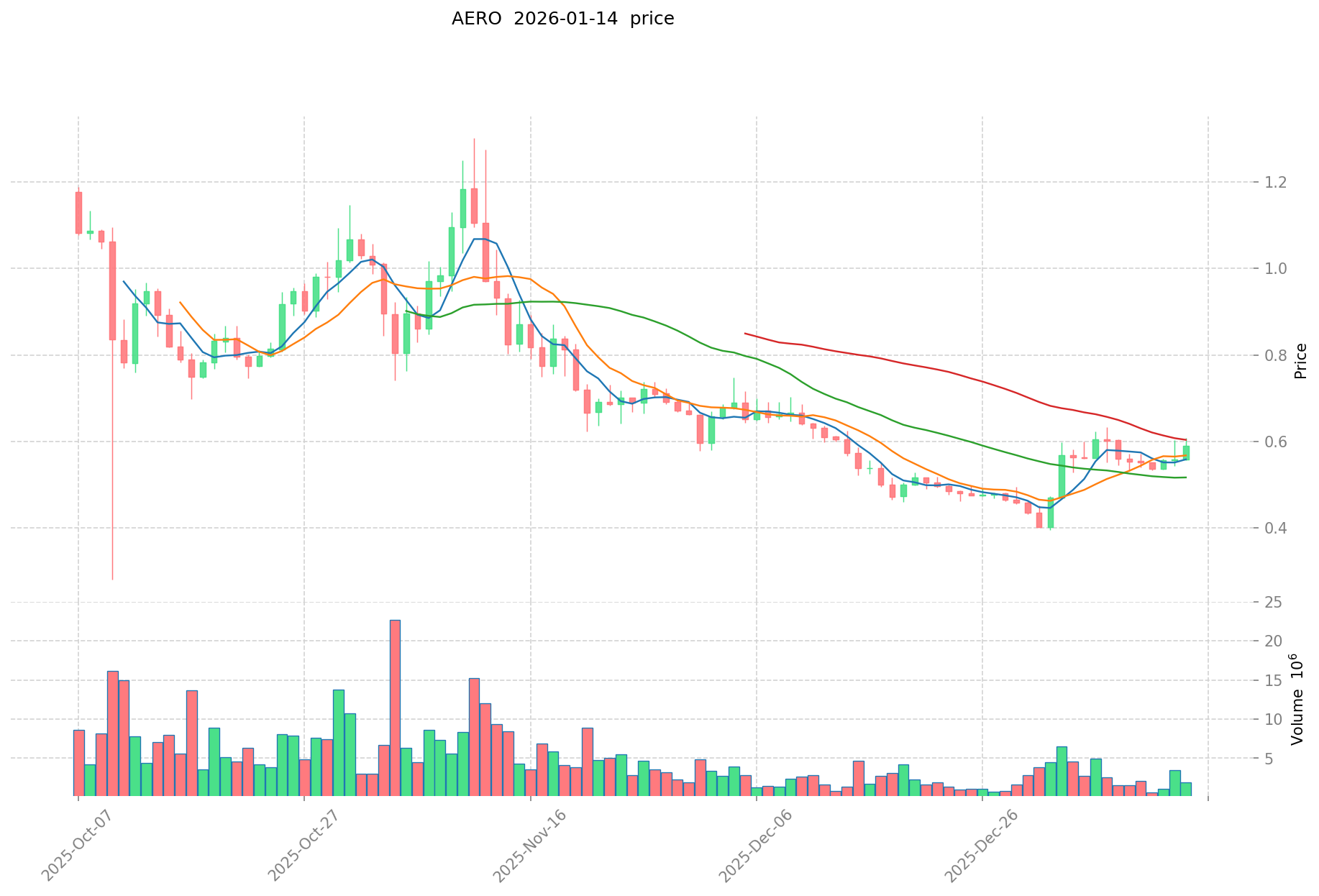
AERO is a significant asset in the cryptocurrency sector. Since its launch in 2023, it has established itself as a next-generation automated market maker (AMM) within the decentralized finance (DeFi) ecosystem. As of January 2026, Aerodrome Finance holds a market capitalization of approximately $548.51 million, with a circulating supply of around 910.55 million tokens and a current price hovering near $0.6024. Positioned as Base's central liquidity hub, AERO has gradually become a focal point when investors discuss "Is Aerodrome Finance (AERO) a good investment?" This article comprehensively analyzes AERO's investment value, historical performance, future price projections, and associated risks to provide reference for investors.
Ranked 126th by market capitalization, AERO demonstrates a relatively high circulation ratio of 97.56%, indicating limited supply overhang. The token has experienced notable volatility, with a 24-hour price change of 5.28% and a 30-day increase of 8.72%. However, the one-year performance shows a decline of 43.03%, reflecting the asset's sensitivity to broader market conditions. With trading volume reaching approximately $1.78 million over 24 hours and availability on 28 exchanges, AERO maintains reasonable market liquidity. The project's holder base of 711,732 addresses suggests a distributed ownership structure within the Base ecosystem.
I. Historical Price Review and Current Investment Value of AERO
- 2023: Project Launch → Initial price at $0.158
- 2024: Bull Market Phase → AERO experienced notable growth during the period
- 2025: Market Adjustment → Price declined from earlier levels to current trading range
Current AERO Investment Market Status (January 2026)
- AERO current price: $0.6024
- 24-hour trading volume: $1,781,420.55
- Circulating supply: 910,547,086.26 AERO
- Market capitalization: $548,513,564.77
- Circulating ratio: 97.56%
Click to view real-time AERO market price
II. Core Factors Influencing Whether AERO is a Good Investment
Supply Mechanism and Scarcity (AERO investment scarcity)
- Supply mechanism → Influences price and investment value
- Historical patterns: Supply changes have contributed to AERO price movements in the past
- Investment significance: Scarcity is a key factor supporting long-term investment potential
Institutional Investment and Mainstream Adoption (Institutional investment in AERO)
- Institutional holding trends: Aerodrome Finance has gained attention as a liquidity hub on the Base network
- Notable platform adoption: Aerodrome Finance (AERO) is listed on platforms such as Phemex, available for both spot and futures trading
- Policy implications: The Coinbase launchpad launch may potentially benefit Aerodrome by routing tokens through Aerodrome pools, which could enhance visibility and adoption
Macroeconomic Environment's Impact on AERO Investment
- Monetary policy and interest rate changes → Alter investment attractiveness
- Role in inflation environment: DeFi tokens may serve as alternative assets during economic uncertainty
- Geopolitical uncertainty → May increase demand for decentralized finance solutions like AERO
Technology and Ecosystem Development (Technology & Ecosystem for AERO investment)
- Base network expansion: Base has goals for 2025, aiming for 25 million users and $100 billion in on-chain assets, which may directly benefit Aerodrome
- Liquidity mining incentives: The platform's liquidity mining programs and veAERO voting mechanism enhance ecosystem engagement
- DeFi applications driving investment value: Aerodrome's role as a central liquidity hub combines features from Curve, Convex, and Uniswap, supporting diverse DeFi use cases
III. AERO Future Investment Forecast and Price Outlook (Is Aerodrome Finance (AERO) worth investing in 2026-2031)
Short-term Investment Forecast (2026, short-term AERO investment outlook)
Based on available market analysis, AERO's short-term price trajectory in 2026 presents several scenarios:
- Conservative forecast: $0.44 - $0.60
- Neutral forecast: $0.60 - $0.73
- Optimistic forecast: $0.73 - $0.86
Technical indicators suggest the token's RSI-30 reading of 26.42 places it in oversold territory, with price levels near the 78.6% Fibonacci support at approximately $0.52, indicating potential for a short-term rebound. However, sustained upward momentum would require additional market catalysts.
Mid-term Investment Outlook (2027-2029, mid-term Aerodrome Finance (AERO) investment forecast)
-
Market phase expectation: The mid-term period may witness gradual ecosystem expansion as Aerodrome Finance consolidates its position as a liquidity hub on the Base network. The AMM's integration of features from established protocols could support steady adoption growth.
-
Investment return forecast:
- 2027: $0.45 - $0.90
- 2028: $0.57 - $1.11
- 2029: $0.81 - $1.42
-
Key catalysts: Factors that may influence mid-term performance include increased user adoption rates, technological developments within the Base ecosystem, broader DeFi sector trends, and the effectiveness of the platform's epoch-based rewards and vote-locking governance model.
Long-term Investment Outlook (Is AERO a good long-term investment?)
- Baseline scenario: $0.65 - $1.62 (assuming steady development and moderate market conditions through 2030-2031)
- Optimistic scenario: $1.29 - $1.97 (contingent upon accelerated ecosystem growth and favorable market environment)
- Risk scenario: Below $0.44 (under adverse market conditions or significant competitive pressures)
View AERO long-term investment and price forecast: Price Prediction
2026-01-14 to 2031 Long-term Outlook
- Base scenario: $0.65 - $1.62 (corresponding to steady progress and gradual mainstream application growth)
- Optimistic scenario: $1.29 - $1.97 (corresponding to large-scale adoption and favorable market conditions)
- Transformative scenario: Above $1.97 (contingent upon breakthrough ecosystem developments and mainstream proliferation)
- 2031-12-31 projected high: $1.97 (based on optimistic development assumptions)
Disclaimer: These forecasts are derived from statistical models and historical patterns. Cryptocurrency markets remain inherently unpredictable, and actual outcomes may differ substantially. This analysis does not constitute investment advice, and users should conduct independent research and consider their risk tolerance before making investment decisions.
| Year |
Predicted High Price |
Predicted Average Price |
Predicted Low Price |
Price Change |
| 2026 |
0.861718 |
0.6026 |
0.439898 |
0 |
| 2027 |
0.90055557 |
0.732159 |
0.44661699 |
21 |
| 2028 |
1.1102459076 |
0.816357285 |
0.5714500995 |
35 |
| 2029 |
1.416053346561 |
0.9633015963 |
0.809173340892 |
59 |
| 2030 |
1.61796136114548 |
1.1896774714305 |
0.654322609286775 |
97 |
| 2031 |
1.965347182803186 |
1.40381941628799 |
1.29151386298495 |
133 |
IV. AERO Investment Strategy and Risk Management (How to invest in DeFi tokens)
Investment Strategy (AERO investment strategy)
Long-term Holding (HODL AERO)
Long-term holding may be suitable for investors who believe in the future development of decentralized finance and the Base ecosystem. This strategy involves purchasing AERO tokens and holding them for an extended period, allowing potential value appreciation as the platform grows. Given that AERO is designed to serve as Base's central liquidity hub by combining features from established protocols, holders may benefit from the protocol's increasing adoption and liquidity provision rewards over time.
Active Trading
Active trading strategies involve utilizing technical analysis and timing market movements to capture short-term price fluctuations. Traders may examine price trends, volume patterns, and market sentiment to execute buy and sell decisions. Given AERO's 24-hour price change of approximately 5.28% and observable volatility between $0.5638 and $0.6273, opportunities for swing trading may exist for experienced traders who can manage the associated risks.
Risk Management (Risk management for AERO investment)
Asset Allocation Ratio
- Conservative investors: May consider allocating 1-3% of their cryptocurrency portfolio to AERO, maintaining the majority in more established assets
- Moderate investors: Could allocate 5-10% to AERO as part of a diversified DeFi token portfolio
- Aggressive investors: Might allocate 10-20% or more, understanding the elevated risk profile of concentrated positions
Risk Hedging Solutions
Implementing a multi-asset portfolio approach can help mitigate concentration risk. Investors may consider diversifying across different blockchain ecosystems, holding stablecoins as a buffer against volatility, and potentially using derivatives or options (where available) to hedge downside risk. Regular portfolio rebalancing based on predetermined thresholds can also help manage exposure.
Secure Storage
- Hot wallets: Suitable for active trading and smaller amounts requiring frequent access
- Cold wallets: Recommended for long-term holdings and larger amounts; hardware wallets such as Ledger or Trezor provide enhanced security
- Best practice: Never store all assets in a single location; implement multi-signature solutions for substantial holdings
V. AERO Investment Risks and Challenges (Risks of investing in DeFi tokens)
Market Risk
AERO exhibits significant price volatility, with the token experiencing fluctuations between its 24-hour low of $0.5638 and high of $0.6273. The broader cryptocurrency market's high volatility can amplify price swings in DeFi tokens. Additionally, tokens with smaller market capitalizations may be more susceptible to price manipulation due to lower liquidity in certain trading pairs.
Regulatory Risk
The regulatory landscape for decentralized finance protocols and associated tokens remains uncertain across different jurisdictions. Policy changes regarding DeFi protocols, liquidity provision, or token classifications could impact AERO's operational environment and market value. Different countries maintain varying stances on cryptocurrency regulation, creating compliance complexity and potential restrictions on access or usage.
Technical Risk
As a protocol combining features from multiple AMM models, AERO's smart contracts carry inherent technical risks. Potential vulnerabilities in code, despite auditing processes, could lead to security breaches or exploits. Protocol upgrades or changes to tokenomics may not proceed as planned, potentially affecting token value. Integration with the Base chain means that any network-level issues could also impact the protocol's functionality and user confidence.
VI. Conclusion: Is DeFi token a Good Investment?
Investment Value Summary
AERO represents a DeFi protocol designed to serve as a central liquidity hub on the Base chain, combining mechanisms from established protocols. The token has shown price volatility, with changes of 5.28% over 24 hours and broader fluctuations over longer timeframes. The project's focus on automated market making and liquidity provision positions it within the growing DeFi sector, though it operates in a competitive and evolving market environment.
Investor Recommendations
✅ Beginners: Consider dollar-cost averaging (DCA) with small, regular purchases to reduce timing risk; prioritize secure wallet storage and educate yourself on DeFi mechanics before investing
✅ Experienced Investors: May explore swing trading opportunities based on technical analysis; maintain diversified portfolio allocation across multiple DeFi protocols and blockchain ecosystems
✅ Institutional Investors: Could consider strategic long-term positioning as part of broader DeFi exposure; conduct thorough due diligence on protocol mechanics, governance structure, and competitive positioning
⚠️ Notice: Cryptocurrency investments carry substantial risk, including potential complete loss of capital. This content is for informational purposes only and does not constitute investment advice. Conduct your own research and consult with financial professionals before making investment decisions.
VII. FAQ
Q1: What is the current market position of Aerodrome Finance (AERO) in the DeFi sector?
As of January 2026, AERO holds a market capitalization of approximately $548.51 million, ranking 126th globally. The token serves as Base's central liquidity hub with a circulating supply of 910.55 million tokens (97.56% circulation ratio) and a current price near $0.6024. The project has established itself as a next-generation AMM combining features from Curve, Convex, and Uniswap, with trading availability on 28 exchanges and a holder base of 711,732 addresses.
Q2: What are the realistic price forecasts for AERO through 2031?
Short-term (2026): Conservative forecasts range from $0.44-$0.60, with optimistic scenarios reaching $0.73-$0.86. Mid-term (2027-2029): Projections suggest gradual growth from $0.45-$0.90 in 2027 to $0.81-$1.42 by 2029. Long-term (2030-2031): Baseline scenarios estimate $0.65-$1.62, while optimistic forecasts project $1.29-$1.97 by 2031. These estimates assume steady ecosystem development and favorable market conditions, though actual outcomes may vary significantly due to market volatility.
Q3: What investment strategies are suitable for different risk profiles?
Conservative investors may consider allocating 1-3% of their cryptocurrency portfolio to AERO, focusing on long-term holding (HODL) strategies to benefit from ecosystem growth. Moderate investors could allocate 5-10% while implementing dollar-cost averaging to manage volatility. Aggressive investors might allocate 10-20% or more, potentially engaging in active trading strategies that capitalize on AERO's price fluctuations (24-hour changes averaging 5.28%). All strategies should incorporate secure storage solutions, with cold wallets recommended for long-term holdings and hot wallets for active trading.
Q4: What are the primary risks associated with investing in AERO?
Market risk includes significant price volatility, with AERO experiencing fluctuations between $0.5638 and $0.6273 within 24-hour periods and a one-year decline of 43.03%. Regulatory risk stems from uncertain global DeFi regulations that could impact operational environments. Technical risk involves potential smart contract vulnerabilities despite auditing processes, as well as dependency on Base chain stability. Additionally, smaller market capitalization tokens face heightened susceptibility to price manipulation and lower liquidity in certain trading pairs.
Q5: What factors could positively influence AERO's investment value?
Several catalysts may support AERO's value appreciation: Base network expansion targeting 25 million users and $100 billion in on-chain assets by 2025, which directly benefits Aerodrome as the central liquidity hub. The Coinbase launchpad launch potentially routing tokens through Aerodrome pools could enhance visibility and adoption. The protocol's liquidity mining incentives and veAERO voting mechanism drive ecosystem engagement, while growing institutional interest in DeFi infrastructure and favorable macroeconomic conditions during inflation periods may increase demand for decentralized finance solutions.
Q6: How does AERO's supply mechanism impact its investment potential?
AERO maintains a high circulating ratio of 97.56% (910.55 million out of total supply), indicating limited supply overhang and reducing future dilution concerns. This supply structure contributes to scarcity dynamics that may support long-term investment potential. The epoch-based rewards system and vote-locking governance model create incentives for token accumulation and extended holding periods, potentially reducing selling pressure and supporting price stability as the ecosystem matures.
Q7: What security measures should investors implement when holding AERO tokens?
Investors should never store all assets in a single location and implement multi-layered security approaches. For long-term holdings and larger amounts, cold wallets (hardware wallets like Ledger or Trezor) provide enhanced security by keeping private keys offline. Hot wallets are suitable for active trading and smaller amounts requiring frequent access. For substantial holdings, multi-signature solutions add an additional security layer. Regular security audits of storage methods and staying informed about potential protocol vulnerabilities are essential practices for protecting AERO investments.
Q8: Is AERO suitable for beginner cryptocurrency investors?
Beginners may consider AERO with appropriate precautions and education. Recommended approaches include: implementing dollar-cost averaging (DCA) with small, regular purchases to reduce timing risk and minimize exposure to volatility; prioritizing secure wallet storage before making initial purchases; dedicating time to understand DeFi mechanics, automated market makers, and liquidity provision concepts; starting with conservative allocation (1-3% of cryptocurrency portfolio); and avoiding large lump-sum investments until gaining familiarity with the asset's behavior. However, beginners should recognize that DeFi tokens carry substantial risk, including potential complete loss of capital, and should only invest amounts they can afford to lose.
* The information is not intended to be and does not constitute financial advice or any other recommendation of any sort offered or endorsed by Gate.