This comprehensive guide analyzes ANDYETH (Andy), a Ethereum-based memecoin launched in March 2024 as Pepe's companion token, providing investors with critical insights into its investment viability. With a market cap of $14.42 million, 1 trillion fixed supply, and availability on 5 exchanges via Gate and other platforms, ANDYETH exhibits extreme volatility, experiencing a 56.75% 30-day gain against an 87.05% annual decline from its December 2024 peak. The article examines ANDYETH's price history, supply mechanisms, community engagement across 24,927 holders, and long-term price forecasts through 2031 ranging from $0.000014458 to $0.000025846420632 under various scenarios. Essential risk factors include market volatility, liquidity constraints, regulatory uncertainty, and technical dependencies on Ethereum infrastructure. The guide delivers actionable investment strategies for beginners through institutional investors, emphasizing conservative allocation (1-3% portfolio maximum), secure storage practices, and
Introduction: Andy (ANDYETH)'s Investment Position and Market Outlook
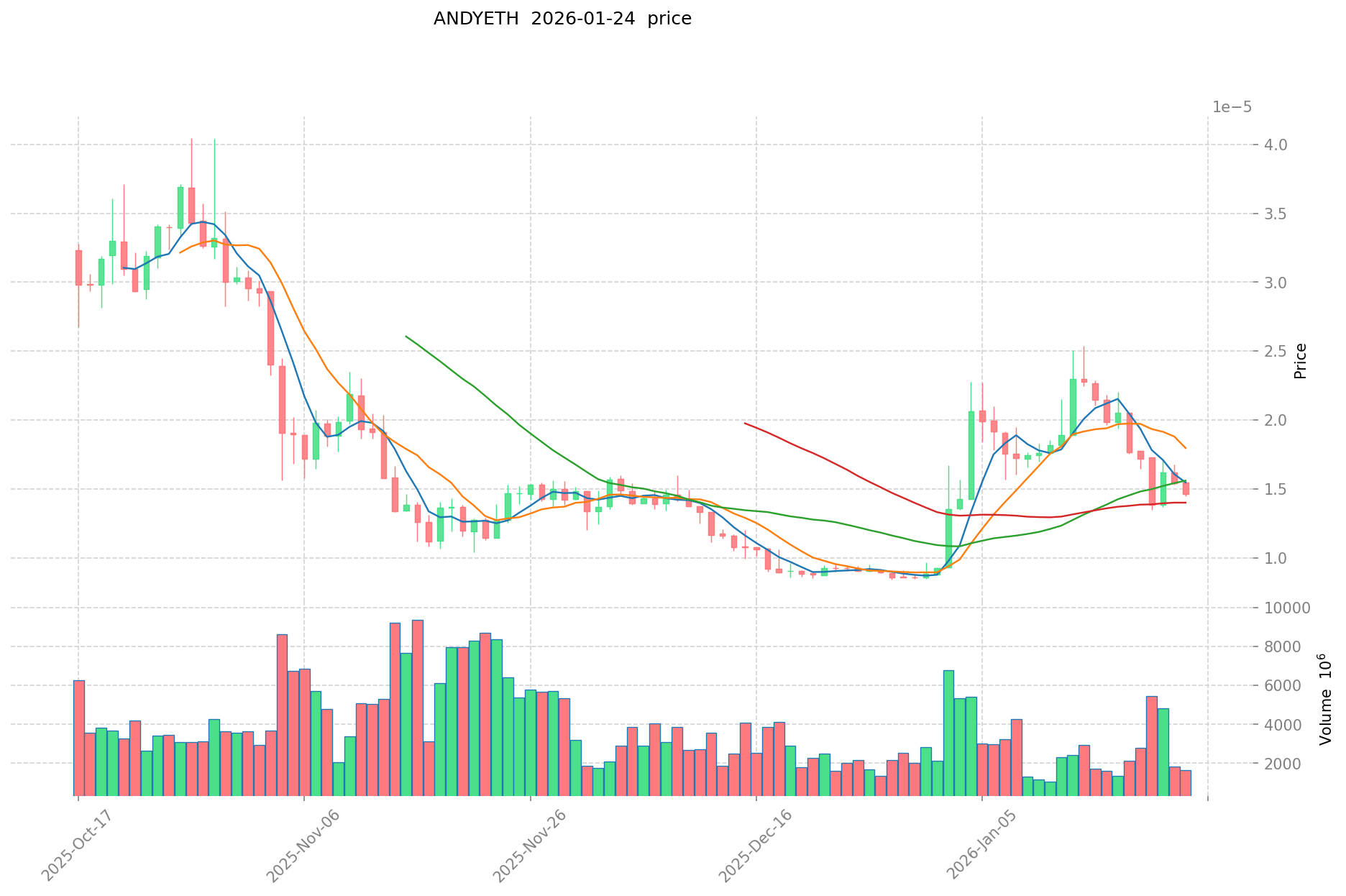
ANDYETH is a memecoin asset in the cryptocurrency sector, launched in March 2024 as a companion token to the popular Pepe memecoin. As of January 24, 2026, ANDYETH holds a market capitalization of approximately $14.42 million, with a circulating supply of 1 trillion tokens, and a current price around $0.000014416. Positioned as "Pepe's lifelong best friend," ANDYETH has attracted attention within the memecoin community, prompting investors to consider "Is Andy (ANDYETH) a good investment?" This article provides a comprehensive analysis of ANDYETH's investment characteristics, historical price movements, future price projections, and associated risks to inform investment considerations.
The token operates on the Ethereum blockchain and is available on 5 exchanges, with approximately 24,927 holders recorded. ANDYETH experienced significant price volatility over the past year, with notable fluctuations including a 56.75% increase over the past 30 days, contrasted by an 87.05% decline over the past year from its historical peak of $0.00036813 in December 2024. With 100% of its maximum supply already in circulation, the token's market dynamics reflect typical memecoin characteristics, where community sentiment and broader crypto market trends play substantial roles in price movements.
I. ANDYETH Price History Review and Investment Value Status
- 2024: Andy token launched in March 2024 → Early investors experienced significant volatility with the token reaching a peak price level in December
- 2024: Market momentum in Q4 2024 → ANDYETH price showed upward movement during the fourth quarter
- 2025: Market correction phase → Price declined from elevated levels in late 2024 to lower price ranges by the end of 2025
Current ANDYETH Investment Market Status (January 2026)
- ANDYETH current price: $0.000014416
- Market sentiment (Fear & Greed Index): Data not available in provided materials
- 24-hour trading volume: $29,528.75
- Institutional investor holdings: Data not available in provided materials
Click to view real-time ANDYETH market price
II. Core Factors Affecting Whether ANDYETH is a Good Investment
Supply Mechanism and Scarcity (ANDYETH investment scarcity)
-
Fixed Supply Model → Influences Price and Investment Value
Andy (ANDYETH) has a maximum supply of 1,000,000,000,000 tokens, with 100% already in circulation as of January 24, 2026. This fixed supply model creates a theoretical scarcity framework, where no additional tokens can be minted, potentially supporting price stability in the long term.
-
Historical Price Performance
Since its launch in March 2024, ANDYETH has experienced significant price volatility. The token reached a notable price level of $0.00036813 in December 2024, but subsequently declined to $0.000008418 in December 2025. As of January 24, 2026, the price stands at $0.000014416, representing a recovery from recent lows but remaining substantially below previous peaks.
-
Investment Significance
The complete circulation of the total supply eliminates future dilution concerns for holders. However, the absence of supply-side adjustments means price movements are driven primarily by demand dynamics and market sentiment, rather than controlled supply mechanisms.
Market Adoption and Community Engagement
-
Holder Distribution
As of the latest data, ANDYETH has approximately 24,927 holders, indicating a moderate level of community participation for a memecoin in this market capitalization range.
-
Exchange Accessibility
The token is available on 5 cryptocurrency exchanges, providing multiple access points for potential investors, though this represents relatively limited mainstream exchange coverage compared to more established digital assets.
-
Market Positioning
ANDYETH positions itself as a companion memecoin to Pepe, aiming to establish itself within the broader memecoin market segment. This thematic connection may influence community engagement and adoption patterns.
Macro Market Environment Impact on ANDYETH Investment
-
Market Performance Context
Over the past year, ANDYETH has experienced a decline of approximately 87.05%, reflecting broader challenges in the memecoin sector and shifting investor sentiment. However, the 30-day performance shows a 56.75% increase, suggesting periods of renewed interest.
-
Volatility Considerations
The 24-hour trading volume of approximately $29,528 and market capitalization of $14.416 million indicate a relatively smaller market presence, which typically correlates with higher price volatility and liquidity considerations for investors.
-
Market Share
With a market dominance of 0.00045%, ANDYETH represents a minor position within the overall cryptocurrency market, suggesting higher risk profiles associated with smaller-cap digital assets.
Technology and Ecosystem Foundation
-
Token Standard Implementation
ANDYETH is deployed on the Ethereum network as an ERC-20 token (contract address: 0x68bbed6a47194eff1cf514b50ea91895597fc91e), providing access to Ethereum's established infrastructure and ecosystem.
-
Ecosystem Integration
As an ERC-20 token, ANDYETH can potentially integrate with various decentralized applications, wallets, and DeFi protocols within the Ethereum ecosystem, though specific ecosystem applications and partnerships were not detailed in available materials.
-
Infrastructure Foundation
The use of Ethereum's network provides established security mechanisms and blockchain infrastructure, which may be relevant considerations for evaluating the technical foundation of the investment.
III. ANDYETH Future Investment Forecast and Price Outlook (Is Andy(ANDYETH) worth investing in 2026-2031)
Short-term Investment Forecast (2026, short-term ANDYETH investment outlook)
- Conservative forecast: $0.00001243388 - $0.000014458
- Neutral forecast: $0.000014458
- Optimistic forecast: $0.000014458 - $0.0000173496
Mid-term Investment Outlook (2027-2029, mid-term Andy(ANDYETH) investment forecast)
- Market stage expectation: The token may experience moderate growth with potential fluctuations driven by memecoin market sentiment and broader crypto market conditions.
- Investment return forecast:
- 2027: $0.000013995344 - $0.000017653218
- 2028: $0.00001476508792 - $0.0000218120617
- 2029: $0.000014857369719 - $0.000023926153834
- Key catalysts: Community engagement trends, memecoin sector performance, and holder base expansion
Long-term Investment Outlook (Is Andy a good long-term investment?)
- Base scenario: $0.000014833597927 - $0.000025846420632 (assumes steady holder growth and sustained community interest)
- Optimistic scenario: $0.000021610719592 - $0.000025846420632 (assumes favorable memecoin market conditions and increased adoption)
- Risk scenario: $0.00001243388 - $0.000014857369719 (under adverse market conditions or reduced community engagement)
View ANDYETH long-term investment and price forecast: Price Prediction
2026-2031 Long-term Outlook
- Base scenario: $0.000014458 - $0.000022475148375 (corresponds to steady progress and gradual mainstream application growth)
- Optimistic scenario: $0.000021610719592 - $0.000025846420632 (corresponds to large-scale adoption and favorable market environment)
- Transformative scenario: Above $0.000025846420632 (in case of breakthrough ecosystem developments and mainstream adoption)
- 2031-12-31 forecast high: $0.000025846420632 (based on optimistic development assumptions)
Disclaimer: Price forecasts are based on historical data analysis and predictive modeling. Cryptocurrency markets are highly volatile and subject to numerous unpredictable factors. These projections should not be construed as investment advice. Past performance does not guarantee future results.
| Year |
Predicted High Price |
Predicted Average Price |
Predicted Low Price |
Price Change |
| 2026 |
0.0000173496 |
0.000014458 |
0.00001243388 |
0 |
| 2027 |
0.000017653218 |
0.0000159038 |
0.000013995344 |
10 |
| 2028 |
0.0000218120617 |
0.000016778509 |
0.00001476508792 |
16 |
| 2029 |
0.000023926153834 |
0.00001929528535 |
0.000014857369719 |
33 |
| 2030 |
0.000023339577159 |
0.000021610719592 |
0.000016208039694 |
49 |
| 2031 |
0.000025846420632 |
0.000022475148375 |
0.000014833597927 |
55 |
IV. Andy Investment Strategy and Risk Management (How to invest in memecoins)
Investment Methodology (Andy investment strategy)
-
Long-term holding (HODL Andy): Suitable for conservative investors who believe in the long-term potential of meme-based cryptocurrencies. This strategy involves purchasing Andy tokens and holding them through market fluctuations, anticipating future value appreciation as the project develops and gains wider adoption within the memecoin community.
-
Active trading: Relies on technical analysis and swing trading strategies. Traders may capitalize on Andy's price volatility by monitoring key support and resistance levels, volume patterns, and short-term price movements to execute buy and sell orders strategically.
Risk Management (Risk management for Andy investment)
-
Asset allocation ratio:
- Conservative investors: Allocate no more than 1-3% of total portfolio to high-risk assets like Andy
- Aggressive investors: May allocate 5-10% depending on risk tolerance and market conditions
- Professional investors: Utilize dynamic allocation strategies based on market analysis and portfolio rebalancing
-
Risk hedging solutions: Implement multi-asset portfolio diversification by combining Andy with established cryptocurrencies and traditional assets. Consider utilizing stablecoins as a hedging instrument during periods of high volatility.
-
Secure storage: Use cold wallets for long-term holdings and hot wallets only for active trading amounts. Hardware wallet options provide enhanced security for substantial Andy holdings, protecting against online threats and unauthorized access.
V. Andy Investment Risks and Challenges (Risks of investing in memecoins)
-
Market risks: Memecoins like Andy exhibit high price volatility, with the token experiencing a 7-day decline of 28.17% and fluctuating between $0.000014332 and $0.000016561 within 24 hours. The memecoin sector is also susceptible to price manipulation due to concentrated holdings and lower liquidity compared to established cryptocurrencies.
-
Regulatory risks: Policy uncertainty varies significantly across jurisdictions. Different countries maintain evolving positions on memecoins and cryptocurrency classification, which could impact Andy's accessibility, trading venues, and legal status in various markets.
-
Technical risks: Smart contract vulnerabilities present potential security concerns for ERC20-based tokens. Network congestion on Ethereum can lead to increased transaction costs and delayed transfers. Additionally, dependencies on the Ethereum network mean that any technical issues or unsuccessful upgrades on the main chain could affect Andy token functionality.
VI. Conclusion: Is memecoin a Good Investment?
-
Investment value summary: Andy presents characteristics typical of memecoins, with significant price volatility as evidenced by its 1-year performance showing an 87.05% decline from previous levels, while demonstrating a 30-day increase of 56.75%. The project maintains a fully circulating supply of 1 trillion tokens with a market cap of approximately $14.4 million and is held by 24,927 addresses.
-
Investor recommendations:
✅ Beginners: Consider dollar-cost averaging approach combined with secure wallet storage practices to mitigate timing risks
✅ Experienced investors: Employ swing trading strategies while maintaining diversified portfolio allocation
✅ Institutional investors: Evaluate strategic positioning within broader memecoin sector exposure
⚠️ Notice: Cryptocurrency investment carries substantial risk. This content is for informational purposes only and does not constitute investment advice.
VII. FAQ
Q1: What is ANDYETH and how does it differ from other memecoins?
ANDYETH is an Ethereum-based memecoin launched in March 2024, positioned as "Pepe's lifelong best friend" and serving as a companion token to the popular Pepe memecoin. Unlike some memecoins with inflationary models, ANDYETH has a fixed maximum supply of 1 trillion tokens with 100% already in circulation, eliminating future dilution concerns. The token operates as an ERC-20 standard asset on the Ethereum blockchain, providing access to established infrastructure and potential DeFi integrations. However, similar to other memecoins, ANDYETH's value is primarily driven by community sentiment and market speculation rather than utility-based fundamentals.
Q2: What has been ANDYETH's historical price performance?
ANDYETH has experienced significant volatility since its March 2024 launch. The token reached a notable peak of $0.00036813 in December 2024, followed by a substantial decline to $0.000008418 by December 2025, representing an 87.05% decrease from its all-time high. As of January 24, 2026, the price stands at $0.000014416, showing a 56.75% recovery over the previous 30 days. This volatility pattern is characteristic of smaller-cap memecoins, which are particularly susceptible to rapid sentiment shifts and market-wide cryptocurrency trends. The 24-hour trading volume of approximately $29,528 and market capitalization of $14.42 million indicate relatively limited liquidity compared to more established digital assets.
Q3: What are the primary risks associated with investing in ANDYETH?
ANDYETH carries several significant investment risks typical of memecoin assets. Market risk is evidenced by extreme price volatility, with 24-hour fluctuations ranging between $0.000014332 and $0.000016561, and recent data showing a 7-day decline of 28.17%. The token's relatively small market dominance of 0.00045% and limited exchange availability (5 platforms) contribute to liquidity concerns and potential for price manipulation. Regulatory uncertainty across different jurisdictions poses additional challenges, as evolving cryptocurrency policies could impact the token's accessibility and legal status. Technical risks include potential smart contract vulnerabilities inherent to ERC-20 tokens and dependency on Ethereum network performance, where congestion can lead to increased transaction costs and delays.
Q4: What is the investment outlook for ANDYETH through 2031?
Price forecasts for ANDYETH suggest varied scenarios depending on market conditions and adoption trends. For 2026, conservative projections range from $0.00001243388 to $0.0000173496, with a neutral forecast around $0.000014458. Mid-term projections (2027-2029) anticipate gradual growth driven by memecoin sector performance and community engagement, with 2029 estimates ranging from $0.000014857369719 to $0.000023926153834. Long-term optimistic scenarios through 2031 project potential highs of $0.000025846420632, representing approximately 55% growth from 2026 levels, contingent upon favorable market conditions and sustained community interest. However, risk scenarios account for potential declines under adverse conditions, emphasizing the speculative nature of these projections.
Q5: What investment strategies are appropriate for ANDYETH?
Investment approaches for ANDYETH depend on individual risk tolerance and experience levels. Long-term holding (HODL) strategies may suit conservative investors willing to withstand volatility while anticipating potential future appreciation within the memecoin sector, though position sizing should remain conservative (1-3% of portfolio for risk-averse investors). Active trading strategies can capitalize on ANDYETH's price volatility through technical analysis and swing trading, monitoring support/resistance levels and volume patterns for strategic entry/exit points. Risk management is essential across all approaches, including diversified portfolio allocation, secure storage practices using hardware wallets for long-term holdings, and potential hedging with stablecoins during high volatility periods. Beginners should consider dollar-cost averaging to mitigate timing risks, while experienced investors may employ more dynamic allocation strategies based on market conditions.
Q6: How liquid is ANDYETH and where can it be traded?
ANDYETH maintains relatively limited liquidity compared to mainstream cryptocurrencies, with a 24-hour trading volume of approximately $29,528 and availability on 5 cryptocurrency exchanges as of January 24, 2026. The token's market capitalization of $14.42 million and approximately 24,927 holders indicate moderate community participation within its market segment. This limited exchange coverage and trading volume can result in wider bid-ask spreads and potential challenges executing large orders without significant price impact. The concentrated nature of the holder base (24,927 addresses controlling the entire 1 trillion token supply) may also contribute to liquidity constraints during periods of heightened market activity. Prospective investors should consider these liquidity characteristics when determining position sizes and entry/exit strategies.
Q7: What role does the Ethereum blockchain play in ANDYETH's functionality?
ANDYETH operates as an ERC-20 token on the Ethereum blockchain (contract address: 0x68bbed6a47194eff1cf514b50ea91895597fc91e), leveraging Ethereum's established infrastructure and security mechanisms. This implementation provides compatibility with various decentralized applications, wallets, and DeFi protocols within the Ethereum ecosystem, potentially enabling future integrations and use cases. However, this dependency also introduces considerations related to Ethereum network performance, including potential transaction cost fluctuations during periods of network congestion and processing delays. The ERC-20 standard offers advantages of widespread wallet support and established security auditing practices, though token holders should remain aware of smart contract risks inherent to any blockchain-based asset. Network upgrades or technical issues on the Ethereum mainnet could also impact ANDYETH's functionality and transaction processing.
Q8: What factors should investors consider when evaluating ANDYETH's long-term potential?
Evaluating ANDYETH's long-term investment potential requires consideration of multiple factors specific to memecoin assets. The fixed supply of 1 trillion tokens with 100% circulation eliminates future dilution but also means price movements depend entirely on demand dynamics rather than supply-side adjustments. Community engagement and holder base expansion represent critical drivers, as the token's value proposition centers on its positioning within the Pepe memecoin ecosystem and broader meme culture. Broader cryptocurrency market trends and memecoin sector sentiment significantly influence price movements, as evidenced by ANDYETH's correlation with overall crypto market cycles. Technical foundation on Ethereum provides infrastructure stability, though limited exchange availability and relatively small market dominance (0.00045%) indicate early-stage market presence. Investors should assess these factors against their risk tolerance, recognizing that memecoin investments carry substantial speculative risk and extreme volatility potential.
* The information is not intended to be and does not constitute financial advice or any other recommendation of any sort offered or endorsed by Gate.