Bio Protocol (BIO) is a decentralized science (DeSci) curation and liquidity protocol enabling global communities to collectively fund and own tokenized biotech projects and intellectual property. This comprehensive analysis examines BIO's investment characteristics, price history from launch at $0.0452 to current levels around $0.04615, and detailed tokenomics with 3.32 billion maximum supply. The article evaluates short-term price forecasts ranging from $0.032389 to $0.0629272, mid-term projections through 2028, and long-term outlook reaching $0.105 by 2031 under optimistic scenarios. Key investment strategies include dollar-cost averaging for beginners, swing trading for experienced investors, and strategic allocation for institutions, balanced against significant market volatility, regulatory uncertainty, and technical risks. The analysis provides actionable recommendations for different investor profiles seeking exposure to emerging biotechnology innovation funding through Gate exchange.
Introduction: Bio Protocol (BIO) Investment Position and Market Outlook
Bio Protocol (BIO) represents a notable asset in the cryptocurrency sector, functioning as a curation and liquidity protocol for Decentralized Science (DeSci). Launched in early January 2025, BIO aims to accelerate biotechnology by enabling global communities of patients, scientists, and biotech professionals to collectively fund, build, and own tokenized biotech projects and intellectual property. As of January 18, 2026, BIO holds a market capitalization of approximately $89.68 million with a circulating supply of around 1.94 billion tokens. The current trading price stands at approximately $0.04615, with the token experiencing price movements that reflect ongoing market dynamics. Positioned at rank 382 in the broader cryptocurrency market with a 0.0045% market dominance, BIO has attracted attention from 10,405 holders across 39 exchanges. This article provides a comprehensive analysis of BIO's investment characteristics, historical price performance, future price projections, and associated investment risks to offer informative perspectives for those evaluating Bio Protocol as a potential addition to their portfolio.
I. Bio Protocol (BIO) Price History Review and Current Investment Value
-
December 2024: Bio Protocol (BIO) launched on exchanges with an initial offering price around $0.0452, marking the project's entry into public markets. Early participants saw significant gains as the token reached trading prices above its launch level.
-
December 25, 2024: BIO experienced notable price appreciation, with the token reaching approximately $1.09 during this period. This represented substantial returns for early holders relative to the initial offering price.
-
October 2025: Following broader market corrections and sector-specific adjustments, BIO's price declined to approximately $0.02906, reflecting a significant retracement from earlier price levels.
Current BIO Investment Market Landscape (January 2026)
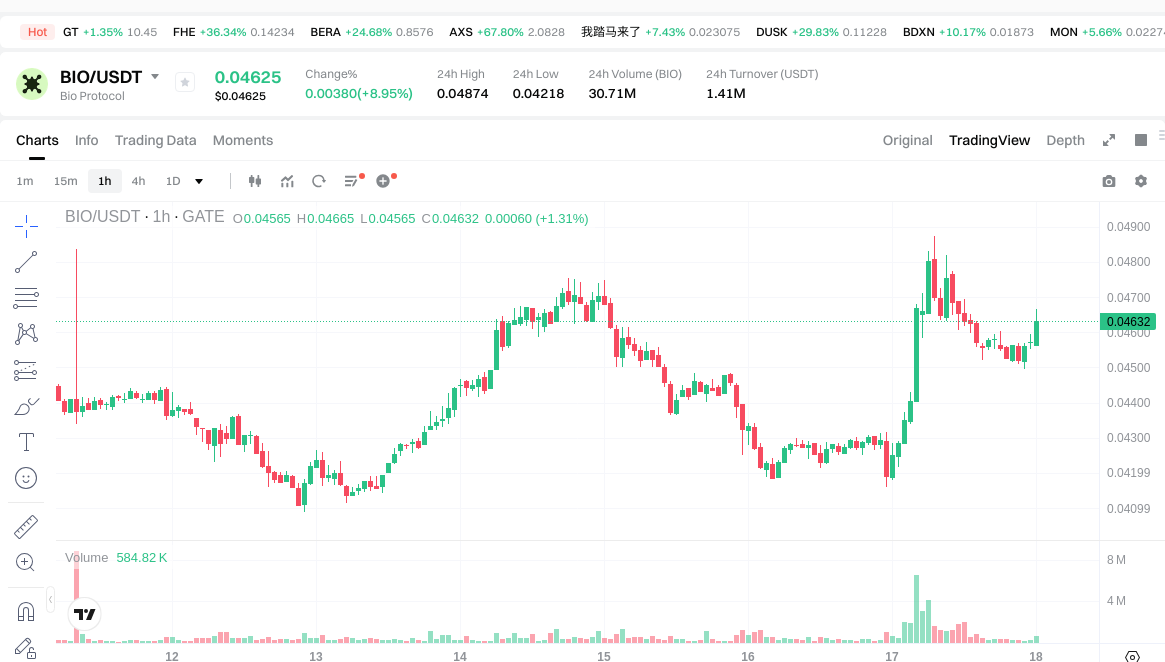
- BIO Current Price: $0.04615 (as of January 18, 2026)
- Market Emotion (Fear & Greed Index): Data not provided in reference materials
- 24-Hour Trading Volume: Approximately $1.40 million, indicating moderate trading activity in the current market environment
- Institutional Investor Holdings: The token has attracted approximately 10,405 holders, suggesting a developing holder base across retail and potentially institutional participants
Click to view real-time BIO market price
II. Core Factors Influencing Whether BIO Is a Good Investment
Supply Mechanism and Scarcity (BIO Investment Scarcity)
- Total and Circulating Supply Impact: BIO has a maximum supply of 3.32 billion tokens, with approximately 1.94 billion tokens currently in circulation (58.53% circulating ratio). This controlled supply structure may contribute to potential scarcity dynamics as adoption increases.
- Supply Dynamics and Price Correlation: The token allocation model includes a 6.9% allocation from new projects launched through the protocol, creating a systematic supply mechanism that ties token generation to ecosystem expansion.
- Investment Implications: The capped maximum supply establishes a framework for potential long-term scarcity, which some market participants view as a factor supporting value retention, though actual price performance depends on multiple variables including demand dynamics and market conditions.
Institutional Investment and Mainstream Adoption (Institutional Investment in BIO)
- Community-Driven Governance Model: BIO operates through a decentralized curation system where token holders stake their tokens to vote on scientific project admissions, creating a community-governed framework rather than traditional institutional control structures.
- Ecosystem Revenue Model: The protocol generates revenue through token allocations from newly launched projects and fees from automated liquidity management systems, establishing a self-sustaining economic model.
- Adoption Metrics: As of January 2026, BIO has approximately 10,405 holders and is listed on 39 exchanges, indicating growing but still developing market presence.
Macroeconomic Environment Impact on BIO Investment
- Market Volatility Observations: BIO has demonstrated significant price volatility, with recorded fluctuations between lower and higher price points since its launch, reflecting sensitivity to broader cryptocurrency market conditions.
- DeSci Sector Positioning: As a decentralized science (DeSci) protocol, BIO's investment profile is influenced by both cryptocurrency market trends and growing interest in blockchain-enabled scientific research funding models.
- Trading Activity: The token recorded a 24-hour trading volume of approximately $1.40 million as of January 18, 2026, with price movements showing sensitivity to market sentiment shifts.
Technology and Ecosystem Development (Technology & Ecosystem for BIO Investment)
- Automated Liquidity Management: The protocol incorporates automated liquidity management systems designed to maintain financial stability for research projects, reducing operational complexity for participating scientists.
- Tokenized Intellectual Property Framework: BIO enables the tokenization of biotechnology projects and intellectual property, creating a novel mechanism for funding and ownership of scientific research outcomes.
- Ecosystem Revenue Reinvestment: The protocol's model includes reinvesting revenue from successful projects back into the ecosystem to fund future innovations, establishing a cyclical funding mechanism.
- Application Scope: The platform serves as infrastructure for funding, developing, and governing tokenized scientific innovation, targeting participation from universities, research institutions, and scientists globally.
III. BIO Future Investment Forecast and Price Outlook (Is Bio Protocol(BIO) worth investing in 2026-2031)
Short-term Investment Forecast (2026, short-term BIO investment outlook)
- Conservative Forecast: $0.032389 - $0.04627
- Neutral Forecast: $0.04627 - $0.0629272
- Optimistic Forecast: $0.0629272 and above
Mid-term Investment Outlook (2027-2028, mid-term Bio Protocol(BIO) investment forecast)
-
Market Stage Expectation: Bio Protocol may enter a phase of ecosystem expansion and adoption growth as the DeSci sector develops. The token's performance could be influenced by project milestones, partnership announcements, and broader market conditions.
-
Investment Return Forecast:
- 2027: $0.044224866 - $0.066064306
- 2028: $0.04524858975 - $0.08024083249
-
Key Catalysts: Expansion of decentralized science initiatives, increased institutional participation in tokenized biotech projects, strategic partnerships with research institutions, and favorable regulatory developments in the DeSci space.
Long-term Investment Outlook (Is BIO a good long-term investment?)
- Base Scenario: $0.070686773758646 - $0.103250343692405 (Assuming steady adoption and moderate market growth through 2030)
- Optimistic Scenario: $0.105037368871696 - higher levels (Contingent on accelerated DeSci sector growth, mainstream adoption of tokenized biotech projects, and favorable market conditions)
- Risk Scenario: Below $0.032389 (In cases of significant market downturns, regulatory challenges, or failure to achieve adoption milestones)
Click to view BIO long-term investment and price forecast: Price Prediction
2026-01-18 to 2031 Long-term Outlook
- Base Scenario: $0.046 - $0.091 (Corresponding to steady progress and gradual mainstream application growth)
- Optimistic Scenario: $0.091 - $0.105 (Corresponding to large-scale adoption and favorable market environment)
- Transformative Scenario: Above $0.105 (Such as breakthrough progress in ecosystem development and mainstream popularization)
- 2031-12-31 Forecast High: $0.105037368871696 (Based on optimistic development assumptions)
Disclaimer: The above forecasts are based on available market data and analytical models. Cryptocurrency investments carry substantial risk, and actual prices may differ significantly from predictions due to market volatility, regulatory changes, technological developments, and other unforeseen factors. This content does not constitute investment advice, and investors should conduct their own research and risk assessment before making investment decisions.
| Year |
Predicted High Price |
Predicted Average Price |
Predicted Low Price |
Price Change |
| 2026 |
0.0629272 |
0.04627 |
0.032389 |
0 |
| 2027 |
0.066064306 |
0.0545986 |
0.044224866 |
18 |
| 2028 |
0.08024083249 |
0.060331453 |
0.04524858975 |
30 |
| 2029 |
0.0885605398587 |
0.070286142745 |
0.06396038989795 |
52 |
| 2030 |
0.103250343692405 |
0.07942334130185 |
0.070686773758646 |
72 |
| 2031 |
0.105037368871696 |
0.091336842497127 |
0.076722947697587 |
97 |
IV. Bio Protocol Investment Strategy and Risk Management (How to invest in DeSci tokens)
Investment Methodology (Bio Protocol investment strategy)
-
Long-term Holding (HODL BIO): Suitable for conservative investors
Long-term holding represents a strategy where investors maintain their BIO token positions over extended periods, focusing on the protocol's fundamental value proposition in decentralized science rather than short-term price movements. This approach may appeal to those who believe in the long-term growth potential of tokenized biotechnology projects and intellectual property democratization.
-
Active Trading: Relies on technical analysis and swing trading
Active traders may leverage BIO's price volatility for short-term profit opportunities. Given the token's 24-hour price fluctuation range between $0.04207 and $0.04874, traders employing technical analysis might identify entry and exit points based on support and resistance levels, volume patterns, and momentum indicators.
Risk Management (Risk management for Bio Protocol investment)
-
Asset Allocation Ratio: Conservative / Aggressive / Professional investors
- Conservative investors might limit BIO exposure to 1-3% of their total portfolio
- Aggressive investors with higher risk tolerance could allocate 5-10%
- Professional investors with deep DeSci sector knowledge might consider larger positions based on comprehensive due diligence
-
Risk Hedging Solutions: Multi-asset portfolio + hedging instruments
Diversification across different cryptocurrency categories and traditional assets can help mitigate BIO-specific risks. Investors might consider combining BIO with established cryptocurrencies, stablecoins, and other DeSci-related tokens to balance sector-specific exposure.
-
Secure Storage: Hot/cold wallets + hardware wallet recommendations
Given BIO's ERC20 standard on Ethereum, investors should prioritize security through:
- Hardware wallets (Ledger, Trezor) for long-term holdings
- Cold storage solutions for large positions
- Reputable software wallets for smaller amounts needed for trading
- Multi-signature wallets for institutional holdings
V. Bio Protocol Investment Risks and Challenges (Risks of investing in DeSci tokens)
-
Market Risk: High volatility and price manipulation concerns
BIO exhibits significant price volatility, with 24-hour changes reaching 10.56% and historical fluctuations ranging from $0.02906 to $1.09. The relatively modest market capitalization of approximately $89.68 million may increase susceptibility to large holder activities and trading volume concentration. With a circulating supply representing 58.53% of maximum supply, token unlock schedules could potentially impact price stability.
-
Regulatory Risk: Policy uncertainty across different jurisdictions
The intersection of decentralized finance and biotechnology intellectual property creates complex regulatory considerations. Different jurisdictions may develop varying approaches to tokenized biotech projects, potentially affecting BIO's operational framework and token utility. Investors should monitor evolving regulations surrounding both cryptocurrency assets and biotechnology governance.
-
Technical Risk: Network security vulnerabilities and upgrade failures
As an ERC20 token operating on Ethereum, BIO inherits the underlying blockchain's security properties and potential vulnerabilities. Smart contract risks associated with the protocol's governance and liquidity mechanisms require ongoing audits and monitoring. Protocol upgrades or modifications to tokenized IP management systems could introduce technical challenges.
VI. Conclusion: Is DeSci a Good Investment?
-
Investment Value Summary: BIO presents notable long-term investment potential within the emerging decentralized science sector, though short-term price movements remain highly volatile.
The protocol addresses a meaningful use case by democratizing access to biotechnology funding and intellectual property ownership. However, investors should recognize that the token has experienced substantial price decline, with current levels significantly below historical peaks. The project's success depends on continued adoption within the scientific community and development of viable tokenized biotech projects.
-
Investor Recommendations:
✅ Beginners: Dollar-cost averaging + secure wallet storage
- Implement systematic periodic purchases to mitigate timing risk
- Prioritize understanding the protocol's fundamentals before investing
- Use established hardware wallets for asset protection
✅ Experienced Investors: Swing trading + portfolio configuration
- Monitor technical indicators and sector developments
- Maintain diversified exposure across multiple DeSci projects
- Set clear risk parameters and stop-loss levels
✅ Institutional Investors: Strategic long-term allocation
- Conduct comprehensive due diligence on protocol mechanics
- Evaluate alignment with broader biotechnology innovation thesis
- Consider governance participation opportunities
⚠️ Disclaimer: Cryptocurrency investments carry substantial risk. This content is provided for informational purposes only and does not constitute investment advice. Investors should conduct independent research and consider their financial situation before making investment decisions.
VII. FAQ
Q1: What is Bio Protocol (BIO) and how does it work in the DeSci ecosystem?
Bio Protocol (BIO) is a curation and liquidity protocol designed for Decentralized Science (DeSci) that enables global communities to collectively fund, build, and own tokenized biotech projects and intellectual property. The protocol operates through a community-driven governance model where token holders stake BIO to vote on scientific project admissions. It generates revenue through token allocations from newly launched projects (6.9% allocation) and fees from automated liquidity management systems. This creates a self-sustaining economic model that democratizes access to biotechnology funding while establishing a framework for tokenized intellectual property ownership, targeting participation from universities, research institutions, and scientists globally.
Q2: What are the key price milestones in BIO's trading history since launch?
Bio Protocol launched in early January 2025 at approximately $0.0452, followed by significant appreciation to around $1.09 by December 25, 2024. However, the token experienced substantial correction, declining to approximately $0.02906 by October 2025. As of January 18, 2026, BIO trades at $0.04615 with a market capitalization of approximately $89.68 million. This price trajectory reflects volatility common in emerging cryptocurrency projects, with movements influenced by broader market conditions and sector-specific developments in the DeSci space.
Q3: How does BIO's tokenomics structure impact its investment potential?
BIO has a maximum supply of 3.32 billion tokens with approximately 1.94 billion tokens currently in circulation (58.53% circulating ratio), establishing a controlled supply framework. The token allocation model includes systematic generation tied to ecosystem expansion through new project launches. This capped maximum supply creates potential scarcity dynamics as adoption increases, though actual price performance depends on demand factors and market conditions. The remaining 41.47% of tokens not yet in circulation could impact future price stability depending on unlock schedules and distribution mechanisms.
Q4: What are the primary risks associated with investing in Bio Protocol?
BIO presents three major risk categories: Market risk includes high volatility with 24-hour changes reaching 10.56% and historical fluctuations from $0.02906 to $1.09, plus potential price manipulation concerns given its relatively modest $89.68 million market capitalization. Regulatory risk stems from policy uncertainty surrounding the intersection of decentralized finance and biotechnology intellectual property across different jurisdictions. Technical risk involves smart contract vulnerabilities associated with governance and liquidity mechanisms, as well as potential challenges from protocol upgrades. Investors should conduct thorough due diligence and implement appropriate risk management strategies.
Q5: What investment strategies are recommended for different types of BIO investors?
For beginners, dollar-cost averaging combined with secure hardware wallet storage is recommended, limiting exposure to 1-3% of portfolio. This approach mitigates timing risk while prioritizing asset security. Experienced investors may employ swing trading strategies leveraging BIO's volatility (24-hour range $0.04207-$0.04874), maintaining 5-10% allocation with clear stop-loss parameters and diversification across multiple DeSci projects. Institutional investors should consider strategic long-term allocation based on comprehensive due diligence, evaluating alignment with biotechnology innovation thesis and exploring governance participation opportunities.
Q6: What are the price forecasts for BIO through 2031?
Short-term forecasts for 2026 range from $0.032389 (conservative) to above $0.0629272 (optimistic). Mid-term projections show potential growth to $0.044224866-$0.066064306 in 2027 and $0.04524858975-$0.08024083249 in 2028, contingent on ecosystem expansion and DeSci sector development. Long-term outlook through 2031 presents a base scenario of $0.070686773758646-$0.103250343692405, optimistic scenario reaching $0.105037368871696, and risk scenario below $0.032389. These projections assume varying levels of adoption, market conditions, and regulatory developments, though actual prices may differ significantly due to cryptocurrency market volatility.
Q7: How does Bio Protocol generate revenue and sustain its ecosystem?
The protocol establishes a multi-faceted revenue model combining token allocations from newly launched projects (6.9% systematic allocation) with fees from automated liquidity management systems. This creates a self-sustaining economic framework where revenue is reinvested back into the ecosystem to fund future innovations, establishing a cyclical funding mechanism. The automated liquidity management reduces operational complexity for participating scientists while maintaining financial stability for research projects. This revenue structure ties token generation directly to ecosystem expansion, potentially creating positive feedback loops as more projects launch through the platform.
Q8: What factors could drive BIO's price appreciation in the coming years?
Key catalysts include expansion of decentralized science initiatives, increased institutional participation in tokenized biotech projects, and strategic partnerships with research institutions. The protocol's current holder base of 10,405 participants across 39 exchanges suggests room for significant growth in adoption. Favorable regulatory developments specifically addressing the DeSci space could remove barriers to institutional involvement. Additionally, successful launches of tokenized biotech projects demonstrating real-world value creation could validate the protocol's fundamental thesis, potentially attracting mainstream attention to the broader DeSci sector and BIO's role as infrastructure for scientific innovation funding.
* The information is not intended to be and does not constitute financial advice or any other recommendation of any sort offered or endorsed by Gate.