This comprehensive analysis evaluates whether Constellation (DAG) represents a viable investment opportunity by examining its blockchain infrastructure positioning, market performance, and growth potential. As a Web3 enterprise-focused zero-layer protocol with a hypergraph network architecture, DAG currently trades at $0.01182 with a $44.92 million market cap as of January 2026. The article examines historical price trends, core factors affecting investment value including its unlimited supply mechanism and 70+ enterprise partnerships, price forecasts ranging from $0.0071 to $0.035 through 2031, and practical investment strategies across different investor profiles. Key considerations include significant volatility (down 83.1% annually), limited liquidity with $28,424 daily trading volume on Gate and other exchanges, regulatory uncertainties, and adoption challenges. The analysis provides risk management guidance, storage recommendations, and FAQ insights to help investors make informed decisions about DAG's
Introduction: Constellation (DAG)'s Investment Position and Market Prospects
DAG is a notable asset in the cryptocurrency sector. Since its launch in 2018, it has made progress in blockchain infrastructure and Web3 applications. As of January 2026, Constellation holds a market capitalization of approximately $44.92 million, with a circulating supply of around 3.80 billion tokens, and the current price is maintained at approximately $0.01182. Positioned as a zero-layer protocol utilizing a hypergraph network architecture, DAG has gradually become a focal point when investors discuss "Is Constellation (DAG) a good investment?" This article will comprehensively analyze Constellation's investment value, historical trends, future price forecasts, and investment risks to provide reference for investors.
I. Constellation (DAG) Historical Price Review and Current Investment Value
- 2018: Constellation launched with initial trading activity → Early investors experienced significant volatility as the project established its market presence
- 2021: Market attention on blockchain infrastructure projects → DAG price showed notable fluctuations during broader market movements
- 2022-2023: Cryptocurrency market adjustment period → Price declined from elevated levels to more conservative valuations
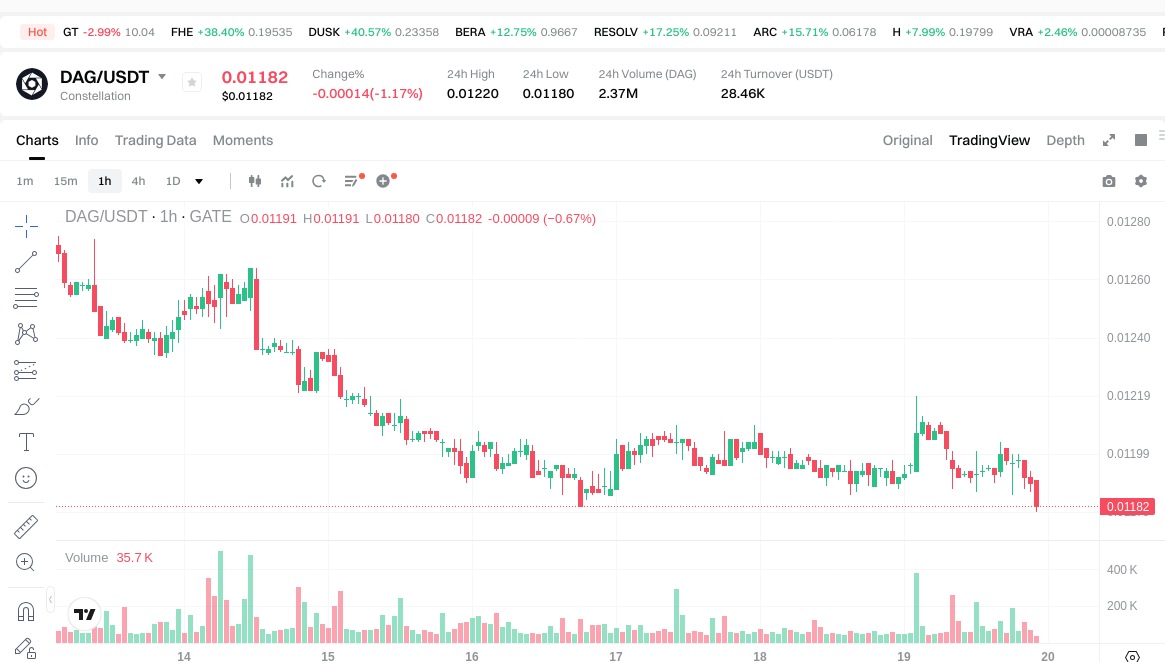
Current DAG Investment Market Status (January 2026)
- DAG current price: 0.01182 USD
- Market sentiment: Data suggests neutral to cautious positioning among participants
- 24-hour trading volume: 28,424.19 USD
- Total market capitalization: Approximately 44.92 million USD
Click to view real-time DAG market price
II. Core Factors Affecting Whether DAG is a Good Investment
Supply Mechanism and Scarcity (DAG Investment Scarcity)
- Unlimited maximum supply → affects long-term price dynamics and investment valuation
- Circulating supply represents 95.01% of total supply (3.80 billion DAG out of 3.80 billion total supply)
- Investment significance: The unlimited supply structure may impact scarcity-driven value appreciation compared to fixed-supply assets
Institutional Investment and Mainstream Adoption (Institutional Investment in DAG)
- Constellation has connected over 70 companies through its accelerator program
- Notable partnerships include Alkimi and Geojam, demonstrating ecosystem development
- The network operates with 120 mainnet nodes that earn DAGx cryptocurrency by maintaining network state
- Enterprise focus: Constellation positions itself as Web3 blockchain infrastructure for enterprises in the stakeholder economy
Macroeconomic Environment Impact on DAG Investment
- Market capitalization stands at approximately $44.92 million with 0.0013% market dominance as of January 19, 2026
- 24-hour trading volume of $28,424 reflects limited liquidity conditions
- Price performance shows significant volatility: -83.1% over one year, -8.66% over 30 days, and -7.0% over 7 days
- Historical price range from all-time low of $0.00110189 (March 9, 2019) to all-time high of $0.451761 (August 26, 2021)
Technology and Ecosystem Development (Technology & Ecosystem for DAG Investment)
- Two-tier consensus architecture: L0 and L1 layers designed to achieve speed and scalability
- Hypergraph network functions as a zero-layer protocol supported by 120 mainnet nodes
- Mobile clients serve as full nodes, forming a distributed operating system with fault resistance and horizontal scalability
- Uses asynchronous ExtendedTrustChain and proof-of-meme consensus model
- Smart contracts implemented as composable microservices compatible with JVM
- Recent launch of currency analysis devices for DOR and traffic applications
- Byzantine fault tolerance ensures stable operations even when nodes act maliciously
- Available on 8 exchanges with 3,211 token holders as of current data
III. DAG Future Investment Forecast and Price Outlook (Is Constellation(DAG) worth investing in 2026-2031)
Short-term DAG Investment Outlook (2026)
- Conservative forecast: $0.0071 - $0.012
- Neutral forecast: $0.012 - $0.017
- Optimistic forecast: $0.017 - $0.020
Mid-term Constellation(DAG) Investment Forecast (2027-2028)
- Market stage expectation: Potential gradual recovery phase with emphasis on network adoption and ecosystem development
- Investment return forecast:
- 2027: $0.014 - $0.020
- 2028: $0.015 - $0.021
- Key catalysts: Network expansion, enhanced partnerships, technological improvements in distributed architecture
Long-term Investment Outlook (Is DAG a good long-term investment?)
- Base scenario: $0.017 - $0.026 (assuming steady ecosystem growth and sustained market participation)
- Optimistic scenario: $0.022 - $0.035 (assuming increased adoption and favorable market conditions)
- Risk scenario: Below $0.013 (under adverse market conditions or reduced network activity)
Check DAG long-term investment and price prediction: Price Prediction
2026-01-19 - 2031 Long-term Outlook
- Base scenario: $0.017 - $0.026 USD (corresponding to steady progress and gradual mainstream application improvement)
- Optimistic scenario: $0.024 - $0.035 USD (corresponding to large-scale adoption and favorable market environment)
- Transformational scenario: Above $0.035 USD (if ecosystem achieves breakthrough progress and mainstream popularization)
- 2031-12-31 predicted high: $0.035 USD (based on optimistic development assumptions)
Disclaimer: Cryptocurrency markets are highly volatile and unpredictable. Price forecasts are based on historical data and current market analysis, and should not be considered as investment advice. Past performance does not guarantee future results. Investors should conduct their own research and consider their risk tolerance before making any investment decisions.
| Year |
Predicted High Price |
Predicted Average Price |
Predicted Low Price |
Price Change |
| 2026 |
0.0166662 |
0.01182 |
0.007092 |
0 |
| 2027 |
0.019797909 |
0.0142431 |
0.013815807 |
20 |
| 2028 |
0.021275630625 |
0.0170205045 |
0.01497804396 |
43 |
| 2029 |
0.025849891209375 |
0.0191480675625 |
0.013212166618125 |
61 |
| 2030 |
0.026323805881546 |
0.022498979385937 |
0.017099224333312 |
90 |
| 2031 |
0.035396519318926 |
0.024411392633742 |
0.016599746990944 |
106 |
IV. Constellation (DAG) Investment Strategy and Risk Management (How to invest in Constellation)
Investment Methodology (Constellation investment strategy)
Long-term Holding (HODL Constellation): This approach suits conservative investors who believe in the project's long-term potential. Given Constellation's focus on Web3 infrastructure and enterprise blockchain solutions, holders may benefit from network growth as more companies join through the accelerator program. However, investors should note the significant price decline of 83.1% over the past year, suggesting considerable volatility.
Active Trading: Traders utilizing technical analysis and swing trading strategies may capitalize on DAG's price movements. With 24-hour trading volume of approximately $28,424 and recent fluctuations ranging from $0.0118 to $0.0122, short-term opportunities exist for experienced traders. The token's historical price range from $0.00110189 (March 2019) to $0.451761 (August 2021) demonstrates substantial volatility patterns.
Risk Management (Risk management for Constellation investment)
Asset Allocation Ratios:
- Conservative investors: Consider allocating 1-3% of crypto portfolio to DAG
- Moderate investors: May allocate 3-7% depending on risk tolerance
- Professional investors: Could allocate 5-10% with active monitoring
Risk Hedging Approaches: Diversify across multiple blockchain assets and consider incorporating stablecoins or traditional assets to balance portfolio volatility. Given DAG's market dominance of only 0.0013%, exposure should be proportionate to overall market risk.
Secure Storage:
- Hot wallets: Suitable for active trading amounts only
- Cold wallets: Recommended for long-term holdings
- Hardware wallets: Optimal security solution for significant DAG holdings
V. Constellation (DAG) Investment Risks and Challenges (Risks of investing in Constellation)
Market Risks: DAG exhibits high volatility with a 7-day decline of 7% and 30-day decline of 8.66%. The current price of $0.01182 represents a substantial decrease from its all-time high of $0.451761, indicating significant price fluctuation potential. With a market cap of approximately $44.9 million and ranking at 562, liquidity concerns may arise during market stress.
Regulatory Risks: As a distributed ledger technology project operating across multiple jurisdictions, Constellation faces evolving regulatory frameworks. Different countries maintain varying stances on blockchain infrastructure projects, creating policy uncertainty that could impact network adoption and token valuation.
Technical Risks: The network's architecture utilizing two-tier consensus (L0 and L1) and hypergraph technology, while innovative, introduces complexity. Network security vulnerabilities, consensus mechanism failures, or unsuccessful protocol upgrades could affect system integrity. The network currently operates with 120 mainnet nodes earning DAG cryptocurrency, and any disruption to node operations could impact network stability.
Adoption Risks: Despite connections with over 70 companies through the accelerator program, widespread enterprise adoption remains uncertain. The success of applications like alkimi and geojam influences network value, but future partnership development and real-world implementation face competitive pressure from established blockchain platforms.
VI. Conclusion: Is Constellation a Good Investment?
Investment Value Summary: Constellation demonstrates technical innovation through its hypergraph architecture and enterprise-focused blockchain infrastructure. However, the token has experienced substantial price volatility, declining 83.1% over the past year. Long-term investment potential exists based on the project's Web3 positioning and enterprise partnerships, but short-term price movements remain highly unpredictable.
Investor Recommendations:
✅ Beginners: Consider dollar-cost averaging with small, regular purchases rather than lump-sum investment. Store DAG tokens in secure wallets and avoid overexposure. Allocate only funds you can afford to lose completely.
✅ Experienced Investors: Employ swing trading strategies during identified support and resistance levels. Maintain diversified portfolio allocation with DAG representing a minor position relative to total crypto holdings. Monitor project development updates and partnership announcements.
✅ Institutional Investors: Evaluate strategic long-term positioning based on enterprise blockchain adoption trends. Consider DAG as a speculative allocation within innovation-focused portfolios, with appropriate risk parameters and exit strategies.
⚠️ Disclaimer: Cryptocurrency investments carry substantial risk including potential total loss of capital. This analysis provides informational content only and does not constitute financial, investment, or trading advice. Conduct independent research and consult qualified financial advisors before making investment decisions.
VII. FAQ
Q1: What is Constellation (DAG) and why might investors consider it?
Constellation is a Web3 blockchain infrastructure project utilizing a hypergraph network architecture functioning as a zero-layer protocol. Investors may consider DAG due to its innovative two-tier consensus system (L0 and L1 layers), enterprise-focused approach with over 70 connected companies through its accelerator program, and its positioning in the stakeholder economy. The network operates with 120 mainnet nodes that maintain network state and earn DAGx cryptocurrency. However, the token has experienced significant volatility, declining 83.1% over the past year, making it a high-risk investment requiring careful consideration of risk tolerance and portfolio allocation.
Q2: What are the current market metrics for Constellation (DAG) as of January 2026?
As of January 19, 2026, DAG trades at approximately $0.01182 USD with a market capitalization of $44.92 million and 0.0013% market dominance. The 24-hour trading volume stands at $28,424.19, reflecting limited liquidity. The circulating supply represents 95.01% of total supply at 3.80 billion DAG tokens, with an unlimited maximum supply structure. The token is available on 8 exchanges with 3,211 token holders. Recent price performance shows -7.0% over 7 days and -8.66% over 30 days, indicating continued downward pressure from broader market conditions.
Q3: What are the price forecasts for DAG through 2031?
Short-term forecasts for 2026 range from $0.0071 (conservative) to $0.020 (optimistic). Mid-term projections for 2027-2028 estimate $0.014-$0.021, contingent on network adoption and ecosystem development. Long-term outlook for 2031 suggests a predicted high of $0.035 in an optimistic scenario, average of $0.024, and low of $0.017 in base scenarios. These forecasts assume varying degrees of enterprise adoption, partnership expansion, and favorable market conditions. However, cryptocurrency markets remain highly volatile and unpredictable, and these projections should not be considered guaranteed outcomes or investment advice.
Q4: What are the primary investment risks associated with Constellation (DAG)?
The primary risks include significant market volatility with historical price fluctuations from $0.00110189 to $0.451761, limited liquidity with relatively low trading volume, regulatory uncertainty across different jurisdictions, technical complexity in the two-tier consensus architecture that could introduce vulnerabilities, and adoption challenges in achieving widespread enterprise implementation. The unlimited supply mechanism affects scarcity-driven value appreciation compared to fixed-supply assets. Additionally, with only 0.0013% market dominance and a market cap of approximately $44.9 million, DAG faces substantial competition from established blockchain platforms and may experience heightened volatility during market stress periods.
Q5: How should different investor types approach DAG investment?
Beginners should employ dollar-cost averaging with small, regular purchases, allocating only 1-3% of their crypto portfolio and funds they can afford to lose completely. Store tokens in secure wallets and avoid overexposure. Experienced investors may consider swing trading strategies utilizing technical analysis, maintaining 3-7% portfolio allocation with active monitoring of support and resistance levels. Institutional investors should evaluate strategic long-term positioning within innovation-focused portfolios, allocating 5-10% with appropriate risk parameters and clear exit strategies. All investor types should diversify across multiple blockchain assets and consider incorporating stablecoins or traditional assets to balance portfolio volatility.
Q6: What technological advantages does Constellation's hypergraph architecture provide?
Constellation's hypergraph network operates as a zero-layer protocol with a two-tier consensus architecture (L0 and L1 layers) designed for speed and scalability. The system utilizes asynchronous ExtendedTrustChain and proof-of-meme consensus models, with smart contracts implemented as composable microservices compatible with JVM. Mobile clients function as full nodes, creating a distributed operating system with fault resistance and horizontal scalability. Byzantine fault tolerance ensures stable operations even when nodes act maliciously. This architecture theoretically enables superior transaction throughput and network resilience compared to traditional blockchain structures, though practical implementation and widespread adoption remain developmental priorities.
Q7: What storage and security measures should DAG investors implement?
Investors should employ tiered storage strategies based on holdings and trading frequency. Hot wallets are suitable only for active trading amounts due to internet connectivity exposure. Cold wallets are recommended for long-term holdings, providing offline security against unauthorized access. Hardware wallets represent the optimal security solution for significant DAG holdings, offering physical device protection with private key isolation. Given the token's volatility and limited liquidity, secure storage becomes particularly important to prevent loss during market movements. Investors should implement multi-signature requirements for large holdings and maintain secure backup procedures for wallet recovery phrases in geographically distributed, protected locations.
Q8: How do Constellation's enterprise partnerships and ecosystem affect investment potential?
Constellation has connected over 70 companies through its accelerator program, with notable partnerships including Alkimi and Geojam demonstrating ecosystem development. The network's 120 mainnet nodes earn DAGx cryptocurrency while maintaining network state, creating economic incentives for infrastructure participation. Recent launches include currency analysis devices for DOR and traffic applications. However, widespread enterprise adoption remains uncertain, and the success of these partnerships directly influences network value and token utility. Future investment potential depends significantly on whether these enterprise relationships translate into sustained network usage, expanded adoption, and demonstrated real-world value creation within the stakeholder economy framework.
* The information is not intended to be and does not constitute financial advice or any other recommendation of any sort offered or endorsed by Gate.