This comprehensive analysis evaluates whether Cronos (CRO) represents a viable investment opportunity in 2024-2026. Currently ranked #34 by market capitalization with a $3.88 billion valuation, CRO operates as an EVM-compatible blockchain ecosystem partnered with Crypto.com and 500+ application developers serving over 100 million users globally. The article examines CRO's historical price performance, identifying a 89.6% decline from its November 2021 peak of $0.97 to current levels near $0.10, while analyzing core investment factors including supply mechanisms, institutional adoption, and ecosystem development. Investment strategies range from conservative long-term holding approaches suitable for 2-5% portfolio allocation to active trading methodologies. The analysis addresses market volatility, regulatory risks, and technical vulnerabilities, providing investor recommendations across experience levels. Price projections indicate potential ranges from $0.13-$0.15 short-term to $0.24-$0.29 long-term, conting
Introduction: Cronos (CRO) Investment Position and Market Prospects
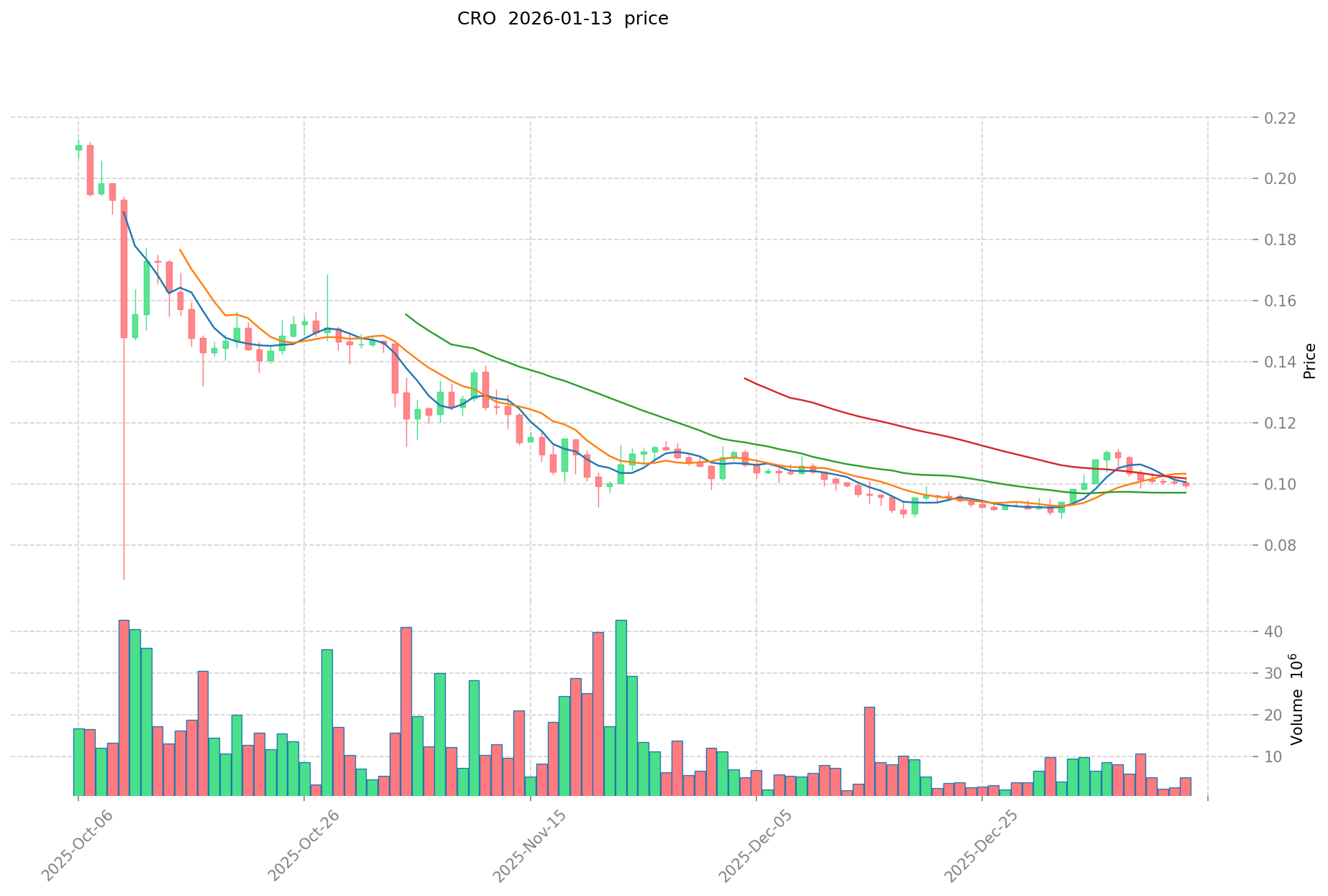
Cronos (CRO) represents a notable digital asset within the cryptocurrency sector. As of January 13, 2026, CRO holds the 34th position by market capitalization, with a total market cap of approximately $9.87 billion and a circulating supply of around 38.61 billion tokens. The current trading price stands at $0.10044. Cronos operates as a blockchain ecosystem partnered with Crypto.com and over 500 application developers, representing an addressable user base exceeding 100 million people globally. The ecosystem focuses on decentralized finance and gaming applications, aiming to facilitate Web3 adoption and self-custody solutions. With 27 exchange listings and over 303,000 holders, CRO has established presence in the digital asset market. This article examines CRO's investment characteristics, historical performance, potential price trajectories, and associated risk factors to provide analytical insights for consideration.
I. Cronos (CRO) Historical Price Review and Current Investment Value
- 2021: Reached peak price in November 2021 → CRO price recorded significant gains during this period
- 2021-2026: Extended market correction phase → Price declined from November 2021 peak of approximately $0.97 to current levels around $0.10
- 2020: Token transition from MCO to CRO → Crypto.com consolidated its token ecosystem with a 1:33 exchange ratio
- 2021 February: 70 billion CRO token burn announcement → Major supply adjustment impacted circulation dynamics
- 2022: Market challenges and volatility → CRO experienced downward pressure following broader crypto market conditions
Current CRO Investment Market Landscape (January 2026)
- CRO current price: Approximately $0.10 USD
- 24-hour trading volume: Around $27.19 million to $438.86 million USD depending on market activity
- Market capitalization: Approximately $3.84-4.11 billion USD
- Circulating supply: Approximately 38.61 billion CRO tokens
- Price performance: Down approximately 1.28-1.70% in recent 24-hour periods
View real-time CRO market price
II. Core Factors Affecting Whether CRO is a Good Investment
Supply Mechanism and Scarcity (CRO Investment Scarcity)
- Maximum supply capped at 100 billion tokens → creates potential scarcity effect
- Current circulating supply represents approximately 38.61% of total supply → gradual release mechanism in place
- Supply dynamics: with a fixed maximum supply and controlled circulation, token scarcity may influence long-term value considerations
- Investment significance: controlled supply mechanism serves as one of several factors in long-term investment evaluation
Institutional Investment and Mainstream Adoption (Institutional Investment in CRO)
- Cronos ecosystem partnered with Crypto.com and over 500 application developers → representing an addressable user base exceeding 100 million people globally
- Token holder base exceeds 303,000 addresses → indicates distributed adoption across user segments
- Listed on 27 exchanges → provides liquidity channels for institutional and retail participants
- Integration within Crypto.com ecosystem → includes benefits such as reduced trading fees and card rewards
Macroeconomic Environment's Impact on CRO Investment
- Broader cryptocurrency market conditions influence CRO performance → token showed 1.28% increase over 24 hours and 2.54% gain over 30 days as of January 13, 2026
- Year-over-year performance reflected 27.13% decline → illustrating sensitivity to extended market cycles
- Market capitalization stands at approximately $3.88 billion with 0.30% market share → positioning within mid-tier cryptocurrency assets
Technology and Ecosystem Development (Technology & Ecosystem for CRO Investment)
- EVM-compatible smart contract platform → facilitates developer adoption and cross-chain interoperability
- Low transaction fees and high-speed processing → supports decentralized finance and gaming applications
- CRO serves multiple utility functions: transaction fee payment (gas), staking for network security and rewards, and ecosystem benefits
- Focus areas include DeFi and gaming sectors → ecosystem development targets these growing application categories
- Open-source network architecture → enables community contribution and ongoing technical development
III. CRO Future Investment Predictions and Price Outlook (Is Cronos (CRO) worth investing in 2026-2030)
Short-term Investment Prediction (2026, short-term CRO investment outlook)
- Conservative forecast: $0.067 - $0.10
- Neutral forecast: $0.10 - $0.13
- Optimistic forecast: $0.13 - $0.15
Mid-term Investment Outlook (2027-2029, mid-term Cronos (CRO) investment forecast)
-
Market phase expectation: The mid-term outlook for CRO suggests potential price fluctuations influenced by broader market dynamics and the expansion of the Crypto.com ecosystem. Various analytical sources indicate mixed scenarios, with both correction risks and growth opportunities expected.
-
Investment return prediction:
- 2027: $0.073 - $0.156
- 2028: $0.11 - $0.18
- 2029: $0.085 - $0.21
-
Key catalysts: Growth drivers may include the expansion of Crypto.com's ecosystem, increased DeFi functionality, strategic partnerships, and broader adoption of blockchain payment solutions. Market sentiment, regulatory developments, and network upgrades could also influence price movements.
Long-term Investment Outlook (Is CRO a good long-term investment?)
- Base scenario: $0.18 - $0.24 (assuming steady ecosystem development and mainstream application growth)
- Optimistic scenario: $0.24 - $0.29 (assuming large-scale adoption and favorable market conditions)
- Risk scenario: $0.10 - $0.18 (under extreme market correction or adverse regulatory conditions)
For more details on CRO long-term investment and price predictions: Price Prediction
2026-2030 Long-term Outlook
- Base scenario: $0.18 - $0.24 (corresponding to steady progress and gradual mainstream application enhancement)
- Optimistic scenario: $0.24 - $0.29 (corresponding to large-scale adoption and favorable market environment)
- Transformative scenario: above $0.30 (if the ecosystem achieves breakthrough progress and mainstream popularization)
- 2030-12-31 predicted high: $0.24 (based on optimistic development assumptions)
Disclaimer: The above price predictions are based on historical data analysis and market trend modeling. Cryptocurrency markets are highly volatile and unpredictable. These forecasts do not constitute investment advice, and actual prices may differ significantly from projections due to various factors including market conditions, regulatory changes, technological developments, and broader economic trends. Investors should conduct their own research and consider their risk tolerance before making investment decisions.
| Year |
Predicted High Price |
Predicted Average Price |
Predicted Low Price |
Price Change |
| 2026 |
0.1467154 |
0.10049 |
0.0673283 |
0 |
| 2027 |
0.155739402 |
0.1236027 |
0.072925593 |
23 |
| 2028 |
0.18017565579 |
0.139671051 |
0.11034013029 |
39 |
| 2029 |
0.20949959294745 |
0.159923353395 |
0.08475937729935 |
59 |
| 2030 |
0.236430685659168 |
0.184711473171225 |
0.097897080780749 |
83 |
| 2031 |
0.269530981651451 |
0.210571079415196 |
0.189513971473676 |
109 |
IV. Cronos Investment Strategy and Risk Management (How to invest in Blockchain Ecosystem Tokens)
Investment Methodology (Cronos investment strategy)
Long-term Holding (HODL Cronos)
For conservative investors seeking exposure to the blockchain ecosystem space, a long-term holding strategy may be considered. This approach involves:
- Accumulating CRO tokens during market corrections or periods of lower volatility
- Holding positions through market cycles to potentially benefit from ecosystem growth
- Monitoring the development progress of the Cronos network and its partnerships
Given Cronos' partnerships with Crypto.com and over 500 application developers representing a user base exceeding 100 million people globally, investors following this strategy typically focus on the long-term adoption trajectory of the platform's DeFi and gaming applications.
Active Trading Strategy
For investors with higher risk tolerance and technical analysis capabilities, active trading approaches may include:
- Technical analysis utilizing support and resistance levels (recent 24H range: $0.09852 - $0.10135)
- Swing trading based on short-term price movements (1H: +0.13%, 24H: +1.28%)
- Monitoring trading volume patterns (24H volume: $438,858.51) for momentum signals
- Setting strategic entry and exit points based on historical price action
Traders should note the token's performance across different timeframes: 7D: -9.15%, 30D: +2.54%, 1Y: -27.13%.
Risk Management (Risk management for Cronos investment)
Asset Allocation Guidelines
Conservative Investors
- Limit blockchain ecosystem token exposure to 2-5% of total investment portfolio
- Prioritize established projects with proven user bases
- Focus on dollar-cost averaging to mitigate timing risk
Moderate Investors
- Allocate 5-10% of portfolio to blockchain ecosystem tokens
- Balance between long-term holdings and selective trading opportunities
- Monitor ecosystem developments and adjust positions accordingly
Aggressive Investors
- May allocate 10-20% to higher-risk blockchain assets
- Engage in active position management based on technical and fundamental signals
- Maintain strict stop-loss disciplines
Risk Hedging Approaches
- Diversification across multiple blockchain ecosystems and asset classes
- Position sizing based on individual risk tolerance
- Consideration of stablecoin allocations for portfolio stability
- Regular portfolio rebalancing to maintain target allocations
Secure Storage Solutions
Hot Wallet Storage
- Suitable for small amounts needed for frequent transactions
- Enable two-factor authentication (2FA) for all accounts
- Use reputable exchange wallets with strong security track records
Cold Wallet Storage
- Recommended for long-term holdings and larger amounts
- Hardware wallet options provide enhanced security through offline storage
- Maintain secure backup of recovery phrases in multiple physical locations
- Consider multi-signature wallets for institutional-level holdings
Best Practices
- Never share private keys or recovery phrases
- Verify contract addresses (e.g., ETH: 0xA0b73E1Ff0B80914AB6fe0444E65848C4C34450b) before transactions
- Regularly update wallet software and security protocols
- Test small transactions before transferring large amounts
V. Cronos Investment Risks and Challenges (Risks of investing in Blockchain Ecosystem Tokens)
Market Risks
High Volatility Characteristics
Cronos has demonstrated significant price volatility across different timeframes. The token experienced a 9.15% decline over 7 days while showing a 1.28% gain in 24 hours, illustrating the unpredictable nature of short-term price movements. Over the past year, CRO has declined by 27.13%, reflecting broader market pressures and shifting investor sentiment in the blockchain ecosystem sector.
The token's 24-hour trading range ($0.09852 - $0.10135) represents approximately 2.87% price fluctuation within a single day, which may result in substantial gains or losses for short-term traders.
Market Manipulation Concerns
With a 24-hour trading volume of $438,858.51 and availability on 27 exchanges, liquidity varies across different trading venues. Lower liquidity on certain platforms may increase vulnerability to:
- Sudden price swings from large orders
- Wider bid-ask spreads during volatile periods
- Potential for coordinated trading activities
Regulatory Risks
Policy Uncertainty Across Jurisdictions
The blockchain ecosystem sector faces evolving regulatory frameworks worldwide. Key concerns include:
- Varying classification of digital assets across different countries
- Potential restrictions on blockchain network operations
- Compliance requirements for ecosystem partners and developers
- Uncertainty regarding taxation policies for token holders
- Possible impact of regulations on exchange listings and accessibility
As Cronos operates with a global user base exceeding 100 million people through partnerships, regulatory changes in major markets could significantly affect ecosystem growth and token utility.
Technical Risks
Network Security Vulnerabilities
As with any blockchain ecosystem, Cronos faces potential technical challenges:
- Smart contract vulnerabilities that could be exploited
- Network congestion during periods of high activity
- Potential security breaches affecting user funds
- Dependencies on external infrastructure and bridges
Development and Upgrade Risks
- Protocol upgrades may encounter unexpected technical issues
- Backward compatibility challenges during network transitions
- Coordination requirements across 500+ application developers
- Potential for bugs or errors in new feature implementations
- Community consensus challenges regarding major protocol changes
Ecosystem Dependency Risks
- Heavy reliance on partnership with Crypto.com for user growth
- Competition from other blockchain ecosystems with similar focuses
- Developer retention and continued application development
- Maintaining security across a growing network of applications
VI. Conclusion: Is Blockchain Ecosystem Token a Good Investment?
Investment Value Summary
Cronos presents a mixed picture for potential investors as of January 13, 2026. The project has established partnerships with Crypto.com and over 500 application developers, representing an addressable user base exceeding 100 million people globally with a focus on DeFi and gaming applications.
Current Market Position:
- Ranked #34 by market capitalization
- Market cap: $3.88 billion
- Circulating supply: 38.61% of total supply
- Trading on 27 exchanges with 303,058 holders
Performance Considerations:
The token has experienced notable price fluctuations with a 27.13% decline over the past year, while showing short-term variability (7D: -9.15%, 30D: +2.54%, 24H: +1.28%). The current price of $0.10044 remains significantly below the historical high of $0.965407 recorded in November 2021.
Investor Recommendations
✅ New Investors
- Consider dollar-cost averaging strategy to mitigate timing risk
- Start with small allocations (2-5% of investment portfolio)
- Prioritize secure storage using hardware wallets for long-term holdings
- Thoroughly research the ecosystem's development progress and partnerships
- Verify contract addresses before any transactions
✅ Experienced Investors
- Evaluate swing trading opportunities based on technical analysis
- Maintain diversified exposure across multiple blockchain ecosystems
- Monitor network developments and ecosystem growth metrics
- Implement strict risk management protocols including stop-loss orders
- Rebalance portfolio regularly based on changing market conditions
✅ Institutional Investors
- Assess strategic allocation as part of blockchain infrastructure exposure
- Conduct comprehensive due diligence on ecosystem partnerships and use cases
- Consider custody solutions with institutional-grade security
- Evaluate regulatory compliance across relevant jurisdictions
- Monitor on-chain metrics and ecosystem activity for informed decision-making
⚠️ Important Disclaimer
Cryptocurrency investments carry substantial risks including high volatility, regulatory uncertainty, and potential loss of capital. Market conditions can change rapidly, and past performance does not indicate future results. This analysis is provided for informational purposes only and does not constitute financial advice, investment recommendations, or an endorsement to buy, sell, or hold any digital assets. Investors should conduct independent research, assess their risk tolerance, and consult with qualified financial advisors before making investment decisions. Only invest amounts you can afford to lose entirely.
VII. FAQ
Q1: What is Cronos (CRO) and how does it differ from other blockchain platforms?
Cronos (CRO) is the native token of an EVM-compatible blockchain ecosystem partnered with Crypto.com and over 500 application developers, serving an addressable user base exceeding 100 million people globally. Unlike many standalone blockchain platforms, Cronos distinguishes itself through its deep integration with the Crypto.com ecosystem, providing utility functions including transaction fee payment (gas), staking for network security and rewards, and ecosystem benefits such as reduced trading fees and card rewards. The platform focuses specifically on DeFi and gaming applications, utilizing low transaction fees and high-speed processing capabilities to facilitate Web3 adoption and self-custody solutions.
Q2: Is CRO a good investment for long-term holding?
CRO presents both opportunities and risks for long-term investors. The token benefits from a capped maximum supply of 100 billion tokens (with only 38.61% currently circulating), partnerships with major platforms, and a growing ecosystem of applications. However, the token has experienced significant price decline from its November 2021 peak of $0.97 to the current price around $0.10, representing a substantial drawdown. Long-term investment projections suggest potential price ranges of $0.18-$0.24 by 2030 under base scenarios, but these forecasts remain speculative. Conservative investors should limit blockchain ecosystem token exposure to 2-5% of their total portfolio and employ dollar-cost averaging strategies to mitigate timing risk.
Q3: What are the main risks associated with investing in CRO?
The primary risks include high market volatility (24-hour price fluctuations of approximately 2.87% and annual decline of 27.13%), regulatory uncertainty across different jurisdictions affecting blockchain network operations, technical vulnerabilities including smart contract exploits and network security breaches, and ecosystem dependency risks stemming from heavy reliance on partnerships with Crypto.com. Additionally, with 24-hour trading volume of $438,858.51 distributed across 27 exchanges, liquidity varies across platforms, potentially exposing investors to market manipulation concerns, wider bid-ask spreads, and sudden price swings from large orders. Investors should only allocate capital they can afford to lose entirely.
Q4: How can I securely store my CRO tokens?
CRO tokens can be stored using two primary methods depending on your usage patterns and security requirements. For small amounts needed for frequent transactions, hot wallet storage through reputable exchange wallets with two-factor authentication (2FA) provides convenient access. For long-term holdings and larger amounts, cold wallet storage using hardware wallets offers enhanced security through offline storage. Best practices include never sharing private keys or recovery phrases, verifying contract addresses (ETH: 0xA0b73E1Ff0B80914AB6fe0444E65848C4C34450b) before transactions, maintaining secure backups of recovery phrases in multiple physical locations, and testing small transactions before transferring large amounts. Institutional holders should consider multi-signature wallet solutions for additional security layers.
Q5: What factors could drive CRO price appreciation in the future?
Several catalysts could potentially influence CRO price movements including expansion of the Crypto.com ecosystem and its 100+ million user base, increased DeFi functionality and application development across the network's 500+ developer partnerships, strategic institutional partnerships, broader adoption of blockchain payment solutions, favorable regulatory developments, network upgrades enhancing scalability and features, and overall cryptocurrency market conditions. The token's controlled supply mechanism with a fixed maximum of 100 billion tokens may also contribute to scarcity effects. However, these factors represent potential opportunities rather than guaranteed outcomes, and actual price performance depends on complex market dynamics and execution of development roadmaps.
Q6: How does CRO compare to its historical price performance?
CRO reached its all-time high of approximately $0.965407 in November 2021 during a broader cryptocurrency market rally. Since then, the token has experienced an extended correction phase, declining approximately 89.6% to current levels around $0.10044 as of January 13, 2026. Over different timeframes, CRO has shown mixed performance: +1.28% over 24 hours, +2.54% over 30 days, -9.15% over 7 days, and -27.13% over one year. This performance reflects both specific challenges within the Cronos ecosystem and broader cryptocurrency market downturns. Investors should recognize that historical performance does not indicate future results and that recovery to previous highs would require substantial percentage gains from current levels.
Q7: What investment strategies are suitable for CRO?
Investment approaches vary based on risk tolerance and objectives. Conservative long-term holding (HODL) strategies involve accumulating CRO during market corrections, holding through market cycles, and monitoring ecosystem development progress—suitable for investors allocating 2-5% of portfolios to blockchain assets. Active trading strategies utilize technical analysis of support/resistance levels, swing trading based on short-term movements, volume pattern monitoring, and strategic entry/exit points—appropriate for investors with higher risk tolerance allocating 10-20% to blockchain assets. Both approaches require strict risk management including position sizing based on risk tolerance, diversification across multiple blockchain ecosystems, consideration of stablecoin allocations for stability, and regular portfolio rebalancing to maintain target allocations.
Q8: What role does CRO play in the broader cryptocurrency ecosystem?
CRO serves multiple utility functions within the Cronos blockchain ecosystem beyond simple speculative trading. As the network's native token, it functions as the primary medium for paying transaction fees (gas), enabling users to interact with decentralized applications built on the platform. Token holders can stake CRO to support network security through validation mechanisms while earning rewards, contributing to the blockchain's consensus and operation. Within the Crypto.com ecosystem specifically, CRO provides practical benefits including reduced trading fees, enhanced card rewards, and access to exclusive platform features. With 303,058+ holders and listings on 27 exchanges, CRO has established liquidity channels for both retail and institutional participants, positioning itself as a mid-tier cryptocurrency asset with approximately $3.88 billion market capitalization and 0.30% market share.
* The information is not intended to be and does not constitute financial advice or any other recommendation of any sort offered or endorsed by Gate.