This comprehensive analysis examines whether dYdX (DYDX) represents a viable investment opportunity. DYDX is a governance token for a decentralized derivatives trading protocol launched in August 2021, currently trading at $0.1975 with a market cap of $162 million. The article evaluates DYDX's investment potential through multiple dimensions: historical price performance showing significant volatility, current market fundamentals including 820.24 million circulating tokens and 45,354 holders, and core investment factors including supply scarcity, institutional adoption across 18 exchanges including Gate, macroeconomic positioning, and proprietary dYdX Chain technology. Investment forecasts range from conservative to optimistic scenarios through 2031. The analysis addresses risk management strategies for different investor profiles, identifies key risks including market volatility, regulatory uncertainty, and technical complexity, and provides specific guidance for beginners, experienced traders, and instituti
Introduction: dYdX (DYDX) Investment Position and Market Outlook
DYDX is a notable asset in the cryptocurrency space, functioning as a decentralized derivatives trading protocol. Since its launch in August 2021, dYdX has established itself in the decentralized finance (DeFi) derivatives trading sector. As of January 16, 2026, DYDX holds a market capitalization of approximately $162 million, with a circulating supply of around 820.24 million tokens. The current price stands at approximately $0.1975, representing a market share of 0.0055%. With over 45,000 holders and listing on 18 exchanges, DYDX serves as a governance token that enables community participation in protocol decisions and offers fee discounts. The protocol operates on a Layer 2 blockchain system, utilizing a hybrid infrastructure model featuring non-custodial trading, on-chain settlement, and an off-chain low-latency matching engine with order books. As investors increasingly explore "Is dYdX (DYDX) a good investment?", this article provides a comprehensive analysis of DYDX's investment characteristics, historical performance, price outlook, and associated risks to support informed decision-making.
I. DYDX Price History Review and Current Investment Value Status
- 2021: DYDX launched its governance token and completed Series C funding of $65 million led by Paradigm → The protocol gained significant market attention during the DeFi boom
- 2024-03-08: DYDX reached a notable price level of $4.52 → Market participants observed substantial growth in the decentralized perpetual contract trading sector
- 2025-10-11: Price experienced considerable correction → DYDX declined to $0.126201 as broader crypto market conditions shifted
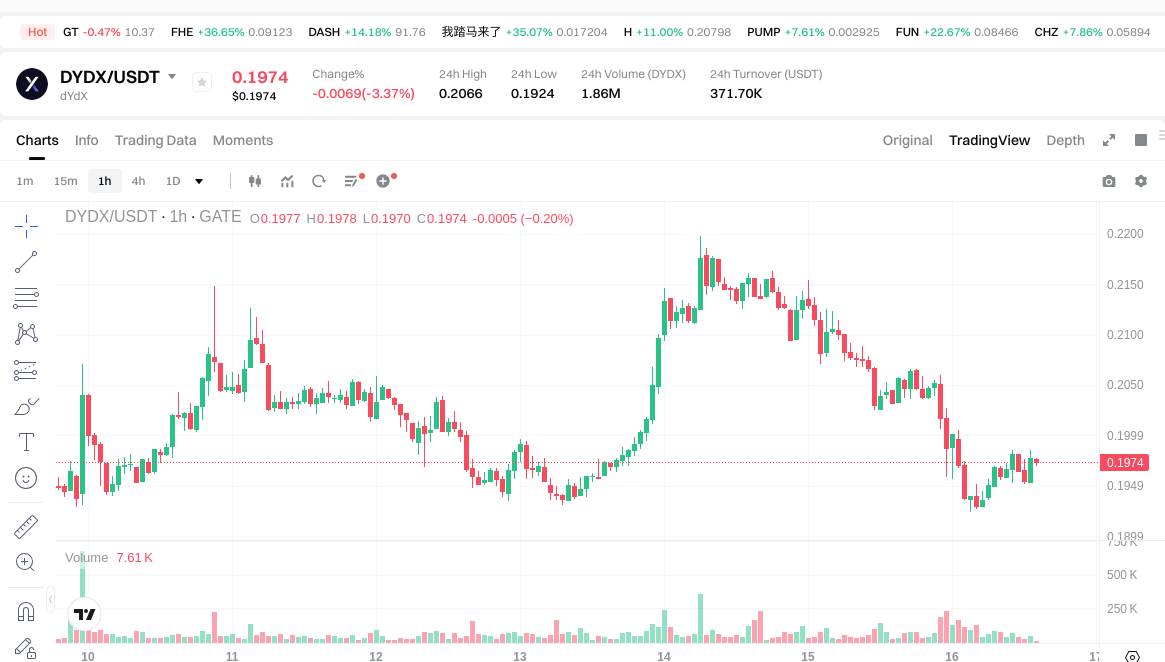
- 2026-01-16: Current trading shows moderate volatility → Price stands at $0.1975 with 24-hour fluctuation of -3.42%
Current DYDX Investment Market Status (January 2026)
- DYDX current price: $0.1975 USD
- Market capitalization: Approximately $162 million USD with circulating supply of 820.24 million tokens
- 24-hour trading volume: $371,882 USD
- Token holders: 45,354 addresses holding DYDX tokens
- Price performance indicators: +0.55% (1H), -3.42% (24H), +1.02% (7D), +10.04% (30D)
Click to view real-time DYDX market price
II. Core Factors Influencing Whether DYDX Is a Good Investment
Supply Mechanism and Scarcity (DYDX Investment Scarcity)
- Supply Structure: dYdX operates with a maximum supply of 1,000,000,000 DYDX tokens, with approximately 820,241,078 tokens currently in circulation (82.02% of maximum supply). The circulating supply represents 958,342,751 total supply, indicating a disciplined supply management approach that may support scarcity dynamics.
- Circulation Ratio Impact: The 82% circulation ratio suggests substantial token distribution has occurred, while retaining approximately 18% for future ecosystem development, staking rewards, and community incentives. This balanced approach may influence long-term supply-demand dynamics.
- Investment Significance: The controlled token release schedule and governance-based supply management through community voting provide transparency in supply decisions, which can be relevant for investors evaluating scarcity as a factor in long-term value assessment.
Institutional Investment and Mainstream Adoption (Institutional Investment in DYDX)
- Holder Base: dYdX has attracted 45,354 token holders as of the current data, indicating a distributed ownership structure across the community and various stakeholder groups.
- Funding History: The project has completed at least four funding rounds, demonstrating institutional interest during earlier development stages, though specific institutional holdings data is not provided in available materials.
- Market Accessibility: DYDX is available for trading on 18 exchanges, including mainstream platforms, which facilitates institutional and retail access. The token's presence across multiple trading venues may contribute to liquidity and adoption potential.
- Ecosystem Position: dYdX functions as a decentralized exchange for perpetual contracts and derivatives, positioning itself within the DeFi sector. Its governance token role enables holders to participate in protocol decision-making, which may align with institutional preferences for governance participation.
Macroeconomic Environment's Impact on DYDX Investment
- Market Positioning: As a DeFi protocol token, DYDX's investment profile may be influenced by broader cryptocurrency market conditions, regulatory developments affecting decentralized exchanges, and macroeconomic factors impacting risk appetite for digital assets.
- Volatility Context: The token has experienced significant price volatility, with historical price ranging from $0.126201 to $4.52. Current price levels ($0.1975 as of January 16, 2026) reflect market conditions that investors may consider when evaluating risk-return profiles.
- Market Share: DYDX maintains a 0.0055% share of the total cryptocurrency market, indicating its position as a niche protocol within the broader crypto ecosystem. Market dynamics affecting DeFi adoption and derivatives trading demand may influence investment considerations.
Technology and Ecosystem Development (Technology & Ecosystem for DYDX Investment)
- Infrastructure Model: dYdX utilizes a hybrid infrastructure combining non-custodial trading, on-chain settlement, and an off-chain low-latency matching engine with order book functionality. The protocol operates on Layer 2 blockchain systems while providing Layer 1 spot, leverage, and lending services.
- dYdX Chain Development: The protocol has developed its proprietary dYdX Chain, described as a Cosmos-based, proof-of-stake blockchain designed to support high-volume trading activities. This technical foundation aims to provide infrastructure for derivatives trading at scale.
- Governance and Utility: DYDX tokens serve multiple functions including protocol governance, trading fee discounts, and staking mechanisms. Token holders can vote on protocol parameters, staking pools, and upgrades, while accessing incentives such as USDC staking rewards for liquidity provision.
- Ecosystem Expansion: Recent initiatives include spot trading feature additions and liquidity incentive programs, indicating the protocol's evolution toward a multi-asset DeFi platform beyond its initial derivatives focus.
- Development Activity: The rebranding of the core development entity from dYdX Trading to dYdX Labs reflects organizational focus on technology development and experimentation. Recent upgrades have targeted performance improvements, expanded access features, and enhanced user experience according to available materials.
III. DYDX Future Investment Forecast and Price Outlook (Is dYdX(DYDX) worth investing in 2026-2031)
Short-term Investment Forecast (2026, short-term DYDX investment outlook)
- Conservative forecast: $0.1856 - $0.1974
- Neutral forecast: $0.1952 - $0.2018
- Optimistic forecast: $0.2066 - $0.2882
Mid-term Investment Outlook (2027-2029, mid-term dYdX(DYDX) investment forecast)
- Market stage expectation: The protocol may experience moderate growth with potential volatility as the decentralized derivatives market evolves and competition intensifies.
- Investment return forecast:
- 2027: $0.2137 - $0.2719
- 2028: $0.2342 - $0.3526
- 2029: $0.2867 - $0.3812
- Key catalysts: Protocol upgrades, trading volume growth, governance developments, and broader DeFi market trends.
Long-term Investment Outlook (Is DYDX a good long-term investment?)
- Base scenario: $0.2093 - $0.4598 (assuming steady protocol development and moderate market conditions)
- Optimistic scenario: $0.4014 - $0.5821 (assuming increased adoption of decentralized derivatives and favorable regulatory environment)
- Risk scenario: Below $0.1856 (under adverse market conditions or significant protocol challenges)
Click to view DYDX long-term investment and price forecast: Price Prediction
2026-01-16 to 2031 Long-term Outlook
- Base scenario: $0.1856 - $0.4598 (corresponding to steady progress and gradual mainstream application improvement)
- Optimistic scenario: $0.4014 - $0.5821 (corresponding to large-scale adoption and favorable market environment)
- Transformative scenario: Above $0.5821 (in case of breakthrough ecosystem developments and mainstream adoption)
- 2031-12-31 forecast high: $0.5821 (based on optimistic development assumptions)
Disclaimer: The forecasts presented are based on historical data and market analysis models and should not be considered as financial advice. Cryptocurrency markets are highly volatile and unpredictable. Actual prices may differ significantly from predictions due to various factors including market sentiment, regulatory changes, technological developments, and macroeconomic conditions. Investors should conduct their own research and consider their risk tolerance before making investment decisions.
| Year |
Predicted High Price |
Predicted Average Price |
Predicted Low Price |
Price Change |
| 2026 |
0.288204 |
0.1974 |
0.185556 |
0 |
| 2027 |
0.27193824 |
0.242802 |
0.21366576 |
22 |
| 2028 |
0.3525970644 |
0.25737012 |
0.2342068092 |
30 |
| 2029 |
0.38122949025 |
0.3049835922 |
0.286684576668 |
54 |
| 2030 |
0.4597627652415 |
0.343106541225 |
0.20929499014725 |
73 |
| 2031 |
0.582080247188212 |
0.40143465323325 |
0.28903295032794 |
103 |
IV. DYDX Investment Strategy and Risk Management (How to invest in DYDX)
Investment Methodology (DYDX investment strategy)
Long-term Holding (HODL DYDX)
Long-term holding represents a strategy suitable for conservative investors who believe in the fundamental value proposition of decentralized derivatives trading. This approach involves acquiring DYDX tokens and maintaining positions through market cycles, focusing on the protocol's governance utility and potential fee discount benefits rather than short-term price movements.
Active Trading
Active trading strategies for DYDX rely on technical analysis and swing trading techniques. Given the token's historical price volatility, with movements ranging from $0.126201 to $4.52, traders may identify opportunities through chart patterns, support and resistance levels, and volume analysis. The 24-hour trading volume of approximately $371,882 suggests moderate liquidity for executing tactical positions.
Risk Management (Risk management for DYDX investment)
Asset Allocation Ratios
- Conservative investors: May consider allocating 1-3% of their cryptocurrency portfolio to DYDX, recognizing its governance-focused use case within the decentralized derivatives ecosystem
- Aggressive investors: Could allocate 5-10% based on higher risk tolerance and conviction in decentralized exchange protocols
- Professional investors: May implement dynamic allocation strategies ranging from 3-15% depending on market conditions, technical indicators, and fundamental developments in the dYdX protocol
Risk Hedging Solutions
Diversification across multiple digital assets remains a fundamental risk management approach. Investors may consider combining DYDX holdings with assets from different categories including layer-1 protocols, stablecoins, and other DeFi tokens to reduce concentration risk. The correlation between DYDX and broader cryptocurrency markets should be monitored regularly.
Secure Storage
- Cold wallets: Hardware wallet solutions provide enhanced security for long-term DYDX holdings by keeping private keys offline
- Hot wallets: Software wallets may be suitable for smaller amounts needed for active trading or governance participation
- Hardware wallet recommendations: Established hardware wallet providers that support ERC-20 tokens can be utilized for DYDX storage, ensuring proper backup of recovery phrases
V. DYDX Investment Risks and Challenges (Risks of investing in DYDX)
Market Risks
DYDX demonstrates significant price volatility, with a one-year performance showing an 85.42% decline. The token's 24-hour price range between $0.1924 and $0.2066 illustrates ongoing volatility. Market participants should be aware that trading in lower-liquidity environments may experience price impacts from larger transactions.
Regulatory Risks
Decentralized derivatives protocols operate in an evolving regulatory landscape where different jurisdictions maintain varying stances on cryptocurrency trading platforms and governance tokens. Regulatory developments in major markets could impact the protocol's operations and token utility.
Technical Risks
As a protocol operating across Layer 1 and Layer 2 infrastructure with off-chain order matching and on-chain settlement, dYdX faces technical complexity risks. Potential vulnerabilities in smart contracts, delays in protocol upgrades, or issues with cross-layer operations could affect the platform's functionality and user confidence.
VI. Conclusion: Is DYDX a Good Investment?
Investment Value Summary
DYDX represents a governance token for a decentralized derivatives trading protocol with specific utility in protocol governance and fee discounts. The token's performance reflects broader challenges in the DeFi derivatives sector, with significant price corrections from peak levels. The circulating supply of approximately 820.24 million tokens represents 82.02% of the total supply, with a market capitalization around $162 million.
Investor Recommendations
✅ Beginners: Consider dollar-cost averaging strategies combined with secure wallet storage. Focus on understanding the protocol's governance mechanism and utility before committing significant capital.
✅ Experienced investors: May explore swing trading opportunities while maintaining a core position for governance participation. Portfolio diversification across multiple DeFi protocols can help manage sector-specific risks.
✅ Institutional investors: Could evaluate DYDX as part of a broader DeFi derivatives exposure strategy, with appropriate position sizing reflecting the token's market capitalization and liquidity profile.
⚠️ Notice: Cryptocurrency investments carry substantial risks including total loss of capital. This content is provided for informational purposes only and does not constitute investment advice. Conduct thorough due diligence and consider consulting financial professionals before making investment decisions.
VII. FAQ
Q1: What is DYDX and how does it work as an investment?
DYDX is the governance token of dYdX, a decentralized derivatives trading protocol launched in August 2021. As an investment, DYDX functions primarily as a governance token that allows holders to participate in protocol decisions through voting on parameters, upgrades, and staking pools. The token also provides utility through trading fee discounts and staking rewards in USDC for liquidity provision. The protocol operates on a hybrid infrastructure model combining Layer 2 blockchain technology with non-custodial trading, on-chain settlement, and an off-chain low-latency matching engine. With approximately 820.24 million tokens in circulation (82.02% of maximum supply) and a market capitalization around $162 million as of January 16, 2026, DYDX represents exposure to the decentralized derivatives trading sector within the broader DeFi ecosystem.
Q2: Is DYDX a good long-term investment for 2026-2031?
DYDX presents a mixed long-term investment profile with significant uncertainties. Long-term price forecasts suggest potential ranging from $0.1856 in conservative scenarios to $0.5821 in optimistic scenarios by 2031, representing potential returns of approximately 103% under favorable conditions. However, investors should note that DYDX has experienced an 85.42% decline over the past year and currently trades at $0.1975, substantially below its historical peak of $4.52. The token's suitability as a long-term investment depends on factors including: the protocol's ability to capture market share in decentralized derivatives trading, successful execution of technology upgrades including the dYdX Chain development, governance effectiveness, and broader adoption of DeFi protocols. Conservative investors might consider allocating only 1-3% of their cryptocurrency portfolio to DYDX due to these uncertainties and the token's relatively small market share of 0.0055%.
Q3: What are the main risks of investing in DYDX?
Investing in DYDX involves three primary risk categories. Market risks include significant price volatility, with the token demonstrating sharp fluctuations and an 85.42% decline over one year, alongside relatively low trading volume of approximately $371,882 daily which may impact liquidity. Regulatory risks stem from the evolving legal landscape for decentralized derivatives platforms, where different jurisdictions maintain varying stances that could affect protocol operations and token utility. Technical risks arise from the protocol's complex infrastructure spanning Layer 1 and Layer 2 systems with off-chain order matching and on-chain settlement, creating potential vulnerabilities in smart contracts, upgrade execution challenges, and cross-layer operational issues. Additionally, competition from other decentralized exchange protocols and centralized alternatives poses business model risks that could impact long-term value.
Q4: How should beginners invest in DYDX?
Beginners should approach DYDX investment with caution and systematic risk management strategies. The recommended approach includes: implementing dollar-cost averaging (DCA) to reduce timing risk by making regular smaller purchases rather than lump sum investments; allocating only 1-3% of a cryptocurrency portfolio to DYDX to maintain appropriate diversification; using secure storage solutions such as hardware wallets for long-term holdings while keeping recovery phrases properly backed up; thoroughly understanding the protocol's governance mechanism and utility before committing capital; and starting with educational resources to comprehend how decentralized derivatives trading works. Beginners should avoid leveraged positions or attempting active trading strategies without substantial experience, and should only invest amounts they can afford to lose completely given the high volatility and risks associated with cryptocurrency investments.
Q5: What factors could drive DYDX price growth in the future?
Several key factors could potentially drive DYDX price appreciation over time. Protocol development achievements including successful implementation of the dYdX Chain upgrades, expansion of spot trading features beyond derivatives, and performance improvements could enhance platform competitiveness. Increased trading volume and user adoption of decentralized derivatives products would demonstrate growing demand for the protocol's services. Governance developments that effectively utilize the token's voting mechanism for beneficial protocol changes could strengthen token utility. Broader DeFi market trends including increased institutional adoption of decentralized trading platforms and favorable regulatory clarity for DeFi protocols could create a supportive environment. Additionally, effective tokenomics management through the remaining 18% of undistributed supply being deployed strategically for ecosystem development and staking rewards could support demand. However, these potential positive catalysts must be weighed against competitive pressures and market uncertainties.
Q6: What is the difference between conservative and optimistic DYDX investment forecasts?
Conservative and optimistic DYDX forecasts reflect different assumptions about protocol development and market conditions. Conservative forecasts for 2026 project prices between $0.1856-$0.1974, assuming steady but limited growth, continued market challenges, and moderate adoption rates. By 2031, conservative scenarios suggest prices reaching $0.2093-$0.4598, representing modest appreciation based on stable protocol operation without breakthrough developments. Optimistic forecasts assume significantly better outcomes: for 2026, prices of $0.2066-$0.2882, and by 2031, reaching $0.4014-$0.5821 (approximately 103% increase from current levels). These optimistic scenarios presume successful technology implementation, substantial growth in decentralized derivatives trading volume, favorable regulatory developments, effective governance execution, and increased institutional adoption. The substantial gap between scenarios underscores the high uncertainty inherent in DYDX investment projections.
Q7: How does DYDX compare to other DeFi protocol tokens?
DYDX occupies a specific niche within the DeFi ecosystem focusing on decentralized derivatives and perpetual contract trading, distinguishing it from general-purpose DeFi tokens. With a market capitalization of approximately $162 million and 0.0055% market share, DYDX is considerably smaller than leading DeFi protocols. The token's governance-focused utility model combined with fee discounts and staking rewards represents a standard approach among DeFi governance tokens. Key differentiators include the protocol's hybrid infrastructure combining on-chain settlement with off-chain order matching, and the development of a proprietary dYdX Chain built on Cosmos technology. However, DYDX has experienced more significant price declines (85.42% over one year) compared to some established DeFi protocols, reflecting challenges specific to the derivatives trading segment and competitive pressures. The token's 18-exchange listing provides reasonable accessibility, though liquidity metrics suggest lower trading volumes than major DeFi tokens.
Q8: What allocation strategy should institutional investors consider for DYDX?
Institutional investors evaluating DYDX should approach allocation through a comprehensive risk-adjusted framework. Professional investors may implement dynamic allocation strategies ranging from 3-15% of a DeFi-focused portfolio depending on conviction levels, with position sizing reflecting the token's market capitalization ($162 million) and liquidity profile (daily volume ~$371,882). Key considerations include: treating DYDX as a tactical exposure to decentralized derivatives trading rather than core DeFi infrastructure; implementing strict risk management protocols given the 85.42% historical decline; evaluating governance participation opportunities as the token enables protocol decision-making; conducting thorough due diligence on the dYdX Chain technology development and competitive positioning; and maintaining diversification across multiple DeFi categories including DEXs, lending protocols, and infrastructure tokens. Institutional approaches should incorporate regular reassessment of allocation based on protocol metrics including trading volume growth, total value locked trends, and governance effectiveness indicators.
* The information is not intended to be and does not constitute financial advice or any other recommendation of any sort offered or endorsed by Gate.