This comprehensive analysis examines whether Elastos (ELA) represents a viable investment opportunity in 2024-2031. Priced at $0.8576 with a $19.78 million market cap, ELA is a Web 3.0 decentralized platform launched in 2018, featuring main-sidechain architecture and multi-layer consensus mechanisms for identity, communication, storage, and computing services. The article evaluates core investment factors including supply scarcity (81.73% of 28.2 million max supply circulating), market adoption, and technology fundamentals. Price projections range from $0.51-$1.06 (2026, conservative) to $1.94-$2.23 (2030-2031, optimistic). ELA carries substantial risks: extreme volatility (-52.89% yearly), limited liquidity ($54,751 daily volume on 7 exchanges), regulatory uncertainty, and competitive pressures. Investment recommendations vary by investor type, emphasizing dollar-cost averaging strategies, secure storage via hardware wallets, and portfolio allocation capped at 1-10% depending on risk tolerance, making ELA su
Introduction: Elastos (ELA) Investment Position and Market Outlook
Elastos (ELA) represents a notable asset in the cryptocurrency sector, having been launched in February 2018 as a next-generation Web 3.0 platform. The project focuses on building a decentralized intelligent World Wide Web (SmartWeb) through blockchain technology, incorporating main-sidechain architecture, multi-layer consensus mechanisms, and smart contract consensus computing. As of January 23, 2026, ELA maintains a market capitalization of approximately $19.78 million, with a circulating supply of around 23.06 million tokens and a current price of approximately $0.8576. With its positioning in the decentralized platform services sector encompassing identity, communication, storage, and computing infrastructure, Elastos has become a subject of discussion among investors evaluating "Is Elastos (ELA) a good investment?" This article provides a comprehensive analysis of ELA's investment characteristics, historical price movements, future price perspectives, and associated risks to serve as a reference for investors.
I. ELA Price History Review and Investment Value Status
- February 2018: Token launched on exchanges → Price reached elevated levels during the crypto market bull cycle
- January 2023: Market downturn phase → ELA price experienced downward pressure
- 2025-2026: Market adjustment period → Price fluctuated within a range
Current ELA Investment Market Status (January 2026)
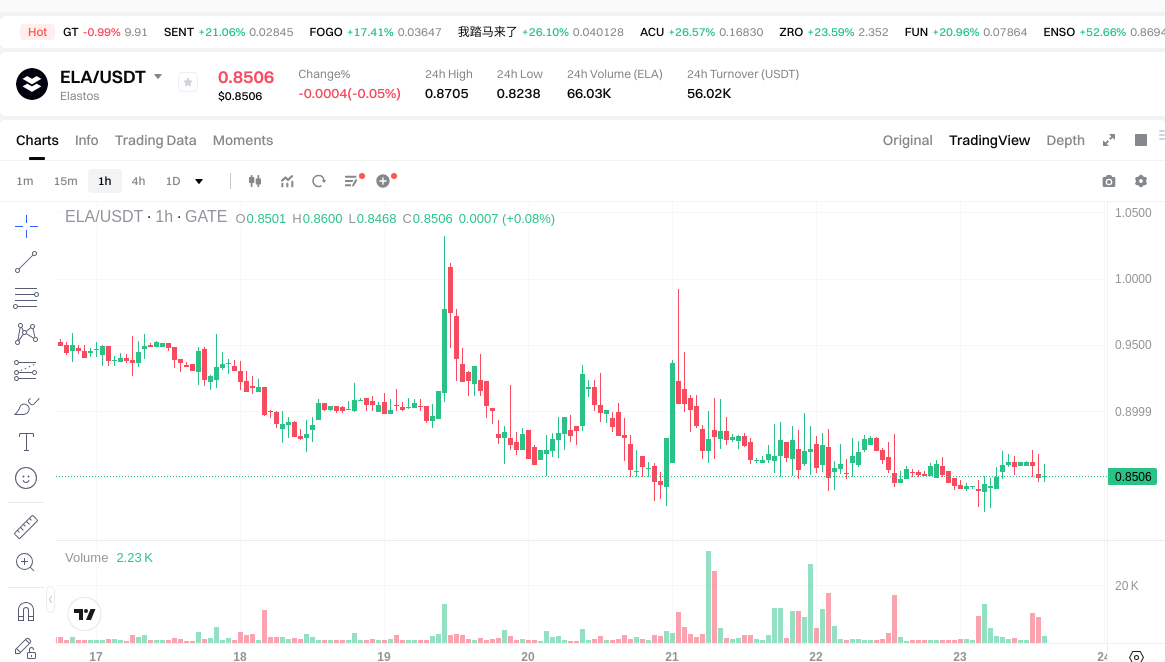
- ELA current price: 0.8576 USD
- 24-hour trading volume: 54,750.95 USD
- Circulating supply: 23,064,925 ELA
- Market capitalization: 19,780,479.68 USD
- Circulating supply ratio: 81.73%
Click to view real-time ELA market price
II. Core Factors Affecting Whether ELA is a Good Investment (Is Elastos(ELA) a Good Investment)
Supply Mechanism and Scarcity (ELA investment scarcity)
- Maximum Supply Cap: ELA has a maximum supply of 28,219,999 tokens, with current circulating supply of 23,064,925 tokens (approximately 81.73% of max supply) → contributes to potential scarcity dynamics
- Supply Distribution: Total supply stands at 26,187,303 tokens, approaching the maximum cap → limited future dilution pressure
- Historical Supply Context: The defined supply cap provides a predictable issuance model that may influence long-term value perception
- Investment Significance: The capped supply mechanism represents a fundamental characteristic that investors consider when evaluating scarcity-based value propositions
Institutional Investment and Mainstream Adoption (Institutional investment in ELA)
- Holder Base: Current data shows 2,562 token holders across tracked addresses
- Exchange Presence: ELA is listed on 7 exchanges, indicating a certain level of market accessibility
- Market Position: Trading volume of approximately $54,751 over 24 hours reflects current market participation levels
Macroeconomic Environment's Impact on ELA Investment
- Monetary Policy and Interest Rate Changes → may alter investment attractiveness across digital asset markets
- Inflation Environment Considerations → potential positioning within broader digital asset hedge strategies
- Geopolitical Uncertainty → could influence demand patterns for decentralized web infrastructure projects
Technology and Ecosystem Development (Technology & Ecosystem for ELA investment)
- Web 3.0 Platform Foundation: Elastos utilizes main-sidechain architecture, multi-layer consensus, and smart contract consensus computing to provide security and trust infrastructure
- Decentralized Services Infrastructure: The platform builds decentralized identity, communication, storage, and computing services aimed at supporting distributed applications
- Privacy and Data Security Focus: User privacy protection and data security features position ELA within the data asset ecosystem
- SmartWeb Vision: The project's focus on building a decentralized intelligent World Wide Web may contribute to long-term ecosystem value considerations
III. ELA Future Investment Prediction and Price Outlook (Is Elastos(ELA) worth investing in 2026-2031)
Short-term Investment Prediction (2026, short-term ELA investment outlook)
- Conservative Prediction: $0.51 - $0.85
- Neutral Prediction: $0.85 - $1.06
- Optimistic Prediction: $1.06 and above
Mid-term Investment Outlook (2027-2029, mid-term Elastos(ELA) investment forecast)
-
Market Stage Expectation: During this period, ELA may experience gradual growth driven by platform development and adoption trends in the Web 3.0 space. The project's focus on decentralized identity, communication, storage, and computing services could attract increased attention as the broader blockchain ecosystem matures.
-
Investment Return Prediction:
- 2027: $0.86 - $1.35
- 2028: $0.69 - $1.62
- 2029: $0.98 - $1.65
-
Key Catalysts: Platform service expansion, ecosystem partnerships, technological upgrades to the main-sidechain architecture, and increased adoption of decentralized applications built on Elastos could serve as potential growth drivers.
Long-term Investment Outlook (Is Elastos a good long-term investment?)
- Base Scenario: $1.25 - $1.73 (assuming steady platform development and moderate user growth)
- Optimistic Scenario: $1.94 - $2.23 (assuming accelerated adoption of Web 3.0 technologies and expanded ecosystem partnerships)
- Risk Scenario: Below $0.79 (under conditions of prolonged market downturn or significant competitive pressure)
View ELA long-term investment and price prediction: Price Prediction
2026-01-23 - 2031 Long-term Outlook
- Base Scenario: $1.25 - $1.73 (corresponding to steady progress and gradual mainstream application growth)
- Optimistic Scenario: $1.94 - $2.23 (corresponding to large-scale adoption and favorable market conditions)
- Transformative Scenario: Above $2.23 (in case of breakthrough ecosystem developments and mainstream adoption)
- 2031-12-31 Predicted High: $2.23 (based on optimistic development assumptions)
Disclaimer: These predictions are based on historical data and market analysis models and do not constitute investment advice. Cryptocurrency markets are highly volatile and subject to various risks. Investors should conduct independent research and consider their own risk tolerance before making investment decisions.
| Year |
Predicted High Price |
Predicted Average Price |
Predicted Low Price |
Price Change |
| 2026 |
1.061375 |
0.8491 |
0.50946 |
0 |
| 2027 |
1.346884875 |
0.9552375 |
0.85971375 |
11 |
| 2028 |
1.622996274375 |
1.1510611875 |
0.6906367125 |
34 |
| 2029 |
1.650564189815625 |
1.3870287309375 |
0.984790398965625 |
61 |
| 2030 |
1.944059469282 |
1.518796460376562 |
1.245413097508781 |
77 |
| 2031 |
2.233542074629772 |
1.731427964829281 |
1.263942414325375 |
101 |
IV. Elastos Investment Strategy and Risk Management (How to invest in Elastos)
Investment Methodology (Elastos investment strategy)
Long-term Holding (HODL Elastos)
For conservative investors seeking steady exposure to Web 3.0 infrastructure projects, a long-term holding strategy may be considered. This approach involves accumulating ELA tokens during periods of market correction and maintaining positions through market cycles. Given Elastos's focus on decentralized identity, communication, storage, and computing services, investors following this strategy typically evaluate the project's technological development progress and ecosystem growth metrics rather than short-term price movements.
Active Trading
Active traders utilizing technical analysis may focus on ELA's price patterns and trading ranges. Based on recent data, the token has demonstrated notable volatility, with a 24-hour high of $0.8705 and low of $0.8238. Traders may consider key resistance and support levels, volume indicators, and momentum signals when executing swing trading strategies. This approach requires continuous market monitoring and disciplined risk management protocols.
Risk Management (Risk management for Elastos investment)
Asset Allocation Ratios
- Conservative Investors: May consider allocating 1-3% of their cryptocurrency portfolio to Elastos, maintaining larger positions in established digital assets while gaining exposure to Web 3.0 infrastructure projects.
- Aggressive Investors: Could allocate 5-10% of their portfolio to mid-cap projects like Elastos, accepting higher volatility in exchange for potential growth opportunities in the decentralized web sector.
- Professional Investors: May employ dynamic allocation strategies based on market conditions, technical developments, and ecosystem metrics, typically ranging from 3-8% of specialized blockchain infrastructure portfolios.
Risk Hedging Solutions
Investors may consider diversifying across multiple blockchain infrastructure projects rather than concentrating solely in Elastos. A multi-asset portfolio approach could include exposure to various Web 3.0 platforms, layer-1 protocols, and decentralized identity solutions. Additionally, some investors utilize stablecoin positions or options strategies to manage downside risk during periods of elevated market volatility.
Secure Storage Solutions
For ELA token storage, investors should consider the following options:
- Hot Wallets: Suitable for active traders requiring frequent access, though carrying higher security risks. Reputable mobile and desktop wallets supporting ERC-20 tokens (as ELA has an Ethereum contract address: 0xe6fd75ff38Adca4B97FBCD938c86b98772431867) may be utilized for smaller holdings.
- Cold Wallets: Recommended for long-term holders storing significant amounts. Hardware wallet solutions from established manufacturers provide enhanced security through offline private key storage.
- Hardware Wallet Recommendations: Leading hardware wallet devices supporting ERC-20 tokens can accommodate ELA storage, offering secure offline storage with transaction signing capabilities.
V. Elastos Investment Risks and Challenges (Risks of investing in Elastos)
Market Risks
High Volatility: Elastos has experienced significant price fluctuations, with recent data showing an 11.65% decline over 7 days and a 27.16% decrease over 30 days. The token's historical price range spans from an all-time high of $89.14 (February 24, 2018) to an all-time low of $0.793867 (January 8, 2023), demonstrating extreme volatility characteristic of mid-cap cryptocurrency assets.
Liquidity Considerations: With a 24-hour trading volume of approximately $54,751 and circulation on 7 exchanges, ELA's liquidity may be limited compared to larger-cap assets. This could result in wider bid-ask spreads and potential slippage during significant position changes.
Market Capitalization Dynamics: With a current market capitalization of approximately $19.78 million and ranking at position 891, Elastos represents a smaller market cap project subject to greater price volatility and susceptibility to broader market sentiment shifts.
Regulatory Risks
Global Policy Uncertainty: Cryptocurrency regulations vary significantly across jurisdictions and continue to evolve. Projects focusing on decentralized infrastructure and Web 3.0 platforms may face regulatory scrutiny regarding data privacy, identity management, and cross-border data flows. Investors should monitor regulatory developments in their respective jurisdictions and key markets where Elastos operates.
Compliance Requirements: As regulatory frameworks mature, blockchain projects may need to implement additional compliance measures, potentially affecting operational flexibility and development timelines. The decentralized nature of Elastos's SmartWeb vision may face challenges in jurisdictions with restrictive data governance policies.
Technical Risks
Network Security: While Elastos employs a main-sidechain architecture with multi-layer consensus mechanisms, all blockchain networks face potential security vulnerabilities. Smart contract exploits, consensus mechanism weaknesses, or infrastructure attacks could impact the platform's functionality and token value.
Upgrade and Development Risks: The successful implementation of Elastos's Web 3.0 infrastructure vision requires continuous technical development and ecosystem expansion. Delays in planned upgrades, technical challenges in implementing decentralized services, or difficulties in achieving developer adoption could affect the project's long-term viability.
Competition and Technology Evolution: The Web 3.0 and decentralized infrastructure sectors feature numerous competing projects with similar objectives. Rapid technological advancement in blockchain scalability, interoperability, and user experience could challenge Elastos's market position if the project cannot maintain competitive development pace.
VI. Conclusion: Is Elastos a Good Investment?
Investment Value Summary
Elastos presents a speculative investment opportunity in the Web 3.0 infrastructure sector, with a focus on decentralized identity, communication, storage, and computing services. The project's main-sidechain architecture and multi-layer consensus approach offer technical differentiation, though the token has experienced substantial volatility, declining 52.89% over the past year. With a relatively small market capitalization of approximately $19.78 million and circulation on limited exchanges, ELA carries elevated risk characteristics typical of mid-cap blockchain infrastructure projects.
Investor Recommendations
✅ Beginners: Consider dollar-cost averaging strategies with small allocation amounts (1-2% of cryptocurrency portfolio) rather than lump-sum investments. Prioritize secure storage solutions using hardware wallets or reputable cold storage options. Focus on understanding the project's technological fundamentals and ecosystem development before committing significant capital.
✅ Experienced Investors: May employ swing trading strategies within established technical ranges, utilizing the token's volatility for potential short-to-medium term gains. Consider portfolio diversification across multiple Web 3.0 infrastructure projects rather than concentrated exposure. Monitor development milestones, ecosystem growth metrics, and competitive positioning when adjusting allocation levels.
✅ Institutional Investors: Could evaluate Elastos as a component within specialized blockchain infrastructure portfolios, maintaining awareness of liquidity constraints and market depth limitations. Consider gradual position building to minimize market impact and implement comprehensive due diligence on technical architecture, development team capabilities, and partnership ecosystem.
⚠️ Disclaimer: Cryptocurrency investments carry substantial risk, including potential loss of principal. Market conditions can change rapidly, and past performance does not indicate future results. This content is provided for informational purposes only and does not constitute financial, investment, or legal advice. Investors should conduct independent research and consult qualified financial professionals before making investment decisions.
VII. FAQ
Q1: What is Elastos (ELA) and what makes it different from other blockchain projects?
Elastos is a Web 3.0 platform launched in February 2018 that aims to build a decentralized intelligent World Wide Web (SmartWeb). What distinguishes Elastos is its main-sidechain architecture combined with multi-layer consensus mechanisms and smart contract consensus computing, specifically designed to provide decentralized infrastructure for identity, communication, storage, and computing services. Unlike many blockchain projects focused solely on financial applications, Elastos emphasizes building foundational infrastructure for privacy protection and data security in the decentralized web ecosystem, positioning itself as an infrastructure layer for distributed applications rather than a simple cryptocurrency.
Q2: Is Elastos (ELA) suitable for long-term investment?
ELA presents a high-risk, speculative investment opportunity rather than a conservative long-term holding. While the project has a defined maximum supply cap of 28,219,999 tokens (with 81.73% already in circulation) that provides scarcity dynamics, the token has experienced extreme volatility—declining 52.89% over the past year and 96.04% from its all-time high of $89.14. With a relatively small market capitalization of approximately $19.78 million and limited liquidity across 7 exchanges, ELA is most suitable for investors who understand Web 3.0 infrastructure projects, can tolerate significant price fluctuations, and are willing to allocate only a small portion (1-5%) of their cryptocurrency portfolio to such speculative assets.
Q3: What are the main risks associated with investing in Elastos?
The primary risks include: (I) Extreme Volatility: ELA has demonstrated substantial price swings, ranging from $89.14 to $0.79, making it susceptible to rapid value changes. (II) Limited Liquidity: With approximately $54,751 in 24-hour trading volume, investors may face wider bid-ask spreads and difficulty executing large trades without price impact. (III) Regulatory Uncertainty: As a decentralized infrastructure project handling identity and data services, Elastos may face evolving regulatory scrutiny across different jurisdictions. (IV) Technical and Competitive Risks: The Web 3.0 sector features numerous competing projects, and Elastos must maintain development momentum to remain relevant. (V) Market Capitalization Risk: At rank 891 with a $19.78 million market cap, ELA is vulnerable to broader market sentiment shifts and capital flight during downturns.
Q4: What is the price prediction for Elastos in 2026-2031?
Based on current market analysis models, ELA price projections show: 2026: Conservative range of $0.51-$1.06, with neutral prediction around $0.85. 2027-2029: Mid-term growth potential ranging from $0.69-$1.65, assuming steady platform development and increased Web 3.0 adoption. 2030-2031: Long-term projections suggest a base scenario of $1.25-$1.73, with optimistic scenarios reaching $1.94-$2.23 if the project achieves substantial ecosystem expansion and mainstream adoption. The predicted high for 2031 is $2.23. However, these predictions are based on historical data and analytical models—actual outcomes depend on numerous variables including market conditions, technological development, competitive dynamics, and regulatory environments. Under adverse conditions, prices could remain below $0.79.
Q5: How should beginners approach investing in Elastos?
Beginners should exercise extreme caution with ELA investment. Recommended approach: (I) Allocation: Limit exposure to 1-2% of total cryptocurrency portfolio, treating it as a speculative position rather than core holding. (II) Entry Strategy: Employ dollar-cost averaging (DCA) by making small, regular purchases rather than lump-sum investments to mitigate timing risk and volatility impact. (III) Storage: Prioritize security by using hardware wallets or reputable cold storage solutions for ERC-20 tokens (ELA contract address: 0xe6fd75ff38Adca4B97FBCD938c86b98772431867). (IV) Education: Thoroughly research Elastos's technical architecture, development roadmap, and ecosystem progress before investing. (V) Risk Management: Only invest capital you can afford to lose completely, and avoid borrowing or using leverage for such high-risk assets.
Q6: What factors could drive Elastos price growth in the future?
Several potential catalysts could influence ELA's value trajectory: (I) Platform Development: Successful implementation and expansion of decentralized identity, communication, storage, and computing services could attract increased developer and user adoption. (II) Web 3.0 Adoption: Broader market acceptance of decentralized web technologies and infrastructure projects could benefit Elastos as sector interest grows. (III) Ecosystem Partnerships: Strategic collaborations with established technology companies or integration into larger blockchain ecosystems could enhance utility and visibility. (IV) Technical Upgrades: Improvements to the main-sidechain architecture, scalability enhancements, or innovative features that differentiate Elastos from competitors. (V) Exchange Listings: Increased presence on major cryptocurrency exchanges could improve liquidity and accessibility. (VI) Regulatory Clarity: Favorable regulatory frameworks for decentralized infrastructure projects could reduce uncertainty and encourage institutional participation.
Q7: Where can I buy and trade Elastos (ELA)?
Elastos is currently listed on 7 cryptocurrency exchanges, though specific platforms vary by jurisdiction. Investors should verify availability in their region and prioritize exchanges with: (I) Established Reputation: Platforms with proven security track records and regulatory compliance. (II) Adequate Liquidity: Given ELA's limited trading volume, choose exchanges offering better market depth to minimize slippage. (III) Security Features: Exchanges providing two-factor authentication, withdrawal whitelisting, and cold storage for user funds. (IV) Fee Structure: Compare trading fees, withdrawal costs, and deposit methods to optimize transaction costs. After purchasing, investors should transfer tokens to personal wallets (hardware or software wallets supporting ERC-20 tokens) rather than leaving significant amounts on exchanges, following the principle of "not your keys, not your coins" for enhanced security.
Q8: How does Elastos compare to other Web 3.0 infrastructure projects?
Elastos occupies a niche position within the Web 3.0 infrastructure landscape. Compared to larger competitors, ELA features: (I) Differentiated Architecture: The main-sidechain design with multi-layer consensus differs from single-chain approaches, though this adds technical complexity. (II) Comprehensive Infrastructure Focus: Unlike projects concentrating on single aspects (identity OR storage OR computing), Elastos attempts to provide integrated services across multiple decentralized infrastructure categories. (III) Market Position: With a $19.78 million market cap and rank 891, Elastos is significantly smaller than leading Web 3.0 protocols, suggesting either undervaluation potential or market skepticism about execution capability. (IV) Development Stage: Launched in 2018, Elastos is neither a new project nor a fully matured ecosystem, requiring investors to evaluate progress against original roadmap promises and current competitive standards. The project faces intense competition from better-funded alternatives with larger communities and developer ecosystems.
* The information is not intended to be and does not constitute financial advice or any other recommendation of any sort offered or endorsed by Gate.