Energy Web Token (EWT) is the native utility token of Energy Web Chain, a blockchain infrastructure serving the energy sector. With a market cap of $62.47 million and trading at $0.7468, EWT functions as a network security mechanism and validator compensation token. This comprehensive analysis examines whether EWT represents a sound investment by evaluating historical performance, current market position, and future potential. The token exhibits significant volatility, with a 50.63% annual decline offset by recent 30-day gains of 10.97%. Key investment considerations include its limited liquidity across 5 exchanges, 389 token holders, and unlimited supply structure. The article provides investment strategies suitable for beginners through institutional investors, price projections through 2031, and critical risk assessments including market volatility, regulatory uncertainty, and technical vulnerabilities. Recommended reading for investors seeking exposure to energy sector blockchain infrastructure developmen
Introduction: Energy Web (EWT) Investment Position and Market Outlook
Energy Web Token (EWT) represents a specialized digital asset within the cryptocurrency sector, serving as the native utility token of the Energy Web Chain, a verified public blockchain infrastructure. As of January 19, 2026, EWT holds a market capitalization of approximately $62.47 million with a circulating supply of 83.65 million tokens, trading at around $0.7468. The token ranks 467th in the overall cryptocurrency market with a market dominance of 0.0018%.
Energy Web Chain operates through a validator network comprising permitted entities from the energy sector, positioning EWT as a functional token for network security and validator compensation through transaction fees and validation rewards. With a contract address deployed on the Ethereum network (0xb66a5d30d04f076e78ffb0d045c55846fdcde928), the token has attracted 389 holders and maintains trading activity across 5 exchanges. Recent market performance indicates a 24-hour price decline of 2.22%, a 7-day decrease of 5.48%, while showing a 30-day gain of 10.97%. The one-year performance reflects a decline of 50.63%, illustrating the asset's price volatility patterns. This analysis examines EWT's investment characteristics, historical price movements, future price projections, and associated investment risks to provide informational context for market participants considering Energy Web Token.
I. Energy Web (EWT) Historical Price Review and Current Investment Value
Based on available data, EWT demonstrates notable price volatility over its trading history. The token's price trajectory reflects broader cryptocurrency market dynamics rather than isolated project-specific events.
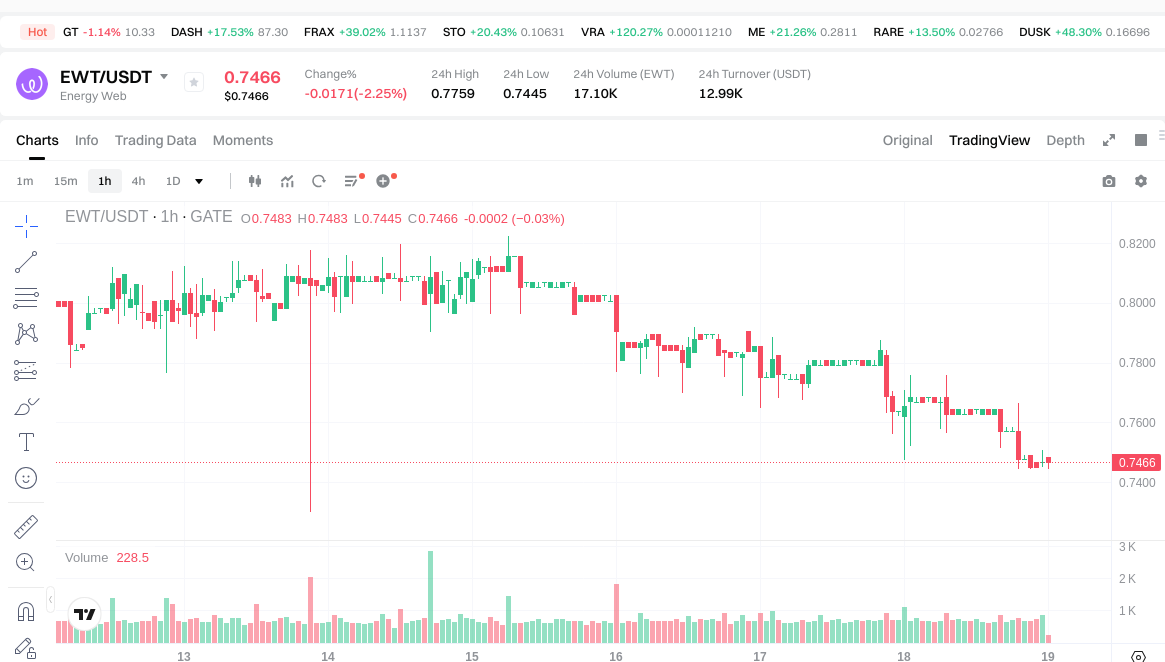
- 2025 (January): Recent price movements show EWT trading at approximately $0.7468, representing a moderate decline of 2.22% over 24 hours. The token has experienced mixed performance across different timeframes: a 1-hour decline of 0.27%, a 7-day decrease of 5.48%, contrasted with a 30-day gain of 10.97%.
- Long-term perspective: Over the past year, EWT has declined by approximately 50.63%, indicating substantial market pressure. This performance aligns with broader challenges facing infrastructure-focused blockchain projects during periods of market consolidation.
- Price range fluctuation: Within the recent 24-hour period, EWT traded between a low of $0.7445 and a high of $0.7759, demonstrating intraday volatility typical of mid-cap cryptocurrency assets.
Current EWT Investment Market Status (January 2026)
- EWT current price: $0.7468 (as of January 19, 2026)
- Market capitalization: Approximately $62.47 million with a fully diluted market cap of $62.18 million
- Market share: 0.0018% of total cryptocurrency market capitalization
- 24-hour trading volume: $12,976.90, suggesting moderate market activity
- Circulating supply: 83,645,644.69 EWT tokens (representing 100.46% of total supply)
- Token holder base: 389 holders across tracked platforms
- Market presence: Listed on 5 exchanges, indicating limited but established liquidity channels
For real-time EWT market prices, visit the Energy Web price page
The current market conditions reflect EWT's position as a specialized infrastructure token within the energy sector blockchain space. Trading activity remains modest compared to mainstream cryptocurrencies, with the token primarily attracting participants interested in energy sector digitalization initiatives. The relatively small holder base and exchange presence suggest EWT operates within a niche market segment focused on energy web infrastructure development.
II. Core Factors Influencing Whether EWT is a Good Investment
Supply Mechanism and Scarcity
- Maximum supply set to ∞ (unlimited) with current circulating supply of 83,645,644.69 EWT → potential dilution concerns for investors
- Total supply of 83,261,458.40 EWT, with circulating supply exceeding total supply at 100.46% ratio → suggesting potential token unlock or minting mechanisms
- Investment implication: The unlimited maximum supply may impact long-term scarcity-based value appreciation compared to fixed-supply digital assets
Institutional Investment and Mainstream Adoption
- Energy Web Chain powered by a validator network comprising major companies in the licensed energy sector → institutional backing from energy industry participants
- Current holder count at 389 addresses → relatively limited adoption base
- EWT serves dual utility functions: protecting network from malicious behavior and compensating validators through transaction fees and verification rewards
Macroeconomic Environment Impact on EWT Investment
- As of January 19, 2026, EWT shows market dominance of 0.0018% with market cap of $62.47 million → highly sensitive to broader cryptocurrency market conditions
- 1-year performance showing -50.63% decline (from approximately $1.51 to $0.75) → reflects significant volatility amid macroeconomic uncertainties
- 30-day performance gained 10.97% → short-term recovery signals amid broader market fluctuations
Technology and Ecosystem Development
- Energy Web Chain operates as a proven public blockchain with first-layer native utility token (EWT) → foundational infrastructure for energy sector applications
- Available on Ethereum network (contract: 0xb66a5d30d04f076e78ffb0d045c55846fdcde928) → leveraging established blockchain infrastructure
- Trading availability on 5 exchanges with 24-hour trading volume of $12,976.90 → limited liquidity compared to major cryptocurrencies
- Investment consideration: Market cap to fully diluted valuation ratio at 100% suggests current valuation reflects all projected token supply
III. EWT Future Investment Forecast and Price Outlook (Is Energy Web(EWT) worth investing in 2026-2031)
Short-term Investment Forecast (2026, short-term EWT investment outlook)
- Conservative forecast: $0.46 - $0.75
- Neutral forecast: $0.75 - $0.84
- Optimistic forecast: $0.84 - $1.03
Mid-term Investment Outlook (2027-2028, mid-term Energy Web(EWT) investment forecast)
- Market phase expectation: The token may experience gradual price appreciation as the energy sector continues exploring blockchain-based solutions. Market observers suggest EWT could benefit from increased institutional interest in decentralized energy infrastructure.
- Investment return forecast:
- 2027: $0.70 - $1.24
- 2028: $0.93 - $1.39
- Key catalysts: Expansion of validator network participation, adoption by energy sector companies, and broader integration of blockchain technology in energy management systems.
Long-term Investment Outlook (Is Energy Web a good long-term investment?)
- Base scenario: $0.93 - $1.76 (assuming steady ecosystem development and moderate market conditions)
- Optimistic scenario: $1.20 - $1.95 (assuming increased adoption in energy sector and favorable regulatory environment)
- Risk scenario: Below $0.70 (under adverse market conditions or limited ecosystem growth)
Click to view EWT long-term investment and price prediction: Price Prediction
2026-01-19 - 2031 Long-term Outlook
- Base scenario: $0.93 - $1.76 (corresponding to steady progress and mainstream application gradual enhancement)
- Optimistic scenario: $1.20 - $1.95 (corresponding to large-scale adoption and favorable market environment)
- Transformative scenario: Above $1.95 (if ecosystem achieves breakthrough development and mainstream popularization)
- 2031-12-31 predicted high: $1.95 (based on optimistic development assumptions)
Disclaimer: Price predictions are based on historical data and statistical models. Actual results may vary significantly due to market volatility, regulatory changes, technological developments, and macroeconomic factors. This analysis does not constitute investment advice, and investors should conduct their own research before making investment decisions.
| Year |
Predicted High Price |
Predicted Average Price |
Predicted Low Price |
Price Change |
| 2026 |
0.940716 |
0.7466 |
0.455426 |
0 |
| 2027 |
1.24017726 |
0.843658 |
0.70023614 |
12 |
| 2028 |
1.3857504479 |
1.04191763 |
0.9273066907 |
39 |
| 2029 |
1.747921016088 |
1.21383403895 |
1.0317589331075 |
62 |
| 2030 |
1.76224425774761 |
1.480877527519 |
0.93295284233697 |
98 |
| 2031 |
1.945873071159966 |
1.621560892633305 |
1.199955060548645 |
117 |
IV. Energy Web (EWT) Investment Strategy and Risk Management (How to invest in Energy Web)
Investment Methodology (EWT investment strategy)
Long-term Holding (HODL EWT): Suitable for Conservative Investors
Long-term holding represents a foundational approach for investors seeking exposure to Energy Web Token. This strategy involves accumulating EWT positions during periods of market correction and maintaining holdings through market cycles. Given the token's focus on energy sector blockchain infrastructure, long-term investors may benefit from potential growth in decentralized energy applications and validator network expansion.
Conservative investors should consider establishing positions gradually through dollar-cost averaging, reducing exposure to short-term price volatility. The validator network structure, which includes established companies in the energy sector, may provide a degree of stability for long-term holders, though market conditions remain inherently volatile.
Active Trading: Technical Analysis and Swing Operations
Active trading strategies for EWT require careful attention to technical indicators and market momentum. Recent price data shows the token trading at $0.7468, with 24-hour price range between $0.7445 and $0.7759. Short-term traders should monitor:
- Support and resistance levels within daily trading ranges
- Volume patterns relative to the 24-hour trading volume of $12,976.89
- Price movements across different timeframes (1H: -0.27%, 24H: -2.22%, 7D: -5.48%)
Swing traders may identify opportunities during periodic corrections, though the 30-day upward movement of 10.97% suggests potential for both upward momentum and profit-taking periods.
Risk Management (Risk management for EWT investment)
Asset Allocation Ratios: Conservative / Aggressive / Professional Investors
Conservative Investors:
- Recommended EWT allocation: 1-3% of cryptocurrency portfolio
- Focus on accumulation during market downturns
- Maintain sufficient stablecoin reserves for market opportunities
Aggressive Investors:
- Potential EWT allocation: 5-10% of cryptocurrency portfolio
- Active position management based on market conditions
- Utilize technical analysis for entry and exit points
Professional Investors:
- Strategic allocation based on sector exposure requirements
- Integration with broader energy sector investment thesis
- Consider validator participation opportunities for qualified entities
With a market capitalization of $62.47 million and ranking at #467, EWT represents a smaller-cap digital asset requiring appropriate position sizing relative to portfolio risk tolerance.
Effective risk management for EWT investment requires diversification across:
- Sector Diversification: Balance EWT holdings with exposure to different blockchain sectors (DeFi, infrastructure, Layer 1/Layer 2 protocols)
- Market Cap Distribution: Combine smaller-cap positions like EWT with larger-cap assets to manage volatility
- Correlation Analysis: Monitor price correlation with broader cryptocurrency markets to optimize hedging strategies
Investors should maintain appropriate reserves in stablecoins or traditional assets to capitalize on market opportunities during significant price corrections, particularly given the token's 1-year performance showing -50.63% change.
Secure Storage: Hot/Cold Wallets + Hardware Wallet Recommendations
Proper security measures are essential for EWT holdings:
Hot Wallet Solutions:
- Suitable for active trading portions of holdings
- MetaMask and similar ERC-20 compatible wallets (contract address: 0xb66a5d30d04f076e78ffb0d045c55846fdcde928 on Ethereum)
- Enable transaction capabilities while maintaining reasonable security protocols
Cold Storage Options:
- Hardware wallets (Ledger, Trezor) for long-term holdings
- Recommended for storing 80-90% of total EWT holdings
- Provides protection against online security threats and exchange vulnerabilities
Security Best Practices:
- Implement multi-signature solutions for significant holdings
- Regular security audits of wallet configurations
- Maintain secure backup procedures for recovery phrases
- Verify contract addresses before transactions using official sources
V. Energy Web (EWT) Investment Risks and Challenges (Risks of investing in Energy Web)
Market Risks: High Volatility and Price Manipulation
Energy Web Token exhibits characteristics common to smaller-cap digital assets:
Volatility Patterns:
Recent price movements demonstrate significant volatility, with 7-day performance showing -5.48% decline and 30-day performance showing 10.97% increase. The 24-hour trading volume of $12,976.89 relative to market capitalization of $62.47 million suggests liquidity considerations for larger position adjustments.
Liquidity Considerations:
With availability on 5 exchanges and 389 token holders, market depth may present challenges for:
- Executing larger orders without significant price impact
- Maintaining stable price discovery during low-volume periods
- Potential for increased spread between bid-ask prices
Market Manipulation Exposure:
Smaller-cap tokens generally face elevated risks from coordinated trading activities, requiring investors to:
- Verify price movements across multiple exchanges
- Monitor unusual volume patterns that may indicate manipulation
- Exercise caution during periods of abnormal price volatility
Regulatory Risks: Policy Uncertainty Across Different Jurisdictions
Cryptocurrency regulatory landscapes continue evolving across jurisdictions:
Sector-Specific Considerations:
Energy sector blockchain applications may face additional scrutiny regarding:
- Energy trading and grid management regulations
- Environmental compliance requirements
- Cross-border energy transaction frameworks
Token Classification Uncertainty:
Regulatory treatment of utility tokens varies by jurisdiction, potentially affecting:
- Exchange listing requirements and availability
- Tax treatment for holders and traders
- Compliance obligations for validator participants
Geographic Policy Divergence:
Investors should monitor:
- Regulatory developments in key markets affecting energy sector blockchain adoption
- Changes in cryptocurrency taxation policies
- Licensing requirements for energy-related blockchain applications
Technical Risks: Network Security Vulnerabilities and Upgrade Failures
Validator Network Dependencies:
The Energy Web Chain's permissioned validator structure creates specific technical considerations:
- Reliance on validator network integrity and performance
- Potential centralization concerns affecting network resilience
- Validator participation requirements and selection processes
Smart Contract Risks:
As an ERC-20 token on Ethereum, EWT faces:
- Potential vulnerabilities in token contract code
- Dependencies on Ethereum network security and performance
- Risks associated with contract upgrades or modifications
Network Upgrade Challenges:
Blockchain infrastructure updates may introduce:
- Temporary network disruptions affecting transaction processing
- Compatibility issues requiring wallet or application updates
- Coordination challenges across validator network participants
Security Incident Exposure:
Investors should remain aware of:
- Historical security incidents affecting similar projects
- Ongoing security audit results and vulnerability disclosures
- Emergency response procedures for critical security issues
VI. Conclusion: Is Energy Web a Good Investment?
Investment Value Summary
Energy Web Token presents a specialized investment opportunity within the blockchain energy sector. The token's connection to energy infrastructure development through its validator network offers exposure to potential growth in decentralized energy applications. However, several factors warrant careful consideration:
Growth Potential Factors:
- Validator network including established energy sector companies
- Positioning within emerging energy blockchain infrastructure
- Utility function for network security and validator compensation
Challenge Factors:
- Market capitalization of $62.47 million indicating smaller-cap status
- Recent 1-year performance showing -50.63% change
- Limited liquidity with 5 exchange listings and 389 holders
- 24-hour trading volume of $12,976.89 suggesting liquidity constraints
Short-term price movements demonstrate significant volatility, with fluctuations ranging from -5.48% (7-day) to +10.97% (30-day). The circulating supply of 83,645,644.69 EWT represents 100.46% of total supply, indicating near-complete token distribution.
Investor Recommendations
✅ Beginners: Dollar-Cost Averaging + Secure Wallet Storage
Recommended Approach:
- Establish small positions through regular, scheduled purchases
- Allocate no more than 1-2% of total cryptocurrency portfolio
- Prioritize security through hardware wallet storage for holdings
- Maintain clear understanding of Energy Web's validator network model
- Monitor project developments through official channels (energyweb.org, Twitter: @energywebx)
Learning Resources:
- Study ERC-20 token mechanics and Ethereum network fundamentals
- Review Energy Web Chain documentation regarding validator operations
- Understand transaction fee structures and network compensation mechanisms
✅ Experienced Investors: Swing Trading + Portfolio Allocation
Strategic Considerations:
- Implement technical analysis for entry/exit timing around support/resistance levels
- Consider 3-5% portfolio allocation based on risk tolerance
- Monitor correlation with broader cryptocurrency markets and energy sector developments
- Evaluate validator participation opportunities if qualified
- Track regulatory developments affecting energy blockchain applications
Trading Parameters:
- Set clear stop-loss levels accounting for volatility patterns
- Monitor 24-hour volume relative to position size for liquidity planning
- Maintain flexibility to adjust positions based on market conditions
✅ Institutional Investors: Strategic Long-term Allocation
Institutional Approach:
- Evaluate Energy Web Token as sector-specific exposure within diversified cryptocurrency holdings
- Consider validator network participation for direct ecosystem involvement
- Assess regulatory compliance requirements across operational jurisdictions
- Implement robust custody solutions appropriate for institutional standards
- Monitor energy sector blockchain adoption metrics and use case development
Due Diligence Focus:
- Validator network composition and governance structure
- Smart contract audit results and security assessments
- Competitive positioning within energy blockchain infrastructure
- Token economics and utility within Energy Web Chain ecosystem
⚠️ Important Disclaimer
Cryptocurrency investments carry substantial risk, including potential total loss of invested capital. Energy Web Token exhibits characteristics typical of smaller-cap digital assets, including:
- High price volatility and limited liquidity
- Regulatory uncertainty affecting energy blockchain applications
- Technical risks associated with network operations and security
- Market manipulation exposure due to smaller market capitalization
This analysis provides informational content only and does not constitute investment advice, financial guidance, or trading recommendations. Investors should:
- Conduct independent research appropriate to their circumstances
- Consult qualified financial advisors before making investment decisions
- Only invest capital they can afford to lose completely
- Understand the specific risks associated with Energy Web Token and the broader cryptocurrency market
- Verify all information through official project sources and independent verification
Past performance, including the 1-year decline of -50.63%, does not indicate future results. Market conditions, regulatory environments, and project developments may change significantly, affecting token value and investment outcomes.
VII. FAQ
Q1: What is Energy Web Token (EWT) and what is its primary function?
Energy Web Token (EWT) is the native utility token of the Energy Web Chain, a verified public blockchain infrastructure specifically designed for the energy sector. The token serves two primary functions: protecting the network from malicious behavior through its staking mechanism, and compensating validators through transaction fees and verification rewards. Operating as an ERC-20 token on the Ethereum network (contract address: 0xb66a5d30d04f076e78ffb0d045c55846fdcde928), EWT enables a permissioned validator network comprising licensed entities from the energy sector. As of January 19, 2026, the token maintains a market capitalization of approximately $62.47 million with 83.65 million tokens in circulation, trading at around $0.7468 across 5 exchanges.
Q2: How has EWT performed historically and what is its current market position?
EWT has experienced significant price volatility over the past year, declining approximately 50.63% from higher levels to its current price of $0.7468. Recent performance shows mixed results: a 7-day decline of 5.48% contrasted with a 30-day gain of 10.97%. The token ranks 467th in the overall cryptocurrency market with a market dominance of 0.0018% and a fully diluted market cap of $62.18 million. With only 389 token holders and 24-hour trading volume of $12,976.90, EWT represents a smaller-cap digital asset with limited liquidity compared to mainstream cryptocurrencies. The circulating supply of 83,645,644.69 EWT represents 100.46% of total supply, indicating near-complete token distribution.
Q3: What are the main investment risks associated with Energy Web Token?
Energy Web Token presents several significant investment risks. Market risks include high price volatility, limited liquidity across only 5 exchanges, and potential exposure to price manipulation due to its smaller market capitalization and trading volume. Regulatory risks stem from evolving cryptocurrency policies and sector-specific considerations affecting energy blockchain applications across different jurisdictions. Technical risks involve the validator network's security and performance, smart contract vulnerabilities inherent to ERC-20 tokens, and potential network upgrade challenges. Additionally, the unlimited maximum supply structure may impact long-term scarcity-based value appreciation, while the relatively small holder base of 389 addresses suggests limited adoption compared to mainstream cryptocurrencies.
Q4: What investment strategies are suitable for different types of EWT investors?
For beginners, a dollar-cost averaging approach with 1-2% portfolio allocation is recommended, combined with secure hardware wallet storage and focus on learning Energy Web's validator network model. Experienced investors may consider swing trading strategies using technical analysis, with 3-5% portfolio allocation, while monitoring support/resistance levels within the daily trading range ($0.7445-$0.7759). Institutional investors should evaluate strategic long-term allocation as sector-specific exposure, potentially considering validator network participation for direct ecosystem involvement. All investor categories should implement proper risk management through diversified portfolios, appropriate position sizing, and security measures including cold storage for 80-90% of holdings using hardware wallets like Ledger or Trezor.
Q5: What are the price projections for EWT through 2031?
Short-term 2026 forecasts range from conservative ($0.46-$0.75) to optimistic ($0.84-$1.03) scenarios. Mid-term projections suggest gradual appreciation, with 2027 estimates ranging $0.70-$1.24 and 2028 ranging $0.93-$1.39, dependent on validator network expansion and energy sector blockchain adoption. Long-term outlook through 2031 presents a base scenario of $0.93-$1.76 assuming steady ecosystem development, an optimistic scenario of $1.20-$1.95 with increased energy sector adoption, and a risk scenario below $0.70 under adverse market conditions. The 2031 predicted high reaches $1.95 based on optimistic assumptions, though investors should note these projections rely on historical data and statistical models rather than guaranteed outcomes.
Q6: How does EWT's supply mechanism affect its investment potential?
Energy Web Token features an unlimited maximum supply (∞), which presents potential dilution concerns for long-term investors compared to fixed-supply digital assets. The current circulating supply of 83,645,644.69 EWT exceeds the total supply of 83,261,458.40 EWT, representing a 100.46% ratio that suggests potential token unlock or minting mechanisms. This supply structure may impact scarcity-based value appreciation over time. However, the fully diluted valuation matches the current market cap at approximately $62.47 million, indicating that current valuation reflects all projected token supply. Investors should monitor token release schedules and validator compensation mechanisms that may affect future supply dynamics.
Q7: What role does the validator network play in EWT's ecosystem and investment thesis?
The Energy Web Chain operates through a permissioned validator network comprising major companies from the licensed energy sector, providing institutional backing and sector-specific expertise. Validators receive compensation through EWT transaction fees and verification rewards, creating utility demand for the token. This structure offers potential stability through established energy industry participation while also creating dependencies on validator network integrity and performance. The validator model presents both opportunities and risks: qualified institutional investors may participate directly in network operations, but the permissioned structure raises considerations regarding centralization versus decentralization trade-offs. The validator network's composition and governance directly influence ecosystem development and long-term investment value.
Q8: What security measures should investors implement when holding EWT?
Investors should implement a multi-layered security approach for EWT holdings. For long-term storage, hardware wallets (Ledger, Trezor) are recommended for 80-90% of total holdings, providing protection against online threats and exchange vulnerabilities. Active trading portions can utilize hot wallets like MetaMask, which support ERC-20 tokens, enabling transaction capabilities while maintaining reasonable security protocols. Essential security practices include verifying the official contract address (0xb66a5d30d04f076e78ffb0d045c55846fdcde928 on Ethereum) before transactions, implementing multi-signature solutions for significant holdings, maintaining secure backup procedures for recovery phrases, and conducting regular security audits of wallet configurations. Given the limited exchange availability and liquidity, proper custody becomes particularly important for larger positions.
* The information is not intended to be and does not constitute financial advice or any other recommendation of any sort offered or endorsed by Gate.