This comprehensive guide evaluates whether Enzyme (MLN) is a sound investment in 2024-2026 and beyond. As an Ethereum-based utility token powering decentralized asset management through the Enzyme protocol, MLN enables users to create, share, and explore DeFi investment strategies via vault mechanisms. Currently priced at $4.64 with a market cap of $13.88 million, the article analyzes MLN's historical volatility, supply dynamics without hard caps, and institutional adoption potential. It provides detailed price forecasts ranging from $3.81-$5.76 (2026) to $8.25-$11.33 (2031), while examining critical investment factors including DeFi ecosystem growth, regulatory developments, and smart contract risks. The guide presents tailored strategies for beginners through institutional investors, emphasizing risk management through diversification and position sizing. Real-time market data available on Gate shows 24-hour volume of $18,346, highlighting liquidity considerations for prospective investors seeking exposure
Introduction: Enzyme (MLN)'s Investment Position and Market Outlook
MLN is an Ethereum token powering the Enzyme protocol (formerly known as Melon protocol), designed to facilitate on-chain asset management within the DeFi ecosystem. Since its launch in February 2017, Enzyme has established itself as a notable infrastructure project in decentralized finance, enabling users to build, share, and explore DeFi investment strategies through "vaults" while filtering by historical performance and risk profiles. As of January 25, 2026, MLN maintains a market capitalization of approximately $13.88 million, with a circulating supply of about 2.99 million tokens and a current price around $4.64. Positioned as a utility token within the asset management sector, MLN has become a focal point for investors examining "Is Enzyme (MLN) a good investment?" This article provides a comprehensive analysis of MLN's investment value, historical price movements, future price projections, and associated investment risks to serve as a reference for potential investors.
I. Historical Price Review and Current Investment Value of MLN
- 2018: MLN reached a notable price level of 258.26 USD on January 4th → representing a significant valuation period in the token's early trading history
- 2020: The token experienced substantial price volatility → MLN declined to 1.79 USD on March 13th during broader market corrections
- Recent Period: MLN has demonstrated price fluctuations → the token has experienced a decline of approximately 71.07% over the past year
Current MLN Investment Market Status (January 2026)
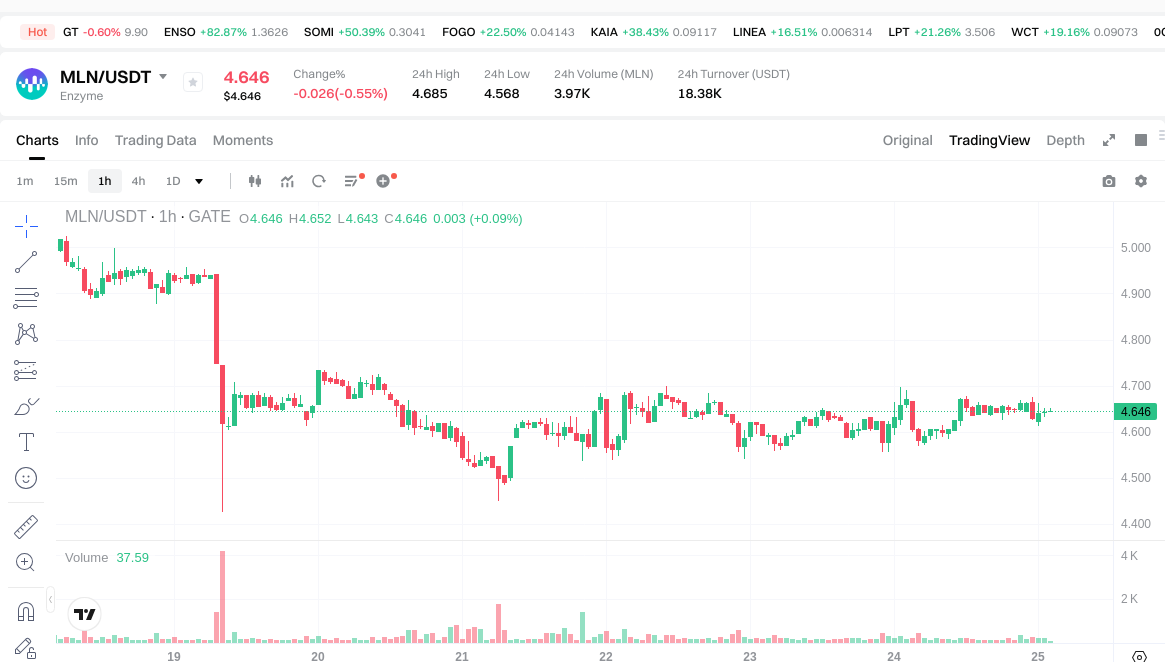
- MLN current price: 4.644 USD
- 24-hour trading volume: 18,346.35 USD
- Market capitalization: 13,877,608.86 USD
- Circulating supply: 2,988,287.87 MLN tokens
- 24-hour price range: 4.568 USD (low) to 4.689 USD (high)
Click to view real-time MLN market price
II. Core Factors Influencing Whether MLN is a Good Investment (Is Enzyme(MLN) a Good Investment)
Supply Mechanism and Scarcity (MLN investment scarcity)
- Unlimited maximum supply mechanism → potential impact on long-term price dynamics
- Circulating supply of approximately 2.99 million MLN tokens with a circulation ratio of nearly 100%
- Investment significance: the token economics model with no hard cap requires consideration of demand-side factors to evaluate scarcity value
Institutional Investment and Mainstream Adoption (Institutional investment in MLN)
- MLN serves as the utility token powering the Enzyme protocol for on-chain asset management in the DeFi ecosystem
- Developer and external contributor participation through grant mechanisms
- Investment value supported by the protocol's role in enabling users to build, share, and explore DeFi investment strategies
Macroeconomic Environment's Impact on MLN Investment
- Monetary policy and interest rate changes → alter investment attractiveness across digital assets
- DeFi sector sensitivity to broader market conditions affecting utility tokens
- Regulatory developments in decentralized finance may influence MLN investment demand
Technology and Ecosystem Development (Technology & Ecosystem for MLN investment)
- Enzyme protocol functionality: vault creation and investment lifecycle management → supports long-term utility value
- DeFi application expansion: users can filter strategies by historical performance and risk profiles
- Ecosystem development driven by MLN token utility for protocol fees and contributor incentives
III. MLN Future Investment Forecast and Price Outlook (Is Enzyme(MLN) worth investing in 2026-2031)
Short-term Investment Forecast (2026, short-term MLN investment outlook)
- Conservative forecast: $3.81 - $4.65
- Neutral forecast: $4.65 - $5.20
- Optimistic forecast: $5.20 - $5.76
Mid-term Investment Outlook (2027-2029, mid-term Enzyme(MLN) investment forecast)
- Market stage expectation: The mid-term period may witness gradual adoption of DeFi asset management solutions, with potential growth driven by ecosystem developments and institutional interest in on-chain portfolio strategies.
- Investment return forecast:
- 2027: $3.02 - $5.93
- 2028: $4.06 - $8.07
- 2029: $5.12 - $8.25
- Key catalysts: Expansion of DeFi investment strategies, integration with emerging protocols, and increased utility of MLN tokens within the Enzyme ecosystem.
Long-term Investment Outlook (Is Enzyme a good long-term investment?)
- Base scenario: $7.16 - $10.02 (assuming steady ecosystem growth and continued development)
- Optimistic scenario: $10.02 - $11.33 (assuming accelerated adoption and favorable market conditions)
- Risk scenario: Below $7.16 (under adverse regulatory developments or market downturns)
View MLN long-term investment and price forecast: Price Prediction
2026-01-25 - 2031 Long-term Outlook
- Base scenario: $7.16 - $10.02 USD (corresponding to steady progress and gradual mainstream adoption)
- Optimistic scenario: $10.02 - $11.33 USD (corresponding to large-scale adoption and favorable market environment)
- Transformative scenario: Above $11.33 USD (in case of breakthrough ecosystem developments and mainstream integration)
- 2031-12-31 predicted high: $11.33 USD (based on optimistic development assumptions)
Disclaimer: This forecast is for informational purposes only and does not constitute investment advice. Cryptocurrency markets are highly volatile and subject to various risks. Past performance does not guarantee future results. Users should conduct independent research and consult with qualified financial advisors before making investment decisions.
| Year |
Predicted High Price |
Predicted Average Price |
Predicted Low Price |
Price Change |
| 2026 |
5.76104 |
4.646 |
3.80972 |
0 |
| 2027 |
5.9320128 |
5.20352 |
3.0180416 |
12 |
| 2028 |
8.07326128 |
5.5677664 |
4.064469472 |
19 |
| 2029 |
8.2528217464 |
6.82051384 |
5.11538538 |
46 |
| 2030 |
10.023768164956 |
7.5366677932 |
7.15983440354 |
62 |
| 2031 |
11.32648119301062 |
8.780217979078 |
8.25340490033332 |
89 |
IV. Enzyme Investment Strategy and Risk Management (How to invest in DeFi asset management tokens)
Investment Strategy (Enzyme investment strategy)
Long-term Holding (HODL MLN)
For conservative investors, long-term holding of MLN may align with the broader adoption trajectory of decentralized finance asset management infrastructure. This approach focuses on the protocol's fundamental value proposition in facilitating on-chain asset management within the DeFi ecosystem, rather than short-term price movements.
Active Trading
Traders employing technical analysis may consider MLN's price movements in relation to broader DeFi market cycles and on-chain activity metrics. Wave-based operations require monitoring trading volumes, which stood at approximately 18,346 units in the recent 24-hour period, alongside price action between support and resistance levels.
Risk Management (Risk management for Enzyme investment)
Asset Allocation Ratios
- Conservative investors: Consider allocating 1-3% of crypto portfolio to specialized DeFi infrastructure tokens like MLN
- Aggressive investors: May increase exposure to 5-10% depending on conviction in DeFi asset management sector
- Professional investors: Portfolio allocation should align with broader DeFi sector exposure and institutional asset management thesis
Risk Hedging Strategies
- Implement multi-asset portfolio construction combining established cryptocurrencies with specialized DeFi tokens
- Consider utilizing diversification across different DeFi protocol categories to mitigate sector-specific risks
- Monitor correlation patterns between MLN and broader market movements
Secure Storage
- Cold wallet storage: Recommended for long-term holdings, particularly given MLN's ERC-20 token structure on Ethereum
- Hot wallet allocation: Limited amounts for active trading or protocol interaction
- Hardware wallet options: Devices supporting Ethereum-based tokens provide enhanced security for MLN storage
V. Enzyme Investment Risks and Challenges (Risks of investing in DeFi asset management tokens)
Market Risk
- High volatility: MLN has experienced significant price fluctuations, with 24-hour changes of -0.95%, 7-day movements of -6.93%, and annual variations reaching -71.07%
- Price dynamics: Historical price range spans from 1.79 to 258.26, indicating substantial volatility characteristics
- Liquidity considerations: Trading volume patterns and market depth should be evaluated before establishing positions
Regulatory Risk
- Uncertainty surrounding asset management protocol regulation across different jurisdictions
- Evolving compliance frameworks for decentralized finance platforms may impact protocol operations
- Potential classification changes for utility tokens in various regulatory environments
Technical Risk
- Smart contract vulnerabilities: DeFi protocols face ongoing security considerations related to code integrity
- Protocol upgrade dependencies: Changes to underlying Ethereum infrastructure or protocol modifications carry implementation risks
- Ecosystem dependencies: Reliance on broader DeFi ecosystem functionality and composability
VI. Conclusion: Is DeFi asset management infrastructure a Good Investment?
Investment Value Summary
MLN represents exposure to decentralized asset management infrastructure within the DeFi ecosystem. The protocol's positioning in on-chain asset management shows long-term potential aligned with DeFi adoption trends, though price action has demonstrated considerable volatility patterns.
Investor Recommendations
✅ Beginners:
- Employ dollar-cost averaging strategies to mitigate timing risk
- Prioritize secure storage solutions with hardware wallet implementation
- Start with conservative allocation percentages
✅ Experienced Investors:
- Consider wave-based operational approaches aligned with DeFi market cycles
- Implement diversified portfolio construction across multiple DeFi sectors
- Monitor on-chain metrics and protocol development updates
✅ Institutional Investors:
- Evaluate strategic long-term positioning within DeFi infrastructure thesis
- Assess correlation patterns with broader crypto asset classes
- Consider risk-adjusted allocation frameworks
⚠️ Disclaimer: Cryptocurrency investments carry substantial risk. This content is provided for informational purposes only and does not constitute investment advice. Market conditions, regulatory environments, and technical factors can change rapidly. Conduct thorough research and consider consulting financial professionals before making investment decisions.
VII. FAQ
Q1: Is Enzyme (MLN) a good investment for beginners in 2026?
MLN presents a high-risk, specialized investment opportunity that beginners should approach with caution and conservative allocation strategies. As a utility token powering decentralized asset management infrastructure, MLN has demonstrated significant volatility with a 71.07% decline over the past year and historical price swings ranging from $1.79 to $258.26. For beginners considering MLN investment, dollar-cost averaging strategies are recommended with portfolio allocation limited to 1-3% of total crypto holdings. The token's current market capitalization of approximately $13.88 million and relatively low trading volume of $18,346 indicate limited liquidity compared to major cryptocurrencies. Beginners should prioritize secure storage using hardware wallets supporting ERC-20 tokens and invest only capital they can afford to lose entirely. Educational preparation regarding DeFi protocols, on-chain asset management concepts, and smart contract risks is essential before establishing any position in MLN.
Q2: What is the realistic price prediction for MLN by 2031?
Based on current market conditions and historical performance analysis, MLN price forecasts for 2031 range from $8.25 (conservative scenario) to $11.33 (optimistic scenario), with an average predicted price of $8.78. These projections assume continued development of the Enzyme protocol, gradual adoption of DeFi asset management solutions, and favorable macroeconomic conditions for cryptocurrency markets. The optimistic scenario of $11.33 represents approximately 144% growth from current levels of $4.64, contingent upon breakthrough ecosystem developments and mainstream integration of decentralized finance infrastructure. However, these forecasts carry substantial uncertainty due to MLN's historical volatility, regulatory unpredictability in the DeFi sector, and competition from alternative asset management protocols. Investors should note that cryptocurrency price predictions extend beyond typical forecasting horizons and are subject to extreme variance based on technological developments, regulatory changes, and broader market sentiment shifts.
Q3: How does MLN's unlimited supply mechanism affect its investment value?
MLN operates without a maximum supply cap, which fundamentally differentiates its scarcity profile from fixed-supply cryptocurrencies like Bitcoin. This unlimited supply mechanism places greater emphasis on demand-side factors to evaluate long-term investment value rather than relying on programmatic scarcity. Currently, approximately 2.99 million MLN tokens circulate with a circulation ratio near 100%, but the absence of a hard cap means future token issuance could theoretically dilute existing holder value if not offset by corresponding demand growth. The investment implications require examining MLN's utility within the Enzyme ecosystem—token burns through protocol fees, grant distribution to developers, and broader DeFi adoption rates become critical variables. Unlike deflationary tokenomics models, MLN's value proposition depends more heavily on protocol usage growth and the expansion of on-chain asset management activities. Investors comparing MLN to fixed-supply assets should adjust valuation frameworks accordingly, focusing on network effects and utility demand rather than scarcity-driven appreciation models.
Q4: What are the primary risks of investing in Enzyme (MLN)?
Investing in MLN carries three primary risk categories that potential investors must evaluate. First, market risk manifests through extreme volatility, evidenced by 24-hour fluctuations of -0.95%, weekly movements of -6.93%, and annual declines reaching -71.07%, alongside low trading volumes of approximately $18,346 that may impair liquidity during market stress. Second, regulatory risk stems from evolving compliance frameworks for DeFi protocols, with uncertainty surrounding how authorities across different jurisdictions will classify and regulate decentralized asset management platforms, potentially impacting protocol operations and token utility. Third, technical risk involves smart contract vulnerabilities inherent in DeFi infrastructure, dependencies on Ethereum network upgrades, and composability risks from interactions with other protocols in the ecosystem. Additionally, MLN faces competitive pressures from alternative asset management solutions within DeFi, market concentration concerns given its relatively small market capitalization of $13.88 million, and ecosystem dependencies that could affect protocol functionality. These risks compound to create a high-risk investment profile suitable only for investors with appropriate risk tolerance and diversified portfolio construction.
Q5: How does Enzyme (MLN) compare to traditional asset management investments?
Enzyme represents a fundamentally different investment paradigm compared to traditional asset management infrastructure, offering decentralized, permissionless access to on-chain portfolio management tools versus centralized, regulated financial institutions. Traditional asset management investments typically involve equities in established firms like BlackRock or Vanguard, which provide stable dividend yields, regulatory protection, and institutional credibility, whereas MLN delivers exposure to emerging DeFi infrastructure with higher volatility, limited regulatory oversight, and technology-dependent value propositions. The key differentiation lies in MLN's role as a utility token enabling protocol functionality rather than representing equity ownership or profit-sharing arrangements. From a risk-return perspective, MLN exhibits significantly higher volatility with potential for substantial gains or losses—evidenced by historical price ranges from $1.79 to $258.26—while traditional asset management stocks demonstrate more moderate fluctuations aligned with broader equity markets. Investors considering MLN should view it as a speculative technology bet on DeFi adoption rather than a replacement for conventional asset management exposure, with appropriate portfolio allocation reflecting its higher risk profile and correlation to cryptocurrency market cycles rather than traditional financial sector performance.
Q6: What investment strategy is most suitable for MLN holders?
The optimal MLN investment strategy depends on investor profile, risk tolerance, and market outlook for decentralized finance infrastructure. Long-term holding (HODL) strategies suit conservative investors betting on the protocol's fundamental value proposition in facilitating on-chain asset management, focusing on multi-year adoption trajectories rather than short-term price movements, with recommended holding periods extending through 2027-2029 when DeFi asset management solutions may achieve broader recognition. This approach requires patient capital allocation of 1-3% of total crypto portfolio with secure cold storage implementation using hardware wallets. Alternatively, active trading strategies employ technical analysis of MLN's price movements relative to DeFi market cycles, monitoring support levels around $3.81 and resistance near $5.76, while tracking on-chain metrics and trading volumes to identify entry and exit points. Dollar-cost averaging provides a middle ground approach, systematically accumulating MLN positions over time to mitigate timing risk inherent in volatile markets, particularly suitable for investors with moderate conviction in DeFi infrastructure growth but uncertainty regarding optimal entry points. Regardless of strategy selection, risk management through diversification across multiple DeFi protocol categories, position sizing aligned with personal risk tolerance, and ongoing monitoring of regulatory developments and protocol updates remains essential for MLN investment success.
Q7: Can institutional investors allocate capital to MLN?
Institutional investors can technically allocate capital to MLN, but face significant operational and regulatory considerations that complicate deployment compared to mainstream cryptocurrency assets. From a portfolio construction perspective, MLN represents specialized exposure to DeFi infrastructure within the asset management vertical, potentially fitting into venture-stage digital asset allocations or thematic DeFi investment mandates rather than core cryptocurrency holdings. Institutional challenges include MLN's relatively small market capitalization of $13.88 million and limited daily trading volume of approximately $18,346, which restrict position sizing and create execution difficulties for larger capital deployments without significant price impact. Custody infrastructure for ERC-20 tokens exists through qualified custodians supporting Ethereum-based assets, addressing one institutional requirement, but regulatory uncertainty surrounding DeFi protocols complicates compliance frameworks and fiduciary duty considerations. Institutional investors evaluating MLN should conduct enhanced due diligence on the Enzyme protocol's smart contract audits, governance structures, and legal entity arrangements, while assessing correlation patterns with broader crypto asset classes to determine diversification benefits. Strategic long-term positioning within a DeFi infrastructure thesis may justify small allocations of 1-3% within specialized digital asset portfolios, but institutions should approach MLN as a high-risk, venture-like exposure rather than established infrastructure investment.
Q8: What factors will most influence MLN's price by 2027-2029?
MLN's mid-term price trajectory through 2027-2029 will primarily depend on three interconnected factor categories: DeFi ecosystem adoption, protocol-specific developments, and macroeconomic conditions. First, broader DeFi adoption rates for decentralized asset management solutions will determine baseline demand for Enzyme protocol functionality, with price forecasts ranging from $3.02-$8.25 across this period contingent upon institutional interest in on-chain portfolio strategies and retail user engagement with vault creation features. Second, protocol-specific catalysts include integration with emerging DeFi protocols, expansion of supported asset classes, governance improvements, and the effectiveness of MLN token utility mechanisms such as fee burns and grant distributions to ecosystem contributors. Third, macroeconomic factors encompassing cryptocurrency market cycles, regulatory clarity developments for DeFi protocols across major jurisdictions, and traditional finance interest rates affecting crypto asset attractiveness will shape investor sentiment toward specialized infrastructure tokens. Additionally, competitive dynamics with alternative asset management protocols, technological advancements in Ethereum scalability affecting transaction costs, and security track record of smart contracts will influence MLN's risk premium relative to established cryptocurrencies. Investors monitoring these factors should track on-chain metrics including total value locked in Enzyme vaults, active user counts, and protocol fee generation as leading indicators for fundamental value development supporting the $4.06-$8.07 price range projected for 2028.
* The information is not intended to be and does not constitute financial advice or any other recommendation of any sort offered or endorsed by Gate.