This comprehensive analysis evaluates whether Ethereum Classic (ETC) represents a viable investment opportunity in 2024-2030. The article examines ETC's current market position—trading at $13.07 with a $2.03 billion market capitalization—alongside its historical price trajectory and fixed maximum supply of 210.7 million tokens. It addresses core investment factors including supply scarcity, institutional adoption across 53 exchanges, technology infrastructure, and macroeconomic sensitivity. The analysis presents multi-scenario price forecasts ranging from $9.39 to $16.43 in 2026, with long-term projections reaching $12.15-$25.52 by 2030. Strategic guidance covers long-term holding versus active trading approaches, risk management protocols, and secure storage solutions via Gate and hardware wallets. The article concludes by assessing ETC as a high-volatility, higher-risk asset suitable for diversified portfolios with appropriate position sizing, emphasizing that historical -48.28% annual decline reflects cryp
Introduction: Ethereum Classic (ETC) Investment Position and Market Prospects
Ethereum Classic (ETC) represents a significant asset in the cryptocurrency sector, serving as a decentralized platform for executing smart contracts since its launch in 2015. As of January 2026, ETC maintains a market capitalization of approximately $2.03 billion with a circulating supply of around 155.11 million tokens, and its current price stands at $13.07. Positioned as the continuation of the original Ethereum chain upholding the "code is law" principle, ETC has gradually become a focal point for investors evaluating "Is Ethereum Classic (ETC) a good investment?" This article provides a comprehensive analysis of ETC's investment value, historical price movements, future price projections, and associated investment risks to serve as a reference for investors.
I. Ethereum Classic (ETC) Price History Review and Investment Value Status
- July 2016: Ethereum Classic emerged as a continuation of the original Ethereum blockchain following a fork, with initial trading around $0.75, representing the project's inception in maintaining the "code is law" principle.
- May 2021: ETC reached a notable price level of $167.09 on May 7, 2021, reflecting strong market interest during the broader cryptocurrency expansion period.
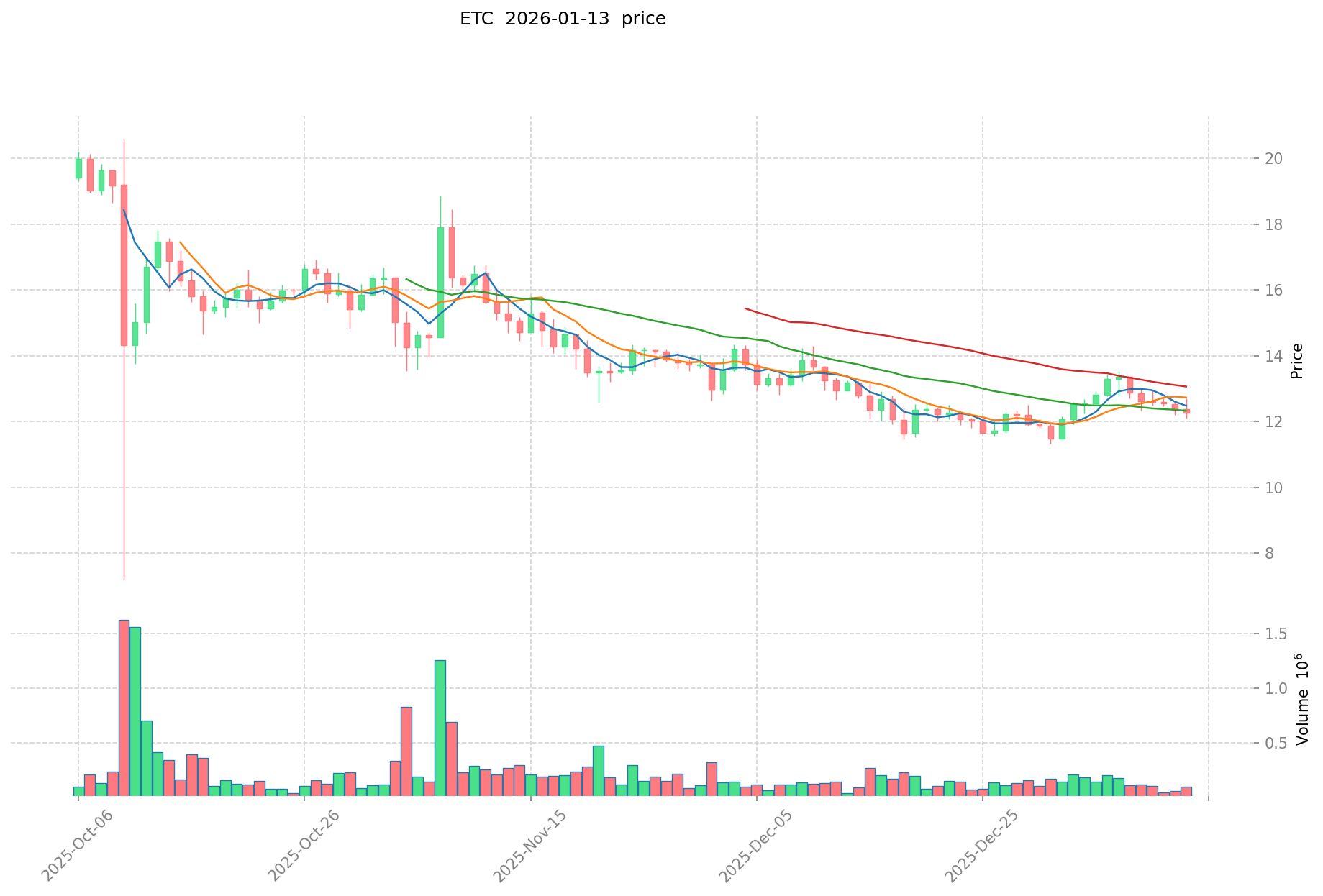
- 2025-2026: Following market cycles, ETC experienced price adjustments, with values declining from previous elevated levels to the current trading range near $13.
Current ETC Investment Market Status (January 2026)
- ETC current price: $13.07
- 24-hour trading volume: $1,650,285.02
- Market capitalization: $2.03 billion
- Circulating supply: 155,109,825.71 ETC
- Price changes: +5.58% (24h), +2.05% (7d), +2.48% (30d), -48.28% (1y)
- Maximum supply: 210,700,000 ETC
- Market dominance: 0.060%
Click to view real-time ETC market price
II. Core Factors Influencing Whether ETC is a Good Investment
Supply Mechanism and Scarcity (ETC Investment Scarcity)
- Fixed Maximum Supply → Impacts Price and Investment Value
Ethereum Classic operates with a defined maximum supply cap of 210,700,000 ETC tokens. As of January 14, 2026, approximately 155,109,825.71 ETC tokens are in circulation, representing roughly 73.62% of the total maximum supply. This controlled emission model creates a deflationary pressure mechanism over time.
- Historical Supply Dynamics
The current circulating supply represents a significant portion of the maximum cap, suggesting that future supply increases will be limited. The token's historical price range has varied from $0.615038 to $167.09, with supply dynamics playing a role in price movements during different market cycles.
- Investment Implications of Scarcity
The predetermined supply ceiling distinguishes ETC from assets with unlimited issuance. As the circulating supply approaches the maximum cap, the rate of new token creation decreases, potentially creating supply-side pressure that may influence long-term valuation dynamics. However, scarcity alone does not guarantee price appreciation, as demand factors and market conditions remain critical variables.
Institutional Investment and Mainstream Adoption (Institutional Investment in ETC)
- Market Presence Indicators
Ethereum Classic maintains trading availability across 53 exchanges as of January 2026, indicating broad market accessibility. The network records approximately 2,794,377 holders, demonstrating a distributed user base. With a market capitalization of approximately $2.03 billion and a market dominance of 0.060%, ETC maintains a presence within the broader cryptocurrency ecosystem.
As a continuation of the original Ethereum chain, Ethereum Classic upholds the "code is law" principle, which may appeal to specific segments of the cryptocurrency community that prioritize immutability. The platform's decentralized infrastructure supports smart contract execution without censorship or third-party interference, positioning it as an alternative platform for certain decentralized applications.
From an investment perspective, ETC can be characterized as a higher-risk asset. Price movements tend to correlate with broader market trends, and volatility remains a defining characteristic. The fully diluted market cap matches the current market capitalization at approximately 73.62%, indicating that a significant portion of tokens are already in circulation.
Macroeconomic Environment's Impact on ETC Investment
Ethereum Classic's price performance shows correlation with broader cryptocurrency market cycles. Over the past year, ETC has experienced a decline of approximately 48.28%, reflecting sensitivity to market-wide conditions. Short-term performance shows mixed signals, with a 24-hour increase of 5.58% and a 7-day increase of 2.05%, suggesting volatility in response to market dynamics.
As of January 14, 2026, ETC trades at approximately $13.07, significantly below previous price levels observed during more favorable market conditions. The 24-hour trading volume stands at approximately $1.65 million, indicating active but moderate market liquidity.
- Risk Considerations in Uncertain Environments
The cryptocurrency market remains subject to regulatory developments, technological changes, and macroeconomic shifts. ETC's historical price volatility, with movements from $0.615038 to $167.09, illustrates the potential for significant price fluctuations. Investors should consider these dynamics when evaluating risk tolerance and investment timeframes.
Technology and Ecosystem Development (Technology & Ecosystem for ETC Investment)
Ethereum Classic operates as a decentralized platform supporting smart contract execution. The network maintains compatibility with Ethereum-based development tools and standards, allowing for the deployment of decentralized applications. The platform's commitment to immutability differentiates it from other smart contract platforms that have implemented protocol changes.
The project maintains active development repositories across multiple implementations, including core-geth, multi-geth, and other client software. The Ethereum Classic Improvement Proposal (ECIP) process provides a framework for protocol upgrades and community governance. Community engagement occurs through various channels, including forums and social media platforms.
The Ethereum Classic ecosystem supports various decentralized applications, including smart contracts for digital asset management and programmable financial instruments. The platform's focus on censorship resistance and immutability may attract specific use cases that prioritize these characteristics. However, ecosystem development activity and application diversity remain important factors in assessing long-term utility and investment potential.
III. ETC Future Investment Forecast and Price Outlook (Is Ethereum Classic(ETC) worth investing in 2026-2030)
Short-term Investment Forecast (2026, short-term ETC investment outlook)
- Conservative Estimate: $9.39 - $13.04
- Neutral Estimate: $13.04 - $14.73
- Optimistic Estimate: $14.73 - $16.43
Mid-term Investment Outlook (2027-2028, mid-term Ethereum Classic(ETC) investment forecast)
-
Market Stage Expectation: The period from 2027 to 2028 may witness gradual recovery and consolidation phases. Market sentiment and broader adoption trends within the decentralized computing sector could influence ETC's trajectory during this timeframe.
-
Investment Return Forecast:
- 2027: $10.76 - $17.24
- 2028: $13.59 - $23.82
-
Key Catalysts: Factors such as network upgrades, increased smart contract utilization, shifts in market sentiment toward proof-of-work platforms, and potential inflows from institutional investors could serve as catalysts.
Long-term Investment Outlook (Is ETC a good long-term investment?)
- Base Scenario: $12.15 - $24.30 by 2030 (assuming steady ecosystem development and moderate adoption growth)
- Optimistic Scenario: $19.90 - $25.52 by 2031 (assuming accelerated adoption, favorable regulatory environments, and successful implementation of protocol enhancements)
- Risk Scenario: Below $12.15 (in cases of prolonged market downturns, increased competition from alternative platforms, or network security concerns)
For more details on ETC long-term investment and price forecasts: Price Prediction
2026-2030 Long-term Outlook
- Base Scenario: $12.15 - $24.30 (corresponding to steady progress and incremental mainstream application growth)
- Optimistic Scenario: $19.90 - $25.52 (corresponding to large-scale adoption and favorable market conditions)
- Transformative Scenario: Above $25.52 (in the event of breakthrough ecosystem developments and mainstream proliferation)
- December 31, 2030 Projected High: $24.30 (based on optimistic development assumptions)
Disclaimer: The forecasts and scenarios presented are based on historical data, market trends, and analytical models. They are intended for informational purposes only and should not be construed as financial advice or guarantees of future performance. Cryptocurrency markets are highly volatile and unpredictable. Investors should conduct their own research and consider their risk tolerance before making any investment decisions.
| Year |
Predicted High Price |
Predicted Average Price |
Predicted Low Price |
Price Change |
| 2026 |
16.42914 |
13.039 |
9.38808 |
0 |
| 2027 |
17.2388619 |
14.73407 |
10.7558711 |
12 |
| 2028 |
23.8198342655 |
15.98646595 |
13.5884960575 |
22 |
| 2029 |
24.281843131455 |
19.90315010775 |
13.53414207327 |
52 |
| 2030 |
24.30174628156275 |
22.0924966196025 |
12.150873140781375 |
69 |
| 2031 |
25.516833595640887 |
23.197121450582625 |
13.222359226832096 |
77 |
IV. Ethereum Classic Investment Strategy and Risk Management (How to invest in Ethereum Classic)
Investment Methodology (Ethereum Classic investment strategy)
Long-term Holding (HODL ETC): Suitable for Conservative Investors
Long-term holding represents a passive investment approach where investors purchase ETC and maintain positions over extended periods, typically months to years. This strategy aims to capture the potential appreciation of Ethereum Classic as the network develops and adoption increases. Conservative investors may find this approach appealing as it reduces exposure to short-term market volatility and eliminates the need for frequent trading decisions.
Key considerations for long-term ETC holders include:
- Understanding the project's fundamental value proposition as a continuation of the original Ethereum chain
- Recognizing that ETC maintains a fixed maximum supply of 210,700,000 tokens, with current circulation at approximately 73.62% of this cap
- Monitoring network developments and ecosystem growth over time
- Accepting that historical data shows significant price fluctuations, with the asset experiencing a -48.28% change over the past year
Active Trading: Technical Analysis and Swing Trading
Active trading involves frequent position adjustments based on market movements, technical indicators, and price patterns. This approach requires substantial market knowledge, time commitment, and risk tolerance. Traders utilizing this strategy typically employ:
- Technical analysis tools to identify entry and exit points
- Chart patterns and momentum indicators
- Short to medium-term position holding periods
- Risk management protocols for each trade
Recent price data indicates ETC exhibited volatility with a 24-hour range between $12.171 and $13.209, suggesting opportunities for swing traders. However, this approach carries higher risk and requires constant market monitoring.
Risk Management (Risk management for ETC investment)
Asset Allocation Ratios: Conservative / Aggressive / Professional Investors
Conservative Investors:
- ETC allocation: 1-3% of total crypto portfolio
- Combined cryptocurrency exposure: 5-10% of total investment portfolio
- Focus on capital preservation with limited downside exposure
- Prioritize established assets alongside smaller positions in alternative chains
Aggressive Investors:
- ETC allocation: 5-10% of crypto portfolio
- Combined cryptocurrency exposure: 20-30% of total investment portfolio
- Accept higher volatility for potential appreciation
- May increase position sizing during perceived market opportunities
Professional Investors:
- ETC allocation: Strategic positioning based on portfolio strategy and market conditions
- Utilize advanced risk metrics and position sizing models
- Implement hedging strategies and derivatives when available
- Continuously rebalance based on risk parameters and market developments
Diversification remains a fundamental principle for managing cryptocurrency investment risk:
- Multi-asset approach: Combining ETC with other blockchain assets, stablecoins, and traditional assets
- Cross-chain diversification: Exposure to different blockchain ecosystems to reduce platform-specific risk
- Correlation analysis: Understanding how ETC moves relative to Bitcoin, Ethereum, and broader crypto markets
- Hedging instruments: Utilizing available derivatives, stablecoins, or inverse positions when appropriate
Investors should note that ETC currently represents approximately 0.060% of the total cryptocurrency market capitalization, indicating its position as a smaller-cap asset within the broader ecosystem.
Secure Storage: Hot/Cold Wallets + Hardware Wallet Recommendations
Storage Strategy Framework:
Cold Storage Solutions:
- Hardware wallets for long-term holdings (majority of assets)
- Paper wallets as backup or inheritance planning tools
- Multi-signature wallets for institutional holdings
- Air-gapped storage for maximum security
Hot Wallet Usage:
- Exchange wallets for active trading positions only
- Mobile or desktop wallets for small amounts needed for transactions
- Limit hot wallet holdings to amounts acceptable to lose
Security Best Practices:
- Never share private keys or seed phrases
- Use strong, unique passwords and two-factor authentication
- Verify wallet addresses before transactions
- Keep backup seed phrases in secure, separate physical locations
- Regularly update wallet software
- Be cautious of phishing attempts and fraudulent websites
With ETC's holder count at approximately 2,794,377 addresses, proper security practices are essential for protecting investments.
V. Ethereum Classic Investment Risks and Challenges (Risks of investing in Ethereum Classic)
Market Risks: High Volatility and Price Manipulation Concerns
Ethereum Classic exhibits substantial price volatility characteristic of cryptocurrency markets:
Historical Volatility:
- The asset experienced a -48.28% decline over the past 12 months
- 24-hour price movements recently showed a 5.58% increase
- Historical price range spans from $0.615038 (July 25, 2016) to $167.09 (May 7, 2021)
- Current trading represents approximately 92.18% below the historical peak
Liquidity Considerations:
- 24-hour trading volume of approximately $1,650,285
- Available on 53 exchanges, providing multiple trading venues
- Market capitalization of approximately $2.03 billion suggests moderate liquidity compared to larger assets
Market Structure Risks:
- Smaller market cap assets may face increased susceptibility to large order impacts
- Lower trading volumes compared to major cryptocurrencies can result in wider bid-ask spreads
- Potential for concentrated holder positions to influence price movements
Regulatory Risks: Policy Uncertainty Across Jurisdictions
Cryptocurrency regulation varies significantly across global jurisdictions, creating uncertainty for ETC investors:
Regulatory Landscape Challenges:
- Different countries maintain varying approaches to cryptocurrency classification and taxation
- Regulatory frameworks continue evolving, potentially impacting trading access, taxation, and legal status
- Cross-border transaction regulations may affect accessibility in certain regions
- Exchange compliance requirements differ by jurisdiction, potentially limiting trading options
Compliance Considerations:
- Investors must understand tax obligations in their respective jurisdictions
- Reporting requirements for cryptocurrency holdings and transactions vary by country
- Regulatory changes may impact exchange availability and trading pairs
- Future policy developments could affect network operations or token economics
As a continuation of the original Ethereum chain following the DAO incident, ETC's adherence to the "code is law" principle may face varying regulatory interpretations across different legal frameworks.
Technical Risks: Network Security Vulnerabilities and Upgrade Challenges
Network Security Considerations:
- As a proof-of-work blockchain, ETC requires sufficient hash rate to maintain security
- Historical incidents in the broader cryptocurrency space highlight potential vulnerabilities
- Smart contract execution risks inherent to programmable blockchains
- Dependency on node operator participation for network health
Development and Upgrade Risks:
- Protocol upgrades require coordination across distributed network participants
- Potential for implementation bugs or unexpected behavior during updates
- Compatibility challenges with existing applications and infrastructure
- Ongoing maintenance requirements for ecosystem tools and infrastructure
Ecosystem Dependencies:
- Reliance on developer community engagement for continued improvement
- Competition from other smart contract platforms for developer attention and user adoption
- Infrastructure requirements for running nodes and maintaining network operations
VI. Conclusion: Is Ethereum Classic a Good Investment?
Investment Value Summary
Ethereum Classic represents a distinctive position within the cryptocurrency ecosystem as the continuation of the original Ethereum blockchain. The project maintains several characteristics that merit consideration:
Value Proposition:
- Operates as a decentralized platform supporting smart contract execution without intermediaries
- Upholds the "code is law" principle, distinguishing it from other blockchain networks
- Fixed maximum supply of 210,700,000 tokens provides a defined supply schedule
- Current circulation of approximately 73.62% of maximum supply
Market Position:
- Maintains presence on 53 exchanges with ongoing trading activity
- Ranks 50th by market capitalization with approximately $2.03 billion in market value
- Holder base of approximately 2,794,377 addresses indicates sustained network participation
Performance Context:
- Recent 24-hour performance showed a 5.58% increase
- One-year performance reflects a -48.28% decline
- Current price represents significant discount from historical peak levels
The asset demonstrates characteristics of both long-term potential through its established network and technological foundation, alongside significant short-term price volatility common to cryptocurrency markets.
Investor Recommendations
✅ Novice Investors:
- Consider dollar-cost averaging approach to mitigate timing risk
- Prioritize secure storage solutions, utilizing hardware wallets for holdings
- Limit position sizing to amounts comfortable with high volatility
- Invest time in understanding blockchain technology and ETC's specific value proposition
- Avoid over-concentration in any single cryptocurrency asset
✅ Experienced Investors:
- Evaluate ETC within broader portfolio context and risk tolerance parameters
- Consider swing trading opportunities based on technical analysis and market conditions
- Implement position sizing consistent with overall portfolio strategy
- Utilize multi-asset diversification to manage cryptocurrency-specific risks
- Maintain awareness of regulatory developments affecting cryptocurrency markets
✅ Institutional Investors:
- Assess ETC as potential strategic allocation within digital asset portfolios
- Implement comprehensive risk management frameworks and compliance protocols
- Consider custody solutions meeting institutional security requirements
- Evaluate position sizing relative to liquidity needs and market depth
- Monitor network development and ecosystem growth metrics
Important Disclaimer
⚠️ Risk Disclosure: Cryptocurrency investments carry substantial risk, including potential complete loss of capital. ETC, like all digital assets, experiences significant price volatility. Historical performance does not guarantee future results. This analysis provides educational information only and does not constitute investment advice. Investors should conduct independent research, consider personal financial circumstances, and consult qualified financial advisors before making investment decisions. Regulatory status and treatment of cryptocurrencies vary by jurisdiction. Only invest amounts you can afford to lose entirely.
VII. FAQ
Q1: What is Ethereum Classic (ETC) and how does it differ from Ethereum (ETH)?
Ethereum Classic is the continuation of the original Ethereum blockchain that maintained the "code is law" principle following the 2016 DAO incident fork. Unlike Ethereum, which implemented a protocol change to reverse the DAO hack, ETC preserved the original chain's immutability stance. Both platforms support smart contract execution, but ETC remains committed to proof-of-work consensus while Ethereum has transitioned to proof-of-stake. ETC has a fixed maximum supply of 210,700,000 tokens, whereas ETH has no hard supply cap. This philosophical difference attracts investors and developers who prioritize immutability and censorship resistance above all else.
Q2: Is Ethereum Classic a good investment for beginners in 2026?
For novice investors, ETC represents a high-risk, high-volatility asset requiring careful consideration. The token experienced a -48.28% decline over the past year, demonstrating significant price fluctuation potential. Beginners should limit ETC allocation to 1-3% of their crypto portfolio and 5-10% of total investment portfolio. Dollar-cost averaging can help mitigate timing risks, while secure storage using hardware wallets is essential. Before investing, newcomers should understand blockchain technology, ETC's value proposition, and only commit capital they can afford to lose entirely. The asset's historical price range from $0.615 to $167.09 illustrates the extreme volatility inherent in this investment.
Q3: What are the main risks associated with investing in Ethereum Classic?
ETC investment carries three primary risk categories: market risk, regulatory risk, and technical risk. Market risk includes extreme price volatility, with 24-hour movements potentially exceeding 5% and annual fluctuations reaching -48%. The relatively modest 24-hour trading volume of $1.65 million creates liquidity concerns compared to larger assets. Regulatory uncertainty across jurisdictions affects trading access, taxation, and legal status. Technical risks encompass network security vulnerabilities inherent to proof-of-work blockchains, smart contract execution risks, and dependency on sustained developer engagement. Investors should implement comprehensive risk management strategies, including position sizing limits, portfolio diversification, and secure storage solutions.
Q4: What is the price forecast for Ethereum Classic through 2030?
Price projections for ETC suggest varied scenarios based on adoption rates and market conditions. Short-term 2026 estimates range from $9.39 to $16.43 depending on market sentiment. Mid-term forecasts project $10.76-$17.24 in 2027 and $13.59-$23.82 in 2028, assuming gradual ecosystem development. Long-term 2030 projections indicate a base scenario of $12.15-$24.30, while optimistic scenarios reach $19.90-$25.52 assuming accelerated adoption and favorable conditions. However, these forecasts are not guarantees—they represent analytical models based on historical data and market trends. Cryptocurrency markets remain highly unpredictable, and actual outcomes may differ significantly from projections.
Q5: How should I store my Ethereum Classic tokens securely?
Secure ETC storage requires implementing a cold/hot wallet strategy based on investment timeline and usage needs. For long-term holdings representing the majority of assets, hardware wallets provide optimal security through offline private key storage. Examples include Ledger and Trezor devices. Hot wallets on exchanges should only hold amounts needed for active trading, as they face higher security risks. Essential security practices include: never sharing private keys or seed phrases, using strong unique passwords with two-factor authentication, verifying wallet addresses before transactions, maintaining backup seed phrases in separate physical locations, and regularly updating wallet software. With approximately 2.79 million ETC holders, proper security protocols are critical for protecting investments from theft or loss.
Q6: What factors could drive Ethereum Classic's price higher in the future?
Several catalysts could potentially influence ETC's upward price movement. The fixed maximum supply of 210.7 million tokens creates scarcity dynamics as circulation approaches 73.62% of the cap, potentially generating supply-side pressure. Network upgrades improving functionality, scalability, or security may attract increased developer and user interest. Growing adoption of decentralized applications prioritizing immutability and censorship resistance could drive utility value. Broader cryptocurrency market bull cycles historically lift most assets, including ETC. Institutional investment inflows or regulatory clarity providing legitimacy to proof-of-work platforms could also serve as positive catalysts. However, these factors do not guarantee price appreciation, as demand dynamics, competition from alternative platforms, and macroeconomic conditions remain critical variables affecting valuation.
Q7: Should I choose long-term holding or active trading for ETC investment?
The optimal strategy depends on individual risk tolerance, time availability, and market expertise. Long-term holding (HODL) suits conservative investors seeking to capture potential appreciation while avoiding short-term volatility. This passive approach requires minimal time commitment and reduces trading costs, but demands patience through market downturns like the recent -48.28% annual decline. Active trading involves frequent position adjustments based on technical analysis and market movements, potentially capitalizing on volatility evidenced by recent 24-hour ranges of $12.17-$13.21. However, active trading requires substantial market knowledge, constant monitoring, and higher risk tolerance. Most investors benefit from combining approaches: maintaining a core long-term position (70-80%) while allocating a smaller portion (20-30%) for tactical trading opportunities based on technical signals and market conditions.
Q8: How does Ethereum Classic's fixed supply affect its investment potential?
ETC's maximum supply cap of 210,700,000 tokens creates distinct economic characteristics compared to unlimited-issuance assets. With current circulation at approximately 155.11 million tokens (73.62% of maximum), remaining token creation is limited and decreasing over time. This deflationary pressure mechanism theoretically creates scarcity value as demand meets constrained supply. The predetermined supply schedule provides transparency regarding future token availability, unlike assets subject to governance decisions that could modify issuance policies. However, scarcity alone does not guarantee price appreciation—actual investment returns depend on adoption rates, utility development, competitive positioning, and broader market conditions. Investors should view the fixed supply as one factor among many when evaluating ETC's long-term value proposition rather than a standalone guarantee of returns.
* The information is not intended to be and does not constitute financial advice or any other recommendation of any sort offered or endorsed by Gate.