This comprehensive guide evaluates whether Falcon Finance (FF) represents a viable investment opportunity within the DeFi collateralization infrastructure space. The article analyzes FF's market position as of January 2026, featuring a $203.32 million market capitalization and current price of $0.08689, while reviewing its volatile price history from a $0.85 peak to current trading levels. The analysis examines core investment factors including FF's supply mechanism (2.34 billion circulating tokens of 10 billion total), institutional adoption indicators, and technology infrastructure operating on Ethereum as an ERC-20 standard. The guide provides detailed price forecasts across multiple scenarios through 2031, with projections ranging from $0.058 to $0.268 depending on adoption rates and market conditions. Investment strategies tailored to different investor types—from beginners using dollar-cost averaging to institutional investors conducting strategic allocation—are presented alongside comprehensive risk ma
Introduction: Falcon Finance (FF)'s Investment Position and Market Outlook
FF is a significant asset in the cryptocurrency sector, having been launched in 2025 and demonstrating notable achievements in the collateralization infrastructure space. As of January 2026, Falcon Finance holds a market capitalization of approximately $203.32 million, with a circulating supply of 2.34 billion tokens, and the current price hovering around $0.08689. Positioned as a universal collateralization infrastructure protocol focused on sustainable yield opportunities, FF has gradually become a focal point when investors discuss "Is Falcon Finance (FF) a good investment?" This article provides a comprehensive analysis of FF's investment value, historical trends, future price projections, and investment risks to serve as a reference for investors.
I. Falcon Finance (FF) Price History Review and Current Investment Value
- 2025: FF reached a peak price of $0.85 on September 29 → significant price volatility observed
- 2025: The token experienced a substantial decline, dropping to $0.04786 on October 10 → market correction phase
- Current phase: As of January 16, 2026, FF is trading at $0.08689 → price fluctuations between $0.0857 and $0.09103 in the past 24 hours
Current FF Investment Market Overview (January 2026)
- Current FF Price: $0.08689
- 24-hour Trading Volume: $1,998,153.47
- Market Capitalization: $203,322,600
- Circulating Supply: 2.34 billion FF tokens (23.4% of total supply)
- Fully Diluted Valuation: $868,900,000
- Total Supply: 10 billion FF tokens
- Market Dominance: 0.025%
- Token Holders: 10,880 addresses
Recent Price Trends
- 1-Hour Change: +0.98%
- 24-Hour Change: -4.34%
- 7-Day Change: -0.89%
- 30-Day Change: -15.74%
- 1-Year Change: -47.14%
View real-time FF market price
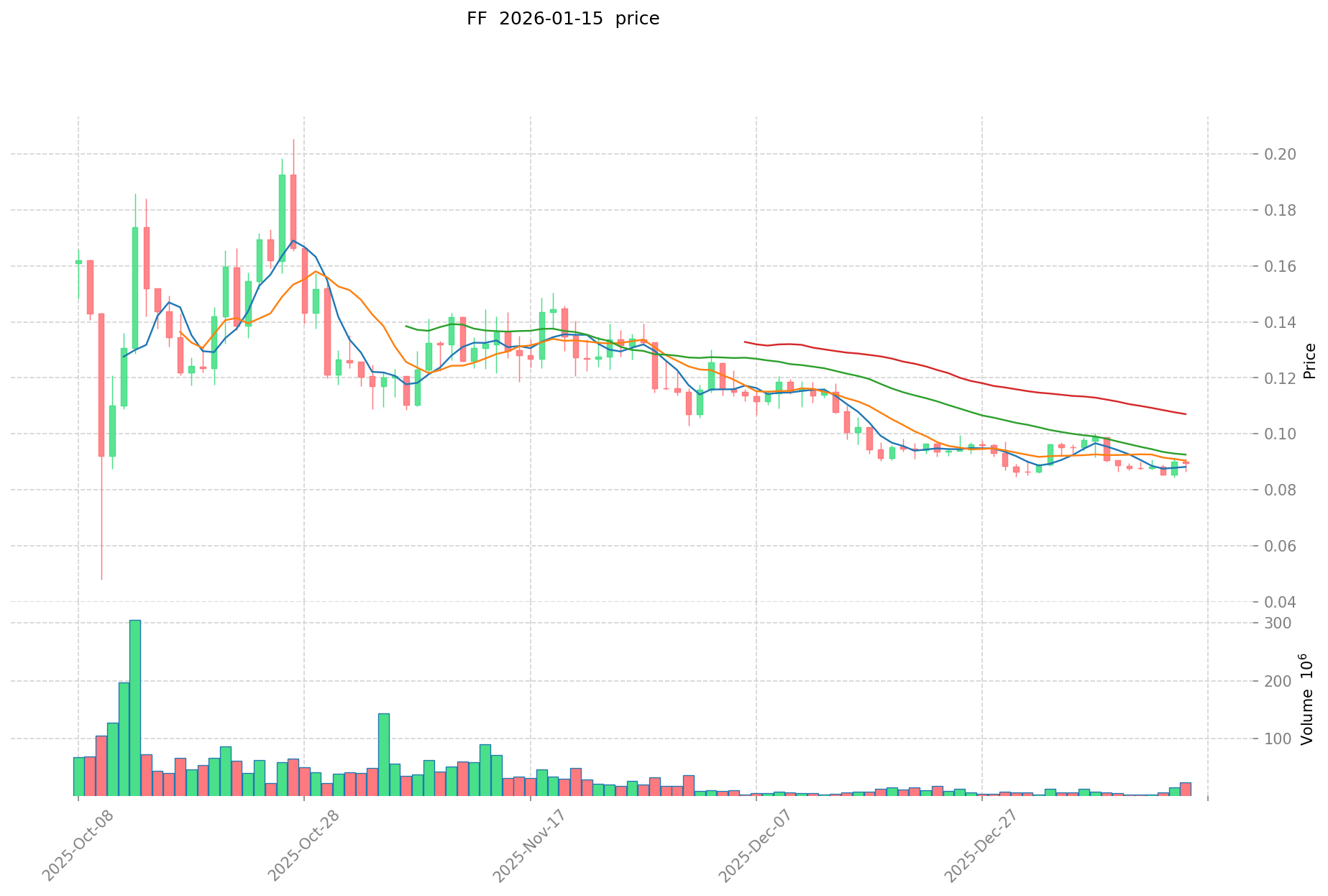
II. Core Factors Influencing Whether FF is a Good Investment (Is Falcon Finance(FF) a Good Investment)
Supply Mechanism and Scarcity (FF investment scarcity)
- Supply Structure Impact on Investment Value: Falcon Finance has a maximum supply of 10 billion FF tokens, with approximately 2.34 billion tokens currently in circulation, representing 23.4% of the total supply. This controlled release mechanism may influence token scarcity dynamics over time.
- Circulation Dynamics: The current circulating supply accounts for less than one-quarter of the maximum supply, suggesting that future token releases could impact market dynamics and investment considerations.
- Investment Implications: The token's supply structure represents one factor among many that investors may consider when evaluating potential scarcity-related value propositions in the long term.
Institutional Investment and Mainstream Adoption (Institutional investment in FF)
- Holder Distribution: As of the latest data, Falcon Finance has approximately 10,880 token holders, indicating a developing user base across the ecosystem.
- Exchange Presence: FF is listed on 31 cryptocurrency exchanges, providing multiple access points for potential investors and contributing to market liquidity.
- Adoption Indicators: The protocol positions itself as the first universal collateralization infrastructure, which may attract attention from users seeking yield opportunities within the decentralized finance space.
Macroeconomic Environment's Impact on FF Investment
- Market Volatility Context: The broader cryptocurrency market continues to experience fluctuations influenced by monetary policy changes, interest rate adjustments, and global economic conditions, which may affect FF's investment attractiveness.
- Risk Considerations: Historical data from similar tokens launched in 2025 suggests that new token launches can experience significant volatility, with median fully diluted valuation drops observed across the sector.
- Economic Uncertainty Factors: Geopolitical developments and macroeconomic shifts may influence investor sentiment toward digital assets, including collateralization protocols like Falcon Finance.
Technology and Ecosystem Development (Technology & Ecosystem for FF investment)
- Protocol Foundation: Falcon Finance is built as a collateralization infrastructure protocol designed to create yield opportunities, supported by a team with expertise in blockchain, financial engineering, and quantitative analysis.
- Technical Standard: The token operates on the Ethereum blockchain using the ERC-20 standard, providing compatibility with the existing Ethereum ecosystem and related applications.
- Ecosystem Positioning: As a protocol focused on trust, transparency, and technical robustness, Falcon Finance aims to enable users to maximize asset utilization within decentralized finance frameworks, though ecosystem development remains an ongoing process.
III. FF Future Investment Forecast and Price Outlook (Is Falcon Finance(FF) worth investing in 2026-2031)
Short-term FF Investment Outlook (2026)
- Conservative Forecast: $0.058 - $0.087
- Neutral Forecast: $0.087 - $0.114
- Optimistic Forecast: $0.114 and above
Mid-term Falcon Finance(FF) Investment Forecast (2027-2028)
-
Market Phase Expectation: The protocol may experience a consolidation phase as it establishes its position as a collateralization infrastructure provider. Growth could be influenced by adoption rates among institutional and retail users seeking sustainable yield opportunities.
-
Investment Return Forecast:
- 2027: $0.058 - $0.139
- 2028: $0.073 - $0.175
-
Key Catalysts: Protocol adoption by DeFi platforms, partnerships with blockchain projects, expansion of collateralization services, and overall market sentiment toward yield-generating protocols.
Long-term Investment Outlook (Is FF a good long-term investment?)
- Base Scenario: $0.095 - $0.182 (assuming steady protocol development and moderate market growth)
- Optimistic Scenario: $0.182 - $0.268 (assuming accelerated adoption and favorable regulatory environment)
- Risk Scenario: Below $0.058 (in case of severe market downturn or protocol-specific challenges)
Click to view FF long-term investment and price forecast: Price Prediction
2026-01-16 - 2031 Long-term Outlook
- Base Scenario: $0.095 - $0.182 USD (corresponding to steady progress and gradual mainstream application growth)
- Optimistic Scenario: $0.182 - $0.268 USD (corresponding to large-scale adoption and favorable market conditions)
- Transformative Scenario: Above $0.268 USD (if ecosystem achieves breakthrough developments and mainstream popularity)
- 2031-12-31 Forecast High: $0.268 USD (based on optimistic development assumptions)
Disclaimer: The above forecasts are based on available data and market analysis as of January 16, 2026. Cryptocurrency investments carry significant risks, and actual prices may differ substantially from projections due to market volatility, regulatory changes, technological developments, and other unforeseen factors. This information does not constitute investment advice, and investors should conduct their own research and consult financial professionals before making investment decisions.
| Year |
Predicted High Price |
Predicted Average Price |
Predicted Low Price |
Price Change |
| 2026 |
0.114378 |
0.08665 |
0.0580555 |
0 |
| 2027 |
0.13870932 |
0.100514 |
0.05829812 |
15 |
| 2028 |
0.1746330236 |
0.11961166 |
0.0729631126 |
37 |
| 2029 |
0.217741065864 |
0.1471223418 |
0.123582767112 |
69 |
| 2030 |
0.20249919125352 |
0.182431703832 |
0.09486448599264 |
109 |
| 2031 |
0.267526972084436 |
0.19246544754276 |
0.136650467755359 |
121 |
IV. FF Investment Strategy and Risk Management (How to invest in Falcon Finance)
Investment Strategy (FF investment strategy)
Long-term Holding (HODL FF): Suitable for conservative investors
Long-term holding represents a fundamental approach for investors seeking exposure to Falcon Finance's collateralization infrastructure protocol. This strategy involves acquiring FF tokens and maintaining positions over extended periods, allowing investors to potentially benefit from the protocol's development and adoption trajectory. Conservative investors may find this approach aligned with their risk tolerance, as it reduces exposure to short-term price fluctuations while focusing on the protocol's underlying value proposition in creating sustainable yield opportunities.
Active Trading: Relying on technical analysis and swing trading
Active trading strategies involve monitoring FF's price movements and executing trades based on technical indicators and market trends. Given the token's 24-hour trading volume of approximately $1.99 million and observable price ranges (24h high: $0.09103, 24h low: $0.0857), traders may identify opportunities for short-term gains. This approach requires continuous market monitoring, understanding of chart patterns, and disciplined execution of entry and exit points based on technical analysis frameworks.
Risk Management (Risk management for FF investment)
Asset Allocation Ratios: Conservative / Aggressive / Professional investors
- Conservative investors: May consider allocating a small percentage (1-3%) of their cryptocurrency portfolio to FF, maintaining larger positions in established assets
- Aggressive investors: Could increase allocation to 5-10% while accepting higher volatility exposure
- Professional investors: May employ dynamic allocation strategies based on market conditions and protocol developments
Risk Hedging Solutions: Multi-asset portfolios + hedging instruments
Diversification across multiple cryptocurrency assets can help mitigate FF-specific risks. Investors may consider:
- Maintaining positions in assets with low correlation to FF's price movements
- Balancing exposure across different protocol types and blockchain ecosystems
- Monitoring the 23.4% circulating supply ratio, as token unlock schedules could impact price dynamics
Secure Storage: Hot and cold wallets + hardware wallet recommendations
Given that FF operates on the Ethereum network as an ERC-20 token (contract address: 0xfa1c09fc8b491b6a4d3ff53a10cad29381b3f949), investors should implement appropriate security measures:
- Cold storage solutions for long-term holdings to minimize exposure to online threats
- Hot wallets for active trading with limited balances
- Hardware wallet options for enhanced security when storing significant amounts
- Regular verification of contract addresses before transactions
V. FF Investment Risks and Challenges (Risks of investing in Falcon Finance)
Market Risk: High volatility and price manipulation concerns
FF has demonstrated notable price volatility across different timeframes. Recent performance shows:
- 1-hour change: +0.98%
- 24-hour change: -4.34%
- 7-day change: -0.89%
- 30-day change: -15.74%
- 1-year change: -47.14%
The token's price range from an observed low of $0.04786 to a high of $0.85 illustrates significant fluctuation potential. With a current market capitalization of approximately $203.32 million and a market cap to fully diluted valuation ratio of 23.4%, the relatively low circulating supply percentage may contribute to price volatility. The concentration of holdings among 10,880 addresses could also present liquidity considerations.
Regulatory Risk: Policy uncertainty across different jurisdictions
As a DeFi protocol offering collateralization infrastructure and yield opportunities, Falcon Finance operates in an evolving regulatory landscape. Different jurisdictions maintain varying approaches to:
- Classification of tokens and their regulatory treatment
- Yield-generating protocols and their compliance requirements
- Cross-border cryptocurrency operations
- Securities law applicability to protocol tokens
Investors should monitor regulatory developments in their respective jurisdictions and assess how changes might impact protocol operations and token utility.
Technical Risk: Network security vulnerabilities and upgrade failures
Technical considerations include:
- Smart contract security: As an ERC-20 token operating on Ethereum, FF depends on the integrity of its smart contract code
- Protocol dependencies: The infrastructure relies on blockchain network performance and security
- Upgrade execution: Future protocol enhancements carry implementation risks
- Network congestion: Ethereum network conditions may affect transaction costs and execution speed
VI. Conclusion: Is Falcon Finance a Good Investment?
Investment Value Summary: FF presents opportunities within the DeFi collateralization space, though subject to notable price movements.
Falcon Finance's positioning as a collateralization infrastructure protocol addresses specific needs within the DeFi ecosystem. The token's performance reflects broader market dynamics, with the fully diluted market cap of approximately $868.9 million representing the protocol's maximum potential valuation based on total supply. However, the significant price decline over various timeframes and substantial volatility indicate the importance of careful consideration before investment.
Investor Recommendations:
✅ Beginners: Dollar-cost averaging + secure wallet storage
- Consider gradual accumulation strategies to average entry costs
- Prioritize security through proper wallet selection and storage practices
- Start with small allocations to understand protocol mechanics and market behavior
✅ Experienced Investors: Swing trading + portfolio allocation
- Monitor technical indicators and trading volumes for entry/exit opportunities
- Implement FF as part of a diversified cryptocurrency portfolio
- Assess risk-reward ratios based on market conditions and protocol developments
✅ Institutional Investors: Strategic long-term allocation
- Evaluate protocol fundamentals and team expertise in blockchain and financial engineering
- Consider FF's role within broader DeFi infrastructure positioning
- Implement appropriate due diligence and risk management frameworks
⚠️ Notice: Cryptocurrency investments carry high risks. This content is for informational purposes only and does not constitute investment advice. Investors should conduct independent research and consider their financial situation, risk tolerance, and investment objectives before making any decisions.
VII. FAQ
Q1: What is Falcon Finance (FF) and what makes it different from other DeFi tokens?
Falcon Finance is a universal collateralization infrastructure protocol launched in 2025, designed to create sustainable yield opportunities within the DeFi ecosystem. Operating as an ERC-20 token on the Ethereum blockchain (contract address: 0xfa1c09fc8b491b6a4d3ff53a10cad29381b3f949), FF distinguishes itself by focusing specifically on collateralization infrastructure rather than being a general-purpose DeFi token. With a current market capitalization of approximately $203.32 million and 10,880 token holders, the protocol emphasizes trust, transparency, and technical robustness. Its team combines expertise in blockchain technology, financial engineering, and quantitative analysis to deliver a specialized solution for maximizing asset utilization in decentralized finance frameworks.
Q2: Why has FF's price declined significantly from its peak, and what does this mean for potential investors?
FF reached its peak price of $0.85 on September 29, 2025, but subsequently experienced a substantial decline to $0.04786 by October 10, 2025, and currently trades at $0.08689 as of January 16, 2026. This represents a 1-year change of -47.14%. The significant volatility reflects broader market dynamics affecting tokens launched in 2025, where median fully diluted valuation drops were observed across the sector. For potential investors, this price history indicates high volatility risk and suggests the importance of implementing risk management strategies such as dollar-cost averaging and limiting FF to a small percentage of overall portfolio allocation. The current price relative to its peak may present an entry opportunity for risk-tolerant investors, though past performance does not guarantee future results.
Q3: How does FF's supply mechanism affect its investment potential?
Falcon Finance has a maximum supply of 10 billion FF tokens, with only 2.34 billion tokens currently in circulation, representing 23.4% of the total supply. This controlled release mechanism creates a significant gap between the current market capitalization ($203.32 million) and the fully diluted valuation ($868.9 million). The low circulating supply percentage means that future token unlocks could potentially impact price dynamics and market liquidity. For investors, this supply structure presents both opportunities and risks: while scarcity in the short term may support price stability, planned token releases could introduce selling pressure. Understanding the token unlock schedule and monitoring the circulating supply ratio remains essential for evaluating FF's investment prospects over different timeframes.
Q4: What are realistic price expectations for FF in 2026 and beyond?
Based on current market analysis as of January 16, 2026, short-term forecasts for 2026 range from a conservative estimate of $0.058-$0.087 to an optimistic scenario of $0.114 and above. Mid-term projections suggest 2027 prices between $0.058-$0.139 and 2028 prices between $0.073-$0.175. Long-term projections through 2031 indicate a base scenario of $0.095-$0.182, an optimistic scenario of $0.182-$0.268, and a transformative scenario above $0.268. However, these forecasts depend on numerous variables including protocol adoption rates, DeFi market growth, regulatory developments, and overall cryptocurrency market conditions. The predicted high for 2031 stands at $0.268, representing a potential 208% increase from current levels under optimistic assumptions. Investors should note that cryptocurrency markets are highly unpredictable, and actual prices may differ substantially from projections.
Q5: What are the main risks associated with investing in FF?
FF investment carries multiple risk categories that investors must consider. Market risk is evidenced by high volatility, with recent performance showing a 30-day decline of -15.74% and 24-hour fluctuations between $0.0857 and $0.09103. The relatively small holder base of 10,880 addresses and low market dominance of 0.025% may contribute to liquidity concerns. Regulatory risk stems from FF's operation as a yield-generating DeFi protocol in an evolving legal landscape, where different jurisdictions maintain varying approaches to token classification and protocol compliance requirements. Technical risk includes smart contract vulnerabilities inherent in ERC-20 tokens, protocol upgrade failures, and dependencies on Ethereum network performance. Additionally, the 23.4% circulating supply ratio means that scheduled token unlocks could introduce selling pressure and price volatility.
Q6: How should different types of investors approach FF investment?
Investment strategies should align with investor experience and risk tolerance. Beginners should consider dollar-cost averaging to gradually build positions, allocating only 1-3% of their cryptocurrency portfolio to FF while prioritizing secure wallet storage solutions. Starting with small amounts allows new investors to understand protocol mechanics and market behavior without excessive risk exposure. Experienced investors might employ swing trading strategies based on technical analysis, taking advantage of FF's observable price ranges and $1.99 million in 24-hour trading volume. They could allocate 5-10% of their portfolio while implementing risk hedging through diversification across multiple assets. Institutional investors should conduct comprehensive due diligence on protocol fundamentals, evaluate the team's expertise in blockchain and financial engineering, and implement strategic long-term allocation strategies with appropriate risk management frameworks considering FF's role within broader DeFi infrastructure positioning.
Q7: Where can I buy FF tokens and how should I store them securely?
FF tokens are available on 31 cryptocurrency exchanges, providing multiple access points for potential investors with varying liquidity levels across platforms. When purchasing FF, investors should verify the correct contract address (0xfa1c09fc8b491b6a4d3ff53a10cad29381b3f949) to avoid scams or counterfeit tokens. For secure storage, a multi-layered approach is recommended: long-term holders should prioritize cold storage solutions such as hardware wallets to minimize exposure to online threats, while active traders might maintain limited balances in hot wallets for convenient access. Given FF's operation as an ERC-20 token on Ethereum, it's compatible with standard Ethereum wallets including MetaMask, Ledger, and Trezor. Investors should regularly verify contract addresses before transactions, implement strong security practices including two-factor authentication, and never share private keys or seed phrases.
Q8: What factors could drive FF's price higher in the future?
Several catalysts could potentially influence FF's price trajectory positively. Protocol adoption by DeFi platforms seeking collateralization infrastructure represents a primary growth driver, as increased utilization could enhance token demand and ecosystem value. Strategic partnerships with established blockchain projects and integration into major DeFi protocols could expand FF's reach and credibility. The development of new features or services within the collateralization framework, backed by the team's expertise in financial engineering and quantitative analysis, may attract additional users seeking sustainable yield opportunities. Broader market conditions, including institutional interest in DeFi infrastructure and favorable regulatory developments, could improve sentiment toward FF. Additionally, the protocol's positioning as the first universal collateralization infrastructure may provide first-mover advantages as the sector matures. However, investors should recognize that price appreciation depends on successful execution across these dimensions and favorable macroeconomic conditions.
* The information is not intended to be and does not constitute financial advice or any other recommendation of any sort offered or endorsed by Gate.











