This comprehensive analysis evaluates whether Hashflow (HFT) represents a sound investment opportunity within the DeFi trading infrastructure sector. The article examines HFT's price history—from its November 2022 launch at $0.15 reaching $3.61, to its current trading price of $0.02675 with an $18.37 million market cap—alongside its fundamental position as a universal zk-settlement layer and RFQ liquidity provider that has facilitated over $20 billion in trading volume. The analysis addresses core investment factors including fixed supply mechanisms (686.80 million circulating tokens), institutional adoption metrics (16,056 holders across 27 exchanges), and technological developments like Hashflow xOS technology. Presented are differentiated price forecasts through 2031 ranging from conservative scenarios ($0.021384-$0.029403 for 2026) to optimistic outlooks (potentially reaching $0.046924 by 2031), alongside structured investment strategies, risk management frameworks, and regulatory considerations. This gui
Introduction: Hashflow (HFT) Investment Position and Market Outlook
Hashflow (HFT) represents a notable asset in the cryptocurrency space, having launched in November 2022 with a focus on decentralized exchange infrastructure and cross-chain trading solutions. As of January 2026, HFT maintains a market capitalization of approximately $18.37 million, with a circulating supply of about 686.80 million tokens, and a current trading price around $0.02675. Positioned as a universal zk-settlement layer and RFQ liquidity provider, Hashflow has evolved from a decentralized exchange into a trust infrastructure for the broader exchange ecosystem, having facilitated over $20 billion in trading volume through professional market makers. With its dual offering of xOS settlement technology and MEV-protected trading infrastructure, HFT has become a point of discussion among investors examining "Is Hashflow (HFT) a good investment?" This article provides a comprehensive analysis of HFT's investment characteristics, historical performance patterns, future price considerations, and associated risk factors to serve as a reference for potential investors.
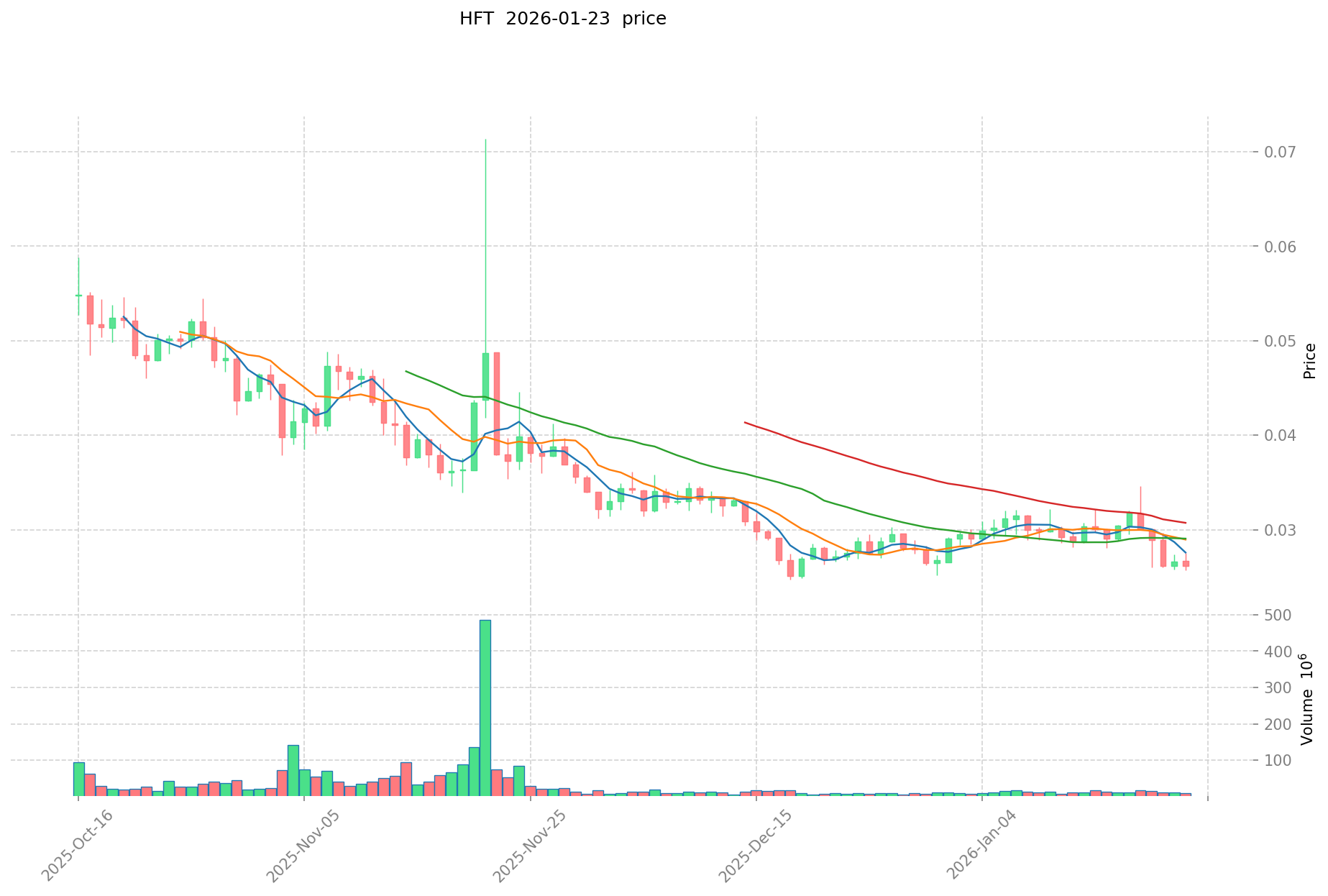
I. HFT Price History Review and Current Investment Value
- 2022: Token launch in November with initial price of $0.15 → Price reached $3.61 in early trading period
- 2025: Market downturn → Price declined to lower levels around $0.0247
- Recent period: Market volatility → Price fluctuated between $0.0257 and $0.0273
Current HFT Investment Market Status (January 2026)
- HFT current price: $0.02675
- Market sentiment (Fear & Greed Index): Neutral
- 24-hour trading volume: $201,579.53
- Token holders: 16,056 addresses
Click to view real-time HFT market price
II. Core Factors Affecting Whether HFT Is a Good Investment (Is Hashflow(HFT) a Good Investment)
Supply Mechanism and Scarcity (HFT Investment Scarcity)
- Fixed Supply Model → Impacts Price and Investment Value
Hashflow (HFT) has a maximum supply capped at 1,000,000,000 tokens, with approximately 686,797,662 tokens currently in circulation, representing a circulating ratio of 68.68%. This fixed supply mechanism creates a degree of scarcity that may influence long-term investment dynamics.
- Historical Context: Price Volatility and Supply Dynamics
Historical data shows HFT reached a notable price level of $3.61 on November 7, 2022, while experiencing a lower price point of $0.02468737 on October 11, 2025. As of January 23, 2026, HFT trades at $0.02675, reflecting significant price fluctuations over time. These variations illustrate how supply dynamics and market conditions interact to shape price movements.
- Investment Implications: Scarcity as a Long-Term Consideration
The controlled supply structure, with nearly 69% of tokens already in circulation, suggests limited additional supply pressure in the near term. For investors evaluating HFT as a long-term holding, understanding the relationship between circulating supply, maximum supply, and market demand remains essential to assessing potential value retention.
Institutional Investment and Mainstream Adoption (Institutional Investment in HFT)
- Liquidity Infrastructure and Market Participation
Hashflow operates as one of DeFi's significant RFQ (Request for Quotation) liquidity sources, having facilitated over $20 billion in trading volume through professional market makers. This infrastructure provides guaranteed pricing and protection against MEV (Maximal Extractable Value) exploits, which may attract institutional participants seeking reliable execution environments.
- Ecosystem Expansion and Trust Positioning
Hashflow has evolved from a decentralized exchange into a broader trust benchmark across the exchange ecosystem, supported by its universal zk-settlement layer, Hashflow xOS. This expansion reflects efforts to establish provable trust standards across exchanges, potentially enhancing institutional confidence in the platform's long-term viability.
- Adoption Metrics
With 16,056 holders and availability on 27 exchanges, HFT demonstrates measurable distribution across the cryptocurrency market. The token's presence on major blockchain networks, including Ethereum (ERC-20 standard) and Binance Smart Chain, facilitates accessibility for diverse investor profiles.
Macroeconomic Environment's Impact on HFT Investment
- Monetary Policy and Interest Rate Dynamics → Altering Investment Attractiveness
Broader macroeconomic conditions, including central bank monetary policies and interest rate adjustments, influence capital flows into cryptocurrency markets. Changes in traditional financial market yields may affect investor appetite for digital assets like HFT, as risk-adjusted return considerations shift across asset classes.
- Market Positioning During Economic Uncertainty
During periods of heightened economic volatility or geopolitical uncertainty, investors may reassess portfolio allocations. While some digital assets are explored as alternative holdings during such periods, HFT's specific role depends on its utility within the DeFi ecosystem and investor perceptions of its risk-return profile.
- Inflation Context and Digital Asset Considerations
In environments where traditional currency purchasing power faces pressure, certain digital assets attract attention as potential portfolio diversifiers. HFT's investment appeal in such contexts would relate to its fundamental utility, liquidity characteristics, and the broader performance of DeFi infrastructure tokens.
Technology and Ecosystem Development (Technology & Ecosystem for HFT Investment)
- Hashflow xOS: Universal zk-Settlement Layer → Enhancing Network Performance and Investment Appeal
The development of Hashflow xOS represents a technical advancement aimed at establishing provable trust standards across exchanges through zero-knowledge settlement technology. This infrastructure enhancement seeks to improve transaction verification and cross-exchange interoperability, potentially strengthening the platform's competitive positioning.
- Professional Market Maker Integration → Supporting Long-Term Value Proposition
Hashflow's integration with professional market makers to facilitate guaranteed pricing and MEV protection contributes to its operational ecosystem. This approach aims to provide users with predictable execution while reducing exposure to common DeFi trading risks, which may support sustained platform usage and token utility.
- DeFi Application Expansion → Driving Investment Value Through Ecosystem Growth
As part of the decentralized finance landscape, HFT's investment value connects to the broader adoption of DeFi protocols, liquidity aggregation services, and cross-chain trading infrastructure. The platform's evolution from a single decentralized exchange to a multi-faceted trust layer reflects ongoing ecosystem development that may influence long-term token utility and demand dynamics.
III. HFT Future Investment Forecast and Price Outlook (Is Hashflow(HFT) worth investing in 2026-2031)
Short-term Investment Forecast (2026, short-term HFT investment outlook)
- Conservative Forecast: $0.021384 - $0.02673
- Neutral Forecast: $0.02673
- Optimistic Forecast: $0.02673 - $0.029403
Mid-term Investment Outlook (2027-2028, mid-term Hashflow(HFT) investment forecast)
- Market Stage Expectation: The token may experience moderate volatility as it establishes its position within the decentralized exchange ecosystem. Growth will likely depend on adoption of Hashflow xOS and expansion of liquidity sources.
- Investment Return Forecast:
- 2027: $0.02638251 - $0.035083125
- 2028: $0.01831339125 - $0.034416545625
- Key Catalysts: Integration of zk-settlement layer technology, expansion of professional market maker partnerships, growth in trading volume, and broader DeFi ecosystem adoption.
Long-term Investment Outlook (Is HFT a good long-term investment?)
- Base Scenario: $0.028046327203125 - $0.04421420994375 (assuming steady development of the Hashflow ecosystem and moderate market conditions)
- Optimistic Scenario: $0.038604944503125 - $0.046924310043548 (assuming widespread adoption of xOS technology, significant increase in trading volume, and favorable market environment)
- Risk Scenario: $0.01831339125 - $0.021384 (under conditions of reduced DeFi activity, increased competition, or adverse regulatory developments)
View HFT long-term investment and price forecast: Price Prediction
2026-01-23 - 2031 Long-term Outlook
- Base Scenario: $0.028046327203125 - $0.038604944503125 (corresponding to steady progress and stable mainstream application growth)
- Optimistic Scenario: $0.042658463675953 - $0.046924310043548 (corresponding to large-scale adoption and favorable market environment)
- Transformative Scenario: Above $0.046924310043548 (if the ecosystem achieves breakthrough developments and mainstream popularization)
- 2031-12-31 Predicted High: $0.046924310043548 (based on optimistic development assumptions)
Disclaimer: This forecast is for informational purposes only and does not constitute investment advice. Cryptocurrency markets are highly volatile and unpredictable. Past performance does not guarantee future results. Investors should conduct their own research and consider their risk tolerance before making investment decisions.
| Year |
Predicted High Price |
Predicted Average Price |
Predicted Low Price |
Price Change |
| 2026 |
0.029403 |
0.02673 |
0.021384 |
0 |
| 2027 |
0.035083125 |
0.0280665 |
0.02638251 |
4 |
| 2028 |
0.034416545625 |
0.0315748125 |
0.01831339125 |
18 |
| 2029 |
0.04421420994375 |
0.0329956790625 |
0.028046327203125 |
23 |
| 2030 |
0.046711982848781 |
0.038604944503125 |
0.030111856712437 |
44 |
| 2031 |
0.046924310043548 |
0.042658463675953 |
0.0358331094878 |
59 |
IV. Hashflow (HFT) Investment Strategy and Risk Management (How to invest in Hashflow)
Investment Methodology (Hashflow investment strategy)
Long-term Holding (HODL HFT): Suitable for conservative investors
For investors with a longer time horizon, accumulating HFT tokens and holding through market cycles may align with belief in the project's evolution from a decentralized exchange into a trust benchmark across the exchange ecosystem. This approach requires patience and tolerance for short-term volatility.
Active Trading: Relying on technical analysis and swing trading
Traders focusing on shorter timeframes may leverage technical indicators, price action patterns, and volume analysis to capitalize on HFT's intraday and weekly price movements. Given the token's recent performance showing a 24-hour change of -0.07% and 7-day decline of -10.39%, active traders should employ disciplined entry and exit strategies.
Risk Management (Risk management for Hashflow investment)
Asset Allocation Ratio: Conservative / Aggressive / Professional investors
- Conservative investors: May limit HFT exposure to 1-3% of total crypto portfolio, prioritizing established assets
- Aggressive investors: Could allocate 5-10% depending on conviction in the project's RFQ liquidity infrastructure and xOS development
- Professional investors: Might consider strategic positioning while maintaining diversified exposure across multiple DeFi protocols
Risk Hedging Solutions: Multi-asset portfolio + hedging instruments
Investors may consider pairing HFT positions with stablecoin reserves, diversifying across different blockchain ecosystems, and utilizing derivative instruments where available to manage downside risk during periods of heightened volatility.
Secure Storage: Hot/cold wallets + hardware wallet recommendations
Given HFT's deployment on Ethereum and BSC networks, investors should prioritize security through:
- Hardware wallets for long-term holdings
- Cold storage solutions for majority of assets
- Hot wallets only for active trading amounts
- Regular security audits of wallet addresses and transaction histories
V. Hashflow (HFT) Investment Risks and Challenges (Risks of investing in Hashflow)
Market Risk: High volatility and price manipulation concerns
HFT exhibits substantial price fluctuations, with 1-year performance showing an -85.55% decline. The token's current market capitalization of approximately $18.37 million and 24-hour trading volume of around $201,580 suggest relatively limited liquidity, which may amplify price swings during periods of increased buying or selling pressure.
Regulatory Risk: Policy uncertainty across different jurisdictions
As with many crypto assets, HFT faces evolving regulatory frameworks worldwide. Changes in securities classification, DeFi protocol oversight, or cross-border trading regulations could impact the project's operations and token utility. Investors should monitor regulatory developments in key markets where Hashflow operates.
Technical Risk: Network security vulnerabilities and upgrade failures
While Hashflow emphasizes protection against MEV exploits and guaranteed pricing through its RFQ model, the platform's expansion into xOS as a universal zk-settlement layer introduces technical complexity. Potential risks include:
- Smart contract vulnerabilities in protocol upgrades
- Integration challenges with professional market makers
- Technical issues during network transitions or scaling solutions
- Security incidents affecting user funds or platform integrity
The token's circulation ratio of approximately 68.68% indicates ongoing token unlocks that could create additional selling pressure.
VI. Conclusion: Is Hashflow (HFT) a Good Investment?
Investment Value Summary: Hashflow presents a specialized investment opportunity within the DeFi trading infrastructure space, having facilitated over $20 billion in trading volume through its RFQ model. However, the token has experienced significant price depreciation over the past year, with substantial volatility across multiple timeframes.
Investor Recommendations:
✅ Beginners: Dollar-cost averaging strategy + secure wallet storage
- Consider gradual accumulation rather than lump-sum investment
- Prioritize learning about the project's technology and use cases
- Use hardware wallets for asset protection
✅ Experienced Investors: Swing trading + portfolio diversification
- Monitor technical indicators and trading volumes for entry/exit points
- Balance HFT exposure with other DeFi protocol tokens
- Stay informed about platform developments and partnership announcements
✅ Institutional Investors: Strategic long-term allocation
- Evaluate Hashflow's competitive positioning in the DEX and settlement layer landscape
- Assess the project's ability to maintain market maker relationships
- Consider correlation with broader DeFi sector performance
⚠️ Disclaimer: Cryptocurrency investments carry substantial risk, and this article is for informational purposes only and does not constitute investment advice. Investors should conduct thorough due diligence and consider their own financial circumstances before making any investment decisions.
VII. FAQ
Q1: What is Hashflow (HFT) and what makes it different from other DEX tokens?
Hashflow (HFT) is the native token of a decentralized exchange that has evolved into a universal zk-settlement layer and RFQ (Request for Quotation) liquidity provider. Unlike traditional DEX tokens, HFT distinguishes itself through its MEV-protected trading infrastructure, guaranteed pricing through professional market makers, and the Hashflow xOS technology that establishes provable trust standards across exchanges. The platform has facilitated over $20 billion in trading volume and positions itself as trust infrastructure for the broader exchange ecosystem rather than just a single trading venue.
Q2: How has HFT performed historically and what is its current market status?
HFT launched in November 2022 with an initial price of $0.15, reaching a peak of $3.61 shortly after launch. As of January 2026, the token trades at approximately $0.02675, representing a significant decline of -85.55% over the past year. The token currently has a market capitalization of around $18.37 million, with 686.80 million tokens in circulation (68.68% of maximum supply), 16,056 holders, and a 24-hour trading volume of approximately $201,580. Recent performance shows a 7-day decline of -10.39% and relatively neutral market sentiment.
Q3: Is HFT suitable for long-term investment or short-term trading?
Both approaches carry distinct considerations. Long-term holders might find value in HFT's evolution as DeFi settlement infrastructure and its partnership with professional market makers, though they must tolerate significant volatility and the token's historical price decline. Short-term traders can leverage HFT's price fluctuations using technical analysis, but should note the relatively limited liquidity (24-hour volume around $201,580) which may amplify price swings. Conservative investors might allocate 1-3% of their crypto portfolio to HFT, while aggressive investors could consider 5-10% based on conviction in the project's technology roadmap.
Q4: What are the main risks associated with investing in HFT?
HFT faces several investment risks: (1) Market risk - substantial volatility with -85.55% annual decline and limited liquidity may lead to price manipulation concerns; (2) Regulatory risk - evolving DeFi regulations across jurisdictions could impact operations and token utility; (3) Technical risk - the platform's expansion into xOS settlement layer introduces complexity, with potential smart contract vulnerabilities, integration challenges, and security concerns; (4) Token economics risk - with 68.68% circulation ratio, ongoing token unlocks could create selling pressure. The relatively small market cap of $18.37 million also indicates higher risk compared to established crypto assets.
Q5: What factors could drive HFT's price in the future?
Several catalysts may influence HFT's price trajectory: positive factors include successful implementation of Hashflow xOS technology, expansion of professional market maker partnerships, increased trading volume through the platform, broader DeFi ecosystem adoption, and favorable macroeconomic conditions for crypto assets. Price forecasts suggest potential ranges from $0.021384-$0.029403 in 2026, extending to $0.0358331-$0.046924 by 2031 under optimistic scenarios. However, downside risks include reduced DeFi activity, intensified competition from other DEX protocols, adverse regulatory developments, and technical setbacks in platform development.
Q6: How should different investor types approach HFT investment?
Investment approach should align with experience level: (1) Beginners should employ dollar-cost averaging to mitigate timing risk, prioritize secure hardware wallet storage, and focus on understanding the project's technology before committing significant capital; (2) Experienced investors might utilize swing trading strategies based on technical indicators while maintaining portfolio diversification across multiple DeFi protocols; (3) Institutional investors could consider strategic long-term allocation while evaluating Hashflow's competitive positioning in the DEX landscape, market maker relationships, and correlation with broader DeFi sector performance. All investors should maintain appropriate position sizing relative to risk tolerance.
Q7: What is the current liquidity situation for HFT and how does it affect investment decisions?
HFT currently demonstrates relatively limited liquidity with a 24-hour trading volume of approximately $201,580 against a market capitalization of $18.37 million, resulting in a volume-to-market-cap ratio of about 1.1%. The token is available on 27 exchanges and supports multiple blockchain networks including Ethereum and Binance Smart Chain. This liquidity profile suggests that larger position entries or exits may experience slippage, making HFT more suitable for smaller allocation sizes within diversified portfolios. Investors should be aware that limited liquidity can amplify both upside and downside price movements during periods of concentrated buying or selling pressure.
Q8: What security measures should HFT investors implement?
Investors should prioritize comprehensive security practices: (1) Use hardware wallets for long-term holdings to protect against online vulnerabilities; (2) Implement cold storage solutions for the majority of HFT holdings, keeping only active trading amounts in hot wallets; (3) Conduct regular security audits of wallet addresses and review transaction histories for unauthorized activity; (4) Enable two-factor authentication on exchange accounts where HFT is traded; (5) Verify smart contract addresses when interacting with the Hashflow protocol; (6) Stay informed about security updates from the Hashflow team and community. Given the platform's emphasis on MEV protection and guaranteed pricing, investors should also understand these mechanisms to maximize security benefits during trading activities.
* The information is not intended to be and does not constitute financial advice or any other recommendation of any sort offered or endorsed by Gate.