This comprehensive analysis evaluates whether Helium (HNT) represents a sound investment in 2024-2026. As a decentralized physical infrastructure network (DePIN) enabling IoT connectivity through community-operated Hotspots, HNT currently trades at $1.3649 with a $254 million market cap. The article examines HNT's supply mechanics, institutional adoption metrics, and technological fundamentals before presenting tiered price scenarios across short, mid, and long-term horizons. Key investment considerations include network growth—with 461,500+ Helium Mobile accounts and 5,451 TB monthly data offloading—alongside significant risks including 71.73% annual price decline, regulatory uncertainties, and technical vulnerabilities. The guide provides tailored investment strategies for conservative, aggressive, and professional investors, emphasizing risk management through diversification, secure storage solutions, and realistic portfolio allocation percentages. Available on Gate and 23 other exchanges, HNT appeals to
Introduction: Helium (HNT) Investment Position and Market Outlook
HNT is a significant asset in the cryptocurrency space. Since its launch in 2020, it has achieved notable progress in the decentralized wireless network and Internet of Things (IoT) connectivity sector. As of January 2026, Helium holds a market capitalization of approximately $254.31 million, with a circulating supply of around 186.32 million tokens, and the current price stands at approximately $1.36. Positioned as a pioneering decentralized physical infrastructure network (DePIN), HNT has gradually become a focal point for investors discussing "Is Helium (HNT) a good investment?" This article comprehensively analyzes HNT's investment value, historical trends, future price predictions, and investment risks to provide reference for investors.
Founded in 2013 by Shawn Fning, Amir Haleem, and Sean Carey, Helium aims to simplify the construction of connected devices. The Helium network operates as a peer-to-peer wireless infrastructure designed to enable low-energy IoT devices to connect with the internet. Network maintainers can earn HNT token rewards through Proof of Coverage challenges, a type of proof-of-work algorithm that uses electromagnetic waves to verify network coverage. HNT tokens generate Data Credits used to pay for data transmission fees, while the network achieves consensus through a HoneyBadgerBFT-based mechanism.
As of January 15, 2026, HNT ranks 207th by market capitalization, with over 536,704 holders and availability on 24 exchanges. The token shows a market dominance of 0.0088%, with a circulating supply representing 83.55% of the maximum supply of 223 million tokens. Recent price performance indicates declines of 2.45% over 24 hours, 10.33% over 7 days, 19.86% over 30 days, and 71.73% over one year, reflecting market volatility and evolving sentiment within the broader cryptocurrency landscape.
I. Helium (HNT) Price History Review and Current Investment Value
- 2021: HNT experienced significant growth during the cryptocurrency bull market, with the token price showing notable appreciation as the network expanded its hotspot infrastructure globally.
- 2021: In August, Helium completed a $111 million token financing round led by a16z, with participation from Ribbit Capital, 10T, Alameda Research, and Multicoin Capital. This funding aimed to accelerate the deployment of Helium's decentralized 5G network and support mobile network operators in expanding their signal coverage using Helium 5G.
- 2021-2026: Following the broader cryptocurrency market correction, HNT price declined substantially from elevated levels, reflecting both market-wide trends and evolving network dynamics.
Current HNT Investment Market Status (January 2026)
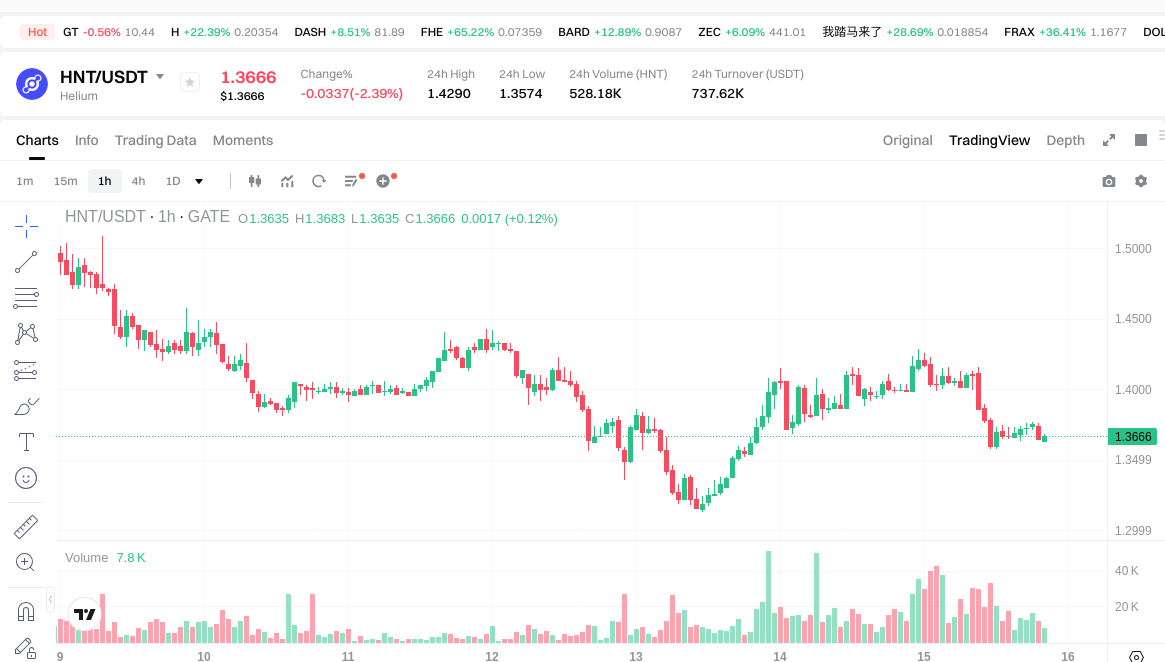
- HNT current price: $1.3649
- 24-hour trading volume: $735,378.18
- Circulating supply: 186,321,438.09 HNT (83.55% of total supply)
- Market capitalization: $254,310,130.85
- Total holders: 536,704
Click to view real-time HNT market price
II. Core Factors Influencing Whether HNT is a Good Investment (Is Helium(HNT) a Good Investment)
Supply Mechanism and Scarcity (HNT investment scarcity)
- Supply mechanism impacts price and investment value
- Historical pattern: In August, Helium reduced daily HNT emissions from 15 million to 7.5 million tokens annually, representing a significant supply adjustment that may influence token economics
- Investment significance: Scarcity dynamics, combined with a maximum supply cap of 223 million HNT and current circulating supply of approximately 186.32 million (83.55% of max supply), contribute to the asset's supply-side fundamentals
Institutional Investment and Mainstream Adoption (Institutional investment in HNT)
- Network growth trends: As of Q3, Helium Mobile accounts exceeded 461,500 (a 48% quarter-over-quarter increase), with average daily users reaching 1.2 million (up 35% in the same period)
- Enterprise data offloading: The network offloaded over 5,451 TB of mobile data from major U.S. carriers, more than doubling quarter-over-quarter, and facilitated over 8,505 TB of paid mobile data since inception
- Foundation support: The Helium Foundation pledged $50 million in grants for expanding hotspots across high-traffic cities, demonstrating institutional commitment to network expansion
Macroeconomic Environment's Impact on HNT Investment
- Market volatility: Cryptocurrency markets remain highly volatile, making price predictions challenging in both short and long-term horizons
- Price performance context: HNT experienced notable price fluctuations, with 24-hour change at -2.45%, 7-day change at -10.33%, 30-day change at -19.86%, and 1-year change at -71.73% as of January 15, 2026
- Economic uncertainty considerations: Broader crypto market trends and macroeconomic conditions continue to influence HNT's investment dynamics
Technology and Ecosystem Development (Technology & Ecosystem for HNT investment)
- Proof of Coverage mechanism: Helium utilizes a Proof of Coverage (PoC) algorithm that validates Hotspots using electromagnetic waves, providing a foundation for network integrity
- Decentralized wireless infrastructure: The network powers wireless connectivity for Internet of Things (IoT) devices and mobile communications through a people-powered model
- Network utility: Hotspot operators earn HNT rewards for providing coverage, while HNT tokens generate Data Credits used to pay for information and token transmission fees
- Consensus mechanism: The network employs a HoneyBadgerBFT-based mechanism to achieve network consensus
- Ecosystem expansion: Growing network stickiness and mainstream appeal signal Helium's emergence as a force in the crypto-native wireless sector, potentially supporting long-term value
III. HNT Future Investment Prediction and Price Outlook (Is Helium(HNT) worth investing in 2026-2031)
Short-term Investment Prediction (2026, short-term HNT investment outlook)
- Conservative Prediction: $0.79 - $1.37
- Neutral Prediction: $1.37 - $1.87
- Optimistic Prediction: $1.87 - $9.43
Mid-term Investment Outlook (2027-2029, mid-term Helium(HNT) investment forecast)
-
Market Stage Expectation: During the 2027-2029 period, HNT is anticipated to experience moderate volatility as the project continues ecosystem development and network expansion. The token may show gradual growth trends influenced by IoT adoption rates and broader market conditions.
-
Investment Return Prediction:
- 2027: $1.39 - $1.73
- 2028: $0.85 - $1.76
- 2029: $0.96 - $2.51
-
Key Catalysts: Ecosystem development progress, IoT device adoption expansion, network coverage improvements, and overall cryptocurrency market sentiment may serve as primary drivers for price movements.
Long-term Investment Outlook (Is HNT a good long-term investment?)
- Base Scenario: $1.75 - $2.26 (assuming steady network growth and moderate IoT sector expansion)
- Optimistic Scenario: $2.19 - $2.91 (assuming accelerated adoption and favorable market conditions)
- Risk Scenario: Below $1.75 (under conditions of market downturn or slower-than-expected network development)
Click to view HNT long-term investment and price prediction: Price Prediction
2026-2031 Long-term Outlook
- Base Scenario: $1.75 - $2.26 (corresponding to steady progress and gradual mainstream application growth)
- Optimistic Scenario: $2.19 - $2.91 (corresponding to large-scale adoption and favorable market environment)
- Transformative Scenario: Above $2.91 (if ecosystem achieves breakthrough developments and mainstream popularization)
- 2031-12-31 Predicted High: $2.91 (based on optimistic development assumptions)
Disclaimer: Price predictions are based on historical data and market analysis models. Actual prices may vary significantly due to market volatility, regulatory changes, technological developments, and other unpredictable factors. This information does not constitute investment advice.
| Year |
Predicted High Price |
Predicted Average Price |
Predicted Low Price |
Price Change |
| 2026 |
1.872105 |
1.3665 |
0.79257 |
0 |
| 2027 |
1.732653675 |
1.6193025 |
1.39260015 |
18 |
| 2028 |
1.759776991875 |
1.6759780875 |
0.854748824625 |
22 |
| 2029 |
2.50810120794375 |
1.7178775396875 |
0.962011422225 |
25 |
| 2030 |
2.260898629982718 |
2.112989373815625 |
1.753781180266968 |
54 |
| 2031 |
2.908635522525898 |
2.186944001899171 |
1.946380161690262 |
60 |
IV. Helium (HNT) Investment Strategy and Risk Management (How to invest in Helium)
Investment Methodology (Helium investment strategy)
Long-term Holding (HODL HNT): Suitable for Conservative Investors
Long-term holding strategies may align with investors who believe in Helium's decentralized wireless infrastructure vision. This approach involves acquiring HNT tokens and maintaining positions through market cycles, potentially reducing the impact of short-term price fluctuations. Given HNT's current price of $1.3649 with a 24-hour change of -2.45%, long-term holders might focus on the project's fundamental development rather than daily price movements.
Conservative investors considering this approach should evaluate Helium's role in IoT connectivity and its Proof-of-Coverage consensus mechanism. The circulating supply of 186,321,438 HNT represents approximately 83.55% of the maximum supply of 223,000,000 tokens, indicating a relatively mature supply distribution.
Active Trading: Technical Analysis and Swing Trading
Active traders may utilize technical analysis to identify entry and exit points based on HNT's price patterns. With a 24-hour trading volume of $735,378, the token demonstrates market liquidity that can support trading activities. The current 24-hour price range between $1.3574 (low) and $1.429 (high) provides insights into intraday volatility levels.
Traders should note HNT's recent performance trends: -0.33% (1H), -2.45% (24H), -10.33% (7D), -19.86% (30D), and -71.73% (1Y). These metrics reflect varying degrees of price movement across different timeframes, which active traders might incorporate into their technical strategies.
Risk Management (Risk management for HNT investment)
Asset Allocation Ratios: Conservative / Aggressive / Professional Investors
Conservative Investors: May consider allocating 1-3% of their cryptocurrency portfolio to HNT, balancing exposure to decentralized infrastructure projects while maintaining diversification across established digital assets.
Aggressive Investors: Could potentially allocate 5-10% to HNT, accepting higher volatility in exchange for potential returns linked to IoT network growth and adoption.
Professional Investors: Might employ dynamic allocation strategies, adjusting HNT positions between 3-15% based on market conditions, technical indicators, and fundamental developments in the Helium ecosystem.
Risk Hedging Solutions: Multi-asset Portfolio + Hedging Instruments
Investors may implement diversification strategies by combining HNT exposure with:
- Established Digital Assets: Balancing HNT holdings with larger market capitalization tokens to reduce portfolio volatility
- Stablecoin Reserves: Maintaining liquidity positions for potential market opportunities or risk mitigation
- Cross-sector Exposure: Diversifying across different cryptocurrency categories beyond infrastructure-focused projects
Given HNT's market dominance of 0.0088% and ranking of 207, investors should consider its position within the broader cryptocurrency market when constructing portfolios.
Secure Storage: Hot/Cold Wallets + Hardware Wallet Recommendations
Cold Wallet Storage: For long-term HNT holdings, hardware wallets provide enhanced security by keeping private keys offline. This approach reduces exposure to online security threats.
Hot Wallet Solutions: Active traders requiring frequent access may utilize exchange wallets or software wallets, though these carry elevated security risks compared to cold storage.
Best Practices:
- Store the majority of HNT holdings (70-90%) in cold storage
- Maintain smaller amounts (10-30%) in hot wallets for trading or transactions
- Implement multi-signature authentication where possible
- Regularly update wallet software and security protocols
Note that HNT operates on the Solana blockchain (contract address: hntyVP6YFm1Hg25TN9WGLqM12b8TQmcknKrdu1oxWux), so compatible wallet solutions should support Solana-based tokens.
V. Helium (HNT) Investment Risks and Challenges (Risks of investing in Helium)
Market Risks: High Volatility and Price Manipulation
HNT demonstrates significant price volatility, as evidenced by its historical price range. The token reached $54.88 on November 13, 2021, and declined to $0.113248 on April 18, 2020. Currently trading at $1.3649, HNT has experienced a 71.73% decline over the past year, illustrating substantial price fluctuation potential.
The 24-hour trading volume of $735,378 relative to a market capitalization of $254,310,130 suggests varying levels of market liquidity. Lower liquidity periods may increase vulnerability to price swings from large transactions. Investors should recognize that smaller market cap tokens can experience more pronounced price movements compared to larger digital assets.
Regulatory Risks: Policy Uncertainty Across Different Countries
As a decentralized wireless infrastructure project, Helium may face regulatory considerations related to:
- Telecommunications Regulations: Requirements for operating wireless networks vary by jurisdiction
- Securities Classification: Different regulatory bodies may classify HNT tokens under various frameworks
- Data Privacy Laws: IoT connectivity services may intersect with data protection regulations
- Cryptocurrency Regulations: Evolving digital asset policies across countries may impact HNT trading and usage
The regulatory landscape for cryptocurrency and wireless infrastructure projects continues to develop, creating uncertainty for investors regarding future compliance requirements and operational constraints.
Technical Risks: Network Security Vulnerabilities and Upgrade Failures
Helium's technical infrastructure involves several risk considerations:
Network Security: The Proof-of-Coverage consensus mechanism and HoneyBadgerBFT-based consensus system require robust security measures. Potential vulnerabilities in network validation or electromagnetic wave verification processes could affect network integrity.
Smart Contract Risks: As HNT operates on Solana, it inherits both the benefits and potential risks associated with the Solana blockchain infrastructure.
Hotspot Network Reliability: The network depends on physical Hotspot devices operated by community members. Geographic coverage gaps, hardware failures, or maintenance issues could impact network functionality.
Protocol Upgrades: Changes to the Helium protocol or migration between blockchain platforms could introduce technical challenges or temporary service disruptions.
Data Credits Mechanism: The system whereby HNT tokens generate Data Credits for network usage involves technical complexity that could face implementation challenges.
VI. Conclusion: Is Helium a Good Investment?
Investment Value Summary
Helium (HNT) presents investment characteristics tied to decentralized wireless infrastructure development. The project's approach to IoT connectivity through community-operated Hotspots and Proof-of-Coverage validation represents a distinct model within the cryptocurrency sector.
Current market metrics show HNT trading at $1.3649 with a market capitalization of $254,310,130 and a circulating supply representing 83.55% of maximum supply. Recent price performance indicates negative trends across multiple timeframes: -2.45% (24H), -10.33% (7D), -19.86% (30D), and -71.73% (1Y).
The token's ranking of 207 and market dominance of 0.0088% position it as a mid-tier cryptocurrency project. Investors should evaluate whether HNT's infrastructure-focused value proposition aligns with their investment objectives and risk tolerance.
Investor Recommendations
✅ Beginners:
- Consider dollar-cost averaging strategies to mitigate entry timing risks
- Utilize secure wallet storage solutions, prioritizing cold storage for long-term holdings
- Start with smaller allocation percentages (1-3% of cryptocurrency portfolio) while learning about the project
- Research Helium's IoT network functionality and Proof-of-Coverage mechanism before investing
✅ Experienced Investors:
- Implement swing trading strategies based on technical analysis and market trends
- Diversify holdings across multiple cryptocurrency categories to balance sector-specific risks
- Monitor Helium network growth metrics and adoption indicators alongside price movements
- Adjust position sizes based on market conditions and portfolio performance
✅ Institutional Investors:
- Evaluate HNT as a potential strategic allocation within decentralized infrastructure themes
- Conduct comprehensive due diligence on regulatory considerations across operating jurisdictions
- Assess correlation patterns between HNT and broader cryptocurrency markets for portfolio optimization
- Consider long-term positioning aligned with IoT network development timelines
⚠️ Disclaimer: Cryptocurrency investment carries substantial risks including price volatility, regulatory uncertainty, and technical challenges. This content is for informational purposes only and does not constitute investment advice. Investors should conduct independent research and consult with financial professionals before making investment decisions.
VII. FAQ
Q1: What is Helium (HNT) and how does it work?
Helium is a decentralized wireless network designed to provide connectivity for Internet of Things (IoT) devices and mobile communications. The network operates through community-operated Hotspots that use a Proof-of-Coverage (PoC) algorithm to validate network coverage using electromagnetic waves. Hotspot operators earn HNT token rewards for providing wireless coverage, while HNT tokens generate Data Credits used to pay for data transmission fees. The network employs a HoneyBadgerBFT-based consensus mechanism and operates on the Solana blockchain.
Q2: Is Helium (HNT) a good investment in 2026?
The investment suitability of HNT depends on individual risk tolerance and investment objectives. As of January 2026, HNT trades at $1.3649 with a market cap of $254 million, ranking 207th by market capitalization. Recent performance shows significant decline (-71.73% over one year), indicating high volatility. Conservative predictions suggest potential prices ranging from $0.79 to $9.43 in 2026. Investors should consider HNT's role in decentralized wireless infrastructure against market risks, regulatory uncertainties, and technical challenges before making investment decisions.
Q3: What are the main risks of investing in Helium (HNT)?
HNT investment involves several key risks: (I) Market Risk - high price volatility as evidenced by 71.73% annual decline and historical range from $0.11 to $54.88; (II) Regulatory Risk - evolving telecommunications and cryptocurrency regulations across jurisdictions that may affect operations; (III) Technical Risk - potential network security vulnerabilities, smart contract risks on Solana blockchain, and reliance on community-operated hardware infrastructure; (IV) Liquidity Risk - trading volume of $735,378 relative to market cap may result in price manipulation vulnerability during low liquidity periods.
Q4: What is the long-term price prediction for HNT through 2031?
Price predictions for HNT through 2031 vary based on adoption scenarios. Conservative base scenario estimates range from $1.75 to $2.26, assuming steady network growth. Optimistic projections suggest $2.19 to $2.91 if accelerated IoT adoption occurs. By 2031, the predicted high reaches $2.91 under favorable conditions. However, these predictions are based on historical data and analytical models; actual prices may differ significantly due to market volatility, regulatory changes, and technological developments. Investors should treat these forecasts as reference points rather than guarantees.
Q5: How should different types of investors approach HNT investment?
Investment strategies should align with investor profiles: (I) Conservative Investors may allocate 1-3% of cryptocurrency portfolio to HNT, focusing on long-term holding (HODL) strategies and cold wallet storage; (II) Aggressive Investors could consider 5-10% allocation, potentially engaging in active trading based on technical analysis while maintaining diversification; (III) Professional Investors might employ dynamic allocation between 3-15%, adjusting positions based on market conditions and Helium ecosystem developments. All investors should implement proper risk management, secure storage solutions, and diversification across multiple digital assets.
Q6: What factors influence HNT's investment value?
Several core factors affect HNT investment value: (I) Supply Mechanism - maximum supply of 223 million tokens with 83.55% already circulating, plus historical emission reductions from 15 million to 7.5 million annually; (II) Network Growth - Helium Mobile accounts exceeded 461,500 with 1.2 million average daily users, and over 5,451 TB of data offloaded from major carriers; (III) Institutional Support - $50 million in grants from Helium Foundation for hotspot expansion; (IV) Technology Development - Proof-of-Coverage validation and IoT connectivity infrastructure improvements; (V) Macroeconomic Conditions - broader cryptocurrency market trends and regulatory environment evolution.
Q7: Where can I buy and store Helium (HNT) safely?
HNT is available on 24 cryptocurrency exchanges and operates on the Solana blockchain (contract address: hntyVP6YFm1Hg25TN9WGLqM12b8TQmcknKrdu1oxWux). For secure storage, investors should use hardware wallets (cold storage) for long-term holdings (70-90% of tokens) and maintain smaller amounts (10-30%) in hot wallets for active trading. Best practices include implementing multi-signature authentication, regularly updating wallet software, and ensuring wallet solutions support Solana-based tokens. Never share private keys and verify contract addresses before transactions to prevent security breaches.
Q8: What is the difference between HNT investment and traditional cryptocurrency investments?
HNT differs from traditional cryptocurrencies through its focus on decentralized physical infrastructure (DePIN) rather than pure financial applications. Unlike Bitcoin or Ethereum, HNT serves as the utility token for a wireless network that provides real-world IoT connectivity services. The token economics involve Proof-of-Coverage validation by physical Hotspot devices rather than traditional mining, and HNT generates Data Credits for network usage payments. This infrastructure-focused model creates value proposition tied to IoT adoption rates and network expansion, presenting different risk-return characteristics compared to conventional digital assets focused on store-of-value or smart contract platforms.
* The information is not intended to be and does not constitute financial advice or any other recommendation of any sort offered or endorsed by Gate.