Highstreet (HIGH) is the native governance and utility token of an open-world metaverse platform integrating MMORPG gaming with NFT commerce. Trading at $0.2234 as of January 2026, HIGH offers multi-platform access across VR, PC, and mobile environments with a market cap of $17.51 million. The token provides ecosystem utility through in-game access, marketplace transactions, and governance rights, alongside DeFi staking mechanisms. While HIGH demonstrates solid tokenomics with 78.38% circulating supply and listings on 26 exchanges including Gate, investors should recognize the significant volatility—the token declined 81.89% year-over-year from historical highs. Price forecasts range from $0.223-$0.330 (2026 conservative-optimistic) to $0.211-$0.601 (long-term base-optimistic scenarios). Investment suitability depends on risk tolerance, with recommended allocation ratios of 1-3% for conservative investors through 5-10% for aggressive exposure. Key risks include market volatility, regulatory uncertainty in gam
Introduction: Highstreet (HIGH) Investment Position and Market Outlook
HIGH is a digital asset within the cryptocurrency sector that serves as the native functional and governance token of the Highstreet metaverse platform. Launched in October 2021 with an initial offering price of 4.23, the token has been deployed as an open-world metaverse project integrating MMORPG gaming mechanics with NFT marketplace functionality. As of January 24, 2026, HIGH is trading at approximately 0.2234, with a circulating supply of around 78.38 million tokens out of a maximum supply of 100 million. The token's market capitalization stands at approximately 17.51 million, ranking 929th in the cryptocurrency market with a dominance of 0.00070%. The project has established contract deployment on the Ethereum network and maintains trading availability across 26 exchanges, with a holder base of 5,613 addresses. Recent price performance indicates a 5.43% change over 24 hours and a 10.62% movement over the past 30 days, while the one-year trend shows an 81.89% decline from previous levels. With its positioning in the metaverse and GameFi sectors, HIGH has become a subject of analysis when examining metaverse-related digital assets. This article provides an examination of HIGH's market characteristics, historical price movements, analytical perspectives on future price trajectories, and associated risk factors for reference purposes.
I. Highstreet (HIGH) Price History Review and Current Investment Value
- 2021: Token launch and early market enthusiasm → HIGH experienced significant price appreciation following its initial listing in October 2021, with the price reaching elevated levels in December 2021
- 2021-2025: Market cycle volatility → Price fluctuated from higher valuation levels to lower price ranges, reflecting broader market conditions and project development phases
- 2025: Market adjustment period → Price movements reflected ongoing shifts in the metaverse and gaming token sectors
Current HIGH Investment Market Status (January 2026)
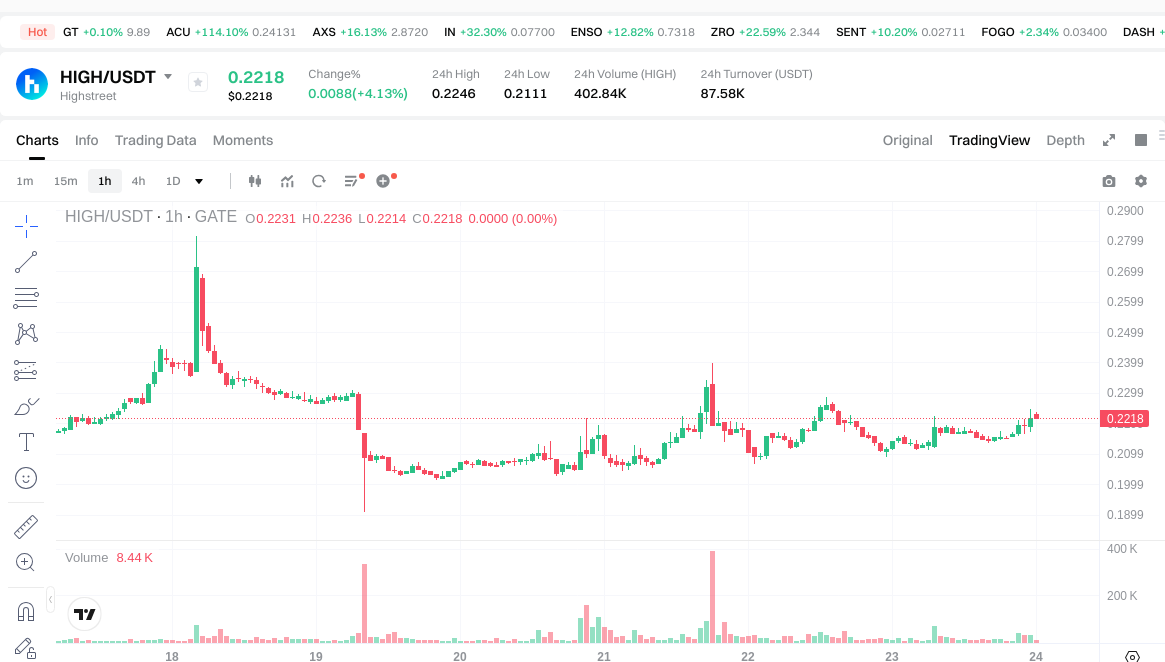
- HIGH current price: $0.2234
- Market sentiment (Fear & Greed Index): Not available in provided materials
- 24-hour trading volume: $87,264.90
- Institutional investor holdings: Not available in provided materials
Click to view real-time HIGH market price
II. Core Factors Affecting Whether HIGH is a Good Investment (Is Highstreet(HIGH) a Good Investment)
Supply Mechanism and Scarcity (HIGH investment scarcity)
- Fixed maximum supply of 100,000,000 HIGH tokens → influences price dynamics and investment value
- Current circulating supply stands at approximately 78,379,370 tokens, representing 78.38% of the maximum supply
- Historical context: HIGH price experienced significant volatility, with notable price levels recorded at $38.42 and $0.189441 at different historical points
- Investment significance: the defined supply cap and current circulation ratio represent key factors in evaluating long-term investment potential
Institutional Investment and Mainstream Adoption (Institutional investment in HIGH)
- HIGH is currently listed on 26 exchanges, indicating a degree of market accessibility
- The project has reportedly engaged with thought leaders from exchanges such as Binance, blockchain platforms including Avalanche, and investment entities such as Republic and Animoca
- Holder base comprises approximately 5,613 addresses, reflecting the current level of community participation
- Market capitalization stands at approximately $17.51 million with a fully diluted valuation of $22.34 million
Macroeconomic Environment's Impact on HIGH Investment
- Broader cryptocurrency market conditions and monetary policy shifts may affect investor appetite for metaverse and gaming-related digital assets
- Market sentiment indicators show a positive reading, suggesting current investor interest in the project
- Regulatory developments affecting NFT and gaming tokens could influence HIGH's investment landscape
- Global economic uncertainty may drive investors toward or away from higher-risk digital asset categories, including metaverse projects
Technology and Ecosystem Development (Technology & Ecosystem for HIGH investment)
- Highstreet operates as an open-world metaverse integrating MMORPG gaming with commerce, NFTs, and both traditional and cryptocurrency brands
- Platform supports multiple access points including VR, PC, and mobile versions, with mobile gameplay featuring a distinct monster-taming experience
- HIGH token utility encompasses in-game access to special areas and events, purchasing special items including real estate and limited edition products in the Highstreet Marketplace, and governance rights for token holders to create and vote on proposals
- Ecosystem components include the Highstreet Marketplace for NFT trading and the Forever Fomo Duck Squad NFTs, which serve as official mascots and offer various benefits such as 2D to 3D NFT conversion, exclusive club access, staking multipliers, and access to airdrops and vaults
- The project is built on Unity by a team with substantial experience in VR development, with the flagship experience designed for VR platforms while maintaining PC compatibility
- DeFi integration through staking mechanisms provides additional utility, with NFT holders receiving enhanced staking rewards compared to non-holders
III. HIGH Future Investment Forecast and Price Outlook (Is Highstreet (HIGH) worth investing in 2026-2031)
Short-term Investment Forecast (2026, short-term HIGH investment outlook)
- Conservative forecast: $0.129 - $0.223
- Neutral forecast: $0.223 - $0.280
- Optimistic forecast: $0.280 - $0.330
Mid-term Investment Outlook (2027-2029, mid-term Highstreet (HIGH) investment forecast)
-
Market stage expectation: During the mid-term period, HIGH may experience gradual value growth as the metaverse and gaming sectors continue to develop. The platform's MMORPG integration with NFT and brand partnerships could drive user engagement.
-
Investment return forecast:
- 2027: $0.227 - $0.376
- 2028: $0.307 - $0.395
- 2029: $0.310 - $0.425
-
Key catalysts: Expansion of the Highstreet Marketplace, increased adoption of VR and PC gaming experiences, strategic brand collaborations, and enhanced governance mechanisms for HIGH token holders.
Long-term Investment Outlook (Is Highstreet a good long-term investment?)
- Base scenario: $0.211 - $0.436 (assumes steady ecosystem development and moderate user growth)
- Optimistic scenario: $0.393 - $0.601 (assumes accelerated metaverse adoption and successful platform expansion)
- Risk scenario: Below $0.211 (in cases of market downturn or reduced user engagement)
Click to view HIGH long-term investment and price forecast: Price Prediction
2026-01-24 - 2031 Long-term Outlook
- Base scenario: $0.314 - $0.436 USD (corresponding to steady progress and gradual mainstream application adoption)
- Optimistic scenario: $0.393 - $0.601 USD (corresponding to large-scale adoption and favorable market conditions)
- Transformative scenario: Above $0.601 USD (in case of breakthrough ecosystem developments and mainstream adoption)
- 2031-12-31 predicted high: $0.601 USD (based on optimistic development assumptions)
Disclaimer: This forecast is for informational purposes only and should not be considered investment advice. Cryptocurrency markets are highly volatile, and actual prices may differ significantly from predictions.
| Year |
Predicted High Price |
Predicted Average Price |
Predicted Low Price |
Price Change |
| 2026 |
0.33004 |
0.223 |
0.12934 |
0 |
| 2027 |
0.3760672 |
0.27652 |
0.2267464 |
24 |
| 2028 |
0.394815256 |
0.3262936 |
0.306715984 |
46 |
| 2029 |
0.42545422504 |
0.360554428 |
0.31007680808 |
61 |
| 2030 |
0.4362348024372 |
0.39300432652 |
0.314403461216 |
76 |
| 2031 |
0.60119836849397 |
0.4146195644786 |
0.211455977884086 |
85 |
Investment Methodology (Highstreet investment strategy)
Long-term Holding (HODL HIGH): This approach may be suitable for investors who believe in the long-term development potential of metaverse and blockchain gaming ecosystems. Given Highstreet's integration of shopping, gaming, and NFT functionalities within an open-world metaverse, investors adopting this strategy would focus on the platform's user growth, brand partnerships, and ecosystem expansion over extended periods. The token's utility in governance, in-game access, and marketplace transactions could provide fundamental support for long-term value.
Active Trading: For traders employing technical analysis and swing trading strategies, HIGH's price movements offer opportunities. Based on recent data, the token has shown volatility with a 24-hour price range between 0.2111 and 0.2246, and periodic fluctuations of 1.92% (1H), 5.43% (24H), and 4.84% (7D). Traders may utilize support and resistance levels, momentum indicators, and volume analysis to identify entry and exit points. However, the significant drawdown from its historical high of 38.42 (December 2021) to current levels around 0.2234 illustrates the substantial volatility inherent in such trading approaches.
Risk Management (Risk management for Highstreet investment)
Asset Allocation Ratios:
- Conservative investors: May consider limiting exposure to 1-3% of their cryptocurrency portfolio, given the token's volatility and relatively small market capitalization of approximately 17.51 million.
- Aggressive investors: Could allocate 5-10% of their crypto holdings, accepting higher risk in pursuit of potential growth tied to metaverse adoption.
- Professional investors: Might incorporate HIGH as part of a diversified gaming/metaverse sector allocation, typically 3-7% within a specialized crypto portfolio, with active monitoring of platform development milestones.
Risk Hedging Solutions: Investors may consider diversifying across multiple metaverse and gaming tokens rather than concentrating positions in a single asset. Portfolio construction could include established cryptocurrencies alongside smaller-cap gaming tokens. Additionally, position sizing based on volatility metrics and implementing stop-loss mechanisms can help manage downside exposure.
Secure Storage: For HIGH token custody, users should evaluate appropriate wallet solutions:
- Hot wallets: Suitable for active traders requiring frequent access, though they carry higher security risks. Users should select reputable wallet providers with strong security features.
- Cold wallets: Recommended for long-term holders, providing offline storage that significantly reduces exposure to online threats.
- Hardware wallets: Devices offering enhanced security through private key isolation may be appropriate for substantial holdings, providing a balance between accessibility and security.
Given that HIGH is deployed as an ERC-20 token on the Ethereum network (contract address: 0x71Ab77b7dbB4fa7e017BC15090b2163221420282), investors should ensure their chosen wallet solutions support Ethereum-based tokens.
Market Risks: HIGH exhibits substantial price volatility, as evidenced by its historical price range from 0.189441 to 38.42. The token has experienced an approximately 81.89% decline over the past year, reflecting broader market conditions and sector-specific challenges. The relatively modest 24-hour trading volume of approximately 87,264.90 and market capitalization of around 17.51 million suggest lower liquidity compared to major cryptocurrencies, which may amplify price swings during periods of buying or selling pressure. The market cap to fully diluted valuation ratio of 78.38% indicates that approximately 78.38% of the maximum supply is already in circulation.
Regulatory Risks: The intersection of gaming, virtual assets, NFTs, and cryptocurrency creates a complex regulatory landscape. Different jurisdictions maintain varying approaches to digital asset classification, NFT regulation, and metaverse platform governance. Evolving policies regarding virtual property rights, in-game asset taxation, and cross-border virtual transactions could impact platform operations and token utility. Investors should monitor regulatory developments in key markets where Highstreet operates or has significant user bases.
Technical Risks: As a platform combining metaverse functionality, MMORPG gaming elements, marketplace operations, and NFT integration across multiple platforms (VR, PC, mobile), Highstreet faces various technical challenges. Network security vulnerabilities could compromise user assets or platform integrity. Smart contract risks associated with the ERC-20 token implementation and marketplace operations require ongoing security audits. Platform scalability challenges may arise as user numbers grow, potentially affecting user experience. The technical complexity of maintaining interoperability across different gaming platforms and ensuring consistent performance across VR, desktop, and mobile versions presents ongoing operational challenges. Additionally, the platform's dependence on underlying blockchain infrastructure means that network congestion or technical issues on the Ethereum network could impact token transactions and platform functionality.
VI. Conclusion: Is Highstreet (HIGH) a Good Investment?
Investment Value Summary: Highstreet (HIGH) represents exposure to the intersection of metaverse gaming, NFT commerce, and decentralized governance within an open-world environment. The platform's integration of traditional and cryptocurrency brands, along with its multi-platform gaming approach (VR, PC, mobile), demonstrates an attempt to create a comprehensive virtual economy. However, the token has experienced substantial price volatility, with significant value decline from historical peaks, reflecting both sector-wide challenges and project-specific dynamics. The token's utility in governance, in-game access, and marketplace transactions provides functional value within the ecosystem.
Investor Recommendations:
✅ Beginners: New investors approaching HIGH should consider:
- Dollar-cost averaging (DCA) strategies to mitigate timing risk in volatile markets
- Secure storage solutions, prioritizing hardware or reputable software wallets with strong security features
- Thorough research into the Highstreet platform, its development roadmap, and the broader metaverse gaming sector
- Starting with modest allocations aligned with risk tolerance
✅ Experienced Investors: Those with cryptocurrency market experience might consider:
- Swing trading approaches based on technical analysis, given the token's periodic volatility patterns
- Portfolio diversification across multiple metaverse and gaming projects to spread sector exposure
- Active monitoring of platform development milestones, partnership announcements, and user growth metrics
- Dynamic position sizing based on market conditions and project progress
✅ Institutional Investors: Professional allocators evaluating HIGH should assess:
- Strategic positioning within broader metaverse and gaming sector allocations
- Due diligence on platform technology, team credentials, competitive positioning, and tokenomics
- Liquidity considerations given the token's market capitalization and trading volumes
- Integration with portfolio risk management frameworks and compliance requirements
⚠️ Disclaimer: Cryptocurrency investments carry substantial risks, including the potential for significant or complete loss of capital. Price volatility in digital assets can be extreme and unpredictable. This analysis is provided for informational purposes only and does not constitute financial, investment, legal, or tax advice. Investors should conduct independent research, assess their risk tolerance, and consult with qualified financial advisors before making investment decisions. Past performance does not indicate future results.
VII. FAQ
Q1: What makes Highstreet (HIGH) different from other metaverse gaming tokens?
Highstreet distinguishes itself through its integration of MMORPG gaming mechanics with NFT marketplace functionality and real-world brand partnerships. The platform offers a unique multi-platform approach with VR, PC, and mobile versions, where the mobile experience features distinct monster-taming gameplay. Unlike purely gaming-focused tokens, HIGH combines shopping, entertainment, and governance within an open-world metaverse built on Unity by a team with substantial VR development experience. The platform's Forever Fomo Duck Squad NFTs provide additional utility through features like 2D to 3D NFT conversion, exclusive club access, staking multipliers, and access to airdrops and vaults.
Q2: How does the HIGH token provide utility within the Highstreet ecosystem?
HIGH serves three primary functions within the Highstreet platform. First, it grants access to special in-game areas and events that are otherwise restricted. Second, token holders can purchase special items including virtual real estate and limited edition products in the Highstreet Marketplace. Third, HIGH provides governance rights, allowing token holders to create and vote on proposals that shape the platform's development. Additionally, the platform integrates DeFi mechanisms through staking, with NFT holders receiving enhanced staking rewards compared to non-holders, creating multiple layers of token utility beyond simple transactional value.
Q3: What are the primary risks associated with investing in HIGH tokens?
HIGH faces several significant risk categories. Market risks include substantial price volatility, evidenced by an approximately 81.89% decline over the past year and historical price fluctuations between 0.189441 and 38.42. The relatively modest 24-hour trading volume of approximately 87,264.90 and market capitalization of around 17.51 million suggest lower liquidity compared to major cryptocurrencies, which may amplify price swings. Regulatory risks stem from the complex intersection of gaming, virtual assets, NFTs, and cryptocurrency, with evolving policies regarding virtual property rights and in-game asset taxation potentially impacting operations. Technical risks include smart contract vulnerabilities, platform scalability challenges, and the complexity of maintaining interoperability across VR, PC, and mobile platforms.
Q4: What is the current supply situation for HIGH tokens, and how does it affect investment value?
HIGH has a fixed maximum supply of 100,000,000 tokens, with approximately 78,379,370 tokens (78.38% of maximum supply) currently in circulation as of January 2026. This defined supply cap creates a scarcity factor that may influence long-term price dynamics. The market cap to fully diluted valuation ratio of 78.38% indicates that the majority of tokens are already circulating, which reduces the potential dilution risk from future token releases. However, the remaining 21.62% of tokens not yet in circulation could still impact future supply dynamics. The token's contract is deployed on the Ethereum network (ERC-20), which affects transaction costs and speed.
Q5: What investment strategies are suitable for different types of HIGH investors?
For beginners, dollar-cost averaging (DCA) strategies help mitigate timing risk in volatile markets, starting with modest allocations of 1-3% of cryptocurrency portfolio in conservative approaches. Experienced investors might employ swing trading based on technical analysis, given HIGH's periodic volatility patterns (24-hour price range between 0.2111 and 0.2246, with fluctuations of 5.43% over 24H and 4.84% over 7D). Long-term holders (HODL strategy) focus on the platform's user growth, brand partnerships, and ecosystem expansion, believing in the metaverse and blockchain gaming ecosystem's long-term potential. Institutional investors typically incorporate HIGH as part of a diversified gaming/metaverse sector allocation (3-7% within specialized crypto portfolios) with active monitoring of development milestones.
Q6: How has HIGH performed historically, and what are the price forecasts for 2026-2031?
HIGH launched in October 2021 with significant initial appreciation, reaching a historical high of 38.42 in December 2021. The token subsequently experienced substantial volatility, declining to current levels around 0.2234 as of January 2026. Short-term forecasts for 2026 range from 0.129 (conservative) to 0.330 (optimistic). Mid-term projections show gradual growth: 2027 (0.227 - 0.376), 2028 (0.307 - 0.395), and 2029 (0.310 - 0.425). Long-term forecasts for 2031 reach a predicted high of 0.601 under optimistic scenarios, though base scenarios suggest 0.211 - 0.436. These projections assume various development scenarios including ecosystem expansion, metaverse adoption rates, and platform user growth. Historical performance shows significant drawdown, emphasizing the volatile nature of metaverse gaming tokens.
Q7: What are the key technical and ecosystem developments supporting HIGH's investment potential?
Highstreet operates on Unity with substantial VR development expertise, offering an open-world metaverse that integrates MMORPG gaming with commerce and NFTs. The platform supports multiple access points including VR (flagship experience), PC compatibility, and mobile versions with distinct gameplay. The Highstreet Marketplace enables NFT trading, while the Forever Fomo Duck Squad NFTs serve as official mascots with benefits including 2D to 3D conversion, exclusive access, and enhanced staking multipliers. DeFi integration through staking mechanisms provides additional utility, with NFT holders receiving superior rewards. The platform has engaged with thought leaders from exchanges like Binance, blockchain platforms including Avalanche, and investment entities such as Republic and Animoca, demonstrating ecosystem partnerships. With 5,613 holder addresses and listings on 26 exchanges, the platform maintains a foundation for continued development.
Q8: What security considerations should HIGH investors prioritize for token storage?
Given HIGH's deployment as an ERC-20 token on Ethereum (contract address: 0x71Ab77b7dbB4fa7e017BC15090b2163221420282), investors must select appropriate Ethereum-compatible wallet solutions. Hot wallets suit active traders requiring frequent access but carry higher security risks and should feature strong security protocols. Cold wallets are recommended for long-term holders, providing offline storage that significantly reduces exposure to online threats. Hardware wallets offer enhanced security through private key isolation and may be appropriate for substantial holdings, balancing accessibility with security. Investors should verify wallet compatibility with ERC-20 tokens, implement strong password protocols, enable two-factor authentication where available, and maintain secure backup of recovery phrases. The platform's integration of marketplace operations, staking mechanisms, and NFT functionalities means investors should remain vigilant about smart contract interactions and approve only trusted platform addresses.
* The information is not intended to be and does not constitute financial advice or any other recommendation of any sort offered or endorsed by Gate.