This comprehensive analysis examines whether Hive (HIVE) represents a sound investment opportunity. Currently trading at $0.09822 with a $50.25 million market cap, HIVE is a decentralized social blockchain launched in March 2020. The article evaluates HIVE's price history, revealing significant volatility including an 80% one-year decline from previous peaks. Key investment factors analyzed include supply mechanics, ecosystem development, and macroeconomic influences. Price forecasts range from $0.0894-$0.1435 for 2026, with long-term projections reaching $0.2463 by 2031 under optimistic scenarios. Investment strategies include long-term holding and active trading approaches, while risk management emphasizes portfolio allocation ratios of 1-10% depending on investor risk tolerance. The analysis addresses regulatory, technical, and market risks associated with HIVE investment, providing actionable guidance for beginners and experienced investors evaluating exposure to decentralized social blockchain platforms.
Introduction: Hive (HIVE) Investment Position and Market Outlook
Hive (HIVE) is a significant asset in the cryptocurrency sector. Launched in March 2020 through a hard fork of the Steem blockchain, it has developed as a decentralized social blockchain focused on Web 3.0 applications. As of January 19, 2026, HIVE maintains a market capitalization of approximately 50.25 million USD, with a circulating supply of around 511.63 million tokens, and a current price near 0.09822 USD. Positioned as a graphene-based blockchain emphasizing true decentralization, speed, and scalability, HIVE has become a topic of interest among investors evaluating "Is Hive (HIVE) a good investment?" This article provides a comprehensive analysis of HIVE's investment characteristics, historical price movements, future price considerations, and associated risks to offer informational reference for market participants.
I. Hive (HIVE) Price History Review and Current Investment Value
- 2020: Hive launched in March 2020 through a hard fork of Steem blockchain at an initial price of approximately 0.2641 USD → Early investors experienced significant volatility as the project established its independent ecosystem
- 2021: Market expansion phase → HIVE price reached 3.41 USD on November 26, 2021, reflecting broader cryptocurrency market momentum during that period
- 2024-2025: Market adjustment cycle → Price declined from higher levels to 0.083898 USD in December 2025, representing a significant correction from previous peaks
Current HIVE Investment Market Status (January 2026)
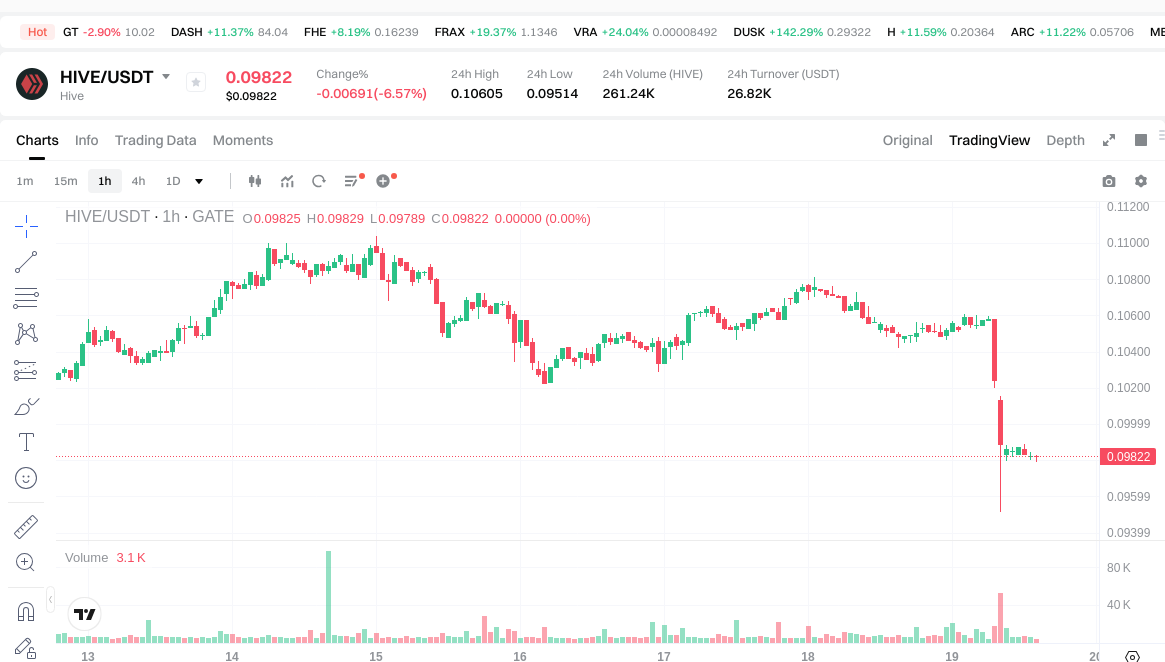
- HIVE current price: 0.09822 USD
- 24-hour trading volume: 26,704.44 USD
- Market capitalization: 50,252,483.03 USD
- Circulating supply: 511,631,877.731 HIVE
- Market dominance: 0.0015%
- Price performance: -6.67% (24H), -6.61% (7D), +10.040% (30D), -79.35% (1Y)
Click to view real-time HIVE market price
II. Core Factors Influencing Whether HIVE Is a Good Investment
Supply Mechanism and Scarcity
- Supply dynamics influence price and investment value
- HIVE operates with a circulating supply of 511,631,877.731 tokens and a total supply of 511,618,890.296 tokens, with a maximum supply of 500,749,242.945 tokens
- The circulate ratio stands at approximately 102.17%, indicating that circulating supply exceeds the stated total supply in current data
- Investment significance: Supply structure plays a role in assessing long-term investment potential
Institutional Investment and Mainstream Adoption
- The project is listed on 11 exchanges, reflecting a degree of market accessibility
- Hive Digital Technologies (a separate publicly traded company) has been noted for its Bitcoin mining operations and AI infrastructure expansion, though direct institutional adoption data for the HIVE token itself was not detailed in available materials
- Mainstream adoption and institutional engagement remain areas for ongoing observation
Macroeconomic Environment Impact on HIVE Investment
- Broader monetary policy and interest rate changes may alter the attractiveness of digital assets
- In inflationary environments, some digital assets are considered for their potential hedging properties
- Geopolitical uncertainties can influence demand for decentralized blockchain tokens
Technology and Ecosystem Development
- Hive is a graphene-based social blockchain launched in March 2020, emphasizing decentralization, speed, and scalability
- The platform features a low threshold for user adoption, delay security, integrated token allocation, and is noted for its open-source development environment
- The blockchain supports decentralized social content and creator rewards, contributing to its ecosystem value
- Ongoing development in decentralized applications (DApps), social gaming, and content creation may support long-term investment considerations
III. HIVE Future Investment Forecast and Price Outlook (Is Hive(HIVE) worth investing in 2026-2031)
Short-term Investment Forecast (2026, short-term HIVE investment outlook)
- Conservative forecast: $0.0894 - $0.0982
- Neutral forecast: $0.0982 - $0.1104
- Optimistic forecast: $0.1104 - $0.1435
Mid-term Investment Outlook (2027-2029, mid-term Hive(HIVE) investment forecast)
- Market stage expectation: Based on various analytical models, HIVE may experience gradual appreciation during this period, with market participants monitoring ecosystem development and broader crypto market trends.
- Investment return forecast:
- 2027: $0.0919 - $0.1705
- 2028: $0.0961 - $0.1719
- 2029: $0.1032 - $0.1842
- Key catalysts: Platform adoption trends, technological upgrades, and overall cryptocurrency market sentiment may influence price movements during this timeframe.
Long-term Investment Outlook (Is HIVE a good long-term investment?)
- Base scenario: $0.1037 - $0.2195 (assuming steady ecosystem growth and sustained community engagement through 2030)
- Optimistic scenario: $0.1705 - $0.2463 (assuming accelerated adoption and favorable market conditions through 2031)
- Risk scenario: Below $0.0894 (under adverse market conditions or significant technological challenges)
View HIVE long-term investment and price forecast: Price Prediction
2026-01-19 - 2031 Long-term Outlook
- Base scenario: $0.0894 - $0.1715 USD (corresponding to steady progress and gradual mainstream application improvement)
- Optimistic scenario: $0.1208 - $0.2463 USD (corresponding to large-scale adoption and favorable market environment)
- Transformative scenario: Above $0.2463 USD (if the ecosystem achieves breakthrough progress and mainstream popularization)
- 2031-12-31 Forecast high: $0.2463 USD (based on optimistic development assumptions)
Disclaimer: Price forecasts are based on historical data and analytical models. Cryptocurrency markets are highly volatile and subject to numerous unpredictable factors. These projections should not be considered as financial advice, and actual prices may differ significantly from forecasts. Investors should conduct their own research and consider their risk tolerance before making any investment decisions.
| Year |
Predicted High Price |
Predicted Average Price |
Predicted Low Price |
Price Change |
| 2026 |
0.1435034 |
0.09829 |
0.0894439 |
0 |
| 2027 |
0.170464347 |
0.1208967 |
0.091881492 |
23 |
| 2028 |
0.17190301773 |
0.1456805235 |
0.09614914551 |
48 |
| 2029 |
0.1841984539134 |
0.158791770615 |
0.10321465089975 |
61 |
| 2030 |
0.219513743698176 |
0.1714951122642 |
0.121761529707582 |
74 |
| 2031 |
0.246335579256296 |
0.195504427981188 |
0.103617346830029 |
99 |
IV. Hive Investment Strategy and Risk Management (How to invest in Hive)
Investment Methodology (Hive investment strategy)
Long-term Holding (HODL Hive)
For conservative investors, a long-term holding strategy may be appropriate when considering Hive. This approach involves purchasing HIVE tokens and maintaining positions through market cycles, focusing on the project's underlying blockchain technology and decentralized governance model. Given Hive's position as a graphene-based social blockchain with emphasis on decentralization and speed, long-term holders typically evaluate the platform's adoption rate and ecosystem development.
Active Trading
Active trading strategies rely on technical analysis and swing trading techniques. Traders may monitor Hive's price movements, which have shown volatility with a 24-hour change of -6.67% and weekly fluctuation of -6.61%. Technical traders often utilize chart patterns, volume indicators, and support/resistance levels. The 24-hour trading range between $0.09514 and $0.10605 provides reference points for short-term position management.
Risk Management (Risk management for Hive investment)
Asset Allocation Ratios
- Conservative Investors: May consider allocating 1-3% of their cryptocurrency portfolio to HIVE, maintaining primary positions in established assets
- Aggressive Investors: Could allocate 5-10% to HIVE as part of a diversified altcoin strategy
- Professional Investors: May implement dynamic allocation strategies based on technical indicators and market conditions
Risk Hedging Approaches
Investors can implement risk management through multi-asset portfolio construction, combining HIVE with assets exhibiting low correlation. Diversification across different blockchain categories and market cap segments can help manage exposure. Position sizing based on individual risk tolerance and regular portfolio rebalancing are essential components of a comprehensive risk management framework.
Secure Storage Solutions
For HIVE token storage, investors should consider:
- Hot Wallets: Convenient for active trading but require strong security protocols
- Cold Wallets: Offline storage solutions for long-term holdings
- Hardware Wallets: Physical devices providing enhanced security for private key management
- Native Hive Wallet: Utilizing the Hive blockchain's native wallet infrastructure
V. Hive Investment Risks and Challenges (Risks of investing in Hive)
Market Risks
Hive demonstrates significant price volatility, with a one-year decline of -79.35% from previous levels. The 24-hour trading volume of $26,704.44 indicates relatively limited liquidity compared to major cryptocurrencies. With a market capitalization of approximately $50.25 million and ranking at #522, HIVE is subject to substantial price fluctuations. The token's historical price range from an all-time high of $3.41 (November 2021) to an all-time low of $0.083898 (December 2025) illustrates the potential for dramatic value changes.
Regulatory Risks
As with all cryptocurrency assets, Hive faces regulatory uncertainty across different jurisdictions. Evolving legal frameworks for blockchain-based social platforms and decentralized governance systems may impact the project's operations and token utility. Investors should monitor regulatory developments in their respective regions and assess potential compliance requirements.
Technical Risks
Hive, as a fork of the Steem blockchain, carries inherent technical considerations:
- Network Security: Blockchain infrastructure security and potential vulnerability exposure
- Upgrade Implementation: Protocol modifications and hard fork execution risks
- Consensus Mechanism: DPOS (Delegated Proof of Stake) governance dependencies and validator reliability
- Smart Contract Integration: The upcoming Smart Media Token integration presents both opportunities and implementation challenges
The open-source nature of the Hive blockchain, while promoting transparency, also requires ongoing community maintenance and development coordination.
VI. Conclusion: Is Hive a Good Investment?
Investment Value Summary
Hive presents characteristics of a decentralized social blockchain with specific technical features including speed, scalability, and community governance. The project's market position at rank #522 with a market cap of $50.25 million reflects its status as a smaller-cap cryptocurrency asset. The significant one-year price decline of -79.35% and current trading levels near historical lows indicate substantial downside realization, though past performance does not indicate future results.
The circulating supply of 511.63 million HIVE tokens represents approximately 102% of the maximum supply, suggesting full token distribution. The project's availability on 11 exchanges provides access points for interested investors.
Investor Recommendations
✅ Beginners: Consider dollar-cost averaging approaches if interested in exposure to decentralized social blockchain platforms. Prioritize secure wallet storage and limit position sizes to amounts comfortable with potential loss. Focus on understanding Hive's governance model and ecosystem before investing.
✅ Experienced Investors: May evaluate swing trading opportunities based on technical analysis of support and resistance levels. Consider portfolio allocation as part of a diversified altcoin strategy, maintaining risk management protocols and position sizing discipline.
✅ Institutional Investors: Should conduct thorough due diligence on Hive's decentralized governance structure, technical roadmap, and competitive positioning within the blockchain social media sector before considering any strategic allocation.
⚠️ Disclaimer: Cryptocurrency investments carry substantial risk, including potential loss of principal. This content is provided for informational purposes only and does not constitute investment advice, financial guidance, or a recommendation to buy, sell, or hold any cryptocurrency asset. Investors should conduct independent research and consult with qualified financial advisors before making investment decisions.
VII. FAQ
Q1: What makes Hive different from other blockchain platforms, and is it a good investment for 2026?
Hive distinguishes itself as a graphene-based social blockchain launched through a hard fork of Steem in March 2020, emphasizing true decentralization, speed, and scalability with integrated token allocation. As of January 19, 2026, HIVE trades at $0.09822 with a market cap of $50.25 million and shows a 30-day gain of +10.04%, though it experienced a -79.35% decline over the past year. The platform's focus on Web 3.0 applications, decentralized social content, and creator rewards positions it within the growing decentralized social media sector. Conservative forecasts project HIVE between $0.0894-$0.1435 for 2026. However, its relatively small market cap (rank #522), limited trading volume ($26,704.44 daily), and significant historical volatility indicate substantial risk. The investment suitability depends on individual risk tolerance, portfolio diversification strategy, and assessment of the decentralized social blockchain market's long-term growth potential.
Q2: How should investors manage risks when investing in Hive (HIVE)?
Risk management for HIVE investment requires careful position sizing and diversification strategies. Conservative investors should consider allocating only 1-3% of their cryptocurrency portfolio to HIVE, while aggressive investors might allocate 5-10% as part of a diversified altcoin strategy. Implementation of proper asset allocation ratios helps mitigate exposure to HIVE's demonstrated volatility, including its -79.35% one-year decline. Investors should combine HIVE holdings with assets exhibiting low correlation across different blockchain categories and market cap segments. Secure storage solutions are critical—utilizing hardware wallets or cold storage for long-term holdings and maintaining strong security protocols for hot wallets used in active trading. Regular portfolio rebalancing based on predetermined thresholds and stop-loss mechanisms can help manage downside risk. Given HIVE's limited liquidity with $26,704.44 daily trading volume, investors should be prepared for potential execution challenges and wider bid-ask spreads during volatile market conditions.
Q3: What is Hive's long-term investment outlook through 2031?
Long-term projections for HIVE through 2031 vary significantly based on different scenarios. Base scenario forecasts suggest HIVE could reach $0.1037-$0.2195 by 2030, assuming steady ecosystem growth and sustained community engagement. Optimistic scenarios project potential prices between $0.1705-$0.2463 by 2031, contingent upon accelerated adoption and favorable market conditions. The 2031 predicted high reaches $0.2463 under optimistic development assumptions, representing approximately 150% increase from current levels. However, risk scenarios indicate potential decline below $0.0894 under adverse market conditions or significant technological challenges. These long-term forecasts incorporate assumptions about platform adoption trends, technological upgrades including Smart Media Token integration, and overall cryptocurrency market sentiment evolution. The project's emphasis on decentralization, speed, and scalability positions it within the growing Web 3.0 ecosystem, though competitive positioning and mainstream adoption rates remain uncertain factors. Investors should recognize that these projections are based on historical data and analytical models, and actual prices may differ significantly due to cryptocurrency market volatility and unpredictable factors.
Q4: What are the main technical and regulatory risks associated with Hive investment?
HIVE faces multiple technical and regulatory risk categories that investors should evaluate. Technical risks include network security vulnerabilities inherent to blockchain infrastructure, upgrade implementation challenges during protocol modifications, and dependencies on DPOS (Delegated Proof of Stake) governance and validator reliability. The upcoming Smart Media Token integration presents both opportunities and implementation challenges requiring careful technical execution. As an open-source blockchain fork of Steem, Hive relies on ongoing community maintenance and development coordination, creating dependencies on contributor engagement. Regulatory risks encompass evolving legal frameworks across different jurisdictions for blockchain-based social platforms and decentralized governance systems. Compliance requirements may impact the project's operations and token utility as governments develop specific regulations for cryptocurrency assets and decentralized applications. The project's emphasis on decentralization and community governance may face scrutiny under traditional securities regulations in certain jurisdictions. Investors should monitor regulatory developments in their respective regions and assess how changing compliance requirements might affect Hive's operational model, token classification, and market accessibility across different geographic markets.
Q5: Is Hive suitable for beginner investors, and what strategies should they consider?
Hive presents characteristics that require careful consideration for beginner investors due to its significant volatility and specialized focus on decentralized social blockchain applications. Beginners should prioritize education about Hive's governance model, DPOS consensus mechanism, and ecosystem functionality before committing capital. Dollar-cost averaging (DCA) approaches may be appropriate for those interested in gaining exposure to decentralized social blockchain platforms, allowing gradual position building while mitigating timing risk. Position sizes should be limited to amounts comfortable with potential loss, given HIVE's demonstrated -79.35% one-year decline and historical price swings between $0.083898 and $3.41. Beginners must establish secure wallet storage protocols, whether utilizing hardware wallets for long-term holdings or the native Hive wallet infrastructure. Understanding the project's circulating supply of 511.63 million tokens (102% of maximum supply) and its relatively small market cap of $50.25 million helps contextualize risk exposure. New investors should avoid over-concentration in HIVE, maintaining diversified portfolios across established cryptocurrencies and traditional assets. Given HIVE's limited liquidity with $26,704.44 daily trading volume, beginners should be prepared for potential execution challenges and avoid large market orders that could experience significant slippage.
Q6: What factors could drive Hive's price growth in the mid-term (2027-2029)?
Mid-term price catalysts for HIVE during 2027-2029 center on ecosystem development, technological advancement, and broader cryptocurrency market trends. Platform adoption rates across decentralized social content creation, gaming applications, and Web 3.0 integration represent primary growth drivers. Forecasts project potential price ranges from $0.0919-$0.1705 in 2027, expanding to $0.1032-$0.1842 by 2029, reflecting approximately 61% cumulative growth under base assumptions. Key catalysts include successful Smart Media Token implementation, expanding the platform's utility for content creators and social application developers. Increased mainstream adoption of decentralized social media platforms could drive user growth and token demand. Technological upgrades enhancing network speed, scalability, and transaction throughput may improve competitive positioning against centralized social platforms. Broader cryptocurrency market sentiment recovery from current levels could provide tailwinds for altcoins including HIVE. Partnership developments with decentralized application developers and integration into larger Web 3.0 ecosystems could expand use cases. Community governance effectiveness and sustainable development funding mechanisms will influence long-term confidence. However, these projections remain subject to significant uncertainty, including competitive pressures from other blockchain social platforms, regulatory developments affecting decentralized applications, and overall cryptocurrency market volatility that could impact achievement of these mid-term growth scenarios.
Q7: How does Hive's supply mechanism affect its investment value?
Hive's supply mechanism presents unique characteristics that influence investment value assessment. The circulating supply of 511,631,877.731 HIVE tokens exceeds both the stated total supply (511,618,890.296) and maximum supply (500,749,242.945), resulting in a circulate ratio of approximately 102.17%. This supply structure indicates nearly complete token distribution with minimal future dilution risk from new issuance. Unlike cryptocurrencies with significant locked or unvested supplies, HIVE's full circulation reduces concerns about future supply increases impacting price. The supply dynamics create a fully diluted market cap approximately equal to current market capitalization, providing clearer valuation metrics compared to projects with substantial unreleased tokens. However, the lack of programmatic supply reduction mechanisms (such as token burns) means scarcity must derive from demand growth rather than supply contraction. The platform's inflation model and reward distribution mechanics for content creators affect long-term token economics. Understanding these supply characteristics is essential for evaluating price potential—with limited additional supply pressure, price appreciation depends primarily on demand drivers including platform adoption, ecosystem growth, and broader market sentiment. Investors should assess whether current circulating supply levels support sustainable network security and governance participation while considering how token distribution patterns among stakeholders might influence market dynamics and price volatility.
Q8: What are the key differences between conservative and aggressive investment strategies for HIVE?
Conservative and aggressive HIVE investment strategies differ significantly in allocation ratios, risk tolerance, and implementation approaches. Conservative investors should consider allocating only 1-3% of their cryptocurrency portfolio to HIVE, prioritizing capital preservation and maintaining primary positions in established cryptocurrencies with larger market caps and greater liquidity. This approach typically involves long-term holding (HODL) strategies, focusing on Hive's underlying blockchain technology and decentralized governance model evolution over extended periods. Conservative investors emphasize secure cold storage solutions, minimal trading frequency, and patient capital deployment through dollar-cost averaging during market downturns. In contrast, aggressive investors might allocate 5-10% to HIVE as part of a diversified altcoin strategy, accepting higher volatility in pursuit of potentially larger returns. Aggressive strategies may incorporate active trading approaches, utilizing technical analysis of HIVE's price movements including its 24-hour trading range between $0.09514-$0.10605 and recent -6.67% daily fluctuation. These investors might implement swing trading techniques, leverage technical indicators, and maintain positions in hot wallets for rapid execution. Professional investors could employ dynamic allocation strategies adjusting position sizes based on market conditions, technical signals, and fundamental developments. Both approaches require secure storage protocols, though conservative strategies prioritize offline cold storage while aggressive traders balance security with accessibility for active position management. Regardless of strategy, proper risk management through stop-loss implementation and regular portfolio rebalancing remains essential given HIVE's demonstrated volatility and -79.35% one-year decline.
* The information is not intended to be and does not constitute financial advice or any other recommendation of any sort offered or endorsed by Gate.