This comprehensive guide evaluates whether IOTA represents a viable investment opportunity through 2031. IOTA is a distributed ledger technology project specializing in feeless machine-to-machine transactions for Internet of Things applications, currently trading at $0.10272 with a market capitalization of $435.3 million as of January 2026. The article analyzes IOTA's price history, technological differentiation through Tangle technology, and multi-year price forecasts ranging from conservative to optimistic scenarios. Critical investment factors examined include supply mechanisms, institutional adoption potential, macroeconomic influences, and ecosystem development progress. Detailed risk assessments address market volatility (-67.57% annual decline), regulatory uncertainties across jurisdictions, and technical vulnerabilities inherent to alternative consensus mechanisms. Practical investment strategies are provided for different investor profiles—from conservative dollar-cost averaging approaches to active
Introduction: IOTA's Investment Position and Market Outlook
IOTA is an important asset in the cryptocurrency field. Launched in 2017, it has achieved notable development in the Internet of Things (IoT) sector. As of January 2026, IOTA's market capitalization stands at approximately $435.33 million, with a circulating supply of around 4.24 billion tokens, and the current price maintaining around $0.10272. With its positioning as a fee-free, scalable solution for machine-to-machine transactions, IOTA has gradually become a focal point for investors discussing "Is IOTA a good investment?" This article will comprehensively analyze IOTA's investment value, historical trends, future price predictions, and investment risks to provide reference for investors.
I. IOTA (IOTA) Price History Review and Current Investment Value
- 2015: IOTA token was launched by the IOTA Foundation, founded by Sergey Ivancheglo, Serguei Popov, David Sonstebo, and Dominik Schiener → Initial stage of the project with focus on Internet of Things (IoT) applications
- 2017: IOTA experienced notable market attention → Price movement reflected broader cryptocurrency market dynamics during that period
- 2024-2026: IOTA has been associated with developments in digital trade infrastructure → The token became part of ADAPT, a digital trade infrastructure being promoted across the African Continental Free Trade Area, covering 55 sovereign nations
Current IOTA Investment Market Status (January 2026)
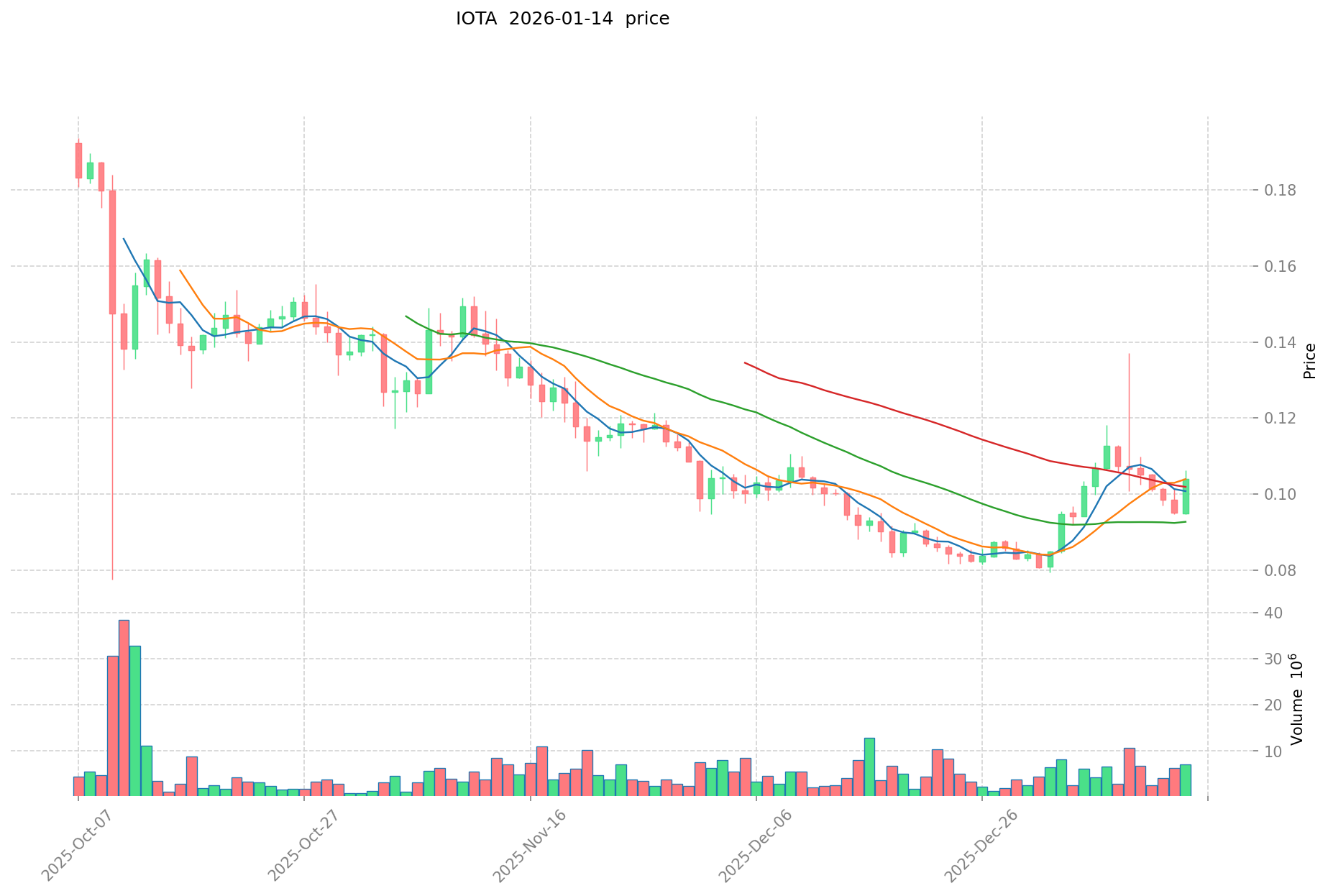
- IOTA current price: $0.10272 (as of January 15, 2026)
- 24-hour trading volume: $807,756.17738
- Market capitalization: $435,334,961.48544
- Circulating supply: 4,238,074,002 IOTA
- Market share: 0.014%
Click to view real-time IOTA market price
II. Core Factors Affecting Whether IOTA is a Good Investment
Supply Mechanism and Scarcity (IOTA investment scarcity)
- Total supply stands at 4,794,742,498 IOTA tokens, with approximately 4,238,074,002 tokens currently in circulation, representing a circulation ratio of 92.13%
- The token operates with no maximum supply cap (indicated as ∞), which may affect long-term scarcity considerations
- Investment significance: The high circulation ratio suggests that a substantial portion of the total supply is already in the market, which could influence supply-side dynamics in future price movements
Institutional Investment and Mainstream Adoption (Institutional investment in IOTA)
- The project maintains a presence across 30 exchanges, indicating a level of market integration
- Current holder base consists of 42,669 addresses, reflecting community participation in the token ecosystem
- The broader adoption of IOTA's technology in the Internet of Things (IoT) sector may influence institutional interest, though specific institutional holding data was not available in the reference materials
Macroeconomic Environment's Impact on IOTA Investment
- As with other digital assets, IOTA's investment appeal may be influenced by broader monetary policy shifts and interest rate adjustments
- Market sentiment indicators show a positive rating of 1, though investors should consider how changing macroeconomic conditions might affect risk appetite for emerging technology-focused tokens
- Global economic uncertainty may impact demand patterns for IoT-related blockchain solutions
Technology and Ecosystem Development (Technology & Ecosystem for IOTA investment)
- IOTA utilizes Tangle technology rather than traditional blockchain architecture, designed specifically for machine-to-machine (M2M) transactions in the IoT ecosystem
- The project focuses on enabling fee-free microtransactions, which may support use cases in device-to-device payment scenarios
- A smart contract deployment exists on the BSC chain at address 0xd944f1D1e9d5f9Bb90b62f9D45e447D989580782, indicating cross-chain presence
- Long-term investment value may be supported by the expansion of IoT applications and the practical implementation of M2M transaction networks
III. IOTA Future Investment Forecast and Price Outlook (Is IOTA(IOTA) worth investing in 2026-2031)
Short-term Investment Forecast (2026, short-term IOTA investment outlook)
Based on available technical analysis and market projections, IOTA presents varied short-term scenarios for 2026:
- Conservative forecast: $0.0606 - $0.0973
- Neutral forecast: $0.0913 - $0.1027
- Optimistic forecast: $0.1011 - $0.1458
Technical indicators suggest mixed signals, with the 200-day Simple Moving Average potentially reaching $0.1417 by February 2026, while shorter-term metrics remain neutral. Market data indicates IOTA maintains a circulating supply of approximately 4.24 billion tokens with a market capitalization around $435 million as of January 2026.
Mid-term Investment Outlook (2027-2028, mid-term IOTA(IOTA) investment forecast)
- Market stage expectation: IOTA may enter a phase of gradual appreciation as the distributed ledger technology sector evolves and Internet of Things applications expand.
- Investment return forecast:
- 2027: $0.0857 - $0.1752
- 2028: $0.0913 - $0.2201
- Key catalysts: Network development progress, adoption rate in machine-to-machine payment scenarios, and overall cryptocurrency market sentiment could influence mid-term performance.
Long-term Investment Outlook (Is IOTA a good long-term investment?)
- Baseline scenario: $0.0961 - $0.2496 (assuming steady ecosystem development and moderate market conditions)
- Optimistic scenario: $0.1760 - $0.2867 (contingent upon successful technology deployment and favorable regulatory environment)
- Risk scenario: $0.0606 - $0.0857 (under adverse market conditions or delayed technological milestones)
Click to view IOTA long-term investment and price forecast: Price Prediction
2026-2031 Long-term Outlook
- Base scenario: $0.0961 - $0.2867 (corresponding to stable progress and steady mainstream application growth)
- Optimistic scenario: $0.1760 - $0.2867 (corresponding to large-scale adoption and favorable market environment)
- Transformative scenario: Above $0.2867 (if ecosystem achieves breakthrough developments and mainstream penetration)
- 2031-12-31 projected high: $0.2847 (based on optimistic development assumptions)
Disclaimer: Price forecasts are based on technical analysis and historical patterns and should not be considered as investment advice. Cryptocurrency markets involve substantial risk, and actual performance may differ materially from projections. Investors should conduct thorough research and consider their risk tolerance before making investment decisions.
| Year |
Predicted High Price |
Predicted Average Price |
Predicted Low Price |
Price Change |
| 2026 |
0.1457914 |
0.10267 |
0.0605753 |
0 |
| 2027 |
0.175165287 |
0.1242307 |
0.085719183 |
20 |
| 2028 |
0.220056050445 |
0.1496979935 |
0.091315776035 |
45 |
| 2029 |
0.249583979662875 |
0.1848770219725 |
0.0961360514257 |
79 |
| 2030 |
0.286744261079347 |
0.217230500817687 |
0.175956705662326 |
111 |
| 2031 |
0.284745740471824 |
0.251987380948517 |
0.196550157139843 |
145 |
IV. IOTA Investment Strategy and Risk Management (How to invest in IOTA)
Investment Methodology (IOTA investment strategy)
Long-term Holding (HODL IOTA)
Long-term holding is generally considered a suitable approach for conservative investors who believe in the fundamental value proposition of IOTA's Tangle technology and its potential applications in the machine-to-machine economy. This strategy involves acquiring IOTA tokens and holding them through market cycles, focusing on the project's long-term development rather than short-term price movements.
Given IOTA's design as a feeless transaction network specifically tailored for the Internet of Things (IoT), long-term holders typically base their investment thesis on the expected growth of IoT adoption and the network's ability to facilitate microtransactions efficiently. However, investors should note that IOTA has experienced significant price fluctuation, with the current price of $0.10272 representing a substantial decline from its historical peak.
Active Trading
Active trading strategies for IOTA rely on technical analysis and swing trading techniques. Traders may utilize various indicators and chart patterns to identify entry and exit points within IOTA's price movements. With a 24-hour trading volume of approximately $807,756 and a 24-hour price range between $0.10088 and $0.10761, IOTA demonstrates moderate liquidity for active trading strategies.
Traders should consider IOTA's recent performance metrics when developing their strategies: the token showed a 0.44% increase over 1 hour, a 0.75% gain over 24 hours, but a -4.81% decline over 7 days and a -67.57% decrease over the past year. These varied timeframe performances suggest the importance of multi-timeframe analysis for active traders.
Risk Management (Risk management for IOTA investment)
Asset Allocation Proportion
Conservative Investors: For risk-averse investors, IOTA should constitute a minimal portion of the overall crypto portfolio, typically not exceeding 2-5% of total crypto holdings, which themselves should represent only a small fraction of total investment capital. This approach acknowledges IOTA's volatility while allowing exposure to potential upside.
Aggressive Investors: More risk-tolerant investors might allocate 5-15% of their cryptocurrency portfolio to IOTA, particularly if they have strong conviction in the IoT sector and IOTA's technological differentiation through its Tangle architecture. However, even aggressive investors should maintain diversification across multiple assets.
Professional Investors: Institutional or professional investors may consider strategic positions in IOTA as part of a broader IoT or distributed ledger technology thesis, with allocation decisions based on comprehensive due diligence, risk modeling, and portfolio optimization frameworks.
Risk Hedging Solutions
A multi-asset portfolio approach can help mitigate IOTA-specific risks. Investors might consider:
- Diversification across different categories of crypto assets (layer-1 protocols, DeFi tokens, stablecoins)
- Inclusion of traditional hedging instruments where available
- Position sizing based on volatility metrics and correlation analysis
- Regular portfolio rebalancing to maintain target allocations
Given IOTA's market capitalization of approximately $435.3 million and ranking of 144 among cryptocurrencies, it represents a mid-to-small cap position in the crypto market, which typically carries higher volatility and liquidity considerations compared to larger-cap assets.
Secure Storage
Cold and Hot Wallet Solutions: IOTA investors should implement a security-first approach to token storage:
- Hot wallets (connected to the internet) may be used for small amounts needed for active trading or frequent transactions
- Cold storage solutions (offline storage) should be employed for the majority of holdings intended for long-term investment
- Multi-signature wallets can provide additional security layers for significant holdings
Hardware Wallet Recommendations: Hardware wallets offer robust security for IOTA storage by keeping private keys offline. Investors should:
- Research hardware wallets that support IOTA tokens
- Purchase devices directly from official manufacturers
- Maintain secure backup procedures for recovery phrases
- Regularly update firmware to address potential security vulnerabilities
Given that IOTA has a smart contract address on the BSC (Binance Smart Chain) network, investors should be aware of the different storage options and ensure they are using compatible wallets for their specific IOTA holdings.
V. IOTA Investment Risks and Challenges (Risks of investing in IOTA)
Market Risks
High Volatility: IOTA demonstrates substantial price volatility, which is characteristic of mid-cap cryptocurrency assets. The token's 1-year performance showing a -67.57% decline illustrates the significant downside risk potential. The current price of $0.10272 represents approximately 98% below the historical high of $5.25 recorded in December 2017, highlighting the magnitude of possible price swings.
Short-term volatility is also evident, with 7-day performance at -4.81% contrasted against 30-day performance of +12.78%, demonstrating rapid price direction changes that can challenge both long-term holders and active traders. This volatility can be attributed to various factors including overall crypto market sentiment, IoT sector developments, and IOTA-specific news or technological updates.
Price Manipulation Concerns: With a 24-hour trading volume of approximately $807,756 and market capitalization around $435.3 million, IOTA operates in a liquidity environment that may be susceptible to significant price movements from large transactions. The market dominance of 0.014% indicates a relatively small market presence, which can amplify the impact of concentrated buying or selling pressure.
Investors should be aware that lower liquidity environments can present challenges for executing large orders without impacting market prices and may increase vulnerability to coordinated trading activities.
Regulatory Risks
Policy Uncertainty Across Jurisdictions: Cryptocurrency regulation varies significantly across different countries and continues to evolve. IOTA, like other digital assets, faces uncertain regulatory frameworks that could impact its adoption, trading, and use cases:
- Some jurisdictions may classify IOTA differently based on its technical characteristics (Tangle technology rather than traditional blockchain)
- Regulatory changes could affect the ability to trade IOTA on certain exchanges or in specific regions
- Future regulations concerning IoT applications and machine-to-machine transactions could indirectly impact IOTA's utility proposition
- Tax treatment of IOTA transactions and holdings varies by jurisdiction and may change over time
Investors should stay informed about regulatory developments in their own jurisdictions and consider how changing regulatory landscapes might affect their IOTA holdings and trading activities.
Technical Risks
Network Security Vulnerabilities: While IOTA's Tangle architecture represents an innovative approach to distributed ledger technology, any technological system carries inherent security risks:
- Smart contract vulnerabilities or protocol-level weaknesses could potentially be exploited
- The relatively unique nature of Tangle technology means it has different security considerations compared to traditional blockchain systems
- Network attacks or attempted exploits could impact token value and user confidence
Upgrade Implementation Challenges: As an evolving technology project, IOTA undergoes periodic updates and improvements to its protocol. These upgrades carry inherent risks:
- Technical complications during implementation could temporarily disrupt network operations
- Unexpected bugs or vulnerabilities might be introduced despite thorough testing procedures
- Coordination challenges during network upgrades could affect user experience or token accessibility
- Delayed or failed upgrades might impact competitive positioning relative to other IoT-focused blockchain projects
Investors should monitor IOTA's development roadmap and be aware that technical projects in the cryptocurrency space face ongoing challenges in maintaining and improving their networks while ensuring security and reliability.
VI. Conclusion: Is IOTA a Good Investment?
Investment Value Summary
IOTA presents a distinctive value proposition in the cryptocurrency space through its focus on machine-to-machine transactions and feeless microtransactions enabled by Tangle technology. The project's concentration on IoT applications differentiates it from traditional blockchain-based cryptocurrencies and positions it within a potentially growing sector.
However, IOTA's investment profile is characterized by substantial volatility and significant risks. The current price of $0.10272 reflects a considerable decrease from historical levels, with a 1-year performance of -67.57% and a current valuation approximately 98% below its all-time high. While the 30-day performance shows a 12.78% increase, suggesting some recent positive momentum, the broader trend indicates substantial price pressure.
With a market capitalization of approximately $435.3 million, ranking 144 among cryptocurrencies, and market dominance of 0.014%, IOTA represents a mid-cap asset with corresponding liquidity and volatility characteristics. The circulating supply of approximately 4.24 billion tokens represents 92.13% of the total supply of 4.79 billion, indicating relatively high token circulation.
Investor Recommendations
✅ Beginners: For new investors, consider the following approach:
- Implement a dollar-cost averaging (DCA) strategy to mitigate timing risk
- Allocate only a small percentage of overall investment capital to IOTA
- Utilize secure wallet storage solutions and prioritize learning proper security practices
- Conduct thorough research on IOTA's technology and use cases before investing
- Avoid investing amounts that would cause financial distress if lost
✅ Experienced Investors: Those with cryptocurrency trading experience might consider:
- Swing trading strategies based on technical analysis and market momentum indicators
- Portfolio allocation as part of a diversified cryptocurrency holding strategy
- Active monitoring of IOTA development updates and IoT sector trends
- Risk management through position sizing relative to volatility metrics
- Utilization of both fundamental analysis and technical indicators for decision-making
✅ Institutional Investors: Professional investors and institutions may approach IOTA as:
- A strategic long-term position within an IoT or distributed ledger technology investment thesis
- Part of a broader portfolio allocation to mid-cap cryptocurrency assets
- An opportunity for exposure to alternative consensus mechanisms beyond traditional blockchain
- A holding subject to rigorous due diligence, risk assessment, and ongoing monitoring protocols
⚠️ Disclaimer: Cryptocurrency investment carries substantial risk, including the potential for complete loss of invested capital. IOTA, like all digital assets, experiences high volatility and is subject to various risks including market, regulatory, and technical uncertainties. This analysis is provided for informational purposes only and does not constitute investment advice, financial advice, trading advice, or recommendations of any kind. Investors should conduct their own research, consider their financial situation and risk tolerance, and consult with qualified financial advisors before making investment decisions.
VII. FAQ
Q1: Is IOTA a good investment for 2026?
IOTA presents a mixed investment profile for 2026, with potential but significant risks. The token's current price of $0.10272 and market capitalization of approximately $435.3 million position it as a mid-cap cryptocurrency with substantial volatility. Short-term forecasts suggest a conservative range of $0.0606 - $0.0973, neutral range of $0.0913 - $0.1027, and optimistic range of $0.1011 - $0.1458 for 2026. The investment appeal depends on individual risk tolerance, with the token showing recent positive momentum (+12.78% over 30 days) despite significant long-term decline (-67.57% over 1 year). Conservative investors should limit allocation to 2-5% of crypto portfolios, while aggressive investors might consider 5-15%. The project's focus on feeless machine-to-machine transactions and IoT applications offers differentiation, but investors must weigh this against high volatility and approximately 98% decline from all-time highs.
Q2: What are the main risks of investing in IOTA?
IOTA investment carries three primary risk categories requiring careful consideration. Market risks include extreme volatility, evidenced by the 98% decline from the $5.25 all-time high and -67.57% annual performance, plus potential price manipulation concerns given the $807,756 daily trading volume and 0.014% market dominance. Regulatory risks stem from evolving cryptocurrency frameworks across jurisdictions, with uncertain classification of Tangle-based assets and varying tax treatments. Technical risks involve potential network security vulnerabilities inherent to the unique Tangle architecture, upgrade implementation challenges that could disrupt operations, and the possibility of undiscovered protocol-level weaknesses. The relatively modest 24-hour trading volume also suggests liquidity constraints that can amplify price movements from large transactions. Investors should implement comprehensive risk management strategies including diversification, appropriate position sizing, and secure storage solutions to mitigate these exposures.
Q3: How does IOTA's Tangle technology differ from traditional blockchain?
IOTA utilizes Tangle technology rather than traditional blockchain architecture, creating fundamental operational differences. Unlike blockchain's sequential block structure, Tangle employs a Directed Acyclic Graph (DAG) where each transaction validates two previous transactions, eliminating the need for miners and associated transaction fees. This feeless structure is specifically designed for machine-to-machine (M2M) microtransactions in the Internet of Things ecosystem, where even minimal fees would be economically prohibitive for small-value transfers. The architecture theoretically enables better scalability as network activity increases, since more transactions lead to faster validation times. However, this innovative approach also means IOTA faces different security considerations compared to established blockchain networks, with unique technical challenges during network upgrades and protocol development. The technology's suitability for IoT applications represents both a differentiation factor and a specialized use case that may limit broader mainstream adoption compared to general-purpose blockchains.
Q4: What is the long-term price prediction for IOTA through 2031?
Long-term price projections for IOTA through 2031 vary significantly based on different scenarios and market conditions. Base scenario forecasts suggest a range of $0.0961 - $0.2867, assuming steady ecosystem development and moderate market conditions. The optimistic scenario projects $0.1760 - $0.2867, contingent upon successful technology deployment and favorable regulatory environments. Specific annual predictions include: 2027 ($0.0857 - $0.1752), 2028 ($0.0913 - $0.2201), 2029 ($0.0961 - $0.2496), 2030 ($0.1760 - $0.2867), and 2031 ($0.1965 - $0.2847 projected high). These forecasts are based on technical analysis and historical patterns, with the 2031-12-31 optimistic high estimated at $0.2847. However, investors must understand that cryptocurrency price predictions carry substantial uncertainty, and actual performance may differ materially from projections. Transformative scenarios could push prices above $0.2867 if the ecosystem achieves breakthrough developments and mainstream IoT penetration, while adverse conditions could result in lower ranges of $0.0606 - $0.0857.
Q5: How should I store IOTA tokens securely?
Secure IOTA storage requires implementing a multi-layered security approach appropriate to holding size and usage patterns. For long-term holdings, cold storage solutions (offline storage) should house the majority of tokens, keeping private keys completely disconnected from internet-connected devices. Hardware wallets provide robust security by maintaining private keys offline while enabling transactions when needed—investors should purchase these devices directly from official manufacturers and regularly update firmware. Hot wallets (internet-connected) may be used for small amounts needed for active trading or frequent transactions, but should contain only minimal balances to limit exposure. Multi-signature wallets can provide additional security layers for significant holdings, requiring multiple approvals for transactions. Investors must also maintain secure backup procedures for recovery phrases, storing them in multiple secure physical locations. Given that IOTA has a smart contract presence on the BSC (Binance Smart Chain) network at address 0xd944f1D1e9d5f9Bb90b62f9D45e447D989580782, ensure wallet compatibility with your specific IOTA holdings format.
Q6: What factors could drive IOTA's price growth in the future?
Several key catalysts could influence IOTA's future price trajectory and investment value. Network development progress and successful implementation of protocol upgrades would strengthen technical foundations and user confidence. Increased adoption rate in machine-to-machine payment scenarios, particularly within the expanding Internet of Things ecosystem, could drive organic demand for IOTA tokens. The project's involvement in digital trade infrastructure initiatives, such as ADAPT across the African Continental Free Trade Area covering 55 nations, represents significant adoption potential. Broader cryptocurrency market sentiment and favorable macroeconomic conditions, including appropriate monetary policy and interest rate environments, would support price appreciation. Large-scale institutional adoption and mainstream integration would provide liquidity and credibility. However, these positive factors must be balanced against risks including regulatory uncertainties, technical implementation challenges, and competition from other IoT-focused blockchain projects. The high circulation ratio of 92.13% means supply-side dynamics are relatively stable, placing greater emphasis on demand-side drivers for price growth.
Q7: Is IOTA suitable for dollar-cost averaging (DCA) strategy?
Dollar-cost averaging is generally considered an appropriate strategy for IOTA investment, particularly for beginners and conservative investors. DCA involves making regular fixed-amount purchases regardless of price, reducing timing risk and emotional decision-making associated with volatile assets. Given IOTA's substantial volatility—evidenced by 24-hour ranges between $0.10088 and $0.10761, 7-day performance of -4.81%, and dramatic long-term fluctuations—DCA helps mitigate the risk of poorly timed lump-sum entries. The strategy is especially relevant given IOTA's 98% decline from all-time highs, as attempting to "time the bottom" in such volatile conditions is extremely challenging. For implementation, investors might consider weekly or monthly purchases of predetermined amounts, allowing accumulation across various price points while maintaining disciplined investment behavior. This approach works best when combined with a long-term investment horizon aligned with belief in IOTA's fundamental technology proposition and IoT sector growth. However, investors should still limit overall IOTA allocation to appropriate portfolio percentages based on risk tolerance, and DCA does not eliminate the underlying risks associated with cryptocurrency investment, including potential for complete capital loss.
Q8: How does IOTA's market position compare to other cryptocurrencies?
IOTA occupies a distinctive but relatively modest position within the cryptocurrency market landscape. With a market capitalization of approximately $435.3 million and ranking of 144 among cryptocurrencies, IOTA represents a mid-cap asset significantly smaller than major cryptocurrencies. The market dominance of 0.014% indicates minimal overall market share, suggesting limited influence on broader crypto market trends. Trading across 30 exchanges provides reasonable accessibility, while the holder base of 42,669 addresses reflects moderate community participation. Unlike general-purpose blockchain platforms, IOTA's specialization in feeless machine-to-machine transactions and IoT applications creates a focused value proposition but potentially narrower use case compared to layer-1 protocols with broader functionality. The 24-hour trading volume of $807,756 suggests moderate liquidity, which can result in wider bid-ask spreads and increased price impact from large transactions compared to higher-volume assets. The circulating supply of 4.24 billion tokens (92.13% of total supply) with no maximum supply cap distinguishes it from fixed-supply cryptocurrencies. This market positioning suggests IOTA functions as a specialized, higher-risk investment option within diversified cryptocurrency portfolios rather than a core holding.
* The information is not intended to be and does not constitute financial advice or any other recommendation of any sort offered or endorsed by Gate.