This comprehensive analysis evaluates IQ as an investment opportunity, examining its market position, ecosystem potential, and financial outlook. IQ, a blockchain-powered knowledge platform with a current market cap of $39.59 million, operates IQ.wiki and IQGPT.com while developing EOAI intelligent agent technology. The article reviews historical price trends showing 76.62% annual decline, analyzes supply dynamics affecting scarcity, and presents price forecasts across conservative, neutral, and optimistic scenarios through 2031. Key sections address investment strategies for different investor profiles, comprehensive risk management including market volatility and regulatory challenges, and security recommendations. Suitable for investors seeking exposure to AI-blockchain convergence, the analysis emphasizes substantial volatility risks and provides actionable insights for portfolio allocation decisions. Track real-time IQ pricing on Gate exchange.
Introduction: IQ's Investment Position and Market Outlook
IQ is a notable asset in the cryptocurrency field, launched in July 2018. It has established itself as a blockchain and AI-powered knowledge ecosystem focused on Web3 and blockchain technology insights. As of January 20, 2026, IQ maintains a market capitalization of approximately $39.59 million with a circulating supply of about 24.54 billion tokens, and the current price stands around $0.001613. With its positioning as a knowledge infrastructure platform developing EOAI (Enshrined On-chain AI) and powering applications like IQ.wiki and IQGPT.com, IQ has become a subject of discussion among investors considering "Is IQ a good investment?" This article provides a comprehensive analysis of IQ's investment value, historical trends, future price predictions, and investment risks to serve as a reference for investors.
I. IQ (IQ) Price History Review and Current Investment Value Status
- 2024: The token experienced significant price fluctuation, reaching a price level of 0.01641 USD on March 27, 2024 → Investors who entered during earlier periods saw notable gains during this phase
- 2025: Market experienced downward pressure → IQ price declined from higher levels to 0.001434 USD by December 19, 2025
- Recent period: The token has shown relative price stability with minor fluctuations → Current trading reflects market consolidation patterns
Current IQ Investment Market Status (January 2026)
- IQ current price: 0.001613 USD
- Market sentiment (Fear & Greed Index): Data not available in provided materials
- 24-hour trading volume: 12,327.24 USD
- Institutional investor holdings: Data not available in provided materials
Click to view real-time IQ market price
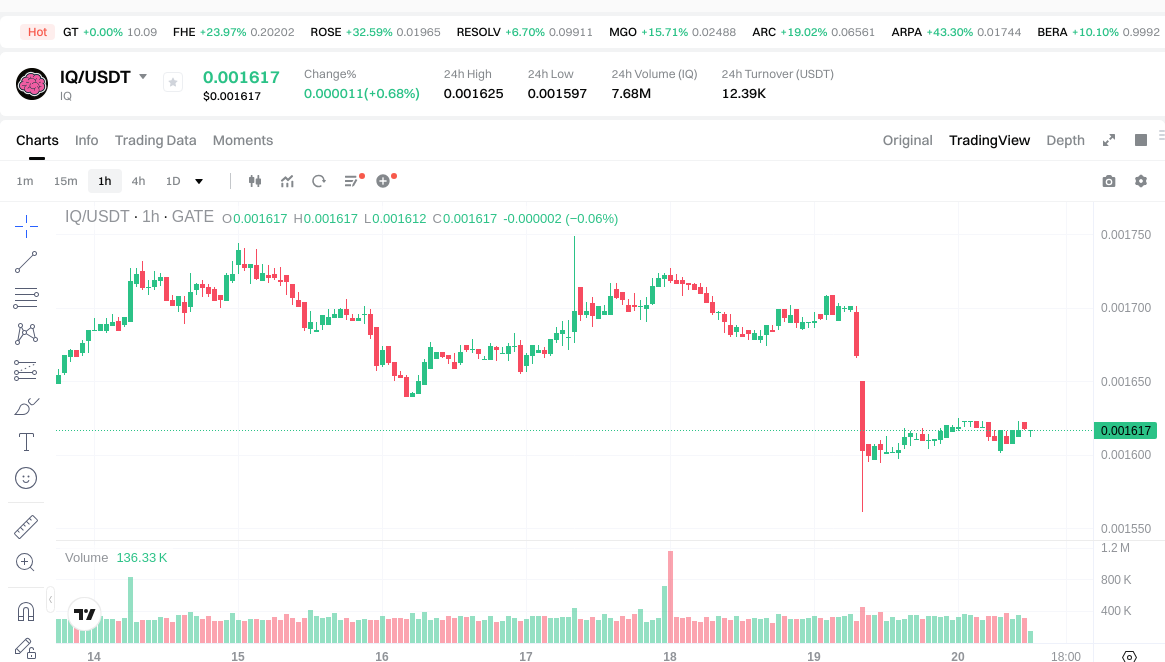
II. Core Factors Affecting Whether IQ is a Good Investment
Supply Mechanism and Scarcity (IQ Investment Scarcity)
- Supply structure influences price and investment value: IQ has a total supply of 21 billion tokens with a maximum supply cap of 60 billion tokens. As of January 20, 2026, approximately 24.54 billion tokens are in circulation, representing about 40.9% of the total supply. This structured supply mechanism may impact long-term scarcity dynamics.
- Circulating supply ratio considerations: With less than half of the total supply currently circulating, future token releases could influence market dynamics and investment considerations.
- Investment significance: Understanding the supply dynamics and release schedule is relevant for evaluating potential long-term investment characteristics.
Institutional Investment and Mainstream Adoption (Institutional Investment in IQ)
- Holder base: As of the latest data, IQ has approximately 3,945 token holders, indicating a developing community of participants.
- Exchange presence: IQ is currently listed on 17 exchanges, providing accessibility for market participants across different platforms.
- Ecosystem applications: The IQ ecosystem powers IQ.wiki, described as a comprehensive blockchain encyclopedia, and IQGPT.com, an AI tool for blockchain knowledge, both aimed at expanding access to blockchain technology.
Macroeconomic Environment's Impact on IQ Investment
- Market performance context: IQ's price movements have shown volatility, with a 1-year performance change of -76.62%, reflecting broader market conditions and sector-specific dynamics.
- Market capitalization positioning: With a market capitalization of approximately $39.59 million and a market dominance of 0.0010%, IQ operates within the mid-to-lower tier of cryptocurrency market capitalizations.
- Economic environment considerations: As with other digital assets, macroeconomic factors including monetary policy shifts, inflation trends, and broader risk sentiment may influence investor interest in tokens like IQ.
Technology and Ecosystem Development (Technology & Ecosystem for IQ Investment)
- EOAI development: IQ is building EOAI (Enshrined On-chain AI), described as an intelligent agent layer focused on liquidity, bridging, lending, and launching tokenized agents, designed to simplify DeFi interactions.
- Knowledge infrastructure: The IQ ecosystem includes IQ.wiki and IQGPT.com, positioning itself within the intersection of blockchain technology and artificial intelligence for knowledge dissemination.
- Technical standard: IQ operates as an ERC-20 token on the Ethereum network, with a contract address verified on Etherscan, utilizing established blockchain infrastructure.
- Application scope: The ecosystem aims to address the increasing complexity of cryptocurrency and DeFi through user-friendly interfaces and AI-powered tools for cross-chain transfers and yield optimization.
III. IQ Future Investment Forecast and Price Outlook (Is IQ(IQ) worth investing in 2026-2031)
Short-term Investment Forecast (2026, short-term IQ investment outlook)
- Conservative forecast: $0.00131 - $0.00162
- Neutral forecast: $0.00162 - $0.00197
- Optimistic forecast: $0.00197 - $0.00210
Mid-term Investment Outlook (2027-2028, mid-term IQ(IQ) investment forecast)
-
Market stage expectation: IQ is projected to experience gradual growth as the EOAI infrastructure matures and blockchain knowledge applications expand their user base. The ecosystem's focus on simplifying DeFi interactions through intelligent agents may attract increased adoption during this period.
-
Investment return forecast:
- 2027: $0.00109 - $0.00239 (approximately 11% annual growth)
- 2028: $0.00178 - $0.00282 (approximately 29% cumulative growth from 2026)
-
Key catalysts: Development progress of EOAI agent layer, expansion of IQ.wiki encyclopedia content, adoption rate of IQGPT.com AI services, and overall Web3 knowledge ecosystem growth.
Long-term Investment Outlook (Is IQ a good long-term investment?)
- Baseline scenario: $0.00186 - $0.00358 (assuming steady ecosystem development and moderate user adoption through 2031)
- Optimistic scenario: $0.00246 - $0.00526 (assuming successful EOAI implementation, significant expansion in blockchain education demand, and favorable DeFi market conditions)
- Risk scenario: $0.00130 - $0.00197 (under conditions of limited adoption, competitive pressure from alternative knowledge platforms, or prolonged market headwinds)
View IQ long-term investment and price forecast: Price Prediction
2026-01-20 - 2031 Long-term Outlook
- Base scenario: $0.00186 - $0.00358 (corresponding to steady progress and mainstream application gradual enhancement)
- Optimistic scenario: $0.00246 - $0.00526 (corresponding to large-scale adoption and favorable market environment)
- Transformative scenario: Above $0.00526 (if ecosystem achieves breakthrough progress and mainstream penetration)
- 2031-12-31 projected high: $0.00526 (based on optimistic development assumptions)
Disclaimer: These forecasts are based on historical data analysis and current market conditions. Cryptocurrency investments carry substantial risk, and actual prices may differ materially from projections due to market volatility, regulatory changes, technological developments, and other unforeseen factors. This analysis does not constitute investment advice.
| Year |
Predicted High Price |
Predicted Average Price |
Predicted Low Price |
Price Change |
| 2026 |
0.00197274 |
0.001617 |
0.00130977 |
0 |
| 2027 |
0.0023871771 |
0.00179487 |
0.0010948707 |
11 |
| 2028 |
0.0028228817925 |
0.00209102355 |
0.0017773700175 |
29 |
| 2029 |
0.003292316579475 |
0.00245695267125 |
0.002383244091112 |
52 |
| 2030 |
0.00428320559179 |
0.002874634625362 |
0.002558424816572 |
78 |
| 2031 |
0.005261012559607 |
0.003578920108576 |
0.001861038456459 |
121 |
IV. IQ Investment Strategy and Risk Management (How to invest in IQ)
Investment Methodology (IQ investment strategy)
-
Long-term holding (HODL IQ): Suitable for conservative investors who believe in the long-term potential of blockchain-powered knowledge ecosystems and AI-driven DeFi solutions. Given IQ's focus on building EOAI infrastructure and applications like IQ.wiki and IQGPT.com, this approach may align with investors seeking exposure to the intersection of AI and blockchain technology.
-
Active trading: Relies on technical analysis and swing trading opportunities. With a 24-hour trading volume of approximately $12,327 and price movements showing short-term fluctuations (1H: -0.43%, 24H: +0.49%, 7D: -2.12%), active traders may identify entry and exit points based on price action patterns and market momentum.
Risk Management (Risk management for IQ investment)
-
Asset allocation ratio:
- Conservative investors: Consider allocating a small percentage (1-3%) of total portfolio to IQ
- Moderate investors: May allocate 3-7% depending on risk tolerance and conviction in the project
- Professional investors: Could consider higher allocations (7-15%) with appropriate hedging strategies
-
Risk hedging solutions: Diversify across multiple blockchain assets, stablecoins, and traditional financial instruments. Consider pairing IQ holdings with less correlated assets to reduce portfolio volatility.
-
Secure storage:
- Hot wallets: Suitable for trading purposes and small amounts
- Cold wallets: Recommended for majority of holdings for enhanced security
- Hardware wallets: Ledger and Trezor offer secure offline storage options for ERC-20 tokens like IQ
V. IQ Investment Risks and Challenges (Risks of investing in IQ)
-
Market risks: The cryptocurrency market exhibits substantial volatility. IQ experienced a 1-year decline of -76.62%, with its price moving from an all-time high of $0.01641 (March 27, 2024) to an all-time low of $0.001434 (December 19, 2025). The current circulating supply represents approximately 40.9% of maximum supply, which may impact future price dynamics.
-
Regulatory risks: Blockchain and AI-powered projects face evolving regulatory frameworks across different jurisdictions. Changes in cryptocurrency regulations, data privacy laws, or AI governance policies could affect IQ's operations and token utility.
-
Technical risks:
- Smart contract vulnerabilities on the Ethereum network
- Potential challenges in EOAI development and deployment
- Integration risks across multiple blockchain ecosystems
- Competition from other AI and knowledge-sharing platforms
VI. Conclusion: Is IQ a Good Investment?
-
Investment value summary: IQ represents an emerging project in the blockchain knowledge ecosystem and AI-driven DeFi space. The platform's focus on simplifying blockchain access through tools like IQ.wiki and IQGPT.com, along with the development of EOAI for streamlined DeFi interactions, presents potential growth opportunities. However, the token has experienced considerable price volatility, with a 76.62% decline over the past year.
-
Investor recommendations:
✅ Beginners: Consider dollar-cost averaging (DCA) strategy with small, regular purchases. Prioritize secure storage in hardware wallets. Start with minimal allocation to understand market dynamics.
✅ Experienced investors: May explore swing trading opportunities based on technical analysis while maintaining a core long-term position. Diversify holdings across multiple blockchain projects to manage sector-specific risks.
✅ Institutional investors: Could evaluate strategic long-term allocation as part of a broader blockchain infrastructure portfolio, with appropriate due diligence on project development, team execution, and market positioning.
⚠️ Disclaimer: Cryptocurrency investments carry substantial risks including potential loss of principal. This analysis is for informational purposes only and does not constitute investment advice. Conduct thorough research and consult with financial professionals before making investment decisions.
VII. FAQ
Q1: What is IQ's current market position and how does it compare to other cryptocurrency projects?
As of January 20, 2026, IQ maintains a market capitalization of approximately $39.59 million with a current price of $0.001613. The token holds a market dominance of 0.0010%, positioning it in the mid-to-lower tier of cryptocurrency market capitalizations. IQ has approximately 3,945 token holders and is listed on 17 exchanges. Unlike many cryptocurrency projects focused solely on financial applications, IQ distinguishes itself through its blockchain-powered knowledge ecosystem, operating IQ.wiki as a comprehensive blockchain encyclopedia and IQGPT.com as an AI tool for blockchain knowledge dissemination.
Q2: How does IQ's supply mechanism affect its investment potential?
IQ operates with a structured supply mechanism featuring a total supply of 21 billion tokens and a maximum supply cap of 60 billion tokens. Currently, approximately 24.54 billion tokens are in circulation, representing about 40.9% of the maximum supply. This means that less than half of the total possible supply is currently available in the market. The gradual release of remaining tokens could influence future price dynamics and scarcity considerations. Understanding this supply structure is relevant for evaluating long-term investment characteristics, as future token releases may impact market dynamics depending on demand growth and ecosystem adoption.
Q3: What is EOAI and how does it contribute to IQ's value proposition?
EOAI (Enshrined On-chain AI) represents IQ's core technological development, described as an intelligent agent layer focused on liquidity, bridging, lending, and launching tokenized agents. The platform aims to simplify DeFi interactions by providing user-friendly interfaces and AI-powered tools for cross-chain transfers and yield optimization. EOAI addresses the increasing complexity of cryptocurrency and DeFi environments, potentially expanding IQ's utility and adoption. The successful development and implementation of EOAI could serve as a significant catalyst for ecosystem growth and token utility expansion throughout 2026-2028.
Q4: What are the main risks associated with investing in IQ?
IQ carries several investment risks that potential investors should consider. Market risk is substantial, as evidenced by the token's 76.62% decline over the past year, with prices moving from an all-time high of $0.01641 in March 2024 to an all-time low of $0.001434 in December 2025. Regulatory risks include evolving frameworks for blockchain, AI governance, and data privacy laws across different jurisdictions. Technical risks encompass smart contract vulnerabilities on the Ethereum network, potential challenges in EOAI development and deployment, integration risks across multiple blockchain ecosystems, and competition from other AI and knowledge-sharing platforms. The current 24-hour trading volume of approximately $12,327 also indicates relatively limited liquidity compared to major cryptocurrencies.
Q5: What investment strategies are suitable for different types of IQ investors?
Different investment approaches suit various investor profiles. Conservative investors might consider a long-term holding (HODL) strategy with minimal portfolio allocation (1-3%) if they believe in the potential of blockchain-powered knowledge ecosystems and AI-driven DeFi solutions. They should prioritize secure storage in hardware wallets like Ledger or Trezor. Moderate investors may allocate 3-7% of their portfolio and explore dollar-cost averaging (DCA) strategies with small, regular purchases to manage volatility. Experienced investors could combine swing trading opportunities based on technical analysis with a core long-term position, utilizing price movements (such as recent fluctuations: 1H: -0.43%, 24H: +0.49%, 7D: -2.12%) to identify entry and exit points while maintaining diversification across multiple blockchain projects.
Q6: What are the price predictions for IQ through 2031?
Price forecasts for IQ vary based on different scenarios. For 2026, conservative predictions range from $0.00131 to $0.00162, neutral forecasts suggest $0.00162 to $0.00197, and optimistic projections indicate $0.00197 to $0.00210. Mid-term outlook for 2027 estimates $0.00109 to $0.00239 (approximately 11% annual growth), while 2028 forecasts range from $0.00178 to $0.00282 (approximately 29% cumulative growth from 2026). Long-term projections through 2031 present a baseline scenario of $0.00186 to $0.00358, an optimistic scenario of $0.00246 to $0.00526, and a risk scenario of $0.00130 to $0.00197. These forecasts depend on factors including EOAI development progress, IQ.wiki content expansion, IQGPT.com adoption rates, and overall Web3 knowledge ecosystem growth.
Q7: How does IQ's ecosystem differentiate itself in the blockchain space?
IQ positions itself at the intersection of blockchain technology and artificial intelligence for knowledge dissemination, creating a unique ecosystem niche. The platform operates IQ.wiki, described as a comprehensive blockchain encyclopedia providing accessible information about Web3 and blockchain technology. Complementing this is IQGPT.com, an AI-powered tool designed to simplify blockchain knowledge access and DeFi interactions. This dual approach of educational infrastructure combined with AI-driven utility tools differentiates IQ from purely financial or single-purpose blockchain projects. As an ERC-20 token on the Ethereum network, IQ leverages established blockchain infrastructure while building specialized applications for knowledge sharing and user-friendly DeFi experiences.
Q8: What key catalysts could drive IQ's future performance?
Several catalysts may influence IQ's future performance and investment potential. Primary factors include the development progress and successful implementation of the EOAI agent layer, which aims to simplify DeFi interactions through intelligent automation. Expansion of IQ.wiki's encyclopedia content and its adoption as a trusted blockchain knowledge resource could drive platform utility. Increasing user adoption of IQGPT.com's AI services for blockchain education and DeFi navigation represents another growth driver. Broader market conditions including overall Web3 knowledge ecosystem growth, favorable DeFi market conditions, and increasing demand for blockchain education solutions could positively impact IQ's trajectory. Additionally, the platform's ability to navigate competitive pressure from alternative knowledge platforms and maintain technological innovation will be crucial for long-term success.
* The information is not intended to be and does not constitute financial advice or any other recommendation of any sort offered or endorsed by Gate.