This comprehensive analysis examines whether Jupiter (JUP) represents a viable investment opportunity in 2024-2026. JUP, Solana's leading DeFi aggregator with a $730.77 million market capitalization, addresses critical liquidity needs by facilitating over 80% of retail liquidity movement within the Solana ecosystem. The article evaluates JUP's investment potential through multiple lenses: historical price analysis showing volatility from $2.2 (January 2024) to current $0.229 levels, tokenomics with controlled 31.9% circulating supply, and detailed price forecasts ranging from $0.21-$0.32 (2026) to $0.37-$0.59 (long-term). Tailored investment strategies address beginner dollar-cost averaging, experienced trader swing trading, and institutional allocation approaches. The analysis emphasizes critical risk factors including market volatility, regulatory uncertainty, and technical vulnerabilities, while providing position sizing guidance and secure storage recommendations via Gate's trading platform.
Introduction: Jupiter (JUP)'s Investment Position and Market Outlook
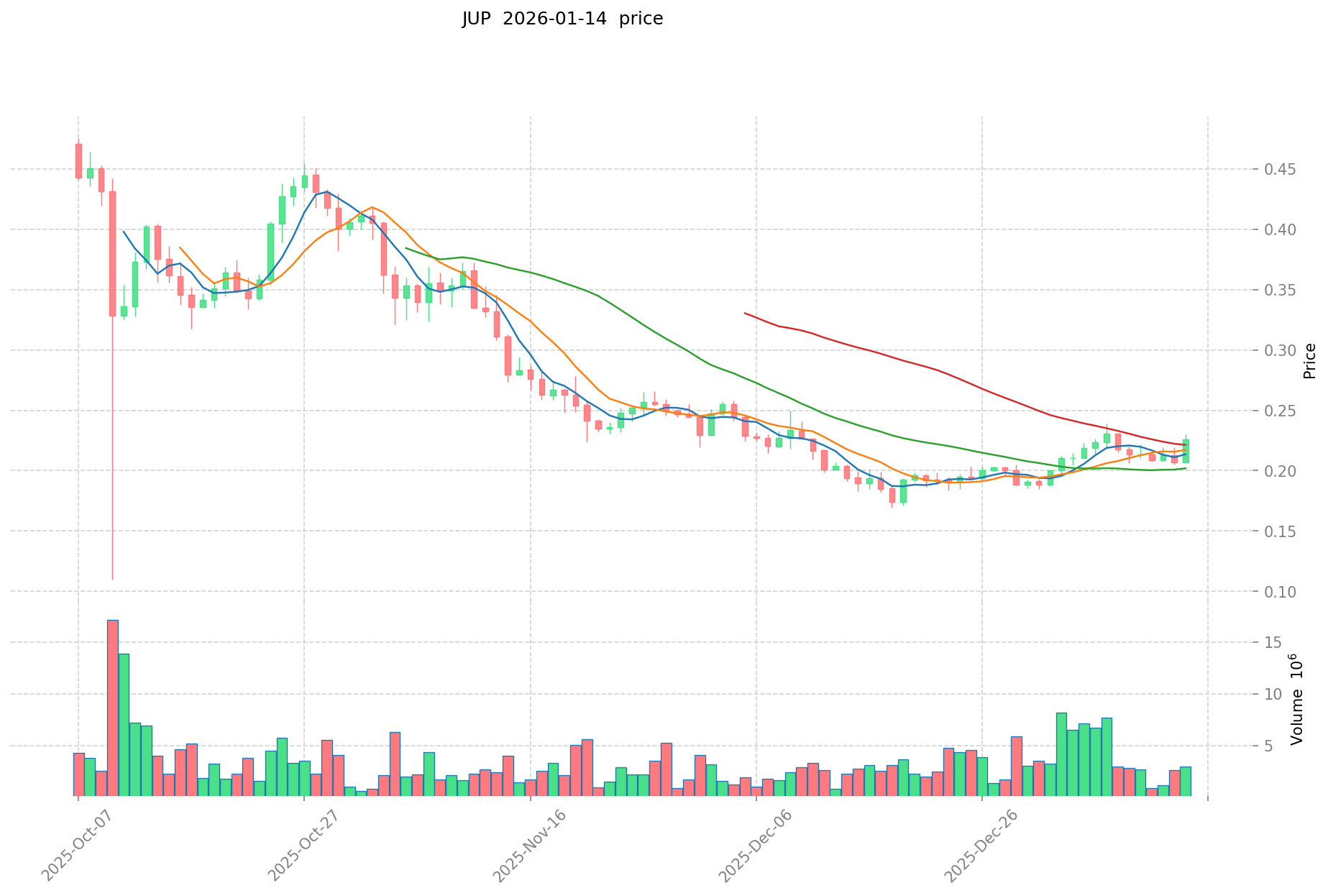
Jupiter (JUP) represents a notable asset in the cryptocurrency sector, having launched in 2024 and established itself as a significant player in the decentralized finance (DeFi) space on Solana. As of January 14, 2026, JUP holds a market capitalization of approximately $730.77 million, with a circulating supply of around 3.19 billion tokens. The current price stands at $0.22905, reflecting recent market dynamics. As the leading DeFi dApp on Solana and serving as the network's primary liquidity infrastructure, Jupiter facilitates a substantial portion of retail liquidity movement within the Solana ecosystem. With its market ranking at position 106 and integration across numerous protocols, JUP has become a focal point when investors consider "Is Jupiter (JUP) a good investment?" This article provides a comprehensive analysis of JUP's investment value, historical price trends, future price predictions, and associated investment risks to offer reference points for potential investors.
I. Jupiter (JUP) Price History Review and Current Investment Value Status
- 2024-01-31: JUP recorded a notable price level of $2.2 during this period → Investors who acquired JUP at lower price points experienced substantial unrealized gains
- 2025-10-10: JUP reached a lower price point of $0.1097 during market conditions → JUP price experienced significant fluctuation throughout the year
- 2024-2025 Market Cycle: From $2.2 declined to $0.1097
Current JUP Investment Market Status (January 2026)
- JUP current price: $0.22905
- 24-hour trading volume: $795,856.46871
- 24-hour price change: +8.28%
- Circulating supply: 3,190,419,072.66 JUP
- Market capitalization: $730,765,488.59
- Total holders: 852,684
Click to view real-time JUP market price
II. Core Factors Influencing Whether JUP is a Good Investment
Supply Mechanism and Scarcity (JUP Investment Scarcity)
- Token supply structure impacts price and investment value dynamics
- Total supply stands at 6.86 billion JUP with a maximum supply of 10 billion tokens
- Current circulating supply represents 31.9% of total supply (3.19 billion tokens), indicating controlled token release
- Investment significance: The gradual supply release mechanism may support long-term value retention
Institutional Investment and Mainstream Adoption (Institutional Investment in JUP)
- Jupiter completed a major community funding round raising $138 million at a valuation of $5.5 billion, with investors receiving fully unlocked JUP tokens priced at $0.55 each
- The platform serves as Solana's primary liquidity infrastructure, driving over 80% of total retail liquidity movement
- Integration with the majority of protocols within the Solana network enhances adoption potential
- Strategic positioning within the Solana ecosystem may influence institutional interest in JUP as an investment vehicle
Macroeconomic Environment's Impact on JUP Investment
- Market capitalization of approximately $730.77 million positions JUP as a mid-cap crypto asset subject to broader market conditions
- Trading volume of $795,856 reflects active market participation influenced by macroeconomic sentiment
- The token's 70.36% decline over one year demonstrates sensitivity to crypto market cycles and risk-off environments
- Volatility patterns suggest JUP investment outcomes remain closely tied to overall digital asset market dynamics
Technology and Ecosystem Development (Technology & Ecosystem for JUP Investment)
- Jupiter operates as the leading DeFi dApp on Solana, leveraging the network's high-speed and low-fee infrastructure
- The platform provides advanced trading features and intelligent liquidity aggregation capabilities
- Seamless integration with multiple Solana protocols strengthens ecosystem interconnectivity
- Potential partnerships and expanded integration with major Solana ecosystem players could enhance JUP's long-term investment appeal
- The success of Solana-based DeFi applications directly influences JUP's investment value proposition
III. JUP Future Investment Forecast and Price Outlook (Is Jupiter (JUP) worth investing in 2026-2031)
Short-term Investment Forecast (2026, short-term JUP investment outlook)
Based on multiple analytical perspectives, Jupiter demonstrates varied short-term price trajectories:
- Conservative forecast: $0.21 - $0.23
- Neutral forecast: $0.23 - $0.28
- Optimistic forecast: $0.28 - $0.32
The conservative scenario reflects current market conditions with JUP trading at approximately $0.229 as of January 14, 2026. The neutral forecast incorporates moderate growth driven by Solana ecosystem development and Jupiter's position as a leading liquidity infrastructure. The optimistic outlook considers potential market momentum and increased trading volume, which has shown an 8.28% uptick in recent periods.
Mid-term Investment Outlook (2027-2028, mid-term Jupiter (JUP) investment forecast)
- Market stage expectation: Consolidation phase with potential for gradual appreciation as DeFi adoption matures within the Solana network
- Investment return forecast:
- 2027: $0.16 - $0.40
- 2028: $0.29 - $0.41
- Key catalysts: Protocol integration expansion, trading volume growth, and broader DeFi sector developments
The mid-term outlook reflects Jupiter's role as Solana's primary liquidity aggregator, facilitating over 80% of retail liquidity movement. Price projections for 2027 suggest a range between $0.16 and $0.40, with average estimates around $0.27. By 2028, the forecast narrows to $0.29 - $0.41, indicating potential price stabilization and moderate appreciation.
Long-term Investment Outlook (Is JUP a good long-term investment?)
- Base scenario: $0.25 - $0.39 (assuming steady ecosystem growth and sustained liquidity provision)
- Optimistic scenario: $0.37 - $0.59 (assuming increased DeFi adoption and enhanced protocol features)
- Risk scenario: $0.16 - $0.28 (under adverse market conditions or competitive pressures)
For comprehensive JUP long-term investment and price forecasts, visit: Price Prediction
2026-2031 Long-term Outlook
- Base scenario: $0.25 - $0.40 (corresponding to steady progress and gradual mainstream application growth)
- Optimistic scenario: $0.37 - $0.59 (corresponding to large-scale adoption and favorable market environment)
- Transformative scenario: Above $0.59 (in case of breakthrough ecosystem developments and mainstream proliferation)
- December 31, 2031 projected high: $0.60 (based on optimistic development assumptions)
The long-term projection spans from 2026 to 2031, with base scenarios ranging between $0.25 and $0.40, reflecting steady ecosystem maturation. The optimistic path suggests potential appreciation to $0.37 - $0.59, driven by DeFi sector expansion and Jupiter's established position within Solana's infrastructure. The transformative scenario exceeds $0.59, contingent upon significant protocol innovations and broader market acceptance.
Analytical sources indicate varied long-term predictions, with some projections suggesting potential growth toward higher price points if favorable market dynamics persist. However, these forecasts remain subject to multiple variables including technological developments, regulatory environments, and competitive landscape evolution.
Disclaimer: Cryptocurrency markets are highly volatile and unpredictable. These projections are based on current market analysis and historical trends but should not be construed as financial advice. Actual outcomes may differ materially from forecasts due to numerous factors beyond analytical scope.
| Year |
Predicted High Price |
Predicted Average Price |
Predicted Low Price |
Price Change |
| 2026 |
0.3206 |
0.229 |
0.21297 |
0 |
| 2027 |
0.39846 |
0.2748 |
0.159384 |
19 |
| 2028 |
0.4073223 |
0.33663 |
0.2895018 |
46 |
| 2029 |
0.4203330495 |
0.37197615 |
0.2417844975 |
62 |
| 2030 |
0.5902703536275 |
0.39615459975 |
0.2495773978425 |
72 |
| 2031 |
0.596787096793387 |
0.49321247668875 |
0.2761989869457 |
115 |
IV. Jupiter Investment Strategy and Risk Management (How to invest in DeFi aggregators)
Investment Strategy (Jupiter investment strategy)
-
Long-term Holding (HODL Jupiter): This approach suits conservative investors who believe in the long-term value of DeFi infrastructure on Solana. Given Jupiter's role as Solana's primary liquidity infrastructure, driving over 80% of retail liquidity movement, a long-term perspective allows investors to potentially benefit from the growth of the Solana ecosystem. However, investors should be aware that JUP has experienced significant price fluctuations, with a historical high of $2.2 (January 31, 2024) and a historical low of $0.1097 (October 10, 2025), representing a 70.36% decline over one year.
-
Active Trading: For experienced traders, Jupiter's price volatility presents opportunities for technical analysis and swing trading. The token has shown notable short-term movements, with a 24-hour change of 8.28% and trading between $0.21043 and $0.22994. Active traders can capitalize on these fluctuations, but must remain vigilant about market conditions and liquidity patterns.
Risk Management (Risk management for Jupiter investment)
-
Asset Allocation Ratios:
- Conservative investors: Allocate 1-3% of crypto portfolio to JUP
- Moderate investors: Consider 3-7% allocation as part of DeFi exposure
- Professional investors: May allocate 7-15% depending on risk appetite and market analysis
-
Risk Hedging Solutions: Diversify across multiple asset classes including major cryptocurrencies, stablecoins, and traditional assets. Consider using derivatives or hedging instruments available on Solana-based protocols to manage downside risk.
-
Secure Storage:
- Hot wallets: Use reputable Solana-compatible wallets for active trading amounts only
- Cold storage: Transfer majority holdings to hardware wallets supporting SPL tokens
- Hardware wallet recommendations: Ledger and Trezor devices with Solana support
V. Jupiter Investment Risks and Challenges (Risks of investing in DeFi aggregators)
-
Market Risks: Jupiter exhibits high price volatility, as evidenced by its 70.36% decline over the past year. The token's price can experience significant swings within short periods, with daily ranges showing variations up to 9%. The relatively low market capitalization to fully diluted valuation ratio of 31.9% indicates substantial token unlock pressure that could affect future prices.
-
Regulatory Risks: DeFi protocols face evolving regulatory frameworks across different jurisdictions. As Jupiter operates as a liquidity aggregator on Solana, changes in regulations affecting DeFi platforms, decentralized exchanges, or the Solana network itself could impact its operations and token value. Different countries maintain varying stances on DeFi protocols, creating uncertainty for global investors.
-
Technical Risks: As a DeFi infrastructure protocol, Jupiter faces several technical challenges:
- Smart contract vulnerabilities that could be exploited by malicious actors
- Dependency on Solana network performance and stability
- Integration risks with multiple protocols within the Solana ecosystem
- Potential issues during protocol upgrades or feature implementations
- Security concerns related to the broader DeFi ecosystem
VI. Conclusion: Is DeFi aggregator a Good Investment?
-
Investment Value Summary: Jupiter demonstrates potential as Solana's leading liquidity infrastructure, serving as a critical component of the ecosystem by facilitating over 80% of retail liquidity movement. However, the token has experienced substantial price volatility, with significant drawdowns from its all-time high.
-
Investor Recommendations:
✅ Beginners: Consider dollar-cost averaging (DCA) strategy to smooth out entry points, and prioritize secure wallet storage using hardware wallets that support SPL tokens.
✅ Experienced Investors: Employ swing trading strategies based on technical analysis while maintaining a diversified portfolio that includes various DeFi protocols and asset classes.
✅ Institutional Investors: Evaluate Jupiter as part of a strategic long-term allocation to Solana ecosystem infrastructure, with appropriate risk management and hedging strategies in place.
⚠️ Disclaimer: Cryptocurrency investments carry substantial risks due to high volatility and market uncertainty. This content is provided for informational purposes only and does not constitute investment advice. Investors should conduct thorough research and consult with financial professionals before making investment decisions.
VII. FAQ
Q1: Is Jupiter (JUP) a good investment in 2026?
Jupiter (JUP) presents a mixed investment opportunity in 2026, suitable for investors with moderate to high risk tolerance and belief in the Solana DeFi ecosystem. As Solana's leading liquidity infrastructure driving over 80% of retail liquidity movement, JUP holds strategic positioning within a growing ecosystem. However, the token has experienced significant volatility, declining 70.36% over the past year from its historical high of $2.2 to its current price of approximately $0.229. Conservative forecasts for 2026 suggest a range of $0.21 - $0.32, while mid-term projections (2027-2028) indicate potential appreciation to $0.16 - $0.41. Investors should consider their risk tolerance, implement appropriate position sizing (1-3% for conservative portfolios, up to 15% for professional traders), and recognize that JUP's performance remains closely tied to Solana's ecosystem development and broader crypto market cycles.
Q2: What are the main risks of investing in Jupiter (JUP)?
The primary risks include market volatility (70.36% annual decline demonstrates significant price fluctuation potential), regulatory uncertainty affecting DeFi protocols globally, and technical vulnerabilities inherent to smart contract-based systems. Additionally, JUP faces token unlock pressure with only 31.9% of total supply currently circulating, which could create selling pressure as more tokens enter circulation. The token's dependency on Solana network performance and its relatively low trading volume of $795,856 compared to larger crypto assets also present liquidity risks. Investors should implement strict risk management, utilize secure storage solutions (hardware wallets for majority holdings), and diversify across multiple asset classes to mitigate these exposures.
Q3: What is Jupiter's price prediction for 2027-2031?
Price projections for Jupiter vary significantly based on different scenarios. For 2027, forecasts range from $0.16 to $0.40 with an average estimate around $0.27. By 2028, predictions narrow to $0.29 - $0.41, suggesting potential price stabilization. Long-term outlook through 2031 shows base scenarios between $0.25 - $0.40, optimistic scenarios of $0.37 - $0.59, and a transformative scenario exceeding $0.59 with a projected high of $0.60 by December 31, 2031. These forecasts assume continued Solana ecosystem growth, expanding DeFi adoption, and Jupiter maintaining its position as the primary liquidity aggregator. However, actual outcomes may differ materially due to numerous unpredictable factors including technological developments, regulatory changes, and competitive landscape evolution.
Q4: How does Jupiter's tokenomics affect its investment potential?
Jupiter's tokenomics structure significantly impacts its investment dynamics. The project has a maximum supply of 10 billion tokens with 6.86 billion total supply, of which only 3.19 billion (31.9%) currently circulates. This controlled release mechanism may support long-term value retention, but also presents substantial unlock pressure that could affect future prices. The project completed a major community funding round raising $138 million at a $5.5 billion valuation, with tokens priced at $0.55 each and fully unlocked for investors. This creates an overhang as early investors acquired tokens at more than double the current market price. The gradual supply release schedule through 2031 means investors should factor in potential dilution effects, though the measured approach may prevent sudden supply shocks compared to projects with cliff unlock events.
Q5: What investment strategies work best for Jupiter (JUP)?
The optimal strategy depends on investor profile and risk tolerance. Long-term holding (HODL) suits conservative investors believing in Solana DeFi infrastructure growth, requiring 1-3% portfolio allocation and patience through volatility cycles. Active trading appeals to experienced traders who can capitalize on JUP's significant price swings, with 24-hour movements reaching 8.28% and daily ranges varying up to 9%. Dollar-cost averaging (DCA) works well for beginners to smooth entry points during volatile periods. Professional investors may employ a hybrid approach combining strategic long-term positioning (7-15% allocation) with tactical trading around key technical levels. All strategies should incorporate proper risk management including diversification across asset classes, secure storage using hardware wallets supporting SPL tokens, and position sizing appropriate to individual risk tolerance and market conditions.
Q6: How does Jupiter compare to other DeFi aggregators as an investment?
Jupiter distinguishes itself as Solana's dominant liquidity infrastructure, facilitating over 80% of retail liquidity movement within the ecosystem and integrating with the majority of Solana protocols. This market leadership position provides competitive advantages including network effects, protocol integration depth, and first-mover benefits within the Solana DeFi landscape. However, compared to multi-chain aggregators on Ethereum or other networks, Jupiter remains dependent on Solana's ecosystem growth and faces concentration risk. Its market capitalization of approximately $730.77 million positions it as a mid-cap crypto asset with higher volatility potential than larger, more established protocols. With 852,684 total holders, Jupiter demonstrates reasonable community adoption though not at the scale of top-tier DeFi protocols. Investors should evaluate Jupiter's investment merit relative to its specialized role within Solana rather than comparing it directly to aggregators on different blockchain ecosystems.
Q7: What catalysts could drive Jupiter's price higher in the future?
Several key catalysts could positively impact Jupiter's price trajectory. Expanded protocol integration within the Solana ecosystem would strengthen network effects and increase trading volume through the platform. Technological developments such as enhanced trading features, improved liquidity aggregation algorithms, or new product launches could attract additional users and liquidity. Broader Solana ecosystem growth, including increased DeFi adoption and mainstream acceptance, would directly benefit Jupiter as the primary liquidity infrastructure. Favorable regulatory clarity for DeFi protocols could reduce uncertainty and attract institutional capital. Strategic partnerships with major Solana ecosystem players or integration with emerging Web3 applications could expand Jupiter's utility. Additionally, successful navigation of token unlock schedules without significant selling pressure, combined with positive macroeconomic conditions for crypto assets, could support price appreciation toward the optimistic forecast range of $0.37 - $0.59 by 2031.
Q8: Should beginners invest in Jupiter (JUP)?
Beginners can consider Jupiter as part of a diversified crypto portfolio, but should approach with appropriate caution and preparation. New investors should first establish foundational positions in major cryptocurrencies before allocating to mid-cap DeFi tokens like JUP. A dollar-cost averaging strategy proves particularly suitable for beginners, allowing gradual accumulation while mitigating timing risk during volatile periods. Start with minimal allocation (1-2% of crypto portfolio) and prioritize learning secure storage practices using hardware wallets that support SPL tokens. Beginners should thoroughly research Solana's ecosystem, understand Jupiter's role as a liquidity aggregator, and recognize the high-risk nature of DeFi investments. Avoid investing amounts you cannot afford to lose, maintain realistic expectations about volatility (70.36% annual decline demonstrates downside potential), and consider consulting with financial professionals before making investment decisions. Education and risk management take precedence over potential returns for new investors entering the DeFi space.
* The information is not intended to be and does not constitute financial advice or any other recommendation of any sort offered or endorsed by Gate.