This comprehensive guide evaluates whether KUB Coin represents a viable investment opportunity in 2024-2026. KUB serves as the native utility token of Bitkub Chain, priced at approximately $1.32 with a $117.42 million market cap and listed on 7 exchanges including Gate. The analysis examines KUB's utility functions—transaction fee payments, exchange credits, and DApp operations—alongside its fixed 110 million token supply with 80.77% in circulation. Historical performance reveals significant volatility, with a 34.79% yearly decline offset by 5.48% 30-day gains. The article provides investment forecasts ranging from $1.06-$1.82 (base scenario) to $1.82-$2.30 (optimistic scenario) through 2031, while addressing critical risks including market volatility, regulatory uncertainty, and ecosystem dependency. Tailored strategies address beginners, experienced traders, and institutional investors, with emphasis on proper portfolio allocation and risk management techniques for cryptocurrency investments.
Introduction: Bitkub Coin (KUB)'s Investment Position and Market Outlook
KUB is an important asset in the cryptocurrency field. As the native and utility token of Bitkub Chain, it serves to fuel, operate, and manage the Bitkub Chain ecosystem. As of January 17, 2026, KUB holds a market capitalization of approximately $117.42 million, with a circulating supply of around 88.85 million tokens, and a current price maintained at approximately $1.32. With its positioning as the native currency of a regional blockchain infrastructure, KUB has gradually become a focal point for investors discussing "Is KUB Coin (KUB) a good investment?" This article will comprehensively analyze KUB's investment value, historical trends, future price projections, and investment risks to provide reference for investors.
Bitkub Chain aims to establish the foundation for a regional blockchain ecosystem, allowing decentralized applications and their assets to operate transparently with affordable transaction fees and high-speed confirmation times. KUB possesses multiple utilities, including paying transaction fees, exchanging transaction fee credits at Bitkub exchange, and facilitating token transfers. With a total supply capped at 110 million tokens and approximately 80.77% already in circulation, KUB demonstrates a relatively high circulation ratio. The token is listed on 7 exchanges and maintains a market dominance of 0.0043%. Price performance shows short-term fluctuations with a 0.33% increase over 1 hour, a 0.12% gain over 24 hours, a 5.48% rise over 30 days, while experiencing a 4.16% decline over 7 days and a 34.79% decrease over the past year.
I. KUB Coin Price History Review and Current Investment Value
KUB Coin Historical Price Trends and Investment Returns
KUB Coin (KUB) was launched on December 27, 2021, with an initial offering price of $7.5. The token's price history demonstrates notable volatility characteristic of emerging blockchain assets.
-
2021: Following its launch in late December, KUB experienced initial market activity as the native utility token of Bitkub Chain, designed to power the blockchain ecosystem with functions including transaction fee payments and exchange fee credit conversion on the Bitkub platform.
-
Price Movement Patterns: KUB has exhibited price fluctuations between $0.381968 and $17.24 during its trading history, reflecting varying market conditions and investor sentiment across different periods.
-
Recent Performance: Over the past year, KUB has shown a decline of approximately 34.79%, indicating significant price adjustment from previous levels. The 30-day period, however, recorded a gain of 5.48%, suggesting some shorter-term recovery momentum.
Current KUB Investment Market Status (January 2026)
- Current KUB Price: $1.3216
- 24-Hour Trading Volume: $19,932.24
- 24-Hour Price Range: Between $1.287 and $1.3467, representing a 0.12% change
- Short-term Price Movement: 1-hour change of +0.33%, 7-day change of -4.16%
- Market Capitalization: Approximately $117.42 million
- Circulating Supply: 88.85 million KUB tokens
- Market Cap to Fully Diluted Valuation Ratio: 80.77%
- Market Dominance: 0.0043% of the overall cryptocurrency market
Click to view real-time KUB market price
KUB serves multiple utilities within the Bitkub Chain ecosystem, including powering decentralized applications with affordable transaction fees and fast confirmation times. The token is available on 7 exchanges and maintains active trading across various platforms. As of January 17, 2026, the token distribution shows 80.77% of the maximum supply of 110 million tokens currently in circulation.
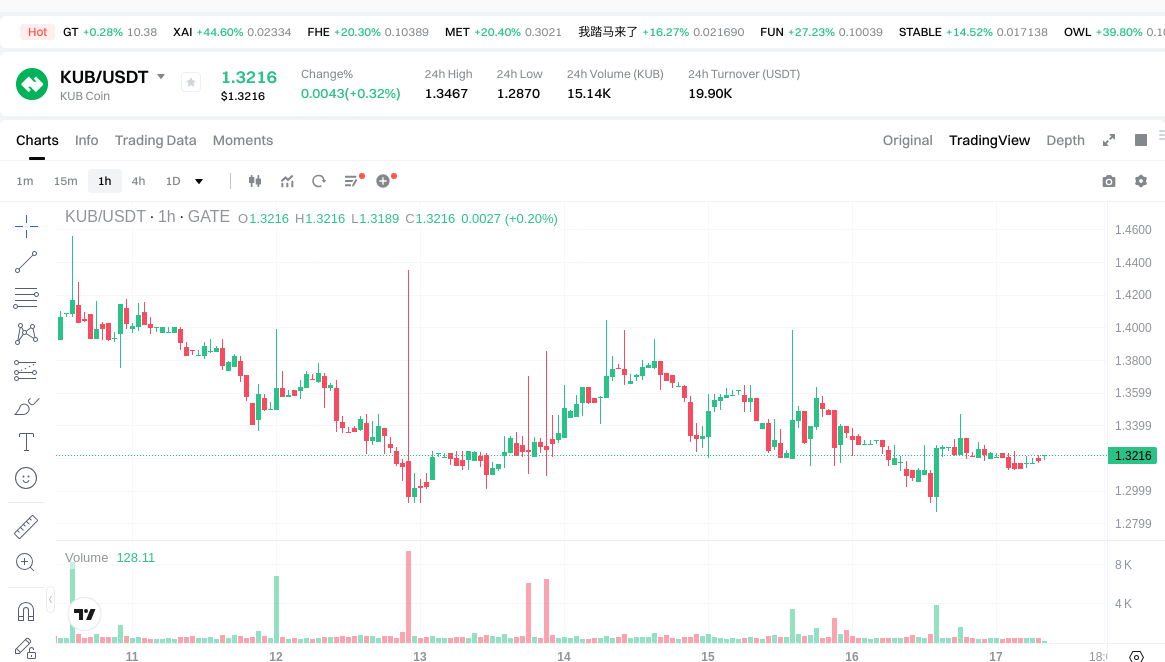
II. Core Factors Affecting Whether KUB is a Good Investment (Is KUB Coin(KUB) a Good Investment)
Supply Mechanism and Scarcity (KUB investment scarcity)
- Fixed supply cap → KUB Coin has a maximum supply of 110,000,000 tokens, with a circulating supply of 88,850,000 tokens as of January 17, 2026, representing approximately 80.77% of the total supply
- Supply characteristics: The limited token supply creates a defined scarcity model, which may influence long-term value considerations for investors evaluating KUB's investment potential
- Investment significance: The supply cap mechanism establishes a framework where no additional tokens can be minted beyond the maximum limit, which represents a key structural element for long-term investment considerations
Institutional Investment and Mainstream Adoption (Institutional investment in KUB)
- Exchange availability: KUB Coin is listed on 7 exchanges as of the current data period, providing accessibility for various investor types
- Trading activity: The 24-hour trading volume stands at $19,932.24, with market capitalization of approximately $117.42 million
- Ecosystem utility: KUB serves as the native currency of Bitkub Chain, utilized for transaction fees, exchange fee credits at Bitkub Exchange, and peer-to-peer transfers within the ecosystem
Macroeconomic Environment's Impact on KUB Investment
- Market positioning: KUB holds a market share of 0.0043% in the broader cryptocurrency market as of January 17, 2026
- Price performance context: KUB has shown varied performance across different timeframes, with a 1-year change of -34.79%, 30-day change of +5.48%, 7-day change of -4.16%, and 24-hour change of +0.12%
- Historical price range: The token has traded between $0.381968 (recorded on July 20, 2021) and $17.24 (recorded on December 28, 2021), demonstrating significant historical volatility patterns
Technology and Ecosystem Development (Technology & Ecosystem for KUB investment)
- Blockchain infrastructure: Bitkub Chain aims to establish a foundation for a native blockchain ecosystem, designed to support decentralized applications and their assets with accessible transaction fees and confirmation times
- Core utilities: KUB functions as the operational currency for the Bitkub Chain ecosystem, providing fuel for network operations, transaction fee payments, and governance functionalities
- Ecosystem applications: The token supports various use cases including DApp operations, transaction processing, and exchange-related services, contributing to the overall utility framework of the Bitkub Chain network
III. KUB Future Investment Forecast and Price Outlook (Is KUB Coin(KUB) worth investing in 2026-2031)
Short-term Investment Forecast (2026, short-term KUB investment outlook)
- Conservative forecast: $1.06 - $1.32
- Neutral forecast: $1.32 - $1.37
- Optimistic forecast: $1.37 - $1.40
Mid-term Investment Outlook (2027-2029, mid-term KUB Coin(KUB) investment forecast)
- Market phase expectation: According to available forecasts, KUB may experience gradual growth during this period, with price movements potentially influenced by broader market conditions and ecosystem development.
- Investment return forecast:
- 2027: $0.96 - $1.66
- 2028: $1.46 - $1.79
- 2029: $1.37 - $1.73
- Key catalysts: Market adoption trends, ecosystem expansion, and overall cryptocurrency market sentiment may play important roles.
Long-term Investment Outlook (Is KUB a good long-term investment?)
- Base scenario: $1.11 - $1.82 (assuming steady ecosystem growth and stable market conditions)
- Optimistic scenario: $1.82 - $2.30 (assuming enhanced adoption and favorable market environment)
- Risk scenario: Below $1.11 (under adverse market conditions or ecosystem challenges)
Click to view KUB long-term investment and price forecast: Price Prediction
2026-2031 Long-term Outlook
- Base scenario: $1.06 - $1.82 USD (corresponding to steady progress and gradual mainstream application growth)
- Optimistic scenario: $1.82 - $2.30 USD (corresponding to large-scale adoption and favorable market environment)
- Transformative scenario: Above $2.30 USD (if ecosystem achieves breakthrough progress and mainstream adoption)
- 2031-12-31 forecast high: $2.30 USD (based on optimistic development assumptions)
Disclaimer: Price forecasts are based on historical data and market analysis models, and actual results may vary significantly due to market volatility, regulatory changes, technological developments, and other unforeseen factors. This information should not be considered as investment advice.
| Year |
Predicted High Price |
Predicted Average Price |
Predicted Low Price |
Price Change |
| 2026 |
1.374464 |
1.3216 |
1.05728 |
0 |
| 2027 |
1.65807936 |
1.348032 |
0.95710272 |
2 |
| 2028 |
1.7886362592 |
1.50305568 |
1.4579640096 |
13 |
| 2029 |
1.72813826808 |
1.6458459696 |
1.366052154768 |
24 |
| 2030 |
1.9569108578544 |
1.68699211884 |
1.3327237738836 |
27 |
| 2031 |
2.295658875317472 |
1.8219514883472 |
1.111390407891792 |
37 |
IV. KUB Investment Strategy and Risk Management (How to invest in cryptocurrency)
Investment Methodology (KUB investment strategy)
Long-term Holding (HODL KUB)
Long-term holding may be suitable for steady investors who believe in the fundamental value proposition of Bitkub Chain ecosystem. This approach involves:
- Accumulating KUB during market corrections
- Focusing on the platform's ecosystem development rather than short-term price movements
- Monitoring the adoption rate of Bitkub Chain's decentralized applications
Active Trading
Active trading strategies rely on technical analysis and swing trading:
- Utilizing technical indicators to identify entry and exit points
- Monitoring 24-hour trading volume (currently at approximately $19,932)
- Tracking price ranges, with recent 24-hour high at $1.3467 and low at $1.287
- Implementing stop-loss orders to manage downside risk
Risk Management (Risk management for KUB investment)
Asset Allocation Ratio
- Conservative Investors: Allocate no more than 1-3% of portfolio to KUB
- Moderate Investors: Consider 3-7% allocation based on risk tolerance
- Experienced Investors: May allocate 7-15% depending on market analysis and conviction
Risk Hedging Approach
- Diversify across multiple blockchain projects and traditional assets
- Consider stablecoin reserves for opportunistic buying during market downturns
- Monitor correlation with broader cryptocurrency market movements
Secure Storage
- Hot Wallets: Suitable for active trading amounts only
- Cold Wallets: Recommended for long-term holdings
- Hardware Wallets: Ledger and Trezor devices offer enhanced security for substantial holdings
- Enable two-factor authentication on exchange accounts
V. KUB Investment Risks and Challenges (Risks of investing in cryptocurrency)
Market Risk
- High Volatility: KUB has experienced significant price fluctuations, with yearly change showing -34.79%
- Liquidity Considerations: Trading volume and market depth should be evaluated before large transactions
- Price Range: Historical data shows substantial variance, with prices ranging from approximately $0.38 to $17.24
Regulatory Risk
- Cryptocurrency regulations vary significantly across jurisdictions
- Changes in regulatory frameworks may impact exchange listings and accessibility
- Compliance requirements may evolve, affecting project operations
- Investors should stay informed about regulatory developments in their respective regions
Technical Risk
- Network Security: Blockchain networks face potential security vulnerabilities
- Smart Contract Risk: Vulnerabilities in smart contracts deployed on the network could pose risks
- Upgrade Challenges: Technical upgrades or changes to the network protocol may encounter difficulties
- Ecosystem Dependency: KUB's value is closely tied to the success and adoption of Bitkub Chain ecosystem
VI. Conclusion: Is Cryptocurrency a Good Investment?
Investment Value Summary
KUB presents opportunities within the blockchain ecosystem context, but faces challenges typical of cryptocurrency investments. The token serves utility functions within Bitkub Chain, including transaction fee payments and exchange fee credits. However, the market has shown substantial volatility, with notable price fluctuations over different time periods.
Investor Recommendations
✅ Beginners:
- Start with small position sizes to understand market dynamics
- Use dollar-cost averaging (DCA) strategy to mitigate timing risk
- Prioritize secure storage solutions immediately after purchase
- Invest only amounts you can afford to lose completely
✅ Experienced Investors:
- Implement swing trading strategies based on technical analysis
- Maintain diversified portfolio allocation across multiple assets
- Set clear profit targets and stop-loss levels
- Monitor ecosystem developments and adoption metrics
✅ Institutional Investors:
- Conduct thorough due diligence on ecosystem fundamentals
- Consider strategic long-term allocation as part of broader digital asset strategy
- Evaluate liquidity requirements and market depth
- Implement robust risk management frameworks
⚠️ Disclaimer: Cryptocurrency investments carry substantial risk, including potential complete loss of capital. This content is for informational purposes only and does not constitute investment advice. Market conditions can change rapidly, and past performance does not guarantee future results. Investors should conduct independent research and consult with financial advisors before making investment decisions.
VII. FAQ
Q1: What is the primary utility of KUB Coin within the Bitkub Chain ecosystem?
KUB serves as the native operational currency for transaction fees, exchange fee credits, and network governance on Bitkub Chain.
KUB functions as the fundamental utility token that powers the entire Bitkub Chain ecosystem. Its primary applications include paying transaction fees for on-chain operations, converting to fee credits at Bitkub Exchange for reduced trading costs, and facilitating peer-to-peer token transfers. The token is designed to support decentralized applications (DApps) running on Bitkub Chain with affordable transaction costs and fast confirmation times. As the native currency, KUB is essential for network operations, making it integral to the platform's functionality and user experience.
Q2: How has KUB's price performed historically since its launch?
KUB has experienced significant volatility, declining 34.79% over the past year but showing 5.48% growth in the last 30 days as of January 2026.
Since launching on December 27, 2021, at $7.50, KUB has demonstrated substantial price fluctuations characteristic of emerging blockchain assets. The token reached a historical high of $17.24 on December 28, 2021, and a low of $0.381968 on July 20, 2021. As of January 17, 2026, KUB trades at approximately $1.32, representing a significant adjustment from peak levels. While the yearly performance shows a decline of 34.79%, shorter-term metrics reveal more nuanced trends: the 30-day period recorded a 5.48% gain, suggesting potential recovery momentum, though the 7-day change of -4.16% indicates ongoing volatility.
Q3: What is KUB's token supply structure and circulation status?
KUB has a fixed maximum supply of 110 million tokens, with approximately 88.85 million (80.77%) currently in circulation.
KUB operates under a fixed supply model capped at 110,000,000 tokens, establishing a defined scarcity framework. As of January 17, 2026, the circulating supply stands at 88,850,000 tokens, representing 80.77% of the total maximum supply. This relatively high circulation ratio indicates that a significant portion of the total supply is already available in the market. The fixed supply cap means no additional tokens can be minted beyond the maximum limit, creating a predictable supply dynamic that may influence long-term value considerations for investors evaluating KUB's scarcity characteristics.
Q4: What are the recommended investment strategies for different types of KUB investors?
Conservative investors should allocate 1-3% of portfolio to KUB, moderate investors 3-7%, and experienced investors 7-15%, with strategy variations based on risk tolerance.
Investment strategies vary significantly based on investor profile. Beginners should start with small position sizes using dollar-cost averaging (DCA) to mitigate timing risk, prioritizing secure storage solutions and investing only amounts they can afford to lose. Experienced investors may implement swing trading strategies based on technical analysis, monitoring the 24-hour trading volume (currently approximately $19,932) and price ranges, while maintaining diversified portfolio allocation. Long-term holders (HODL strategy) should focus on accumulating KUB during market corrections and monitoring the adoption rate of Bitkub Chain's decentralized applications rather than short-term price movements. All investors should implement stop-loss orders and maintain appropriate asset allocation based on their risk tolerance levels.
Q5: What are the major risks associated with investing in KUB?
Primary risks include high market volatility (34.79% annual decline), regulatory uncertainty, technical vulnerabilities, and ecosystem dependency.
KUB investment carries multiple risk categories requiring careful consideration. Market risk manifests through significant price volatility, with yearly changes showing -34.79% and historical price ranges spanning from $0.38 to $17.24. Liquidity considerations are important given the 24-hour trading volume of approximately $19,932. Regulatory risk varies across jurisdictions, with evolving compliance requirements potentially impacting exchange listings and project operations. Technical risks include potential network security vulnerabilities, smart contract risks in deployed applications, and challenges during protocol upgrades. Additionally, KUB's value is closely tied to the success and adoption of the Bitkub Chain ecosystem, creating ecosystem dependency risk where the token's performance correlates directly with platform development and user adoption rates.
Q6: What are the long-term price projections for KUB through 2031?
Base scenario projects $1.06-$1.82 by 2031, with optimistic scenario reaching $1.82-$2.30, though forecasts carry significant uncertainty.
Long-term projections for KUB through 2031 present multiple scenarios based on different market assumptions. The base scenario anticipates steady ecosystem growth with prices ranging from $1.06 to $1.82, assuming stable market conditions and gradual adoption. The optimistic scenario projects $1.82 to $2.30, contingent upon enhanced adoption and favorable market environment. Yearly forecasts show progressive potential: 2027 ($0.96-$1.66), 2028 ($1.46-$1.79), 2029 ($1.37-$1.73), 2030 ($1.33-$1.96), culminating in 2031 with a predicted high of $2.30. However, these projections are based on historical data and market analysis models, and actual results may vary significantly due to market volatility, regulatory changes, technological developments, and unforeseen factors.
Q7: How does KUB compare in terms of market positioning and exchange availability?
KUB holds a 0.0043% market share with $117.42 million market capitalization and is listed on 7 exchanges as of January 2026.
KUB maintains a relatively modest position in the broader cryptocurrency market, commanding approximately 0.0043% market dominance with a market capitalization of $117.42 million as of January 17, 2026. The token is accessible through 7 different exchanges, providing multiple entry points for investors across various platforms. This exchange availability enables liquidity and trading flexibility, though investors should evaluate market depth before executing large transactions. The current market positioning reflects KUB's status as a regional blockchain infrastructure token rather than a globally dominant cryptocurrency, which influences both investment considerations and liquidity characteristics for potential investors evaluating accessibility and trading options.
Q8: What security measures should KUB investors implement for asset protection?
Investors should use cold wallets for long-term holdings, hardware wallets like Ledger or Trezor for substantial amounts, and enable two-factor authentication.
Proper security implementation is critical for KUB asset protection across different holding strategies. Hot wallets should be reserved exclusively for active trading amounts, minimizing exposure to online security risks. Cold wallets are strongly recommended for long-term holdings, providing offline storage that significantly reduces vulnerability to hacking attempts. For substantial holdings, hardware wallets such as Ledger and Trezor devices offer enhanced security through physical isolation of private keys. Additionally, all exchange accounts should have two-factor authentication (2FA) enabled to add an extra layer of account protection. Investors should also maintain separate wallets for different purposes, regularly update security software, and never share private keys or seed phrases with anyone, as these measures collectively create a comprehensive security framework for KUB investment protection.
* The information is not intended to be and does not constitute financial advice or any other recommendation of any sort offered or endorsed by Gate.










