This comprehensive analysis examines whether Mitosis (MITO) represents a viable investment opportunity within the cryptocurrency sector. As of January 2026, MITO trades at $0.0662 with a market capitalization of $12.99 million, positioning itself as an innovative cross-chain liquidity protocol for the modular blockchain era. The article evaluates MITO's investment potential through multiple lenses: historical price trends showing significant volatility, current market metrics including 75,125 holders across 18 exchanges on Gate, and fundamental factors such as controlled token economics with only 19.63% circulating supply. Price predictions range from conservative to optimistic scenarios through 2031. Investment strategies accommodate diverse investor profiles, from conservative dollar-cost averaging approaches to active trading opportunities exploiting MITO's volatility. Critical risk factors include market volatility with 68.19% year-to-date decline, technical complexity of cross-chain mechanisms, regulator
Introduction: Mitosis (MITO) Investment Position and Market Outlook
MITO is a notable asset in the cryptocurrency sector. As of January 25, 2026, Mitosis holds a market cap of approximately $12.99 million, with a circulating supply of around 196.27 million tokens, and the current price is maintained at approximately $0.0662. Positioned as a liquidity protocol for the modular era that redefines cross-chain liquidity, MITO has gradually become a focal point for investors discussing "Is Mitosis (MITO) a good investment?" The project enables cross-chain liquidity providers to receive derivative tokens convertible 1:1 with their locked assets, which can be utilized across various DeFi applications on Ethereum L1 and L2 rollups. With approximately 75,125 holders and trading available on 18 exchanges, MITO represents a developing presence in the cross-chain liquidity space. This article will provide a comprehensive analysis of MITO's investment value, historical trends, future price outlook, and investment risks to serve as a reference for investors.
I. MITO Price History Review and Investment Value Status
- 2025: Token launch in September with initial pricing around $0.45 → Price experienced significant volatility in early trading phase
- 2025: Market correction phase in October → MITO price declined from higher levels to approximately $0.05
- 2025-2026: Price recovery period → Trading range established between $0.05 and current levels
Current MITO Investment Market Status (January 2026)
- MITO current price: $0.0662
- 24-hour trading volume: $25,439.43
- Market capitalization: $12,993,278.03
- Circulating supply: 196,273,082 MITO (19.63% of total supply)
- Fully diluted valuation: $66,200,000
- Total supply: 1,000,000,000 MITO
- Number of holders: 75,125
- Available on 18 exchanges
Click to view real-time MITO market price
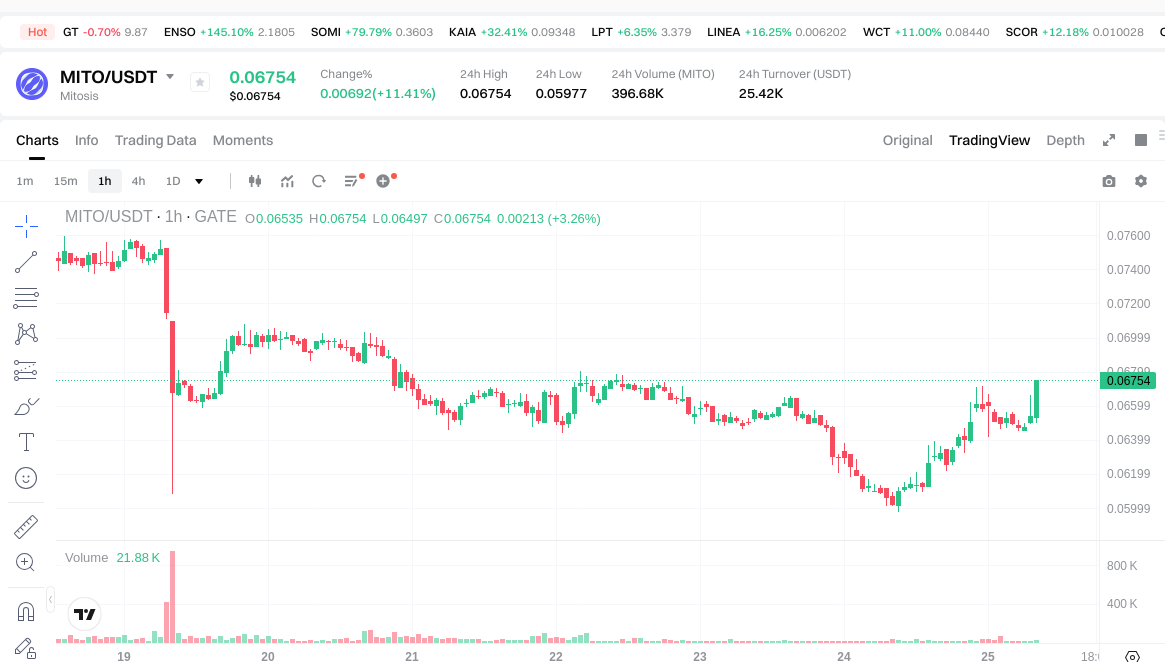
II. Core Factors Affecting Whether MITO is a Good Investment (Is Mitosis(MITO) a Good Investment)
Supply Mechanism and Scarcity (MITO investment scarcity)
- Supply mechanism: MITO has a maximum supply of 1,000,000,000 tokens, with a current circulating supply of 196,273,082 tokens (approximately 19.63% of total supply). This controlled release mechanism may influence price dynamics and investment value over time.
- Historical patterns: MITO's price has experienced notable volatility, with trading ranges between $0.05 and $0.45. Such price movements reflect market response to supply-demand dynamics in the token's early trading phase.
- Investment significance: The relatively low circulating supply ratio suggests potential future unlock events that investors should monitor, as scarcity dynamics may play a role in supporting long-term investment considerations.
Institutional Investment and Mainstream Adoption (Institutional investment in MITO)
- Holder base: MITO currently has approximately 75,125 token holders, indicating a growing community base for the protocol.
- Exchange presence: The token is listed on 18 exchanges, providing multiple access points for investors and contributing to liquidity.
- Market positioning: With a market capitalization of approximately $12,993,278 and a market dominance of 0.0020%, MITO remains in an early-stage adoption phase within the broader cryptocurrency market.
Macroeconomic Environment's Impact on MITO Investment
- Market conditions: Cryptocurrency investments, including MITO, may be influenced by broader monetary policy shifts and interest rate changes that affect risk appetite in digital asset markets.
- Volatility considerations: Recent price performance shows mixed trends, with 24-hour gains of 9% contrasted against 7-day declines of -7.44% and year-to-date performance of -68.19%, reflecting the volatile nature of emerging crypto assets.
- Market uncertainty: Global economic conditions and regulatory developments in the cryptocurrency sector may impact investor sentiment toward tokens like MITO.
Technology and Ecosystem Development (Technology & Ecosystem for MITO investment)
- Core protocol function: Mitosis operates as a liquidity protocol designed for the modular blockchain era, aiming to redefine cross-chain liquidity mechanisms. The protocol enables cross-chain liquidity provision by issuing derivative tokens that maintain 1:1 convertibility with locked assets.
- Technical architecture: Built on the BEP-20 standard and deployed on BSC (Binance Smart Chain), the protocol allows liquidity providers to utilize derivative tokens across supported Ethereum L1 and L2 rollup ecosystems.
- DeFi integration potential: The protocol's design enables liquidity providers to participate in various DeFi applications while earning fee sharing rewards, potentially expanding use cases within the decentralized finance ecosystem.
- Development activity: The project maintains open-source development through GitHub repositories, suggesting ongoing technical development and community transparency.
III. MITO Future Investment Prediction and Price Outlook (Is Mitosis (MITO) worth investing in 2026-2031)
Short-term Investment Prediction (2026, short-term MITO investment outlook)
- Conservative prediction: $0.0432 - $0.0675
- Neutral prediction: $0.0662 - $0.0803
- Optimistic prediction: $0.0803 - $0.0932
Mid-term Investment Outlook (2027-2029, mid-term Mitosis (MITO) investment forecast)
- Market stage expectation: Based on the predictive data, MITO may experience gradual growth during the mid-term period, with fluctuations reflecting market dynamics and ecosystem development in the cross-chain liquidity sector
- Investment return prediction:
- 2027: $0.0602 - $0.0876
- 2028: $0.0638 - $0.1117
- 2029: $0.0519 - $0.1272
- Key catalysts: Expansion of cross-chain DeFi applications, enhanced liquidity mechanisms, and broader adoption of derivative tokens within supported Ethereum L1 and L2 ecosystems
Long-term Investment Outlook (Is MITO a good long-term investment?)
- Base scenario: $0.0596 - $0.1575 (assuming steady development of cross-chain liquidity protocols and moderate market adoption)
- Optimistic scenario: $0.0932 - $0.1575 (assuming accelerated DeFi integration and favorable regulatory environment for decentralized liquidity solutions)
- Risk scenario: $0.0432 - $0.0638 (in case of prolonged market downturn or limited adoption of cross-chain liquidity mechanisms)
Check MITO long-term investment and price prediction: Price Prediction
2026-01-25 - 2031 Long-term Outlook
- Base scenario: $0.0596 - $0.1125 USD (corresponding to steady progress and gradual mainstream application enhancement)
- Optimistic scenario: $0.0932 - $0.1575 USD (corresponding to large-scale adoption and favorable market conditions)
- Transformative scenario: Above $0.1575 USD (if ecosystem achieves breakthrough developments and mainstream popularization)
- 2031-12-31 predicted high: $0.1575 USD (based on optimistic development assumptions)
Disclaimer: The above predictions are based on historical data and market analysis models. Cryptocurrency investments carry substantial risk, and actual prices may differ significantly from predictions due to market volatility, regulatory changes, technological developments, and other unforeseen factors. This content does not constitute investment advice, and investors should conduct independent research and consult professionals before making investment decisions.
| Year |
Predicted High Price |
Predicted Average Price |
Predicted Low Price |
Price Change |
| 2026 |
0.0932052 |
0.06754 |
0.0432256 |
2 |
| 2027 |
0.087606134 |
0.0803726 |
0.06027945 |
21 |
| 2028 |
0.11170585811 |
0.083989367 |
0.06383191892 |
26 |
| 2029 |
0.1272018963215 |
0.097847612555 |
0.05185923465415 |
47 |
| 2030 |
0.15753465621355 |
0.11252475443825 |
0.059638119852272 |
69 |
| 2031 |
0.140430893538936 |
0.1350297053259 |
0.093170496674871 |
103 |
IV. Mitosis Investment Strategy and Risk Management (How to invest in cryptocurrency)
Investment Strategy (Mitosis investment strategy)
-
Long-term holding (HODL Mitosis): Suitable for conservative investors who believe in the long-term development potential of cross-chain liquidity protocols. Holding MITO tokens may allow investors to benefit from the ecosystem's growth and the increasing adoption of its derivative token mechanism across supported Ethereum L1 and L2 rollups.
-
Active trading: Relies on technical analysis and swing trading strategies. Given MITO's price volatility, with a 24-hour price change of 9% and a 7-day change of -7.44%, active traders may seek to capitalize on short-term price movements. Technical indicators and market sentiment analysis can inform entry and exit points.
Risk Management (Risk management for Mitosis investment)
-
Asset allocation ratio:
- Conservative investors: Allocate no more than 5-10% of total crypto portfolio to MITO
- Aggressive investors: May allocate 15-25% depending on risk tolerance
- Professional investors: Can adjust allocation based on comprehensive market analysis and portfolio strategy
-
Risk hedging solutions: Diversify across multiple assets including established cryptocurrencies, stablecoins, and other DeFi protocols. Consider using hedging instruments available in the crypto market to mitigate downside risk.
-
Secure storage:
- Cold wallets: Hardware wallets (such as Ledger or Trezor) for long-term holdings
- Hot wallets: Use reputable wallets with strong security features for active trading
- Verify contract address (0x8e1e6bf7e13c400269987b65ab2b5724b016caef on BSC) before any transactions
V. Mitosis Investment Risks and Challenges (Risks of investing in cryptocurrency)
-
Market risk: MITO exhibits significant volatility, with a historical range between $0.05 and $0.45. The 24-hour trading volume of approximately $25,439 indicates relatively modest liquidity compared to major cryptocurrencies, which may amplify price swings. Market capitalization represents only 0.0020% of the total crypto market, suggesting exposure to price fluctuation risks.
-
Regulatory risk: As a cross-chain liquidity protocol operating across multiple blockchain networks, Mitosis may face varying regulatory frameworks in different jurisdictions. Policy uncertainty regarding DeFi protocols and derivative tokens could impact the project's operations and token value.
-
Technical risk: The protocol's complexity in enabling cross-chain liquidity provision and derivative token mechanisms introduces technical vulnerabilities. Potential risks include smart contract bugs, cross-chain bridge security issues, or failures during protocol upgrades. With a circulating supply of 196,273,082 MITO (19.63% of total supply), token economics and future token releases may affect price dynamics.
VI. Conclusion: Is cryptocurrency a Good Investment?
-
Investment value summary: Mitosis presents an innovative approach to cross-chain liquidity in the modular blockchain era, with potential for growth as the DeFi ecosystem expands. However, the token demonstrates considerable price volatility, declining 68.19% over the past year, which indicates substantial short-term risks alongside any long-term potential.
-
Investor recommendations:
✅ Beginners: Consider dollar-cost averaging (DCA) strategy combined with secure wallet storage. Start with small allocations to understand the protocol and market dynamics.
✅ Experienced investors: May explore swing trading opportunities while maintaining core holdings. Implement portfolio diversification across multiple DeFi protocols and blockchain ecosystems.
✅ Institutional investors: Conduct thorough due diligence on the protocol's technical architecture, team background, and competitive positioning before considering strategic long-term allocation.
⚠️ Disclaimer: Cryptocurrency investment carries significant risk. This content is for informational purposes only and does not constitute investment advice. Investors should conduct independent research and assess their risk tolerance before making investment decisions.
VII. FAQ
Q1: What makes Mitosis (MITO) different from other cross-chain liquidity protocols?
Mitosis distinguishes itself by issuing derivative tokens that maintain 1:1 convertibility with locked assets, enabling liquidity providers to utilize their capital across various DeFi applications on Ethereum L1 and L2 rollups while still earning fee sharing rewards. Unlike traditional cross-chain protocols that simply bridge assets, Mitosis's approach allows users to maintain liquidity exposure while participating in multiple DeFi ecosystems simultaneously, creating a more capital-efficient solution for the modular blockchain era.
Q2: Why has MITO's price declined 68.19% since launch despite its innovative technology?
The significant price decline reflects the token's early-stage market phase and broader cryptocurrency market conditions. MITO launched in September 2025 at approximately $0.45 and experienced typical post-launch volatility as the market adjusted to its valuation. With only 19.63% of total supply currently circulating (196,273,082 of 1 billion tokens) and a modest 24-hour trading volume of $25,439, the token remains susceptible to price fluctuations. Additionally, the project is still building its ecosystem and user base, with approximately 75,125 holders representing an early adoption stage.
Q3: Is MITO suitable for long-term investment or short-term trading?
Both strategies have merit depending on investor profile and risk tolerance. Long-term holders may benefit from ecosystem development and increasing adoption of cross-chain liquidity solutions, with conservative price predictions ranging from $0.0596 to $0.1575 by 2031. Short-term traders can capitalize on MITO's volatility, as evidenced by 24-hour price swings of 9% and weekly changes of -7.44%. Conservative investors should allocate no more than 5-10% of their crypto portfolio to MITO, while active traders can employ technical analysis and swing trading strategies based on market momentum.
Q4: What are the main risks associated with investing in MITO?
Three primary risk categories affect MITO investment: Market risk includes significant price volatility and relatively low liquidity with a market cap of only $12.99 million and 0.0020% market dominance. Technical risk encompasses smart contract vulnerabilities, cross-chain bridge security concerns, and the complexity of the derivative token mechanism. Regulatory risk stems from uncertain DeFi regulations across different jurisdictions and potential policy changes affecting cross-chain protocols. Additionally, with 80.37% of tokens still locked, future token unlocks could create selling pressure and impact price dynamics.
Q5: How does MITO's tokenomics structure affect its investment potential?
MITO's tokenomics presents both opportunities and considerations for investors. With a fixed maximum supply of 1 billion tokens and only 196.27 million currently circulating, the controlled release mechanism creates potential scarcity dynamics. However, the substantial portion of locked tokens (approximately 803.73 million) indicates future unlock events that could influence supply-demand balance. The BEP-20 standard on Binance Smart Chain provides efficient transaction processing and lower fees compared to Ethereum mainnet. Liquidity providers earning fee sharing rewards creates utility beyond speculation, though the token's investment value ultimately depends on adoption rates and ecosystem growth within supported Ethereum L1 and L2 rollups.
Q6: What catalysts could drive MITO's price growth in 2026-2027?
Several potential catalysts may influence MITO's price trajectory in the near to mid-term: Expanded integration with major DeFi protocols on Ethereum L2 rollups could increase demand for the derivative token mechanism. Growing adoption of modular blockchain architectures may position Mitosis favorably as infrastructure for cross-chain liquidity. Strategic partnerships with established DeFi platforms could enhance credibility and user acquisition. Technical upgrades improving security and efficiency of the cross-chain mechanism may attract institutional participation. Market predictions suggest a range of $0.0662-$0.0932 for 2026 and $0.0602-$0.0876 for 2027, contingent on successful execution of these development milestones and favorable cryptocurrency market conditions.
Q7: How should different investor types approach MITO allocation in their portfolios?
Investment approach should align with individual risk profiles and experience levels. Beginners should consider dollar-cost averaging (DCA) strategy with allocations not exceeding 5-10% of their crypto portfolio, prioritizing secure cold wallet storage and gradual learning about the protocol's mechanics. Experienced investors can allocate 15-25% while employing active trading strategies to capitalize on volatility, maintaining core holdings for potential long-term appreciation and diversifying across multiple DeFi protocols. Institutional investors should conduct comprehensive due diligence on technical architecture, team credentials, competitive positioning, and regulatory compliance before considering strategic allocations, potentially utilizing hedging instruments available in crypto markets to manage downside risk.
Q8: Where can investors safely purchase and store MITO tokens?
MITO is currently available on 18 cryptocurrency exchanges, providing multiple access points for purchase. Investors should verify they are transacting with the correct contract address (0x8e1e6bf7e13c400269987b65ab2b5724b016caef on Binance Smart Chain) to avoid fraudulent tokens. For secure storage, long-term holders should utilize hardware wallets such as Ledger or Trezor that support BEP-20 tokens. Active traders may use reputable hot wallets with strong security features and two-factor authentication enabled. Always conduct transactions through established exchanges with adequate liquidity and security measures, and never share private keys or seed phrases with third parties.
* The information is not intended to be and does not constitute financial advice or any other recommendation of any sort offered or endorsed by Gate.