This comprehensive analysis evaluates whether Moca Coin (MOCA) represents a viable investment opportunity. MOCA powers the Moca Network ecosystem, supported by over 450 companies through Mocaverse and Animoca Brands. Launched in July 2024, the token currently trades at $0.02213 with a market cap of $28.28 million across 21 exchanges including Gate. The article examines MOCA's substantial price volatility—from a $60.78 peak to current levels—alongside its supply mechanics and institutional backing. It provides detailed price predictions through 2031 across conservative, neutral, and optimistic scenarios, investment strategies for different investor profiles, and critical risk assessments including market volatility, regulatory uncertainty, and technical vulnerabilities. Suitable for beginners through institutional investors, this guide combines fundamental analysis with practical investment guidance to support informed MOCA investment decisions.
Introduction: Moca Coin (MOCA)'s Investment Position and Market Outlook
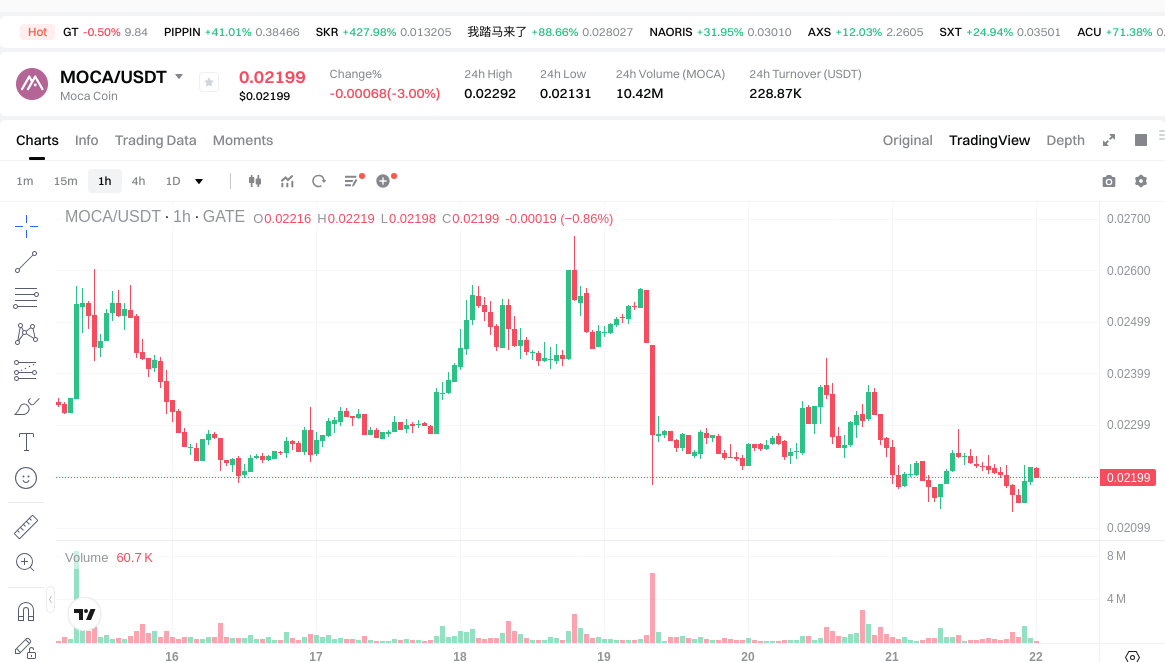
Moca Coin (MOCA) serves as the fundamental resource powering the Moca Network, an interoperable consumer network supported by an ecosystem of over 450 companies through Mocaverse and Animoca Brands. Launched in July 2024, MOCA has established its presence in the blockchain infrastructure space. As of January 22, 2026, MOCA holds a market capitalization of approximately $28.28 million with a circulating supply of 1.28 billion tokens, currently trading at around $0.02213. With approximately 9,649 holders and listings on 21 exchanges, MOCA has garnered attention in discussions around "Is Moca Coin (MOCA) a good investment?" This article provides a comprehensive analysis of MOCA's investment value, historical performance, future price projections, and associated risks to assist investors in their evaluation.
I. MOCA Price History Review and Current Investment Value
- 2024: Token launch in July with initial price of $0.1125 → Price reached $60.7803 in December, representing substantial growth from launch price
- 2025: Market correction phase → Price declined to $0.01839 in December, reflecting broader market adjustment
- Current cycle: Price recovering from recent low → Trading at $0.02213 as of January 2026
Current MOCA Investment Market Status (January 2026)
- MOCA current price: $0.02213
- 24-hour trading volume: $230,234.02
- Circulating supply: 1,277,777,777.75 MOCA (14.38% of total supply)
- Market capitalization: $28,277,222.22
- Fully diluted valuation: $196,711,111.09
- Token holders: 9,649
- Listed on 21 exchanges
Click to view real-time MOCA market price
II. Core Factors Affecting Whether MOCA is a Good Investment (Is Moca Coin(MOCA) a Good Investment)
Supply Mechanism and Scarcity (MOCA investment scarcity)
- Maximum Supply Cap: 8,888,888,888 MOCA tokens, with a current circulating supply of approximately 1,277,777,777.75 tokens (14.38% of total supply) → influences price dynamics and investment value
- Historical context: Price fluctuations have been observed, with trading activity reflecting supply-demand interactions in the market
- Investment significance: The controlled supply structure and gradual token release mechanism represent factors in evaluating long-term investment potential
Institutional Investment and Mainstream Adoption (Institutional investment in MOCA)
- Ecosystem foundation: MOCA is supported by the Moca Network ecosystem, which includes over 450 companies seeded by Mocaverse and Animoca Brands
- Holder base: Approximately 9,649 holders as of current data → indicates growing adoption and distribution
- Trading availability: Listed on 21 exchanges, providing accessibility for institutional and retail participants
Macroeconomic Environment's Impact on MOCA Investment
- Market capitalization positioning: Currently ranked 738 with a market cap of approximately $28.28 million and market dominance of 0.0061%
- Monetary policy considerations: As a digital asset, MOCA's investment attractiveness may be influenced by changes in interest rates and liquidity conditions in the broader cryptocurrency market
- Market sentiment: Trading volume of approximately $230,234 over 24 hours reflects current market participation levels
Technology and Ecosystem Development (Technology & Ecosystem for MOCA investment)
- Network infrastructure: MOCA operates as the underlying resource powering the Moca Network, an interoperable consumer network
- Token standard: Built on the ERC-20 protocol on the Ethereum blockchain, ensuring compatibility with established DeFi infrastructure
- Ecosystem applications: The network's integration with Mocaverse and Animoca Brands' portfolio provides potential use cases across digital entertainment, gaming, and consumer applications
- Development resources: Technical documentation available through the project's litepaper, outlining the token's utility and network architecture
III. MOCA Future Investment Prediction and Price Outlook (Is Moca Coin (MOCA) worth investing in 2026-2031)
Short-term Investment Prediction (2026, short-term MOCA investment outlook)
- Conservative Prediction: $0.0130 - $0.0220
- Neutral Prediction: $0.0220 - $0.0275
- Optimistic Prediction: $0.0275 - $0.0328
Mid-term Investment Outlook (2027-2029, mid-term Moca Coin (MOCA) investment forecast)
-
Market Stage Expectation: During this period, MOCA may experience gradual growth supported by ecosystem development and potential network expansion. The token could see increased adoption within the Moca Network's interoperable consumer ecosystem.
-
Investment Return Prediction:
- 2027: $0.0230 - $0.0356
- 2028: $0.0277 - $0.0330
- 2029: $0.0190 - $0.0439
-
Key Catalysts: Ecosystem expansion within the Moca Network, integration progress with Animoca Brands portfolio companies, and broader adoption of network utilities.
Long-term Investment Outlook (Is MOCA a good long-term investment?)
- Base Scenario: $0.0362 - $0.0533 (Assuming steady ecosystem growth and stable market conditions)
- Optimistic Scenario: $0.0457 - $0.0612 (Assuming accelerated adoption and favorable market environment)
- Risk Scenario: $0.0190 - $0.0300 (Under challenging market conditions or slower ecosystem development)
Click to view MOCA long-term investment and price prediction: Price Prediction
2026-01-22 - 2031 Long-term Outlook
- Base Scenario: $0.0362 - $0.0533 (Corresponding to steady progress and gradual mainstream application enhancement)
- Optimistic Scenario: $0.0457 - $0.0612 (Corresponding to large-scale adoption and favorable market environment)
- Transformative Scenario: Above $0.0612 (Such as breakthrough ecosystem development and mainstream adoption)
- 2031-12-31 Predicted High: $0.0612 (Based on optimistic development assumptions)
Disclaimer: Price predictions are based on historical data analysis and market trends. Cryptocurrency investments carry substantial risks, and actual prices may differ significantly from forecasts. This information does not constitute investment advice.
| Year |
Predicted High Price |
Predicted Average Price |
Predicted Low Price |
Price Change |
| 2026 |
0.0327502 |
0.02198 |
0.0129682 |
0 |
| 2027 |
0.03557463 |
0.0273651 |
0.022986684 |
23 |
| 2028 |
0.03304335825 |
0.031469865 |
0.0276934812 |
42 |
| 2029 |
0.04386899181 |
0.032256611625 |
0.01903140085875 |
45 |
| 2030 |
0.0532879224045 |
0.0380628017175 |
0.036159661631625 |
71 |
| 2031 |
0.06120498516174 |
0.045675362061 |
0.03745379689002 |
106 |
IV. MOCA Investment Strategy and Risk Management (How to invest in MOCA)
Investment Methodology (MOCA investment strategy)
Long-term Holding (HODL MOCA)
Long-term holding represents a strategy suitable for conservative investors who believe in the fundamental value proposition of the Moca Network ecosystem. This approach involves acquiring MOCA tokens and maintaining positions through market cycles, focusing on the project's long-term development rather than short-term price movements.
Given MOCA's role as the underlying resource powering the Moca Network—an interoperable consumer network with an ecosystem of over 450 companies seeded by Mocaverse and Animoca Brands—long-term holders may consider the network's expansion potential and partnership development as key factors in their investment thesis.
Active Trading
Active trading strategies rely on technical analysis and swing trading operations. Traders utilizing this approach may consider:
- Technical Analysis: Monitoring support and resistance levels, with recent data showing a 24-hour trading range between $0.02131 and $0.02292
- Volume Analysis: Observing the 24-hour trading volume of approximately $230,234 to gauge market liquidity
- Trend Following: Analyzing price movements across different timeframes, noting the -2.03% change over 24 hours, -6.88% over 7 days, and +7.62% over 30 days
Risk Management (Risk management for MOCA investment)
Asset Allocation Ratios
Conservative Investors: May consider allocating 1-3% of their cryptocurrency portfolio to MOCA, maintaining larger positions in more established digital assets.
Aggressive Investors: Could allocate 5-10% of their portfolio, accepting higher volatility in exchange for potential growth opportunities within the Moca Network ecosystem.
Professional Investors: May employ dynamic allocation strategies ranging from 3-15%, adjusting positions based on market conditions, technical indicators, and ecosystem development milestones.
Risk Hedging Solutions
A diversified approach to MOCA investment should incorporate:
- Multi-asset Portfolio Construction: Combining MOCA with various digital assets across different sectors and risk profiles
- Position Sizing: Limiting individual position exposure based on personal risk tolerance
- Stop-loss Mechanisms: Implementing predetermined exit points to manage downside risk
Secure Storage
Given that MOCA operates on the ERC-20 standard on the Ethereum network, investors should prioritize secure storage solutions:
- Cold Wallets: Hardware wallets compatible with Ethereum-based tokens provide offline storage for long-term holdings
- Hot Wallets: For active traders, reputable software wallets with strong security features offer convenient access while maintaining reasonable security standards
- Hardware Wallet Recommendations: Industry-standard devices supporting ERC-20 tokens can provide enhanced security for MOCA holdings
V. MOCA Investment Risks and Challenges (Risks of investing in MOCA)
Market Risks
High Volatility
MOCA has demonstrated substantial price volatility, as evidenced by:
- A 1-year price change of -87.59%
- Historical price range from $0.01839 (recorded on December 18, 2025) to $60.7803 (recorded on December 16, 2024)
- Short-term fluctuations including a -2.03% change in 24 hours and -6.88% over 7 days
This volatility pattern suggests that MOCA investors should prepare for significant price swings and potential rapid changes in portfolio value.
Price Manipulation Concerns
With a market capitalization of approximately $28.28 million and a circulating supply representing only 14.38% of the total supply, the token may be subject to concentrated holdings and potential price influence by large holders. The relatively modest 24-hour trading volume of $230,234 could indicate liquidity constraints during periods of high market activity.
Regulatory Risks
Policy Uncertainty Across Jurisdictions
As a digital asset operating within the broader cryptocurrency ecosystem, MOCA faces regulatory uncertainties that vary by jurisdiction:
- Jurisdictional Variations: Different countries maintain distinct regulatory frameworks for digital assets, which may affect MOCA's accessibility and trading conditions
- Compliance Requirements: Evolving regulatory standards may impact the Moca Network's operations and token utility
- Classification Uncertainty: The regulatory classification of utility tokens like MOCA may differ across regions, potentially affecting investor protections and legal status
Technical Risks
Network Security Vulnerabilities
As an ERC-20 token operating on the Ethereum network, MOCA's security depends on:
- The integrity of its smart contract implementation
- The underlying Ethereum network's security infrastructure
- Potential vulnerabilities in the token contract or associated protocols
Upgrade Implementation Challenges
The Moca Network's development roadmap may include technical upgrades and protocol changes that carry inherent risks:
- Implementation delays or technical difficulties
- Potential bugs or vulnerabilities introduced during upgrade processes
- Community consensus challenges regarding protocol modifications
VI. Conclusion: Is MOCA a Good Investment?
Investment Value Summary
MOCA presents a complex investment proposition characterized by its integration within the Moca Network ecosystem, which encompasses over 450 companies through partnerships with Mocaverse and Animoca Brands. The token's fundamental role as the underlying resource for this interoperable consumer network provides a use case foundation.
However, the investment landscape for MOCA reflects significant price volatility, with an 87.59% decline over one year and substantial historical price ranges. The current market capitalization of $28.28 million and circulating supply of 14.38% indicate a token in early stages of distribution, which may contribute to price discovery dynamics.
Investor Recommendations
✅ Beginners
- Consider dollar-cost averaging strategies to mitigate entry timing risk
- Prioritize secure storage solutions using reputable hardware wallets supporting ERC-20 tokens
- Allocate only amounts that can be comfortably held through significant market fluctuations
- Focus on understanding the Moca Network ecosystem and its development trajectory
✅ Experienced Investors
- Employ technical analysis to identify potential swing trading opportunities within established support and resistance levels
- Implement portfolio diversification strategies that limit MOCA exposure to appropriate risk-adjusted levels
- Monitor ecosystem developments and partnership announcements that may influence token utility and demand
- Utilize risk management tools including position sizing and stop-loss mechanisms
✅ Institutional Investors
- Evaluate MOCA within the context of broader digital asset portfolio strategies
- Consider long-term allocation decisions based on thorough due diligence of the Moca Network's business model and ecosystem growth potential
- Assess liquidity profiles and market depth before establishing significant positions
- Implement comprehensive risk frameworks that account for regulatory, technical, and market-specific factors
⚠️ Disclaimer: Cryptocurrency investments carry substantial risk due to price volatility, regulatory uncertainty, and technical challenges. This content is provided for informational purposes only and does not constitute investment advice. Investors should conduct thorough independent research and consider their individual financial circumstances, risk tolerance, and investment objectives before making any investment decisions regarding MOCA or other digital assets.
VII. FAQ
Q1: What is Moca Coin (MOCA) and what is its primary function?
MOCA is the native utility token of the Moca Network, serving as the fundamental resource powering an interoperable consumer network. Built as an ERC-20 token on the Ethereum blockchain, MOCA facilitates network operations within an ecosystem comprising over 450 companies seeded by Mocaverse and Animoca Brands. The token launched in July 2024 with a maximum supply of 8,888,888,888 tokens, of which approximately 14.38% is currently in circulation.
Q2: How has MOCA's price performed since its launch?
MOCA has experienced significant volatility since its launch. The token debuted at $0.1125 in July 2024 and reached a peak of $60.7803 in December 2024. Subsequently, the price underwent substantial correction, declining to $0.01839 by December 2025, representing an 87.59% decrease from its all-time high. As of January 22, 2026, MOCA trades at approximately $0.02213, showing signs of recovery from recent lows.
Q3: What percentage of my portfolio should I allocate to MOCA?
Allocation recommendations vary based on investor risk profiles. Conservative investors may consider limiting MOCA exposure to 1-3% of their cryptocurrency portfolio, maintaining larger positions in more established digital assets. Aggressive investors accepting higher volatility might allocate 5-10%, while professional investors could employ dynamic strategies ranging from 3-15%. These recommendations account for MOCA's substantial price volatility and relatively early development stage.
Q4: What are the primary risks associated with investing in MOCA?
MOCA investments face several risk categories. Market risks include extreme volatility, as evidenced by the token's 87.59% one-year decline and daily price swings. The modest market capitalization of $28.28 million and limited circulating supply (14.38%) may expose investors to liquidity constraints and potential price manipulation. Regulatory uncertainties affecting digital assets globally represent additional considerations. Technical risks include smart contract vulnerabilities and potential challenges during protocol upgrades.
Q5: Where can I trade MOCA and how should I store it securely?
MOCA is listed on 21 exchanges, providing multiple trading venues for investors. For secure storage, since MOCA operates on the ERC-20 standard, investors can utilize hardware wallets compatible with Ethereum-based tokens for long-term holdings. These cold storage solutions provide offline security for substantial positions. Active traders may opt for reputable software wallets offering convenient access while maintaining reasonable security standards. Investors should prioritize established wallet providers with proven security track records.
Q6: What factors could drive MOCA's future price appreciation?
Several catalysts may influence MOCA's potential price trajectory. Ecosystem expansion within the Moca Network, including increased adoption among the 450+ partner companies, represents a fundamental driver. Integration progress with Animoca Brands' portfolio companies could enhance token utility and demand. Broader adoption of the network's interoperable consumer applications may increase transaction volumes. Additionally, favorable macroeconomic conditions in the cryptocurrency market and successful implementation of technical upgrades could contribute to positive price momentum.
Q7: Is MOCA suitable for long-term investment?
MOCA's suitability for long-term investment depends on individual risk tolerance and belief in the Moca Network ecosystem's development potential. The token's integration within a network supported by over 450 companies provides fundamental infrastructure. However, the 87.59% one-year decline, limited circulating supply, and early development stage suggest substantial uncertainty. Long-term investors should maintain realistic expectations regarding volatility, implement appropriate position sizing, and consider MOCA as part of a diversified digital asset portfolio rather than a concentrated holding.
Q8: What is the price outlook for MOCA through 2031?
Price predictions for MOCA vary across scenarios. Short-term forecasts for 2026 range from $0.0130-$0.0328 depending on market conditions. Mid-term projections suggest potential ranges of $0.0230-$0.0356 for 2027 and $0.0190-$0.0439 for 2029. Long-term outlook through 2031 presents a base scenario of $0.0362-$0.0533, with optimistic projections reaching $0.0457-$0.0612 under favorable adoption conditions. These predictions carry substantial uncertainty and should not be interpreted as investment guarantees, as actual prices may differ significantly based on market dynamics and ecosystem development.
* The information is not intended to be and does not constitute financial advice or any other recommendation of any sort offered or endorsed by Gate.












