This comprehensive analysis examines whether Morpho Labs (MORPHO) represents a viable investment opportunity in the DeFi lending sector. Launched in November 2024, MORPHO operates as a peer-to-peer matching optimization layer above protocols like Compound and Aave, reaching $765.36 million market capitalization as of January 2026. The article evaluates MORPHO's investment value through price history analysis, revealing a 450% surge to $4.19 in January 2025 followed by 66% correction to current $1.41 levels, alongside institutional adoption catalysts including Coinbase integration. Critical factors addressed include supply scarcity mechanisms, regulatory considerations, technological innovations, and macroeconomic influences on DeFi lending markets. The analysis provides differentiated investment strategies for beginners, experienced traders, and institutional investors, coupled with comprehensive risk management frameworks covering market volatility, regulatory evolution, and technical vulnerabilities. Long-t
Introduction: Morpho Labs (MORPHO) Investment Position and Market Outlook
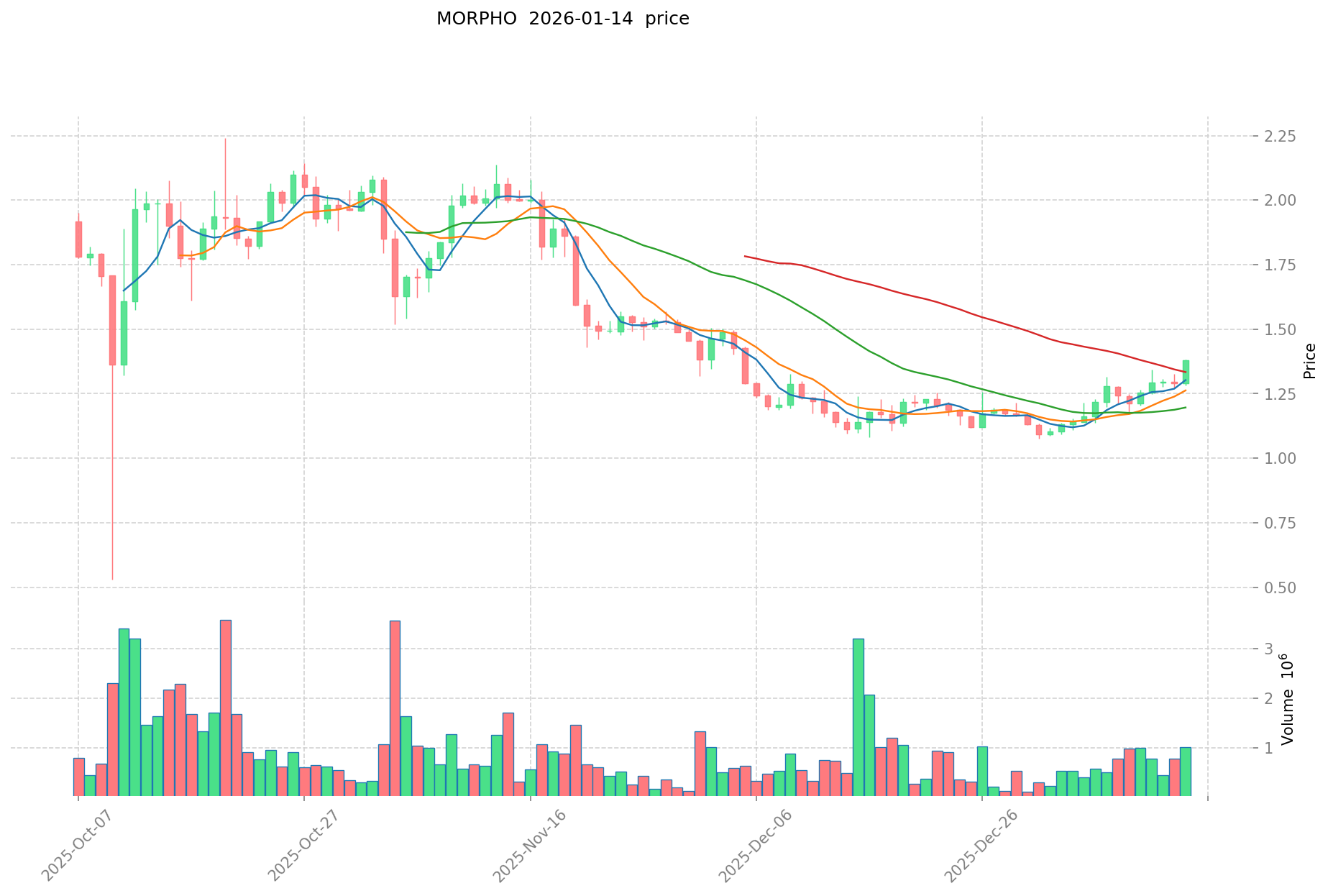
MORPHO represents a notable asset in the cryptocurrency sector, having launched in November 2024. Operating as a lending protocol on the Ethereum blockchain, MORPHO has established itself in the decentralized finance (DeFi) lending space. As of January 14, 2026, MORPHO holds a market capitalization of approximately $765.36 million, with a circulating supply of 543.27 million tokens out of a total supply of 1 billion tokens. The current price stands at $1.4088, reflecting a 24-hour increase of 8.37%. With its positioning as a lending pool optimizer that operates above protocols like Compound and Aave, MORPHO has attracted attention from market participants examining "Is Morpho Labs (MORPHO) a good investment?" This analysis examines MORPHO's investment characteristics, historical price movements, future price projections, and associated investment considerations to provide reference information for market participants.
Morpho functions as a lending protocol that combines liquidity pool models with peer-to-peer matching mechanisms. The protocol aims to enhance capital efficiency for both lenders and borrowers while maintaining the user experience and risk parameters of underlying protocols. With 16,726 token holders and availability on 36 exchanges, MORPHO demonstrates measurable adoption within the DeFi ecosystem. The token's performance shows a 7-day gain of 11.31% and a 30-day increase of 27.13%, though it has experienced a decline of 43.12% over the past year from its initial listing. The token reached a price peak of $4.1905 on January 17, 2025, and a low of $0.5291 on October 10, 2025, indicating significant price volatility. Currently ranking 103rd by market capitalization with a 0.041% market dominance, MORPHO's market position reflects its status as an emerging protocol within the competitive DeFi lending sector.
I. Morpho Labs (MORPHO) Price History Review and Current Investment Value
- 2024: Token launch on November 20, 2024 at an initial price of $0.75, followed by rapid appreciation to approximately $4.19 in January 2025 → Early investors experienced substantial returns with gains exceeding 450% within two months
- January 2025: Price reached its peak level around $4.19 on January 17, 2025 → MORPHO demonstrated strong upward momentum during this period, reflecting positive market sentiment toward the lending protocol
- Mid-January 2025 to Current: Market entered correction phase → Price declined from the January peak to approximately $1.41 as of January 14, 2026, representing a retreat of about 66% from the peak level
Current MORPHO Investment Market Status (January 2026)
- MORPHO current price: $1.41 (as of January 14, 2026)
- 24-hour price change: +8.37%, indicating short-term positive momentum
- 24-hour trading volume: $1.49 million, suggesting moderate trading activity
- Market capitalization: $765.36 million with a circulating supply of 543.27 million tokens (54.33% of total supply)
- Circulating market cap to fully diluted valuation ratio: 54.33%, with maximum supply capped at 1 billion tokens
Click to view real-time MORPHO market price
II. Core Factors Affecting Whether MORPHO is a Good Investment
Supply Mechanism and Scarcity (MORPHO Investment Scarcity)
- Token Supply Structure → MORPHO has a maximum supply of 1,000,000,000 tokens with a current circulating supply of 543,271,706 tokens (approximately 54.33% of total supply). This controlled supply structure provides a foundation for potential value appreciation as adoption increases.
- Historical Price Movement → Since its launch at $0.75 in November 2024, MORPHO has demonstrated significant price volatility, reaching a notable high of $4.1905 in January 2025 before correcting to current levels around $1.41 as of January 14, 2026.
- Investment Significance → The finite supply cap combined with ongoing token releases to the DAO treasury (35.40%) and Morpho Association (6.30%) creates a structured scarcity model that may support long-term investment considerations, though market dynamics remain a key variable.
Institutional Investment and Mainstream Adoption (Institutional Investment in MORPHO)
- Institutional Integration Trends → Morpho has secured strategic partnerships with major crypto infrastructure providers. A prominent integration with Coinbase launched Bitcoin-backed on-chain loans on the Base network in January 2025, enabling institutional clients to access on-chain lending markets.
- Enterprise Adoption → The protocol has evolved into key infrastructure for lending products across the crypto industry, powering services for exchanges, payment platforms, and regulated financial institutions. The protocol reached $6.7 billion in Total Value Locked (TVL) by August 2025.
- Regulatory Environment Considerations → As institutional adoption grows through regulated platforms like Coinbase, MORPHO's position as backend infrastructure may benefit from increased legitimacy within traditional finance frameworks, though regulatory developments continue to evolve.
Macroeconomic Environment's Impact on MORPHO Investment
- DeFi Market Conditions → As a decentralized lending protocol, MORPHO's investment appeal correlates with broader DeFi sector growth and liquidity conditions. Interest rate environments in traditional finance may influence capital flows into DeFi lending alternatives.
- Market Volatility Context → MORPHO has demonstrated considerable price volatility, with 24-hour changes of 8.37%, 7-day changes of 11.31%, and 30-day changes of 27.13% as of January 14, 2026, reflecting the dynamic nature of DeFi token markets.
- Crypto Market Correlation → With a market cap ranking of #103 and market dominance of 0.041%, MORPHO's investment performance remains influenced by broader cryptocurrency market trends and sentiment.
Technology and Ecosystem Development (Technology & Ecosystem for MORPHO Investment)
- Protocol Innovation → Morpho combines isolated lending markets with advanced features including Vaults, Bundlers, and the Public Allocator. The protocol employs an optimized peer-to-peer matching engine that pairs lenders and borrowers directly, aiming to improve rates for both parties compared to traditional pool-based models.
- Network Infrastructure → The protocol operates as a non-custodial lending platform on Ethereum, enabling overcollateralized crypto lending and borrowing through permissionless markets. The MORPHO token functions primarily as a governance mechanism within this infrastructure.
- Ecosystem Expansion → Planned developments include the launch of Morpho-Aave-V3, the protocol's third instance. The protocol has achieved deposits exceeding $600 million and continues to expand its integration across DeFi applications, payment systems, and institutional lending products.
- Investment Value Proposition → The token's utility is currently focused on governance rather than direct protocol usage, as most institutional integrations utilize Morpho as backend infrastructure without requiring MORPHO token holdings, which represents a consideration for investment evaluation.
III. MORPHO Future Investment Forecast and Price Outlook (Is Morpho Labs (MORPHO) worth investing in 2026-2031)
Short-term Investment Forecast (2026, short-term MORPHO investment outlook)
- Conservative forecast: $1.15 - $1.41
- Neutral forecast: $1.41 - $1.60
- Optimistic forecast: $1.60 - $1.80
Mid-term Investment Outlook (2027-2029, mid-term Morpho Labs (MORPHO) investment forecast)
-
Market stage expectations: According to analytical projections, MORPHO may experience gradual growth during the mid-term period, potentially influenced by developments in the broader DeFi lending sector and global digital asset regulatory dynamics.
-
Investment return forecast:
- 2027: $1.51 - $2.26
- 2028: $1.78 - $2.75
- 2029: $1.78 - $3.39
-
Key catalysts: Technological progress in the DeFi lending space, regulatory clarity in digital asset markets, and potential expansion of the protocol's user base may serve as important factors.
Long-term Investment Outlook (Is MORPHO a good long-term investment?)
- Base scenario: $1.69 - $3.18 (assuming steady protocol development and moderate market conditions through 2030)
- Optimistic scenario: $2.84 - $3.66 (assuming favorable regulatory environment and broader DeFi adoption through 2031)
- Risk scenario: Below $1.69 (under adverse market conditions or significant competitive pressure)
Click to view MORPHO long-term investment and price forecast: Price Prediction
2026-2031 Long-term Outlook
- Base scenario: $1.69 - $3.18 (corresponding to steady progress and gradual mainstream application growth)
- Optimistic scenario: $2.84 - $3.66 (corresponding to large-scale adoption and favorable market environment)
- Transformative scenario: Above $3.66 (if the ecosystem achieves breakthrough developments and mainstream adoption)
- December 31, 2031 projected high: $3.66 (based on optimistic development assumptions)
Disclaimer: The above forecasts are based on historical data analysis and market projections. Cryptocurrency markets are highly volatile and subject to numerous unpredictable factors. These projections should not be considered as investment advice. Investors should conduct their own research and consider their risk tolerance before making any investment decisions.
| Year |
Predicted High Price |
Predicted Average Price |
Predicted Low Price |
Price Change |
| 2026 |
1.802752 |
1.4084 |
1.154888 |
0 |
| 2027 |
2.26386216 |
1.605576 |
1.50924144 |
14 |
| 2028 |
2.7473010936 |
1.93471908 |
1.7799415536 |
37 |
| 2029 |
3.39446462586 |
2.3410100868 |
1.779167665968 |
66 |
| 2030 |
3.1831884655263 |
2.86773735633 |
1.6919650402347 |
104 |
| 2031 |
3.660810122223061 |
3.02546291092815 |
2.843935136272461 |
115 |
IV. MORPHO Investment Strategy and Risk Management (How to invest in Decentralized Lending Protocols)
Investment Strategy (MORPHO investment strategy)
-
Long-term Holding (HODL MORPHO): Suitable for conservative investors who believe in the long-term development of decentralized lending protocols. Given Morpho's optimization layer over established protocols like Compound and Aave, holding MORPHO tokens may capture value as the protocol grows its Total Value Locked (TVL) and user base. However, investors should note that the token has experienced significant volatility, with a 43.12% decline over the past year, indicating the need for a strong risk tolerance.
-
Active Trading: For experienced traders who rely on technical analysis and swing trading strategies. The token has shown notable short-term movements, with an 8.37% increase in 24 hours and 11.31% over 7 days. Active traders may capitalize on these price fluctuations, but should be aware that 24-hour trading volume of approximately $1.49 million suggests moderate liquidity that could impact execution during high volatility periods.
Risk Management (Risk management for MORPHO investment)
-
Asset Allocation Ratios:
- Conservative investors: 1-3% of crypto portfolio allocation to lending protocol tokens
- Aggressive investors: 5-10% allocation with active monitoring
- Professional investors: May consider larger positions with sophisticated hedging strategies
-
Risk Hedging Solutions: Diversify across multiple DeFi categories including lending protocols, DEXs, and layer-1 blockchains. Consider stablecoin positions to manage downside risk. Given MORPHO's correlation with Ethereum ecosystem performance, balancing exposure across multiple blockchain ecosystems may reduce concentration risk.
-
Secure Storage:
- Cold wallet storage: Hardware wallets such as Ledger or Trezor for long-term holdings
- Hot wallet solutions: MetaMask or other ERC-20 compatible wallets for active trading, but minimize amounts stored
- Multi-signature wallets: For institutional investors or large holdings
- Note: MORPHO operates on Ethereum (contract address: 0x58d97b57bb95320f9a05dc918aef65434969c2b2), requiring ETH for transaction fees
V. MORPHO Investment Risks and Challenges (Risks of investing in Decentralized Lending Protocols)
-
Market Risk: MORPHO exhibits high volatility characteristics common to DeFi governance tokens. The token reached $4.19 on January 17, 2025, but currently trades at $1.41, representing a significant decline. Price volatility may be influenced by broader crypto market sentiment, Ethereum network performance, and competition from other lending protocols. The current circulating supply of 543.27 million tokens (54.33% of max supply) means future token unlocks could create selling pressure.
-
Regulatory Risk: Decentralized lending protocols face evolving regulatory frameworks across jurisdictions. Different countries maintain varying stances on DeFi protocols, with potential impacts including:
- Classification of governance tokens as securities
- Requirements for KYC/AML compliance that could affect protocol accessibility
- Restrictions on lending activities or interest-bearing products
- Cross-border regulatory coordination that may impose operational constraints
-
Technical Risk:
- Smart contract vulnerabilities: Despite audits, lending protocols face ongoing security risks
- Integration risks: Morpho's optimization layer depends on underlying protocols (Compound, Aave); issues with base protocols could affect Morpho
- Upgrade implementation risks: Protocol updates or the planned Morpho-Aave-V3 deployment could encounter technical challenges
- Network congestion: High Ethereum gas fees during peak periods may impact user experience and adoption
VI. Conclusion: Is Decentralized Lending Protocol Token a Good Investment?
-
Investment Value Summary: MORPHO represents exposure to the evolving DeFi lending sector with its unique peer-to-peer matching optimization model. The protocol demonstrates technological innovation by improving capital efficiency over established platforms while maintaining similar liquidity and risk parameters. However, the token has experienced substantial price volatility, declining 43.12% over the past year while showing recent recovery with 27.13% gains over 30 days. The investment carries both growth potential tied to DeFi adoption and significant downside risks from market volatility and competition.
-
Investor Recommendations:
- ✅ Beginners: Consider dollar-cost averaging (DCA) strategy with small, regular purchases. Prioritize secure storage using hardware wallets. Limit allocation to 1-3% of total crypto portfolio. Focus on learning about DeFi mechanics before increasing position size.
- ✅ Experienced Investors: May employ swing trading strategies to capture short-term price movements. Maintain diversified exposure across multiple DeFi protocols and blockchain ecosystems. Monitor protocol metrics including TVL, user growth, and competitive positioning regularly.
- ✅ Institutional Investors: Strategic long-term allocation may be appropriate as part of broader DeFi exposure. Conduct thorough due diligence on smart contract security, team background, and protocol economics. Consider hedging strategies and maintaining risk management frameworks appropriate to organizational guidelines.
⚠️ Disclaimer: Cryptocurrency investments carry high risk due to market volatility, regulatory uncertainty, and technical vulnerabilities. This content is for informational purposes only and does not constitute investment advice. Conduct independent research and consider consulting financial advisors before making investment decisions.
VII. FAQ
Q1: What is Morpho Labs (MORPHO) and how does it differ from traditional lending protocols like Compound and Aave?
Morpho Labs is a decentralized lending protocol operating on Ethereum that functions as an optimization layer above existing protocols like Compound and Aave. Unlike traditional pool-based lending models, Morpho combines liquidity pools with peer-to-peer matching mechanisms to directly pair lenders and borrowers, thereby improving capital efficiency and offering better rates for both parties while maintaining the risk parameters and liquidity guarantees of underlying protocols. The MORPHO token, launched in November 2024, primarily serves as a governance mechanism rather than a protocol utility token.
Q2: Is MORPHO a good short-term investment based on current market conditions?
Short-term investment in MORPHO carries significant volatility considerations. As of January 14, 2026, the token demonstrates positive momentum with an 8.37% gain over 24 hours and 11.31% over 7 days, suggesting short-term upward pressure. However, conservative forecasts project prices between $1.15 and $1.80 for 2026, with moderate trading volume of approximately $1.49 million indicating liquidity constraints. The token's historical volatility, including a 66% decline from its January 2025 peak of $4.19 to current levels around $1.41, indicates that short-term trading requires active risk management and technical analysis capabilities.
Q3: What are the primary risks associated with investing in MORPHO tokens?
MORPHO investment carries three major risk categories: Market risk includes extreme price volatility, with the token experiencing a 43.12% decline over the past year and significant intraday fluctuations. Regulatory risk stems from evolving DeFi regulations globally, with potential impacts including governance token classification as securities, KYC/AML requirements, or lending activity restrictions. Technical risk encompasses smart contract vulnerabilities, integration dependencies on underlying protocols (Compound and Aave), upgrade implementation challenges, and Ethereum network congestion affecting user experience and adoption rates.
Q4: How should different investor types approach MORPHO allocation in their portfolios?
Investment allocation should vary based on experience level and risk tolerance. Beginners should limit MORPHO exposure to 1-3% of their crypto portfolio, employ dollar-cost averaging strategies, and prioritize secure hardware wallet storage. Experienced investors may allocate 5-10% with active monitoring and swing trading strategies to capture short-term price movements, while maintaining diversification across multiple DeFi protocols. Institutional investors can consider strategic long-term allocations as part of broader DeFi exposure, implementing sophisticated hedging strategies, conducting thorough smart contract audits, and maintaining risk management frameworks aligned with organizational guidelines.
Q5: What institutional adoption has MORPHO achieved and how does this affect investment value?
Morpho has secured significant institutional integration, notably partnering with Coinbase to launch Bitcoin-backed on-chain loans on the Base network in January 2025. The protocol serves as backend infrastructure for exchanges, payment platforms, and regulated financial institutions, reaching $6.7 billion in Total Value Locked (TVL) by August 2025. However, most institutional integrations utilize Morpho as infrastructure without requiring MORPHO token holdings, which represents an important consideration for investment evaluation. The token's value proposition centers on governance rights rather than direct protocol usage, potentially limiting direct correlation between protocol growth and token value appreciation.
Q6: What are the long-term price projections for MORPHO through 2031?
Long-term forecasts project varying scenarios based on protocol development and market conditions. Base scenario estimates range from $1.69 to $3.18 through 2030, assuming steady protocol development and moderate market conditions. Optimistic scenario projects $2.84 to $3.66 through 2031, contingent on favorable regulatory environment and broader DeFi adoption. By December 31, 2031, the projected high reaches $3.66 under optimistic assumptions. However, these projections carry significant uncertainty due to cryptocurrency market volatility, regulatory developments, and competitive dynamics within the DeFi lending sector. Investors should note that actual outcomes may vary substantially from these estimates.
Q7: What technological advantages does Morpho's protocol architecture provide for the DeFi lending ecosystem?
Morpho employs an optimized peer-to-peer matching engine that directly pairs lenders and borrowers, improving capital efficiency compared to traditional pool-based models where liquidity sits idle. The protocol features isolated lending markets with advanced capabilities including Vaults, Bundlers, and the Public Allocator, operating as a non-custodial platform enabling overcollateralized crypto lending through permissionless markets. Planned developments include the launch of Morpho-Aave-V3, the protocol's third instance. The architecture maintains user experience and risk parameters of underlying protocols while enhancing rates for both lenders and borrowers, positioning Morpho as infrastructure layer for DeFi applications, payment systems, and institutional lending products.
Q8: How does MORPHO's token supply structure impact long-term investment considerations?
MORPHO has a maximum supply capped at 1 billion tokens, with current circulating supply of 543.27 million tokens (54.33% of total supply). The controlled supply structure includes ongoing token releases to the DAO treasury (35.40%) and Morpho Association (6.30%), creating a structured scarcity model with potential support for long-term value appreciation as adoption increases. However, future token unlocks from the remaining 45.67% of supply may create selling pressure. The circulating market cap to fully diluted valuation ratio of 54.33% indicates substantial future token releases that investors should factor into valuation assessments, alongside the token's primary function as a governance mechanism rather than a required utility token for protocol usage.
* The information is not intended to be and does not constitute financial advice or any other recommendation of any sort offered or endorsed by Gate.