This comprehensive analysis evaluates NAVI Protocol (NAVX) as an investment opportunity, examining its role as the first native one-stop liquidity protocol on the Sui blockchain. The article assesses NAVX's price performance, current market position at $10.23 million capitalization, and innovative features including Automatic Leverage Vaults and Isolation Mode. Covering historical volatility from $0.428 to $0.01254, the analysis provides price forecasts through 2031 and evaluates key factors including supply mechanisms, ecosystem adoption, and macroeconomic influences. Investment strategies span conservative long-term holding to active trading approaches with risk management guidelines. The analysis addresses regulatory, technical, and market risks while offering recommendations for beginner, experienced, and institutional investors seeking exposure to Sui-native DeFi infrastructure through Gate exchange listings.
Introduction: NAVI Protocol (NAVX) Investment Position and Market Outlook
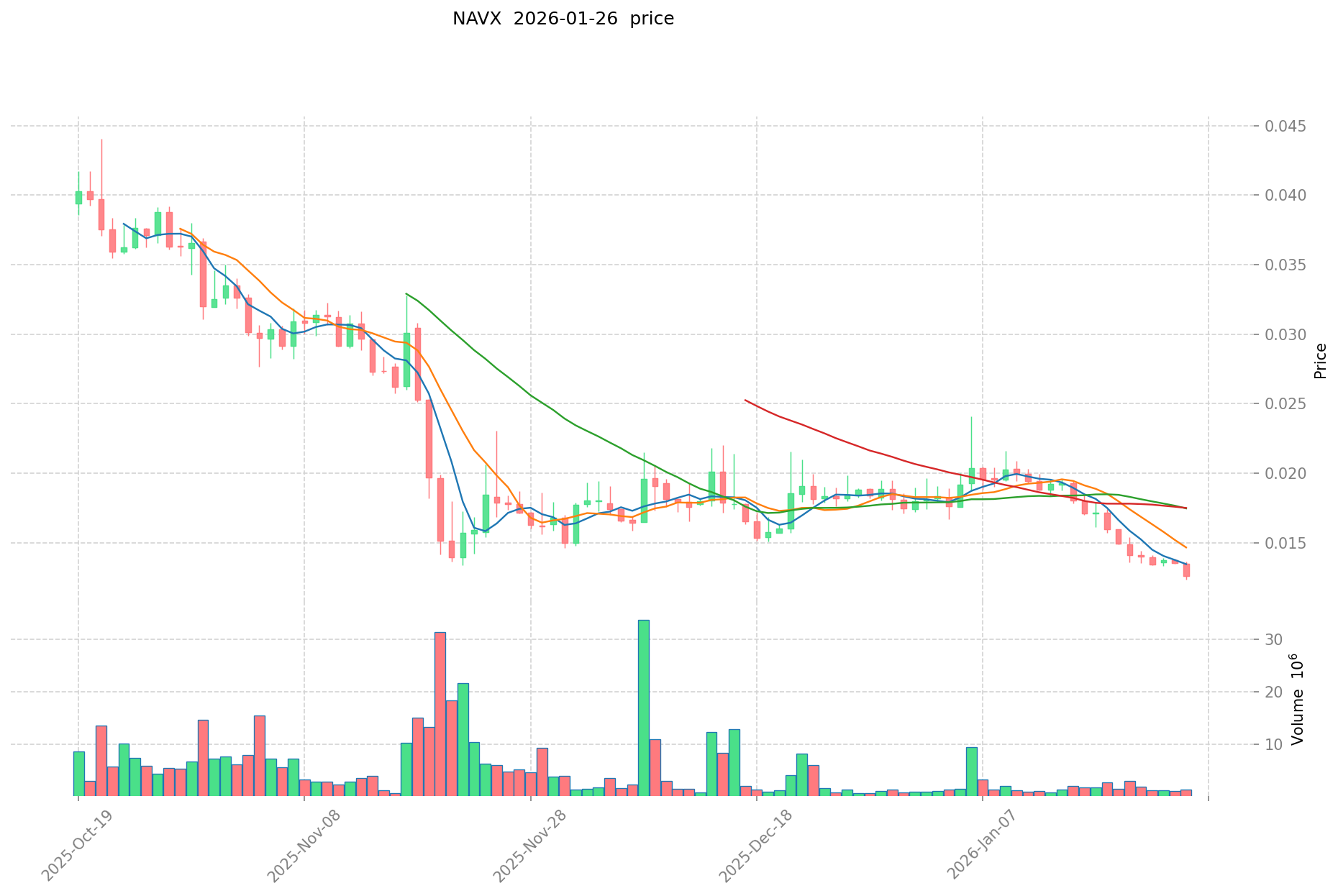
NAVX is a notable asset in the cryptocurrency space, launched in February 2024 as the first native one-stop liquidity protocol on the Sui blockchain. As of January 2026, NAVX holds a market capitalization of approximately $10.23 million, with a circulating supply of around 816.17 million tokens, and the current price stands at $0.01254. Positioned as a liquidity protocol offering innovative features such as Automatic Leverage Vaults and Isolation Mode, NAVX has attracted attention among participants within the Sui ecosystem. The protocol currently serves approximately 96,015 holders and is listed on 15 exchanges. With a market share of 0.00040% and ranking at 1,179 in the broader cryptocurrency market, NAVX has experienced notable price fluctuations since its launch, including a recorded price range from $0.01 to $0.428. This article provides a comprehensive analysis of NAVX's investment characteristics, historical price movements, future price considerations, and associated risks to serve as a reference for market participants.
I. Token (NAVX) Price History Review and Current Investment Value
- 2024: NAVX reached a price level of $0.428 on March 29, 2024 → Subsequent market adjustments led to notable price volatility
- 2024: On June 19, 2024, NAVX traded at $0.01 → The token experienced significant price fluctuations during this period
- 2024-2026: Market cycles → Price declined from higher levels to current trading range
Current NAVX Investment Market Status (January 2026)
- NAVX current price: $0.01254
- 24-hour trading volume: $18,760.68
- Circulating supply: 816,167,495.24 NAVX
- Market capitalization: $10,234,740.39
- 24-hour price range: $0.01234 - $0.01363
- Recent price changes: +0.16% (1H), -7.38% (24H), -21.52% (7D), -32.07% (30D), -88.71% (1Y)
Click to view real-time NAVX market price
II. Core Factors Influencing Whether NAVX is a Good Investment (Is NAVI Protocol(NAVX) a Good Investment)
Supply Mechanism and Scarcity (NAVX investment scarcity)
- Fixed supply mechanism → Influences price and investment value
- NAVX has a maximum supply of 1,000,000,000 tokens, with approximately 81.62% currently in circulation (816,167,495.24 tokens). The predetermined supply cap creates a scarcity-based economic model that may support long-term value preservation.
- Investment significance: Scarcity remains a key factor supporting long-term investment considerations
Institutional Investment and Mainstream Adoption (Institutional investment in NAVX)
- Market positioning: NAVI Protocol serves as the first native one-stop liquidity protocol on the Sui blockchain, with a holder base of 96,015 addresses, indicating growing community adoption
- The protocol's presence across 15 exchanges demonstrates a degree of market acceptance and accessibility for investors
- Market capitalization stands at approximately $10.23 million, with a market dominance of 0.00040%, positioning it as a mid-to-lower tier digital asset in terms of market presence
Macroeconomic Environment's Impact on NAVX Investment
- Monetary policy and interest rate changes → Alter investment attractiveness
- As a digital asset within the DeFi ecosystem, NAVX's investment appeal may be influenced by broader market liquidity conditions and risk appetite shifts driven by macroeconomic factors
- Geopolitical uncertainty → May enhance demand for alternative digital assets
Technology and Ecosystem Development (Technology & Ecosystem for NAVX investment)
- Innovative protocol features: Automatic Leverage Vaults and Isolation Mode enable users to leverage assets while managing risk exposure, potentially enhancing the protocol's utility value
- Ecosystem expansion: As a native liquidity protocol on Sui, NAVI's development supports multiple risk-tier digital assets, with advanced security features designed to protect user funds and mitigate systemic risks
- DeFi application integration: The protocol's role as a lending and borrowing platform within the Sui ecosystem provides foundational infrastructure that may support long-term value creation through increased protocol usage and total value locked growth
III. NAVX Future Investment Forecast and Price Outlook (Is NAVI Protocol (NAVX) worth investing in 2026-2031)
Short-term Investment Forecast (2026, short-term NAVX investment outlook)
- Conservative Forecast: $0.0073 - $0.0100
- Neutral Forecast: $0.0100 - $0.0125
- Optimistic Forecast: $0.0125 - $0.0142
Mid-term Investment Outlook (2027-2029, mid-term NAVI Protocol (NAVX) investment forecast)
-
Market Phase Expectation: NAVX may experience gradual recovery and development during the mid-term period, with potential expansion in the Sui ecosystem liquidity protocol sector. The protocol's innovative features such as Automatic Leverage Vaults and Isolation Mode could attract more users seeking yield opportunities with controlled risk exposure.
-
Investment Return Forecast:
- 2027: $0.0081 - $0.0160
- 2028: $0.0097 - $0.0188
- 2029: $0.0097 - $0.0239
-
Key Catalysts: Adoption growth within the Sui ecosystem, integration of new digital assets at various risk levels, enhanced security features implementation, and overall DeFi market sentiment recovery.
Long-term Investment Outlook (Is NAVI Protocol a good long-term investment?)
- Baseline Scenario: $0.0142 - $0.0204 (assuming steady protocol development and moderate ecosystem growth)
- Optimistic Scenario: $0.0204 - $0.0349 (assuming increased adoption of Sui-native protocols and broader DeFi market expansion)
- Risk Scenario: $0.0073 - $0.0097 (under adverse market conditions or reduced liquidity protocol demand)
View NAVX long-term investment and price forecast: Price Prediction
2026-2031 Long-term Outlook
- Base Scenario: $0.0142 - $0.0245 (corresponding to steady progress and gradual mainstream application enhancement)
- Optimistic Scenario: $0.0245 - $0.0348 (corresponding to large-scale adoption and favorable market environment)
- Transformative Scenario: Above $0.0348 (such as breakthrough ecosystem developments and mainstream popularization)
- 2031-12-31 Predicted High: $0.0348 (based on optimistic development assumptions)
Disclaimer: The forecasts provided are based on historical data and market analysis models. Cryptocurrency markets are highly volatile and subject to various unpredictable factors. These predictions do not constitute investment advice, and investors should conduct their own research and risk assessment before making any investment decisions.
| Year |
Predicted High Price |
Predicted Average Price |
Predicted Low Price |
Price Change |
| 2026 |
0.0141702 |
0.01254 |
0.0072732 |
0 |
| 2027 |
0.01602612 |
0.0133551 |
0.008146611 |
6 |
| 2028 |
0.0188039808 |
0.01469061 |
0.0096958026 |
17 |
| 2029 |
0.023948632422 |
0.0167472954 |
0.009713431332 |
33 |
| 2030 |
0.02869062911451 |
0.020347963911 |
0.0142435747377 |
62 |
| 2031 |
0.034817401048112 |
0.024519296512755 |
0.01495677087278 |
95 |
IV. NAVX Investment Strategy and Risk Management (How to invest in NAVI Protocol)
Investment Strategy (NAVX investment strategy)
Long-term Holding (HODL NAVX)
Long-term holding represents a conservative approach suitable for investors seeking exposure to Sui ecosystem liquidity protocols. This strategy involves acquiring NAVX tokens and maintaining positions through market cycles, focusing on the protocol's fundamental development rather than short-term price movements. Investors adopting this method typically evaluate the protocol's liquidity provision capabilities, user adoption metrics, and integration within the Sui network.
Active Trading
Active trading strategies rely on technical analysis and market timing to capitalize on NAVX price fluctuations. Given the token's historical volatility range between $0.01 and $0.428, traders may identify entry and exit points based on price action, volume patterns, and broader cryptocurrency market trends. This approach requires continuous monitoring of market conditions and technical indicators.
Risk Management (Risk management for NAVX investment)
Asset Allocation Ratios
- Conservative investors: Allocate 1-3% of cryptocurrency portfolio to NAVX, prioritizing established assets
- Aggressive investors: May allocate 5-10% to NAVX as part of a diversified DeFi protocol exposure
- Professional investors: Position sizing based on comprehensive risk assessment and portfolio correlation analysis
Risk Hedging Approaches
Implementing multi-asset portfolio strategies can help mitigate concentration risk. Combining NAVX exposure with other liquidity protocol tokens, stablecoins, and major cryptocurrencies may reduce overall portfolio volatility. Investors may also consider limiting exposure during periods of heightened market uncertainty.
Secure Storage Solutions
Protecting NAVX tokens requires appropriate wallet infrastructure:
- Cold storage: Hardware wallets compatible with Sui network provide enhanced security for long-term holdings
- Hot wallets: Protocol-integrated wallets enable participation in liquidity provision while maintaining reasonable security standards
- Security practices: Implementation of multi-signature authentication, regular security audits of wallet software, and segregation of holdings across multiple storage solutions
V. NAVX Investment Risks and Challenges (Risks of investing in NAVI Protocol)
Market Risks
NAVX exhibits significant price volatility, with historical data showing a decline of 88.71% over one year and 32.07% over 30 days as of January 26, 2026. The token's relatively low market capitalization of approximately $10.23 million creates susceptibility to substantial price swings based on trading volumes. Limited liquidity across 15 exchanges may result in slippage during larger transactions and potential difficulties in executing trades at desired price levels.
Regulatory Risks
Digital assets face evolving regulatory frameworks across different jurisdictions. Policy developments regarding DeFi protocols, liquidity provision mechanisms, and cryptocurrency taxation may impact NAVX's operational environment and market accessibility. Investors should monitor regulatory announcements in their respective regions that could affect the trading, holding, or usage of NAVX tokens.
Technical Risks
As a protocol operating on the Sui network, NAVX faces technical considerations including:
- Smart contract vulnerabilities that could affect user funds or protocol functionality
- Network-level risks associated with the Sui blockchain infrastructure
- Protocol upgrade implementations that may introduce unforeseen technical issues
- Integration dependencies with other DeFi protocols and potential cascading effects from external protocol failures
The protocol's innovative features such as Automatic Leverage Vaults and Isolation Mode, while designed to minimize risks, introduce additional complexity that requires thorough understanding and careful usage.
VI. Conclusion: Is NAVI Protocol a Good Investment?
Investment Value Summary
NAVX represents exposure to liquidity protocol infrastructure within the Sui ecosystem. The token's circulating supply of approximately 816 million tokens (81.62% of total supply) indicates substantial token distribution. However, the significant price decline from its all-time high of $0.428 in March 2024 to current levels around $0.01254 reflects substantial volatility. The protocol's position as a native liquidity solution on Sui may offer long-term potential as the ecosystem develops, though short-term price movements remain highly uncertain.
Investor Recommendations
✅ Beginners: Consider dollar-cost averaging strategies to build positions gradually while minimizing timing risk. Prioritize secure wallet storage and thorough understanding of the protocol's functionality before investing. Start with minimal allocation to assess risk tolerance.
✅ Experienced investors: May explore tactical trading approaches based on technical analysis and market conditions. Consider portfolio diversification across multiple DeFi protocols and maintain disciplined position sizing relative to overall portfolio risk parameters.
✅ Institutional investors: Evaluate NAVX within broader DeFi protocol allocation strategies, assessing liquidity depth, protocol economics, and integration within portfolio construction frameworks. Consider longer-term positioning based on comprehensive due diligence.
⚠️ Disclaimer: Cryptocurrency investments carry substantial risks including potential total loss of capital. This content provides informational analysis only and does not constitute investment advice. Individuals should conduct independent research and consult qualified financial advisors before making investment decisions.
VII. FAQ
Q1: What is NAVI Protocol (NAVX) and what makes it unique in the cryptocurrency market?
NAVI Protocol is the first native one-stop liquidity protocol on the Sui blockchain, launched in February 2024. The protocol distinguishes itself through innovative features including Automatic Leverage Vaults and Isolation Mode, which enable users to leverage their assets while managing risk exposure. As a comprehensive liquidity solution, NAVX serves as foundational DeFi infrastructure supporting lending, borrowing, and yield generation across multiple risk-tier digital assets within the Sui ecosystem.
Q2: How has NAVX's price performed since its launch, and what is its current market position?
NAVX experienced significant price volatility since its February 2024 launch, reaching an all-time high of $0.428 on March 29, 2024, before declining to current levels around $0.01254 as of January 2026. This represents an 88.71% decrease over one year. The token currently holds a market capitalization of approximately $10.23 million with a circulating supply of 816.17 million tokens (81.62% of total supply), ranking at position 1,179 in the broader cryptocurrency market with 96,015 holders across 15 exchanges.
Q3: What are the main factors that could influence NAVX's investment value in the future?
Several key factors may impact NAVX's investment value: (1) Adoption growth within the Sui ecosystem and integration of new digital assets at various risk levels; (2) Implementation and user adoption of innovative features such as Automatic Leverage Vaults and Isolation Mode; (3) Overall DeFi market sentiment and recovery trends; (4) Macroeconomic conditions affecting cryptocurrency liquidity and risk appetite; (5) Technical developments and security enhancements within the protocol; and (6) Regulatory developments affecting DeFi protocols and liquidity provision mechanisms.
Q4: What investment strategies are suitable for different types of NAVX investors?
Conservative investors may adopt a long-term holding (HODL) strategy with 1-3% portfolio allocation, focusing on the protocol's fundamental development rather than short-term price movements. Experienced investors might explore active trading approaches based on technical analysis, given NAVX's historical volatility range between $0.01 and $0.428. Institutional investors should evaluate NAVX within broader DeFi protocol allocation strategies, assessing liquidity depth, protocol economics, and integration within comprehensive portfolio construction frameworks. Dollar-cost averaging strategies can help mitigate timing risk across all investor categories.
Q5: What are the primary risks associated with investing in NAVX?
NAVX investment carries substantial risks including: (1) Market risk—significant price volatility with 88.71% decline over one year and limited liquidity across 15 exchanges; (2) Regulatory risk—evolving policy frameworks regarding DeFi protocols, liquidity provision mechanisms, and cryptocurrency taxation; (3) Technical risk—smart contract vulnerabilities, Sui blockchain infrastructure dependencies, protocol upgrade implementations, and integration risks with external DeFi protocols. The token's relatively low market capitalization of $10.23 million creates susceptibility to substantial price swings based on trading volumes and may result in slippage during larger transactions.
Q6: What is the long-term price forecast for NAVX through 2031?
Based on analytical models, NAVX price projections vary significantly by scenario: Under a baseline scenario assuming steady protocol development, prices may range from $0.0142 to $0.0245 by 2031. An optimistic scenario, contingent on increased Sui ecosystem adoption and broader DeFi market expansion, projects a range of $0.0245 to $0.0348. The transformative scenario, assuming breakthrough ecosystem developments, suggests potential prices above $0.0348. However, these forecasts carry substantial uncertainty given cryptocurrency market volatility, and actual prices may differ significantly based on unpredictable market factors.
Q7: How should investors securely store their NAVX tokens?
Protecting NAVX tokens requires appropriate security infrastructure: (1) Cold storage—hardware wallets compatible with the Sui network provide enhanced security for long-term holdings by keeping private keys offline; (2) Hot wallets—protocol-integrated wallets enable participation in liquidity provision activities while maintaining reasonable security standards for active use; (3) Security practices—implementing multi-signature authentication, conducting regular security audits of wallet software, and segregating holdings across multiple storage solutions to minimize concentration risk. Investors should prioritize security measures proportional to their holdings and intended usage patterns.
Q8: Is NAVI Protocol suitable for beginner cryptocurrency investors?
Beginners considering NAVX investment should approach with caution due to the token's significant volatility and technical complexity. New investors should prioritize: (1) Understanding the protocol's functionality and risk mechanisms thoroughly before investing; (2) Starting with minimal allocation (1-3% of portfolio) to assess personal risk tolerance; (3) Implementing dollar-cost averaging strategies to build positions gradually while minimizing timing risk; (4) Securing proper wallet storage and understanding transaction procedures; (5) Conducting independent research and potentially consulting qualified financial advisors. The protocol's innovative features require careful study, and beginners should acknowledge cryptocurrency investments carry substantial risks including potential total loss of capital.
* The information is not intended to be and does not constitute financial advice or any other recommendation of any sort offered or endorsed by Gate.