This comprehensive article analyzes whether Neo (NEO) is a worthwhile investment in 2024-2026 and beyond. As of January 2026, NEO trades at $3.986 with a market capitalization of $281 million, offering moderate adoption across 32 exchanges on Gate and other platforms. The article examines Neo's investment fundamentals, including its fixed supply of 100 million tokens, multi-language smart contract capabilities via NEO N3 platform, and EVM compatibility supporting ecosystem expansion. Price predictions range from $2.55-$3.86 (conservative 2026) to $13.01-$15.79 (optimistic 2030-2031), reflecting varying market scenarios. Key investment considerations include high volatility, regulatory uncertainty, and technical risks balanced against long-term blockchain infrastructure potential. The analysis provides actionable investment strategies for beginners through institutional investors, emphasizing diversification, risk management, and secure storage solutions for Neo holdings on Gate exchange.
Introduction: Neo (NEO)'s Investment Position and Market Outlook
Neo is an important asset in the cryptocurrency field. Since its launch in 2014, it has achieved notable progress in blockchain infrastructure and smart contract development. As of January 2026, Neo maintains a market capitalization of approximately $281.13 million, with a circulating supply of around 70.53 million tokens, and the current price stands at approximately $3.986. Positioned as a community-driven open-source platform leveraging blockchain technology and digital identity, Neo enables developers to digitalize and automate asset management through smart contracts. The project is dedicated to building next-generation Internet infrastructure through distributed networks, laying the foundation for large-scale blockchain implementation to realize the vision of a smart economy. With a ranking of 197 in the cryptocurrency market and a market dominance of 0.011%, Neo has gradually become a focal point for investors discussing "Is Neo (NEO) a good investment?" This article will comprehensively analyze Neo's investment value, historical trends, future price predictions, and investment risks to provide reference for investors.
I. Neo (NEO) Price History Review and Current Investment Value
-
2017-2018: NEO experienced significant price appreciation during the broader cryptocurrency bull market, driven by investor enthusiasm for blockchain projects and smart contract functionality. The project gained attention with its "smart economy" concept. Prices rose substantially during this period, with NEO attracting considerable market interest.
-
2018-2019: Following the broader cryptocurrency market correction, NEO prices declined significantly. This adjustment phase was influenced by overall market trends, decreased investor sentiment, and reduced trading volumes. The price remained at relatively lower levels for an extended period, though NEO maintained certain market attention, particularly through smart contract and blockchain application initiatives.
-
2019-2021: NEO prices showed a phased recovery, particularly during periods when the broader cryptocurrency market recovered and Bitcoin prices increased. During this time, NEO's ecosystem development gradually improved, including DApp project implementations, cross-chain collaborations, and technical upgrades. These factors drove market reassessment of NEO's value, with prices showing an upward trend amid volatility.
-
2022-2023: The cryptocurrency market experienced considerable volatility influenced by macroeconomic conditions and policy environments. NEO prices generally maintained consolidation in the mid-to-low range. Nevertheless, NEO continued to rely on its robust technical foundation and community support, demonstrating short-term increases during market recoveries.
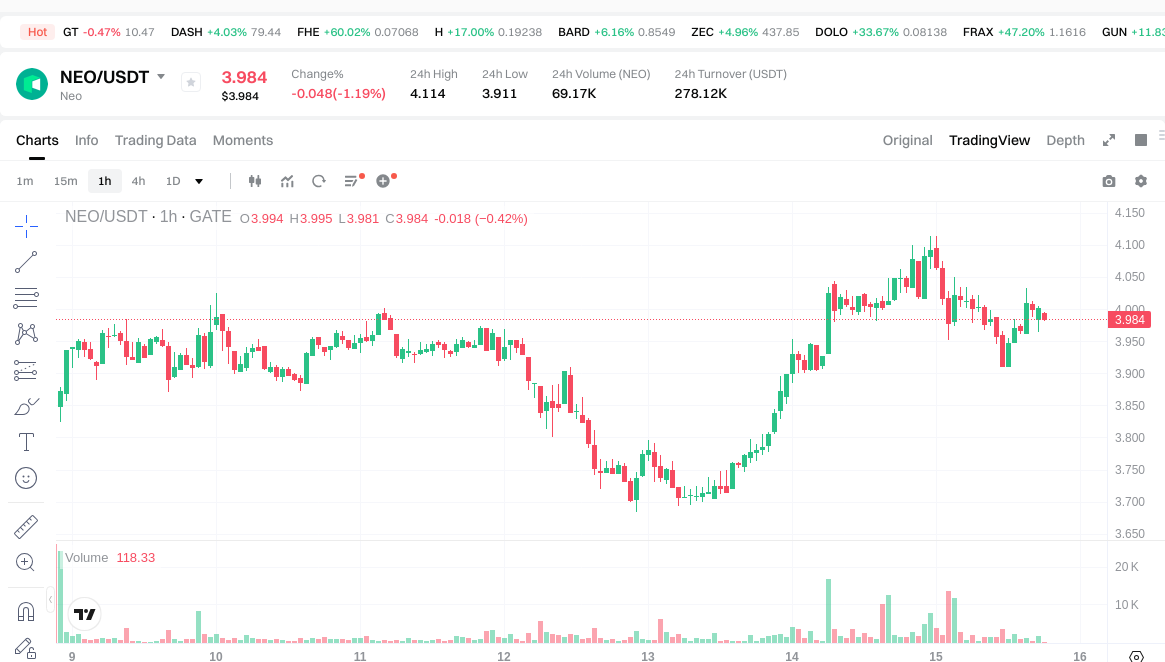
Current NEO Investment Market Status (January 2026)
- NEO current price: $3.986
- 24-hour price change: -1.82%
- 24-hour trading volume: $281,203.07
- Market capitalization: $281,132,580
- Circulating supply: 70.53 million NEO (70.53% of total supply)
Click to view real-time NEO market price
Looking ahead, NEO's price trajectory may be influenced by several key factors: the cyclical volatility of the broader cryptocurrency market will continue to affect short-term prices; NEO's ecosystem development and practical application implementation will impact investor confidence; and global cryptocurrency regulatory policies and technical upgrade progress may also provide support or pressure on prices. Overall, NEO demonstrates long-term potential, though short-term volatility remains significant.
II. Core Factors Influencing Whether NEO Is a Good Investment
Supply Mechanism and Scarcity (NEO Investment Scarcity)
- NEO operates with a fixed maximum supply of 100,000,000 tokens, with approximately 70,530,000 tokens currently in circulation (70.53% circulating supply ratio). This predetermined supply cap introduces a scarcity element that may influence long-term investment dynamics.
- Historical context: NEO's price has experienced significant volatility since its inception, with fluctuations shaped by broader market cycles and platform developments. The token's supply structure has remained a constant factor throughout these cycles.
- Investment implications: The fixed supply model provides a predictable scarcity framework, which some analysts view as a potential foundation for long-term value consideration, though this does not guarantee price appreciation.
Institutional Investment and Mainstream Adoption (Institutional Investment in NEO)
- NEO maintains listings across 32 exchanges and holds approximately 135,358 holders as of current data, reflecting a moderate level of adoption within the crypto ecosystem.
- Platform recognition: NEO was featured in Binance's 8-year anniversary recognition, indicating continued attention from major exchange platforms within the industry.
- Adoption considerations: While NEO has established a presence in the blockchain space, detailed information regarding specific institutional holdings or major enterprise adoption patterns was not available in the provided materials.
Macroeconomic Environment's Impact on NEO Investment
- Broader market conditions: Cryptocurrency markets, including NEO, typically respond to shifts in global monetary policy, interest rate adjustments, and liquidity conditions. These macroeconomic factors can influence investor risk appetite and capital flows into digital assets.
- Market positioning: While NEO operates within the broader digital asset category, specific data regarding its performance as an inflation hedge or during geopolitical uncertainty periods was not detailed in the available materials.
- Investment context: NEO's market capitalization stands at approximately $281,132,580, representing 0.011% market dominance, positioning it as a mid-cap asset subject to both sector-wide trends and platform-specific developments.
Technology and Ecosystem Development (Technology & Ecosystem for NEO Investment)
- NEO N3 platform: The migration to N3 represents a significant technical upgrade, enabling developers to build Web3 applications using multiple programming languages. This multi-language support aims to lower barriers to entry for developers and potentially expand the platform's ecosystem.
- Infrastructure developments: SpoonOS has been introduced as Web3 infrastructure designed for AI agents, representing an effort to position NEO within emerging technology trends. Additionally, the NEO X mainnet upgrade incorporates anti-MEV (Miner Extractable Value) mechanisms intended to address fairness concerns in transaction ordering.
- Ecosystem components: The platform features DeFi infrastructure, with CarrotSwap serving as a decentralized exchange within the ecosystem. NEO's tokenomics include a dual-token model (NEO and GAS), where GAS serves as the network's operational token. Community grants and governance initiatives remain active, supporting ongoing development efforts.
- Technical considerations: NEO has implemented EVM (Ethereum Virtual Machine) compatibility features, potentially enabling cross-chain interactions and expanding the range of applications that can be deployed on the platform.
III. NEO Future Investment Prediction and Price Outlook (Is Neo(NEO) worth investing in 2026-2031)
Short-term Investment Prediction (2026, short-term NEO investment outlook)
Based on multiple forecasting models, NEO's price trajectory in 2026 presents varied scenarios. Conservative estimates suggest a trading range between $2.55 and $3.86, reflecting potential market consolidation. Neutral forecasts indicate a range of $3.53 to $4.07, incorporating moderate growth expectations. Optimistic projections place NEO between $5.94 and $8.51 by year-end 2026, assuming favorable market conditions and ecosystem development. These predictions account for historical patterns, market volatility, and current technical indicators showing neutral momentum with RSI around 57.
Mid-term Investment Outlook (2027-2029, mid-term Neo(NEO) investment forecast)
-
Market Phase Expectations: The mid-term period may witness progressive ecosystem maturation, with NEO potentially transitioning through accumulation and growth phases. Technical analysis suggests monitoring key moving averages (50-day, 100-day, 200-day) for trend confirmation signals.
-
Investment Return Projections:
- 2027: $4.25 to $7.39, representing potential appreciation of 24% from 2026 baseline
- 2028: $5.90 to $6.79, with growth scenarios ranging from 45.77% in optimistic cases
- 2029: $6.48 to $7.78, reflecting continued upward trajectory under favorable conditions
-
Key Catalysts: Supply-demand dynamics, market sentiment shifts, regulatory developments, institutional adoption rates, and broader macroeconomic trends (including inflation and interest rates) may influence price movements. Breakthrough developments in the Neo ecosystem and increased mainstream adoption could serve as significant growth drivers.
Long-term Investment Outlook (Is NEO a good long-term investment?)
- Baseline Scenario: $7.13 - $10.89 range through 2031 (assuming steady ecosystem development and moderate market growth)
- Optimistic Scenario: $13.01 - $15.79 range by 2030-2031 (contingent upon accelerated adoption and favorable regulatory environment)
- Risk Scenario: $2.42 - $4.50 range (under adverse market conditions or significant ecosystem challenges)
Check NEO long-term investment and price prediction: Price Prediction
2026-2031 Long-term Outlook
- Base Scenario: $3.86 - $7.56 USD (corresponding to steady progress and gradual mainstream application growth)
- Optimistic Scenario: $7.39 - $15.79 USD (corresponding to large-scale adoption and favorable market environment)
- Transformative Scenario: Above $34.01 USD (contingent upon breakthrough ecosystem developments and mainstream penetration by 2034)
- 2031-12-31 Projected High: $10.89 USD (based on optimistic development assumptions)
Disclaimer: These projections are derived from statistical models and historical patterns. Cryptocurrency markets exhibit high volatility, and actual prices may vary significantly from predictions. Multiple factors including supply-demand dynamics, market sentiment, regulatory changes, institutional adoption, and macroeconomic conditions influence price movements. This information is for reference purposes only and does not constitute investment advice. Investors should conduct thorough research and consider their risk tolerance before making investment decisions.
| Year |
Predicted High Price |
Predicted Average Price |
Predicted Low Price |
Price Change |
| 2026 |
5.93616 |
3.984 |
2.54976 |
0 |
| 2027 |
7.3905192 |
4.96008 |
4.8112776 |
24 |
| 2028 |
6.79282956 |
6.1752996 |
3.766932756 |
54 |
| 2029 |
7.780877496 |
6.48406458 |
6.0301800594 |
62 |
| 2030 |
7.98836756256 |
7.132471038 |
6.34789922382 |
78 |
| 2031 |
10.8870037924032 |
7.56041930028 |
7.1067941422632 |
89 |
IV. Neo Investment Strategy and Risk Management (How to invest in Neo)
Investment Strategy (Neo investment strategy)
Long-term Holding (HODL Neo)
For conservative investors seeking stability, long-term holding represents a viable approach to Neo investment. This strategy involves purchasing Neo tokens and maintaining positions through market fluctuations, focusing on the platform's fundamental value proposition in building next-generation internet infrastructure through blockchain technology. Long-term holders typically prioritize Neo's community-driven development model and its vision for realizing an intelligent economy.
Active Trading
Active trading strategies rely on technical analysis and swing trading operations. Traders may utilize Neo's price volatility to capitalize on short-term price movements. With 24-hour trading volume reaching $281,203.07, the market provides liquidity for active trading approaches. Technical indicators, chart patterns, and market sentiment analysis form the foundation of this methodology.
Risk Management (Risk management for Neo investment)
Asset Allocation Ratios
- Conservative Investors: May consider allocating 2-5% of their cryptocurrency portfolio to Neo, maintaining larger positions in more established assets
- Aggressive Investors: Could allocate 10-15% to Neo within a diversified crypto portfolio, accepting higher volatility for potential growth
- Professional Investors: May employ dynamic allocation strategies based on market conditions and technical indicators
Risk Hedging Solutions
Implementing a multi-asset portfolio approach helps mitigate concentration risk. Investors may consider:
- Diversification across different blockchain platforms and use cases
- Incorporating stablecoins to preserve capital during volatile periods
- Utilizing risk management tools available on trading platforms
Secure Storage
Cold and Hot Wallet Solutions:
- Hot wallets facilitate active trading and regular transactions
- Cold storage solutions provide enhanced security for long-term holdings
Hardware Wallet Recommendations:
Hardware wallets offer offline storage with private key protection, suitable for investors prioritizing security over convenience.
V. Neo Investment Risks and Challenges (Risks of investing in Neo)
Market Risk
High Volatility: Neo demonstrates significant price fluctuations, with a 24-hour change of -1.82% and a 1-year change of -73.21%. The current price of $3.986 represents a substantial decline from its all-time high of $198.38 recorded on January 15, 2018.
Price Manipulation Concerns: As with many cryptocurrency markets, potential exists for price manipulation through various mechanisms, particularly during periods of lower liquidity.
Regulatory Risk
Policy Uncertainty Across Jurisdictions: Regulatory frameworks for blockchain platforms and digital assets vary significantly across countries. Changes in regulatory stance can impact Neo's adoption, trading availability, and overall market sentiment. Investors should monitor regulatory developments in key markets.
Technical Risk
Network Security Vulnerabilities: Blockchain platforms face ongoing challenges related to network security, smart contract vulnerabilities, and potential exploits. While Neo maintains an active development community with repositories on GitHub, technical risks remain inherent to the platform.
Upgrade Failures: Protocol upgrades and network improvements carry implementation risks that could temporarily affect network functionality or user confidence.
VI. Conclusion: Is Neo a Good Investment?
Investment Value Summary
Neo presents a complex investment proposition. The platform's community-driven development model and focus on building blockchain infrastructure for an intelligent economy provide long-term potential. However, investors should note the substantial price volatility, as evidenced by the -73.21% change over the past year and the significant gap between current price ($3.986) and all-time high ($198.38).
The circulating supply of 70,530,000 NEO represents 70.53% of the total supply of 100,000,000, with a market capitalization of approximately $281 million and market dominance of 0.011%.
Investor Recommendations
✅ Beginners:
- Consider dollar-cost averaging (DCA) approach to mitigate timing risk
- Prioritize secure wallet storage solutions
- Allocate only funds you can afford to lose
- Conduct thorough research before investing
✅ Experienced Investors:
- Employ swing trading strategies based on technical analysis
- Maintain diversified portfolio allocation
- Monitor on-chain metrics and development activity
- Utilize risk management tools
✅ Institutional Investors:
- Consider strategic long-term allocation within blockchain infrastructure thesis
- Conduct comprehensive due diligence on platform development and ecosystem growth
- Implement professional risk management frameworks
⚠️ Important Notice: Cryptocurrency investments carry substantial risk due to high volatility and market uncertainty. This content is provided for informational purposes only and does not constitute investment advice. Investors should conduct independent research and consult with financial advisors before making investment decisions.
VII. FAQ
Q1: What is Neo (NEO) and why is it considered an investment opportunity?
Neo is a community-driven open-source blockchain platform launched in 2014 that enables developers to digitalize and automate asset management through smart contracts. It is considered an investment opportunity due to its focus on building next-generation Internet infrastructure for a "smart economy," its fixed maximum supply of 100 million tokens creating scarcity, and its technical features including multi-language smart contract support and EVM compatibility. As of January 2026, NEO maintains a market capitalization of approximately $281 million with the current price at $3.986.
Q2: How has Neo's price performed historically?
Neo experienced significant appreciation during the 2017-2018 bull market, reaching an all-time high of $198.38 on January 15, 2018. Following the broader market correction, prices declined substantially through 2018-2019. The platform showed phased recovery between 2019-2021 alongside Bitcoin's rise. Currently, NEO trades at $3.986, representing a -73.21% change over the past year. The historical performance demonstrates high volatility characteristic of cryptocurrency markets, influenced by market cycles, ecosystem developments, and broader macroeconomic conditions.
Q3: What are the price predictions for Neo through 2031?
Short-term projections for 2026 range from conservative estimates of $2.55-$3.86 to optimistic scenarios of $5.94-$8.51. Mid-term forecasts suggest prices between $4.25-$7.39 for 2027, $5.90-$6.79 for 2028, and $6.48-$7.78 for 2029. Long-term outlook through 2031 presents a baseline scenario of $7.13-$10.89, with optimistic projections reaching $13.01-$15.79 by 2030-2031. These predictions account for ecosystem development, market conditions, and adoption rates, though actual prices may vary significantly due to market volatility.
Q4: What are the main risks associated with investing in Neo?
Primary risks include high market volatility, as evidenced by the -73.21% decline over the past year and significant gap from all-time highs. Regulatory uncertainty across different jurisdictions poses policy risks affecting adoption and trading availability. Technical risks encompass potential network security vulnerabilities and smart contract exploits. The platform's relatively small market dominance of 0.011% and 24-hour trading volume of $281,203 indicates lower liquidity compared to major cryptocurrencies. Price manipulation concerns exist during periods of reduced market activity.
Q5: What investment strategies are recommended for Neo?
Long-term holding (HODL) suits conservative investors focusing on fundamental value and ecosystem development, typically allocating 2-5% of their crypto portfolio. Active traders may utilize technical analysis and swing trading strategies, with aggressive investors potentially allocating 10-15% based on market conditions. Dollar-cost averaging (DCA) helps mitigate timing risk, particularly for beginners. Diversification across multiple assets and secure storage solutions (hardware wallets for long-term holdings, hot wallets for active trading) form essential components of risk management.
Q6: How does Neo's technology and ecosystem support investment potential?
Neo N3 platform enables multi-language smart contract development, lowering barriers for developers. The platform features EVM compatibility for cross-chain interactions, DeFi infrastructure including CarrotSwap decentralized exchange, and a dual-token model (NEO and GAS). Recent developments include NEO X mainnet upgrade with anti-MEV mechanisms and SpoonOS infrastructure for AI agents. Active GitHub repositories and community governance initiatives demonstrate ongoing development. These technical features position Neo within emerging blockchain trends, though ecosystem adoption and practical implementation remain key factors for long-term value.
Q7: Is Neo suitable for institutional investors?
Neo may warrant consideration for institutional investors as part of a blockchain infrastructure thesis, though several factors require evaluation. The platform maintains listings across 32 exchanges with approximately 135,358 holders, indicating moderate adoption. Recognition from major platforms like Binance suggests industry attention. However, the relatively small market capitalization of $281 million and 0.011% market dominance indicate mid-cap status subject to higher volatility. Institutional investors should conduct comprehensive due diligence on development progress, regulatory compliance, and implement professional risk management frameworks before allocating capital.
Q8: What factors most significantly influence Neo's investment value?
Key factors include the fixed supply mechanism of 100 million tokens with 70.53% currently circulating, creating potential scarcity dynamics. Broader cryptocurrency market cycles and macroeconomic conditions (monetary policy, interest rates, liquidity) significantly impact price movements. Ecosystem development progress, including DApp implementations and cross-chain collaborations, influences investor confidence. Regulatory policy changes across jurisdictions affect adoption rates. Technical upgrades and mainstream adoption levels serve as catalysts for value reassessment. Market sentiment and institutional participation patterns also play substantial roles in determining investment value.
* The information is not intended to be and does not constitute financial advice or any other recommendation of any sort offered or endorsed by Gate.