This comprehensive analysis examines Numbers Protocol (NUM) as an investment opportunity within the decentralized media sector. Trading at $0.008498 as of January 2026 with a market cap of $7.46 million, NUM serves as the native token for a decentralized photo network enabling copyright registration and digital media authentication. The article evaluates NUM's tokenomics, historical price performance (79.16% annual decline), short and long-term price forecasts, and multi-tiered investment strategies suitable for different investor profiles. Key considerations include market volatility, limited liquidity across 4 exchanges, regulatory uncertainty, and technical risks. The analysis provides actionable guidance for beginners through institutional investors, emphasizing risk management, secure storage on Gate and alternative wallets, and the importance of independent research before capital deployment in this emerging but volatile cryptocurrency asset.
Introduction: Numbers Protocol (NUM) Investment Position and Market Prospects
NUM is a notable asset in the cryptocurrency field. As of January 27, 2026, NUM has a market capitalization of approximately $7.46 million, with a circulating supply of around 877.50 million tokens, and the current price stands at approximately $0.008498. Numbers Protocol operates as a decentralized photo network, creating community, value, and trust for digital media. The native token NUM serves multiple functions including purchasing, gifting, and registering copyrights for images and videos within this ecosystem. With a market ranking of 1344 and availability on 4 exchanges, NUM has gradually become a subject of discussion among investors considering "Is Numbers Protocol (NUM) a good investment?" This article will comprehensively analyze NUM's investment value, historical trends, future price predictions, and investment risks to provide reference for investors.
I. Numbers Protocol (NUM) Price History and Investment Value Status
The price history of Numbers Protocol (NUM) reflects the broader volatility characteristic of digital asset markets. According to available data, NUM experienced significant price fluctuations since its launch.
-
2021: NUM reached a notable peak at $2.52 on November 28, 2021, during a period of heightened market activity across the digital asset sector. This represented a period of strong investor interest in decentralized photo network solutions.
-
2025: The token experienced substantial downward price movement, with NUM recording a low of $0.00532095 on December 8, 2025. This represented a considerable decline from previous levels, reflecting broader market adjustments and changing investor sentiment.
-
2026: As of January 27, 2026, NUM is trading at approximately $0.008498, showing some recovery from the December 2025 levels but remaining well below historical peaks. Over the past year, the token has experienced a decline of approximately 79.16%.
Current NUM Investment Market Status (January 2026)
- Current NUM Price: $0.008498 (as of January 27, 2026)
- 24-hour Price Range: High of $0.009351, low of $0.008233
- 24-hour Trading Volume: $47,496.34
- Recent Price Performance:
- 1-hour change: +0.12%
- 24-hour change: -1.1%
- 7-day change: +8.01%
- 30-day change: +1.06%
- 1-year change: -79.16%
Click to view real-time NUM market price
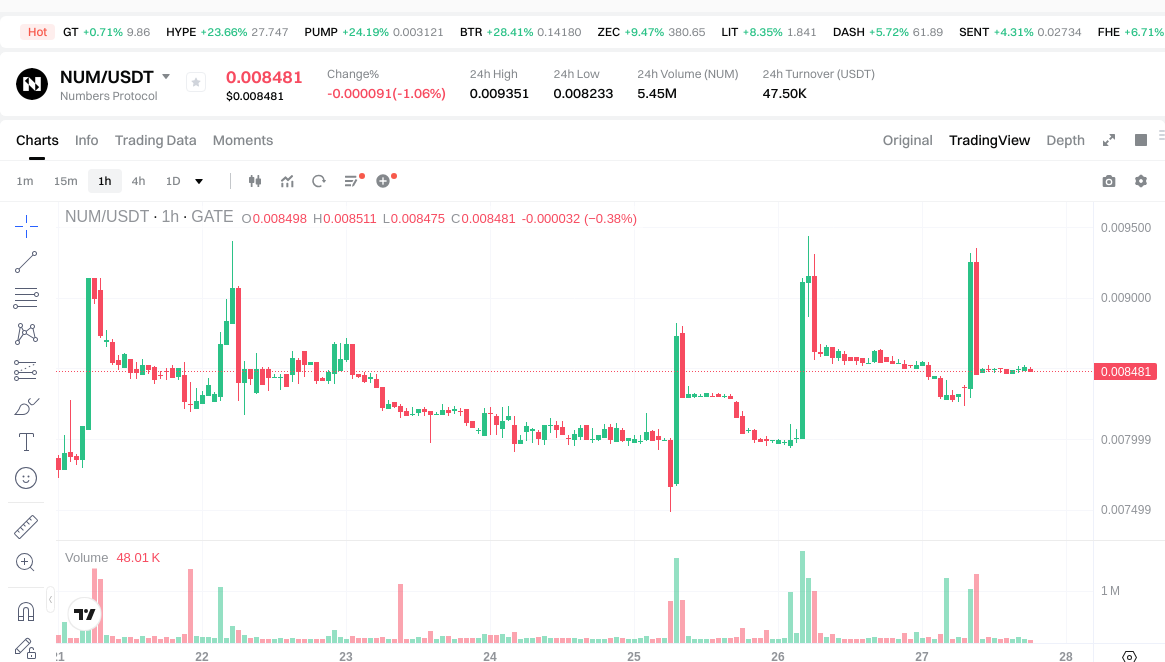
II. Core Factors Affecting Whether NUM is a Good Investment
Supply Mechanism and Scarcity
- Numbers Protocol (NUM) has a maximum supply of 1,000,000,000 tokens, with 877,495,317 tokens currently in circulation, representing approximately 87.75% of the total supply
- The circulating supply ratio indicates that most tokens are already in the market, which may limit future scarcity-driven price appreciation
- Investment consideration: With a relatively high circulating supply ratio, the scarcity factor may have limited influence on long-term investment value compared to projects with lower circulation rates
Institutional Investment and Mainstream Adoption
- Numbers Protocol currently has 1,832 token holders as of January 27, 2026
- The token is listed on 4 exchanges, indicating relatively limited mainstream adoption compared to major cryptocurrencies
- Market dominance stands at 0.00023%, reflecting minimal institutional presence and mainstream recognition in the broader crypto market
Macroeconomic Environment Impact on NUM Investment
- NUM's price performance shows significant sensitivity to market conditions, with a one-year decline of 79.16% as of January 27, 2026
- The token's price of $0.008498 represents a substantial decrease from its historical peak of $2.52 recorded in November 2021
- Current market capitalization of $7,456,955 places NUM in a micro-cap category, making it more susceptible to broader macroeconomic pressures and market volatility
Technology and Ecosystem Development
- Numbers Protocol operates as a decentralized photo network aimed at creating community, value, and trust for digital media
- The NUM token serves as the native token for the decentralized photo network, with utility in purchasing, gifting, and registering copyright for images and videos
- Contract deployments exist on both BSC (BNB Smart Chain) and Ethereum networks, providing multi-chain accessibility
- According to various price prediction sources, technical analysis indicators present mixed signals, with some forecasts suggesting bearish trends for 2026
III. NUM Future Investment Forecast and Price Outlook (Is Numbers Protocol(NUM) worth investing in 2026-2031)
Short-term Investment Forecast (2026, short-term NUM investment outlook)
- Conservative forecast: $0.00611 - $0.00848
- Neutral forecast: $0.00785 - $0.00920
- Optimistic forecast: $0.00920 - $0.00992
Mid-term Investment Outlook (2027-2029, mid-term Numbers Protocol(NUM) investment forecast)
- Market stage expectation: The token may enter a gradual recovery phase with potential ecosystem expansion and increased utility adoption within the decentralized photo network.
- Investment return forecast:
- 2027: $0.00865 - $0.01325
- 2028: $0.00662 - $0.01392
- 2029: $0.01018 - $0.01785
- Key catalysts: Ecosystem developments, partnerships within digital media verification space, and broader adoption of decentralized photo registration services.
Long-term Investment Outlook (Is NUM a good long-term investment?)
- Base scenario: $0.01107 - $0.01757 (assuming steady ecosystem growth and maintained network activity)
- Optimistic scenario: $0.01521 - $0.02021 (assuming accelerated adoption and favorable market conditions)
- Risk scenario: Below $0.00662 (under adverse market conditions or limited ecosystem expansion)
Click to view NUM long-term investment and price forecast: Price Prediction
2026-01-27 - 2031 Long-term Outlook
- Base scenario: $0.01107 - $0.01757 (corresponding to steady progress and gradual mainstream application enhancement)
- Optimistic scenario: $0.01521 - $0.02021 (corresponding to large-scale adoption and favorable market environment)
- Transformative scenario: Above $0.02021 (in case of breakthrough ecosystem developments and mainstream adoption)
- 2031-12-31 predicted high: $0.02021 (based on optimistic development assumptions)
Disclaimer: The forecasts presented are based on historical data analysis and market trends. Cryptocurrency investments carry substantial risks, and actual prices may differ materially from projections due to market volatility, regulatory changes, technological developments, and other unforeseen factors. This information should not be construed as investment advice.
| Year |
Predicted High Price |
Predicted Average Price |
Predicted Low Price |
Price Change |
| 2026 |
0.00992277 |
0.008481 |
0.00610632 |
0 |
| 2027 |
0.0132507144 |
0.009201885 |
0.0086497719 |
8 |
| 2028 |
0.013920611628 |
0.0112262997 |
0.006623516823 |
32 |
| 2029 |
0.01785430704288 |
0.012573455664 |
0.01018449908784 |
47 |
| 2030 |
0.019930184573006 |
0.01521388135344 |
0.014453187285768 |
79 |
| 2031 |
0.020207837907706 |
0.017572032963223 |
0.01107038076683 |
106 |
IV. NUM Investment Strategy and Risk Management (How to invest in Numbers Protocol)
Investment Methodology (NUM investment strategy)
Long-term Holding (HODL NUM): Suitable for conservative investors
Long-term holding is a passive investment approach that involves purchasing NUM tokens and maintaining positions over extended periods, typically measured in years. This strategy aims to capture potential value appreciation as the Numbers Protocol ecosystem develops and adoption increases. Conservative investors may consider this approach to minimize transaction costs and avoid short-term market volatility. The strategy relies on the fundamental belief that decentralized photo networks will gain broader acceptance in digital media markets over time.
Active Trading: Relies on technical analysis and swing operations
Active trading involves frequent position adjustments based on technical indicators, chart patterns, and market momentum. Traders utilizing this approach typically employ tools such as moving averages, relative strength index (RSI), and volume analysis to identify entry and exit points. Given NUM's 24-hour price range between $0.008233 and $0.009351 as of January 27, 2026, swing traders may seek to capitalize on intraday price movements. This methodology requires continuous market monitoring and understanding of cryptocurrency market dynamics.
Risk Management (Risk management for NUM investment)
Asset Allocation Ratio: Conservative / Aggressive / Professional investors
- Conservative investors: May consider allocating 1-3% of their cryptocurrency portfolio to NUM, maintaining larger positions in established assets with higher market capitalization and liquidity.
- Aggressive investors: Could allocate 5-10% of their cryptocurrency holdings to NUM, accepting higher risk exposure in exchange for potential returns from emerging protocols.
- Professional investors: Might employ dynamic allocation strategies ranging from 3-15% based on market conditions, technical indicators, and fundamental developments within the Numbers Protocol ecosystem.
Risk Hedging Solutions: Multi-asset portfolio + hedging instruments
Investors can implement diversification strategies by combining NUM holdings with assets exhibiting low correlation, such as stablecoins, Bitcoin, or traditional financial instruments. Portfolio construction may include pairing NUM positions with established cryptocurrencies to balance risk-reward profiles. Advanced investors might explore options contracts or futures (where available) to hedge downside risk, though such instruments may have limited availability for lower market cap tokens.
Secure Storage: Hot and cold wallets + hardware wallet recommendations
NUM tokens deployed on BSC (contract: 0xeceb87cf00dcbf2d4e2880223743ff087a995ad9) and ETH (contract: 0x3496b523e5c00a4b4150d6721320cddb234c3079) require appropriate storage solutions:
- Hot wallets: Software wallets like MetaMask or Trust Wallet offer convenient access for active traders, supporting both BSC and ETH networks.
- Cold storage: Hardware wallets such as Ledger or Trezor provide enhanced security for long-term holdings by keeping private keys offline.
- Best practices: Investors should verify contract addresses before transactions, enable two-factor authentication on exchange accounts, and maintain backup recovery phrases in secure physical locations.
V. NUM Investment Risks and Challenges (Risks of investing in Numbers Protocol)
Market Risk: High volatility and price manipulation
NUM demonstrates significant price volatility, with a 1-year decline of 79.16% as of January 27, 2026. The token's 24-hour trading volume of $47,496.34 relative to its market capitalization of approximately $7.46 million indicates limited liquidity, which can amplify price swings during periods of buying or selling pressure. The price range from an all-time high of $2.52 (November 28, 2021) to an all-time low of $0.005321 (December 8, 2025) illustrates the substantial volatility characteristic of lower market cap digital assets. Limited exchange listings (4 exchanges) may concentrate trading activity and potentially increase susceptibility to market manipulation.
Regulatory Risk: Policy uncertainty across different countries
Cryptocurrency regulations continue to evolve globally, with varying approaches across jurisdictions. Digital asset projects involving media content and copyright registration, such as Numbers Protocol, may face additional scrutiny regarding intellectual property laws, data privacy regulations, and content authenticity standards. Changes in regulatory frameworks could impact token utility, trading availability, or operational parameters of the protocol. Investors should monitor regulatory developments in their respective jurisdictions and understand compliance requirements for cryptocurrency holdings.
Technical Risk: Network security vulnerabilities and upgrade failures
As a protocol operating across multiple blockchain networks (BSC and ETH), NUM faces technical risks inherent to distributed systems. Smart contract vulnerabilities could potentially expose user funds or protocol functionality to exploits. Network congestion on underlying blockchains may affect transaction processing times and costs. Protocol upgrades or migrations carry implementation risks that could temporarily disrupt services or introduce unforeseen technical issues. With 1,832 token holders as of the latest data, the relatively limited user base may indicate early-stage adoption risks and potential challenges in achieving network effects necessary for long-term sustainability.
VI. Conclusion: Is Numbers Protocol a Good Investment?
Investment Value Summary: NUM presents characteristics of an emerging protocol in the decentralized media sector, with notable long-term uncertainty and substantial short-term price volatility.
Numbers Protocol aims to address digital media authenticity and copyright challenges through blockchain technology. The token's market position, with a ranking of 1,344 and market dominance of 0.00023%, reflects its status as a smaller market cap asset within the broader cryptocurrency ecosystem. The circulating supply of 877,495,317 NUM tokens represents 87.75% of the maximum supply of 1,000,000,000 tokens, indicating relatively high circulation. Recent price movements show a 7-day increase of 8.01% alongside a 1-year decline of 79.16%, demonstrating mixed short and medium-term performance trends.
Investor Recommendations:
✅ Beginners: Consider dollar-cost averaging (DCA) strategies combined with secure wallet storage. New investors should prioritize understanding the protocol's fundamentals, verifying contract addresses, and practicing proper security measures before committing capital. Start with small allocations to gain familiarity with cryptocurrency markets and the specific characteristics of lower market cap tokens.
✅ Experienced Investors: May explore swing trading opportunities alongside diversified portfolio allocation. Technical analysis skills can help identify potential entry and exit points within NUM's price ranges. Experienced participants should assess risk-reward ratios carefully and maintain position sizing discipline given the token's volatility profile and liquidity constraints.
✅ Institutional Investors: Could evaluate strategic long-term allocation within specialized digital media or Web3 portfolio segments. Institutional participants should conduct comprehensive due diligence on protocol development progress, team credentials, partnership ecosystem, and competitive positioning within the decentralized media landscape. Consider appropriate allocation sizing relative to overall fund mandates and risk parameters.
⚠️ Disclaimer: Cryptocurrency investments carry substantial risk, including potential total loss of capital. This content serves informational purposes only and does not constitute investment advice, financial guidance, or recommendations to buy, sell, or hold any digital assets. Market conditions, regulatory environments, and protocol developments can change rapidly. Individuals should conduct independent research, assess personal risk tolerance, and consult qualified financial advisors before making investment decisions.
VII. FAQ
Q1: What is Numbers Protocol (NUM) and what makes it unique in the cryptocurrency market?
Numbers Protocol (NUM) is the native token of a decentralized photo network designed to create community, value, and trust for digital media. The protocol addresses digital media authenticity and copyright challenges through blockchain technology, allowing users to purchase, gift, and register copyrights for images and videos. What distinguishes NUM from other cryptocurrencies is its specific focus on the decentralized media verification sector, operating across both BSC (BNB Smart Chain) and Ethereum networks to provide multi-chain accessibility for digital content creators and users seeking provenance and ownership verification for visual media.
Q2: How volatile is NUM compared to major cryptocurrencies?
NUM exhibits significantly higher volatility compared to established cryptocurrencies. The token experienced a 79.16% decline over the past year (as of January 27, 2026), dropping from a historical peak of $2.52 in November 2021 to its current price of approximately $0.008498. With a 24-hour trading volume of only $47,496.34 against a market capitalization of approximately $7.46 million, NUM demonstrates limited liquidity characteristics typical of lower market cap assets. This liquidity profile can amplify price swings during buying or selling pressure, making NUM considerably more volatile than major cryptocurrencies with higher trading volumes and deeper market depth.
Q3: Is Numbers Protocol (NUM) suitable for long-term investment?
NUM's suitability for long-term investment depends heavily on individual risk tolerance and portfolio strategy. Conservative long-term forecasts suggest potential price ranges of $0.01107 - $0.01757 by 2031, representing modest appreciation from current levels under steady ecosystem growth assumptions. However, several risk factors warrant consideration: the token's market ranking of 1,344, limited exchange listings (4 exchanges), and relatively small holder base of 1,832 participants indicate early-stage adoption. Conservative investors might allocate 1-3% of their cryptocurrency portfolio to NUM, while more aggressive investors could consider 5-10% allocations. The investment thesis relies on the fundamental belief that decentralized photo networks will gain broader acceptance in digital media markets over extended time horizons.
Q4: What are the primary risks associated with investing in NUM?
NUM investment carries multiple risk categories: (1) Market Risk - substantial price volatility demonstrated by the 79.16% annual decline and wide historical price range from $2.52 to $0.005321, alongside limited liquidity that may increase susceptibility to price manipulation; (2) Regulatory Risk - evolving cryptocurrency regulations globally, with potential additional scrutiny for projects involving media content, copyright registration, intellectual property laws, and data privacy standards; (3) Technical Risk - smart contract vulnerabilities across BSC and ETH networks, network congestion affecting transaction costs, and protocol upgrade implementation risks. The relatively limited user base of 1,832 token holders suggests early-stage adoption risks and potential challenges in achieving network effects necessary for long-term sustainability.
Q5: How should beginners approach investing in Numbers Protocol (NUM)?
Beginners should prioritize education and risk management when considering NUM investment. Start by understanding the protocol's fundamentals, including its role in digital media authentication and copyright registration. Implement dollar-cost averaging (DCA) strategies to mitigate timing risk, purchasing small amounts regularly rather than committing large capital upfront. Verify contract addresses (BSC: 0xeceb87cf00dcbf2d4e2880223743ff087a995ad9; ETH: 0x3496b523e5c00a4b4150d6721320cddb234c3079) before transactions. Practice proper security measures using reputable wallets like MetaMask or Trust Wallet, enable two-factor authentication, and maintain secure backup recovery phrases. Begin with minimal allocations to gain familiarity with cryptocurrency markets and NUM's specific characteristics before increasing position sizes.
Q6: What trading strategies work best for NUM given its market characteristics?
NUM's trading characteristics support different strategic approaches: (1) Long-term Holding (HODL) suits conservative investors who believe in the protocol's fundamental value proposition and can tolerate extended drawdown periods, minimizing transaction costs while awaiting ecosystem development; (2) Active Trading may appeal to experienced traders who can capitalize on price volatility, utilizing technical indicators such as moving averages, RSI, and volume analysis to identify entry and exit points within the 24-hour trading ranges (recent range: $0.008233 - $0.009351). Given the limited liquidity, swing traders should employ appropriate position sizing and avoid large orders that could significantly impact market prices. Risk management through stop-loss orders and defined profit targets becomes particularly important for active strategies.
Q7: What factors could drive NUM price appreciation in the future?
Several catalysts could potentially drive NUM price appreciation: (1) Ecosystem Development - successful expansion of the Numbers Protocol network, increased adoption among digital content creators, and partnerships within the digital media verification space; (2) Utility Expansion - broader use cases for NUM tokens beyond current copyright registration functions, potentially including governance rights or additional protocol features; (3) Market Conditions - favorable macroeconomic environment for cryptocurrency assets and increased investor interest in Web3 and decentralized media solutions; (4) Technical Milestones - successful protocol upgrades, enhanced security implementations, and improved cross-chain functionality. However, these potential catalysts face execution risks and depend on sustained development efforts, making price appreciation uncertain rather than guaranteed.
Q8: How does NUM's tokenomics structure affect its investment potential?
NUM's tokenomics present a mixed investment profile. The maximum supply of 1,000,000,000 tokens with 877,495,317 currently in circulation represents 87.75% distribution, indicating that most tokens are already in the market. This high circulation ratio may limit future scarcity-driven price appreciation compared to projects with lower circulation rates or deflationary mechanisms. The relatively mature supply distribution reduces concerns about major unlocks diluting token value but also means scarcity cannot serve as a primary value driver. With only 1,832 token holders, the concentration of holdings could create supply dynamics that amplify price movements in either direction. Investors should recognize that NUM's value proposition relies primarily on utility adoption and ecosystem growth rather than supply scarcity mechanisms.
* The information is not intended to be and does not constitute financial advice or any other recommendation of any sort offered or endorsed by Gate.