PAAL AI is an AI-powered blockchain ecosystem launched in 2023, currently trading at $0.03394 with a market capitalization of $33.94 million and 998.65 million circulating tokens (99.87% of total supply). This comprehensive investment analysis examines whether PAAL represents a viable opportunity by evaluating historical price movements (from $0.00008 to $0.88 peak), fundamental tokenomics, ecosystem technology incorporating machine learning and automated decision-making, and market dynamics across 12 exchanges including Gate.com. The guide addresses core investment considerations including supply scarcity, technology development potential, macroeconomic factors, and holder base growth to 56,925 addresses. Price forecasts range from $0.026-$0.041 (2026) to $0.067-$0.091 (2031 optimistic scenario), balanced against significant volatility risks and regulatory uncertainties. Strategic recommendations differentiate approaches for beginners (dollar-cost averaging), experienced traders (swing trading), and instituti
Introduction: PAAL AI (PAAL) Investment Position and Market Prospects
PAAL AI is a notable asset in the cryptocurrency space, having launched in 2023 and establishing its presence in the AI-powered blockchain ecosystem. As of January 2026, PAAL holds a market capitalization of approximately $33.94 million, with a circulating supply of around 998.65 million tokens, and a current price hovering near $0.03394. Positioned as an advanced AI-driven ecosystem featuring chatbots built on artificial intelligence and machine learning technologies, PAAL has attracted attention for its approach to streamlining tasks such as natural language understanding, decision-making, and trading automation. With over 56,925 holders and availability on 12 exchanges, the token has gradually become a focal point when investors discuss "Is PAAL AI (PAAL) a good investment?" This article provides a comprehensive analysis of PAAL's investment value, historical price movements, future price projections, and associated investment risks to offer reference points for potential investors.
I. PAAL Token Price History Review and Current Investment Value
- 2023: Initial market entry with launch price of $0.00008 → Token experienced significant growth trajectory
- September 2023: Price reached lower price range around $0.0088 → Represented early-stage valuation period
- March 2024: Milestone achievement with price reaching $0.88 → Reflected positive market momentum and investor interest
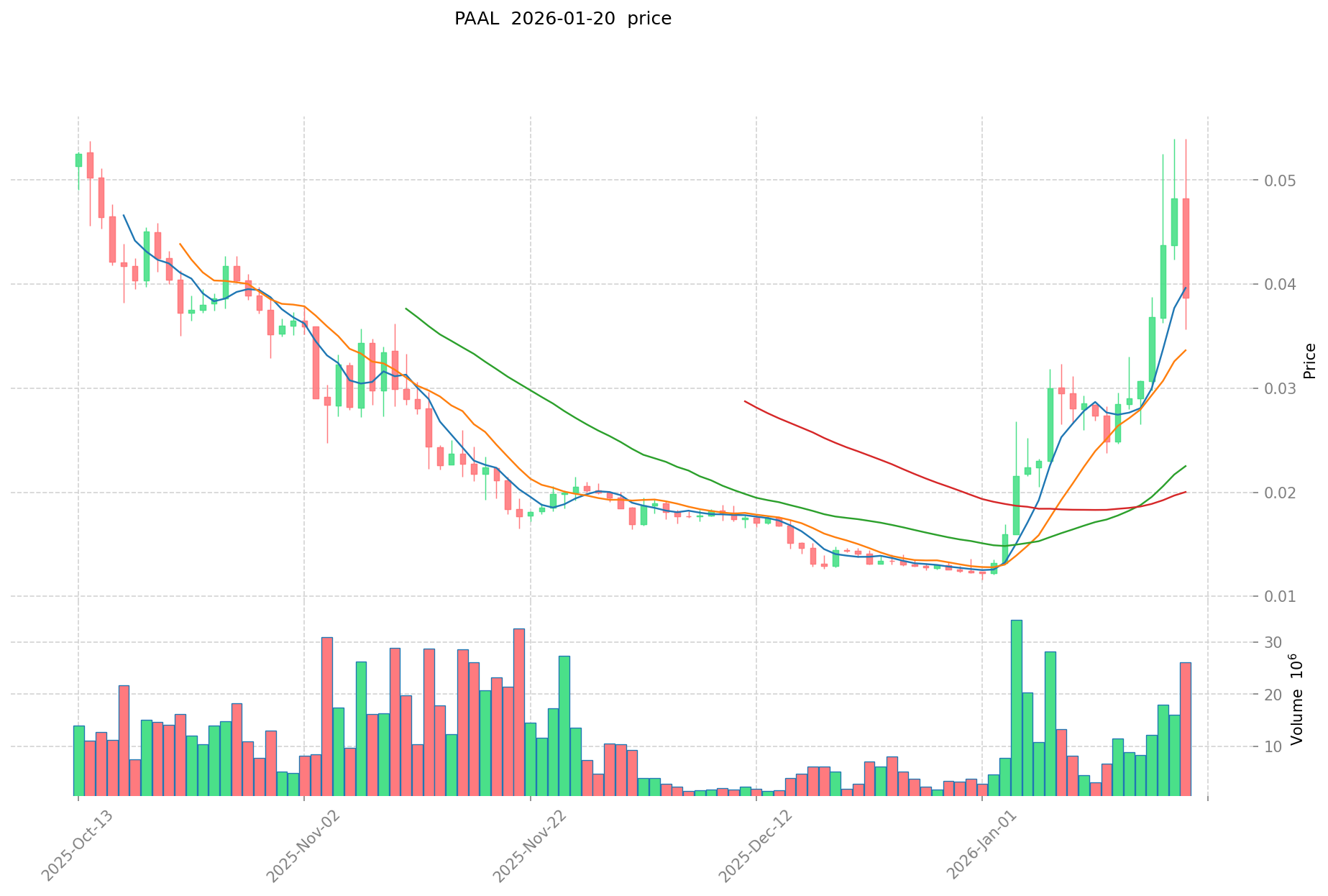
- 2025-2026: Market adjustment period → Price corrected to current levels around $0.03394
Current PAAL Investment Market Status (January 2026)
- PAAL current price: $0.03394
- 24-hour trading volume: $755,560.31
- Market capitalization: $33.89 million
- Circulating supply: 998.65 million PAAL (99.87% of total supply)
- Holder count: 56,925 addresses
Click to view real-time PAAL market price
II. Core Factors Affecting Whether PAAL is a Good Investment (Is PAAL AI(PAAL) a Good Investment)
Supply Mechanism and Scarcity (PAAL investment scarcity)
- Total Supply: PAAL AI has a maximum supply of 1,000,000,000 tokens, with approximately 998,652,231 tokens (99.87%) currently in circulation. This near-complete circulation suggests limited future supply pressure.
- Supply Impact on Price: The fixed supply model creates a deflationary framework that could support price appreciation as demand increases, particularly if adoption of PAAL AI's chatbot ecosystem expands.
- Investment Significance: The high circulating supply ratio (99.87%) reduces uncertainty around future token unlocks, which is often a favorable condition for investors seeking price stability and long-term value retention.
Institutional Investment and Mainstream Adoption (Institutional investment in PAAL)
- Holder Base: PAAL AI currently has approximately 56,925 token holders, indicating a growing community base. However, specific data on institutional holdings or enterprise partnerships were not detailed in the available materials.
- Exchange Presence: PAAL is listed on 12 exchanges, including Gate.com, which suggests a degree of market accessibility and liquidity for investors.
- Adoption Potential: PAAL AI's ecosystem focuses on AI-powered chatbots designed to streamline tasks such as natural language understanding, decision-making, and trading. The practical utility of these applications could drive broader adoption if the platform gains traction in decentralized AI services.
Macroeconomic Environment's Impact on PAAL Investment
- Market Sentiment: As of January 21, 2026, PAAL's price stands at $0.03394, reflecting a 143.34% increase over the past 30 days, though it has declined 89.92% over the past year. Such volatility underscores the influence of broader crypto market cycles and risk appetite.
- Crypto Market Dynamics: The performance of PAAL is closely tied to overall cryptocurrency market conditions, including regulatory developments, macroeconomic shifts, and investor sentiment toward AI-focused blockchain projects.
- Inflation and Alternative Assets: In environments where investors seek exposure to emerging technologies like AI and machine learning, PAAL's positioning as an AI-driven ecosystem could attract capital seeking diversification beyond traditional assets.
Technology and Ecosystem Development (Technology & Ecosystem for PAAL investment)
- AI and ML Integration: PAAL AI's ecosystem leverages artificial intelligence and machine learning technologies to offer chatbot solutions. The focus on automating complex tasks may enhance the platform's value proposition as AI adoption accelerates across industries.
- Ecosystem Expansion: The platform's roadmap and ongoing development could influence long-term investment value. Continued innovation in natural language processing, decision-making tools, and trading automation may strengthen PAAL's competitive position.
- DeFi and Application Use Cases: While specific DeFi integrations, NFT applications, or payment use cases were not detailed in the provided materials, the broader AI and crypto convergence trend suggests potential for ecosystem growth if PAAL expands its utility and partnerships within the decentralized finance and Web3 space.
III. PAAL Future Investment Forecast and Price Outlook (Is PAAL AI(PAAL) worth investing in 2026-2031)
Short-term Investment Forecast (2026, short-term PAAL investment outlook)
- Conservative Forecast: $0.026 - $0.034
- Neutral Forecast: $0.034 - $0.038
- Optimistic Forecast: $0.038 - $0.041
Based on current market data, PAAL AI demonstrates notable volatility with a 24-hour decline of 16.44% alongside a 30-day surge of 143.34%. The short-term outlook reflects this mixed momentum, where conservative scenarios account for potential market corrections while optimistic projections consider continuation of recent upward trends.
Mid-term Investment Outlook (2027-2029, mid-term PAAL AI(PAAL) investment forecast)
-
Market Stage Expectation: The mid-term period may witness PAAL AI's ecosystem maturation as AI and ML technologies continue evolving. The project's focus on natural language understanding and decision-making automation could position it favorably if broader AI adoption accelerates.
-
Investment Return Forecast:
- 2027: $0.027 - $0.055
- 2028: $0.024 - $0.050
- 2029: $0.039 - $0.063
-
Key Catalysts: Potential drivers include advancement in chatbot functionality, expansion of the AI ecosystem, partnerships within the blockchain and AI sectors, and overall sentiment toward AI-driven crypto projects.
Long-term Investment Outlook (Is PAAL a good long-term investment?)
- Base Scenario: $0.046 - $0.079 (assuming steady ecosystem development and moderate market conditions)
- Optimistic Scenario: $0.067 - $0.091 (assuming successful mainstream adoption and favorable regulatory environment)
- Risk Scenario: $0.026 - $0.039 (under conditions of market downturn or project development setbacks)
View PAAL long-term investment and price forecast: Price Prediction
2026-01-21 - 2031 Long-term Outlook
- Base Scenario: $0.046 - $0.056 (corresponding to steady progress and mainstream application growth)
- Optimistic Scenario: $0.067 - $0.091 (corresponding to large-scale adoption and favorable market environment)
- Transformative Scenario: Above $0.091 (if ecosystem achieves breakthrough developments and mainstream penetration)
- 2031-12-31 Predicted High: $0.091 (based on optimistic development assumptions)
Disclaimer: Price predictions are speculative and based on historical data, market trends, and project fundamentals. Cryptocurrency investments carry substantial risk, and past performance does not guarantee future results. Investors should conduct thorough research and consider their risk tolerance before making investment decisions.
| Year |
Predicted High Price |
Predicted Average Price |
Predicted Low Price |
Price Change |
| 2026 |
0.040572 |
0.03381 |
0.0256956 |
0 |
| 2027 |
0.05504268 |
0.037191 |
0.02677752 |
9 |
| 2028 |
0.0502673556 |
0.04611684 |
0.0239807568 |
35 |
| 2029 |
0.063131648118 |
0.0481920978 |
0.03855367824 |
41 |
| 2030 |
0.07848324087219 |
0.055661872959 |
0.04564273582638 |
64 |
| 2031 |
0.090547951836053 |
0.067072556915595 |
0.051645868825008 |
97 |
IV. PAAL AI Investment Strategy and Risk Management (How to invest in AI-powered crypto)
Investment Methodology (PAAL AI investment strategy)
-
Long-term Holding (HODL PAAL): Suitable for conservative investors
Long-term holding strategies focus on accumulating PAAL tokens during market corrections and maintaining positions through market cycles. Given PAAL AI's positioning in the AI and machine learning infrastructure space, investors adopting this approach typically evaluate the project's technological development roadmap and ecosystem expansion rather than short-term price movements.
-
Active Trading: Relies on technical analysis and swing trading
Active traders may capitalize on PAAL's price volatility, which has demonstrated significant fluctuations historically. Technical indicators, volume analysis, and market sentiment tracking can inform entry and exit points. Given the 24-hour price change of -16.44% and weekly gain of 22.33%, swing trading opportunities may present themselves during volatility periods.
Risk Management (Risk management for PAAL AI investment)
-
Asset Allocation Ratio: Conservative / Aggressive / Professional investors
- Conservative investors: Consider allocating no more than 1-3% of total portfolio to PAAL
- Aggressive investors: May allocate 5-10% depending on risk tolerance
- Professional investors: Can consider higher allocations with appropriate hedging strategies
-
Risk Hedging Solutions: Multi-asset portfolio + hedging tools
Diversification across different crypto categories (Layer 1s, DeFi, AI tokens) can help mitigate PAAL-specific risks. Investors might consider balancing PAAL holdings with more established cryptocurrencies or stablecoins to reduce overall portfolio volatility.
-
Secure Storage: Hot/cold wallets + hardware wallet recommendations
Given that PAAL is an ERC-20 token deployed on Ethereum (contract address: 0x14feE680690900BA0ccCfC76AD70Fd1b95D10e16), secure storage options include:
- Hardware wallets (Ledger, Trezor) for long-term holdings
- Software wallets with strong security features for active trading
- Multi-signature wallets for institutional holdings
V. PAAL AI Investment Risks and Challenges (Risks of investing in AI-powered crypto)
-
Market Risk: High volatility and price manipulation potential
PAAL has experienced substantial price fluctuations, with a historical high of $0.88 (March 2024) and historical low of $0.0088 (September 2023). The 1-year price change of -89.92% demonstrates significant volatility. With a relatively modest market capitalization of approximately $33.94 million and 24-hour trading volume around $755,560, the token may be susceptible to larger price swings compared to higher-liquidity assets.
-
Regulatory Risk: Policy uncertainty across different jurisdictions
AI-focused cryptocurrency projects face evolving regulatory frameworks globally. Different countries maintain varying approaches to AI technology regulation and digital asset classification. Investors should monitor regulatory developments that may impact AI-powered blockchain projects, including data privacy requirements, AI governance frameworks, and cryptocurrency trading restrictions in their respective jurisdictions.
-
Technical Risk: Network security vulnerabilities and upgrade failures
As an AI and ML-powered ecosystem, PAAL AI faces technical challenges inherent to both blockchain infrastructure and artificial intelligence systems. Potential risks include smart contract vulnerabilities on the Ethereum network, AI model accuracy issues, integration challenges with third-party platforms, and potential technical difficulties during system upgrades or feature implementations.
VI. Conclusion: Is AI-powered crypto a Good Investment?
-
Investment Value Summary: PAAL AI presents notable long-term potential within the AI-blockchain intersection, though short-term price volatility remains substantial.
The project's focus on AI-powered chatbots and machine learning applications addresses growing demand for automated decision-making tools in the crypto space. With approximately 56,925 holders and availability on 12 exchanges, PAAL has established a presence in the market. However, the significant year-over-year decline and high volatility indicate considerable risk factors that investors must carefully evaluate.
-
Investor Recommendations:
✅ Beginners: Dollar-cost averaging + secure wallet storage
New investors should consider gradual accumulation strategies rather than large lump-sum investments. Prioritize learning about secure storage practices and understanding the project's technology before committing significant capital.
✅ Experienced Investors: Swing trading + portfolio diversification
Those with market experience may explore swing trading opportunities during volatility periods while maintaining core holdings. Diversification across multiple AI-related projects and established cryptocurrencies can help manage sector-specific risks.
✅ Institutional Investors: Strategic long-term allocation
Institutional participants might consider PAAL as part of a broader AI-blockchain thesis, with appropriate position sizing and risk management frameworks. Due diligence on technology architecture, team credentials, and competitive positioning is essential.
⚠️ Disclaimer: Cryptocurrency investment carries substantial risk. This content is for informational purposes only and does not constitute investment advice. Investors should conduct independent research and consult with financial advisors before making investment decisions.
VII. FAQ
Q1: What is PAAL AI and what makes it different from other AI crypto projects?
PAAL AI is an AI-powered blockchain ecosystem that launched in 2023, featuring advanced chatbots built on artificial intelligence and machine learning technologies. The platform differentiates itself by focusing on practical applications such as natural language understanding, automated decision-making, and trading automation. Unlike many AI crypto projects that primarily focus on infrastructure or data processing, PAAL AI delivers user-facing chatbot solutions designed to streamline complex tasks within the crypto ecosystem. The project operates as an ERC-20 token on Ethereum with approximately 56,925 holders and availability on 12 exchanges as of January 2026.
Q2: What is PAAL's historical price performance and current market position?
PAAL AI has demonstrated significant volatility since its launch. Starting from an initial price of $0.00008 in 2023, the token reached its all-time high of $0.88 in March 2024. However, following a substantial market correction, PAAL currently trades at approximately $0.03394 (as of January 2026), representing an 89.92% decline over the past year despite showing a 143.34% gain over the past 30 days. With a market capitalization of $33.94 million and circulating supply of 998.65 million tokens (99.87% of total supply), PAAL occupies a mid-to-small cap position in the AI crypto sector.
Q3: What are the main investment risks associated with PAAL AI?
The primary risks include high market volatility, with PAAL experiencing dramatic price swings between $0.0088 and $0.88 historically. The relatively modest market capitalization of $33.94 million and 24-hour trading volume around $755,560 make the token susceptible to significant price manipulation and liquidity concerns. Additionally, investors face regulatory uncertainty regarding AI-powered blockchain projects across different jurisdictions, technical risks related to smart contract vulnerabilities and AI model accuracy, and competitive pressure from established AI crypto projects. The token's year-over-year decline of 89.92% demonstrates substantial downside risk that potential investors must carefully consider.
Q4: What is PAAL's price forecast for 2026-2031?
Price predictions vary significantly based on adoption scenarios. For 2026, forecasts range from a conservative $0.026-$0.034 to an optimistic $0.038-$0.041. Looking toward 2031, base case scenarios project $0.046-$0.056, while optimistic scenarios suggest $0.067-$0.091 if mainstream adoption accelerates. The predicted high for 2031 stands at $0.091, representing potential upside from current levels. However, these projections remain highly speculative and depend on numerous factors including ecosystem development, AI technology advancement, market conditions, and regulatory environment. Investors should note that past performance does not guarantee future results, and cryptocurrency investments carry substantial risk.
Q5: How should different types of investors approach PAAL AI investment?
Investment strategies should align with investor experience and risk tolerance. Beginners are recommended to adopt dollar-cost averaging strategies, allocating no more than 1-3% of their portfolio to PAAL while prioritizing secure wallet storage using hardware wallets like Ledger or Trezor. Experienced investors might consider swing trading opportunities during volatility periods while maintaining diversified portfolios, potentially allocating 5-10% depending on risk appetite. Institutional investors should conduct comprehensive due diligence on technology architecture, team credentials, and competitive positioning before considering strategic long-term allocations as part of a broader AI-blockchain investment thesis with appropriate hedging strategies.
Q6: What factors could drive PAAL AI's future value appreciation?
Several catalysts could support PAAL's long-term value. The fixed supply model of 1 billion tokens with 99.87% already in circulation creates a deflationary framework that may support price appreciation as demand increases. Technological advancement in AI and machine learning applications, particularly in natural language processing and automated decision-making, could enhance the platform's utility and adoption. Expansion of the chatbot ecosystem, strategic partnerships within blockchain and AI sectors, and broader mainstream adoption of AI-driven crypto services represent potential growth drivers. Additionally, favorable regulatory developments toward AI technology and cryptocurrency could create a more supportive environment for projects like PAAL AI.
Q7: What is the current token distribution and liquidity situation for PAAL?
PAAL AI maintains a total supply of 1,000,000,000 tokens with approximately 998,652,231 tokens (99.87%) currently in circulation. This near-complete circulation reduces uncertainty around future token unlocks, which typically represents a favorable condition for price stability. The token is held by approximately 56,925 addresses and is available for trading on 12 exchanges including Gate.com, providing reasonable accessibility for investors. However, with a 24-hour trading volume of approximately $755,560 against a market capitalization of $33.94 million, liquidity remains moderate compared to larger cryptocurrency projects, potentially resulting in higher slippage for significant transactions.
Q8: How does PAAL AI's technology infrastructure support its investment value?
PAAL AI's ecosystem leverages artificial intelligence and machine learning technologies to deliver chatbot solutions focused on automating complex tasks within the crypto space. Operating as an ERC-20 token on Ethereum (contract address: 0x14feE680690900BA0ccCfC76AD70Fd1b95D10e16), the project benefits from Ethereum's established security infrastructure and DeFi ecosystem integration potential. The platform's focus on practical applications such as natural language understanding, decision-making automation, and trading assistance positions it within the growing convergence of AI and blockchain technology. However, the investment value ultimately depends on continued technological innovation, successful implementation of roadmap objectives, and the platform's ability to differentiate itself in an increasingly competitive AI crypto landscape.
* The information is not intended to be and does not constitute financial advice or any other recommendation of any sort offered or endorsed by Gate.