This comprehensive analysis evaluates whether Pitbull (PIT) represents a viable cryptocurrency investment opportunity. The article examines PIT's market position with a current $8.38 million market cap and 525,809 holders, analyzing its community-driven governance model and automatic holder reward mechanism on Binance Smart Chain. Key sections cover PIT's price history from March 2021 launch through January 2026, current market performance showing 28.06% annual decline, and supply dynamics with 38.8 trillion circulating tokens. The investment analysis includes price forecasts for 2026-2031, with projections ranging from conservative to optimistic scenarios. Investment strategies encompass long-term holding and active trading approaches, alongside essential risk management guidelines for different investor profiles. Critical risk factors include high volatility, limited liquidity with $12,348 daily trading volume, regulatory uncertainties, and technical dependencies. The analysis concludes PIT carries substant
Introduction: Pitbull (PIT) Investment Position and Market Outlook
PIT is a cryptocurrency asset launched in March 2021, featuring holder rewards through its reflection mechanism. As of January 27, 2026, Pitbull holds a market cap of approximately $8.38 million, with a circulating supply of around 38.8 trillion tokens, and a current price maintaining around $0.0000000002159. With over 525,000 holders and its positioning as a community-driven project, Pitbull has attracted attention in discussions about "Is Pitbull (PIT) a good investment?" This article provides a comprehensive analysis of PIT's investment characteristics, historical performance, price outlook, and associated risks for investor reference.
I. Pitbull (PIT) Price History Review and Investment Value Status
- 2021: Project launched on Binance Smart Chain in March with community-driven governance → Early participants experienced significant volatility as the token established market presence
- 2021: Price reached elevated levels in August 2021 → PIT experienced substantial price movements during the broader crypto market cycle
- 2021-2026: Market cycle evolution → Price declined from mid-2021 peaks to current levels, reflecting broader meme token sector trends
Current PIT Investment Market Status (January 2026)
- PIT current price: $0.0000000002159
- Market sentiment: Price down 0.41% in 24 hours, showing mild negative momentum
- 24-hour trading volume: $12,348.60
- Token holders: 525,809 addresses holding PIT tokens
Click to view real-time PIT market price
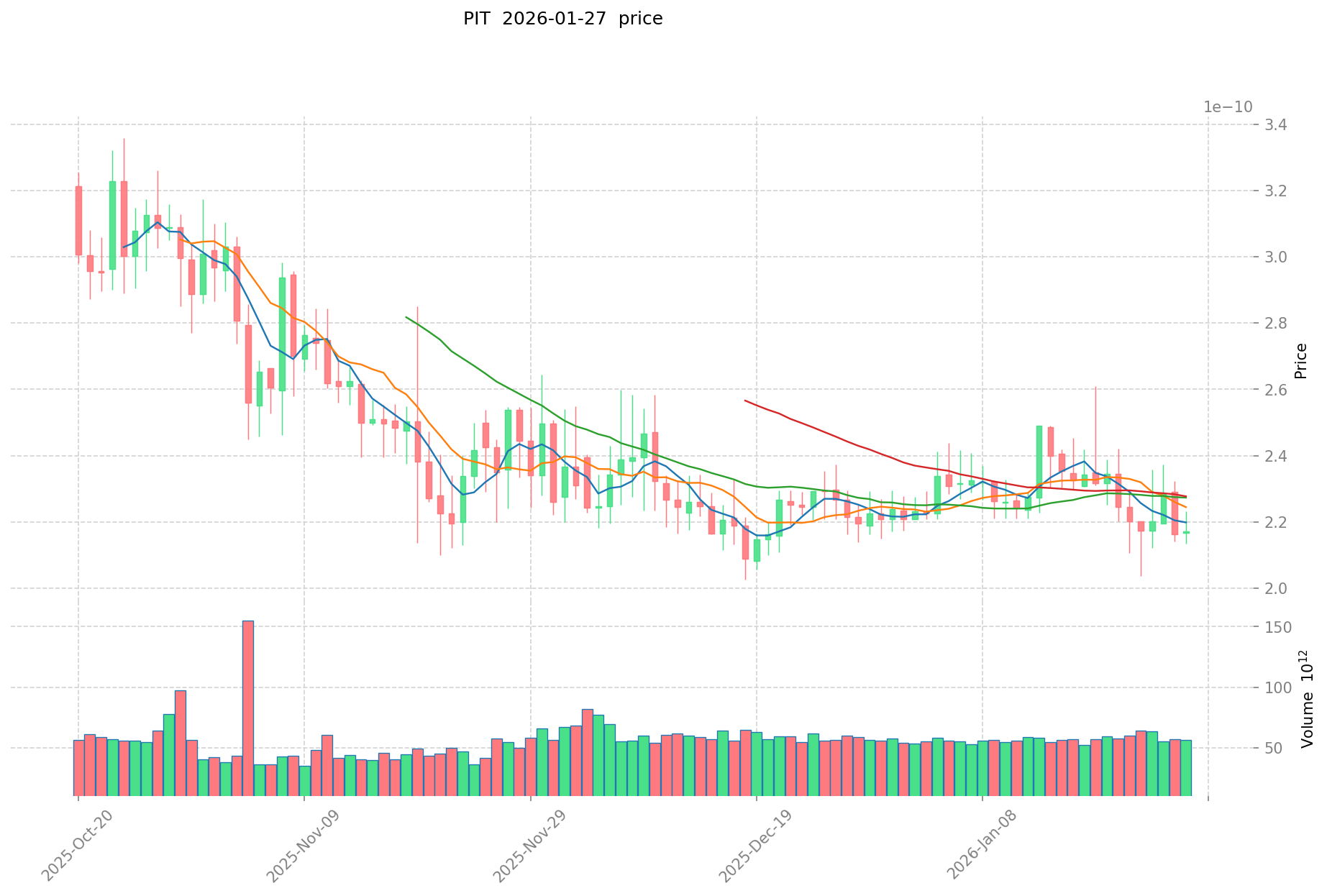
II. Core Factors Influencing Whether PIT is a Good Investment
Supply Mechanism and Scarcity (PIT Investment Scarcity)
- Supply Structure: Pitbull (PIT) has a circulating supply of approximately 38.80 trillion tokens out of a maximum supply of 100 quadrillion tokens, representing a circulating ratio of about 38.80%. The token incorporates a holding reward mechanism where holders earn passive income through transaction redistribution.
- Scarcity Characteristics: With ownership transferred to the community at creation and no contract owner, the supply mechanism is fixed without centralized control. The token's deflationary feature through transaction burns may gradually reduce circulating supply over time.
- Investment Implications: The automated reward system for holders provides a passive income component, while the community-driven ownership model eliminates single-point control risks. However, the large maximum supply relative to current circulation suggests potential dilution concerns for long-term investors.
Community Governance and Development Activity (Community-Driven Investment in PIT)
- Community Structure: Pitbull operates as a 100% community-driven project with no centralized ownership. Since its launch on March 17, 2021, on Binance Smart Chain, the project has been maintained by volunteer contributors including graphic designers, writers, web developers, marketers, data analysts, and translators.
- Holder Base: The token has accumulated approximately 525,809 holders as of January 2026, indicating broad community participation and distribution.
- Development Activity: Community volunteers continue to build and refine the ecosystem with contributions spanning technical development, marketing initiatives, and content creation. The project's GitHub presence suggests ongoing technical development efforts.
- Investment Significance: Strong community engagement with over 500,000 holders demonstrates sustained interest and may provide price support during market downturns. The volunteer-driven development model reduces operational costs but may also present coordination challenges compared to traditionally funded projects.
- Price Performance: As of January 27, 2026, PIT trades at $0.0000000002159, representing a decline of approximately 28.06% over the past year. Recent performance shows a 1-hour decline of 0.27%, 24-hour decline of 0.41%, 7-day decline of 7.96%, and 30-day decline of 2.48%.
- Historical Price Range: The token reached a notable price level of $0.000000150393 on August 18, 2021, while trading at significantly lower levels on October 13, 2021. Current prices remain well below the 2021 peak.
- Market Capitalization: PIT maintains a market capitalization of approximately $8.38 million with a 24-hour trading volume of $12,348.60, representing a market dominance of 0.00026%.
- Volatility Characteristics: The token exhibits high volatility typical of meme-based cryptocurrencies, with significant price fluctuations across different timeframes. The market cap to fully diluted valuation ratio of 38.8% suggests substantial potential dilution risk.
- Investment Implications: The sustained negative performance across multiple timeframes and high volatility present considerable risk factors. Low trading volume relative to market cap may indicate limited liquidity for larger positions.
Technology and Ecosystem Development (Technology & Ecosystem for PIT Investment)
- Smart Contract Platform: Pitbull is deployed on Binance Smart Chain (BSC) with contract address 0xA57ac35CE91Ee92CaEfAA8dc04140C8e232c2E50. The smart contract implements an automatic reward distribution mechanism for token holders.
- Holding Reward Feature: The token incorporates a transaction tax that redistributes a portion to existing holders, providing passive income through holding. This mechanism incentivizes long-term holding behavior among token holders.
- Ecosystem Applications: Community initiatives include staking mechanisms and NFT-related projects aimed at expanding utility beyond simple token holding. The project maintains active social media presence on Twitter and Reddit for community engagement.
- Technical Infrastructure: The project operates without a centralized owner, with contract ownership renounced at creation. This immutable structure provides transparency but limits future upgrade capabilities.
- Investment Significance: The automatic reward mechanism provides ongoing yield for holders, potentially offsetting some price volatility. However, the limited ecosystem development compared to larger projects and reliance on BSC infrastructure present constraints on technical innovation and application diversity.
III. PIT Future Investment Forecast and Price Outlook (Is Pitbull (PIT) worth investing in 2026-2031)
Short-term Investment Forecast (2026, short-term PIT investment outlook)
Based on available market data, short-term price predictions for Pitbull (PIT) in 2026 present varying scenarios:
- Conservative forecast: $0.000000000177448 - $0.0000000002164
- Neutral forecast: $0.0000000002164 - $0.000000000241286
- Optimistic forecast: $0.000000000241286 - $0.000000000266172
Current market indicators suggest PIT has experienced modest volatility, with 24-hour changes of -0.41% and weekly fluctuations of -7.96%. The token maintains a circulating supply of approximately 38.8 trillion tokens, representing 38.8% of the maximum supply.
Mid-term Investment Outlook (2027-2029, mid-term Pitbull (PIT) investment forecast)
-
Market stage expectation: The mid-term period may see gradual price adjustments as the community-driven project continues development efforts. Market sentiment remains mixed, with technical indicators showing neutral signals.
-
Investment return forecast:
- 2027: $0.000000000132707 - $0.000000000359516 (potential growth of approximately 11% from 2026 baseline)
- 2028: $0.00000000027036 - $0.000000000327437 (potential growth of approximately 39% from 2026 baseline)
- 2029: $0.000000000197769 - $0.000000000373563 (potential growth of approximately 45% from 2026 baseline)
-
Key catalysts: Community development initiatives, volunteer contributions from designers and developers, potential platform integrations, and broader cryptocurrency market trends may influence price movements.
Long-term Investment Outlook (Is Pitbull a good long-term investment?)
- Baseline scenario: $0.000000000237181 - $0.000000000381552 by 2030 (assuming steady community engagement and maintained holder base of 525,809+ addresses)
- Optimistic scenario: $0.000000000343741 - $0.000000000427923 by 2031 (assuming increased adoption and favorable market conditions)
- Risk scenario: Below $0.000000000177448 (under conditions of reduced trading volume or broader market downturns)
Click to view PIT long-term investment and price prediction: Price Prediction
2026-2031 Long-term Outlook
- Base scenario: $0.000000000177448 - $0.000000000343741 (corresponding to steady progress and gradual mainstream application)
- Optimistic scenario: $0.000000000343741 - $0.000000000427923 (corresponding to large-scale adoption and favorable market environment)
- Transformational scenario: Above $0.000000000427923 (subject to breakthrough ecosystem developments and mainstream penetration)
- 2031-12-31 predicted high: $0.000000000427923 (based on optimistic development assumptions)
Disclaimer: The above forecasts are based on historical data analysis and market predictions from various sources. Cryptocurrency investments carry substantial risk due to market volatility. Price predictions should not be considered as investment advice. The actual performance of PIT may differ materially from these projections due to numerous factors including market sentiment, regulatory changes, technological developments, and macroeconomic conditions. Investors should conduct independent research and consider their risk tolerance before making investment decisions.
| Year |
Predicted High Price |
Predicted Average Price |
Predicted Low Price |
Price Change |
| 2026 |
0.000000000266172 |
0.0000000002164 |
0.000000000177448 |
0 |
| 2027 |
0.000000000359516 |
0.000000000241286 |
0.000000000132707 |
11 |
| 2028 |
0.000000000327437 |
0.000000000300401 |
0.00000000027036 |
39 |
| 2029 |
0.000000000373563 |
0.000000000313919 |
0.000000000197769 |
45 |
| 2030 |
0.000000000381552 |
0.000000000343741 |
0.000000000237181 |
59 |
| 2031 |
0.000000000427923 |
0.000000000362647 |
0.000000000221214 |
67 |
IV. Pitbull Investment Strategy and Risk Management (How to invest in Pitbull)
Investment Methodology (Pitbull investment strategy)
Long-term Holding (HODL Pitbull)
For conservative investors seeking steady growth, a long-term holding strategy may be considered for PIT. This approach involves purchasing tokens and maintaining positions through market cycles, potentially benefiting from the project's community-driven development model. The token's holder base of approximately 525,809 addresses suggests a distributed ownership structure. However, investors should note the token has experienced significant price fluctuations since its launch in March 2021.
Active Trading
Active traders may employ technical analysis and swing trading strategies based on PIT's price movements. The 24-hour trading volume of approximately $12,348 indicates available liquidity for short-term positions. Traders should monitor key technical levels, including the 24-hour high of $0.0000000002232 and low of $0.0000000002135, to identify potential entry and exit points.
Risk Management (Risk management for Pitbull investment)
Asset Allocation Ratios
- Conservative investors: Consider allocating no more than 1-2% of cryptocurrency portfolio to PIT, given its relatively small market capitalization and volatility
- Aggressive investors: May allocate 5-10% while maintaining diversification across multiple assets
- Professional investors: Should conduct thorough due diligence and consider position sizing based on risk tolerance and portfolio objectives
Risk Hedging Solutions
Investors may consider:
- Diversifying across multiple cryptocurrency categories to reduce concentration risk
- Maintaining stable positions in established cryptocurrencies alongside smaller cap holdings
- Setting predetermined exit strategies and stop-loss levels
Secure Storage
- Hot wallets: Suitable for active trading amounts on BSC-compatible wallets
- Cold storage: Recommended for long-term holdings using hardware wallets that support BSC tokens
- Security considerations: Verify the official contract address (0xA57ac35CE91Ee92CaEfAA8dc04140C8e232c2E50) on BSC blockchain before any transactions
V. Pitbull Investment Risks and Challenges (Risks of investing in Pitbull)
Market Risks
- High volatility: PIT has demonstrated substantial price fluctuations, with a 1-year decline of approximately 28.06% and 7-day decline of 7.96%
- Price movements: The token's historical price range spans from $0.000000000000000001 to $0.000000150393, indicating extreme volatility
- Market depth: With a relatively small market capitalization of approximately $8.38 million and limited exchange listings (4 exchanges), the token may experience liquidity challenges
Regulatory Risks
- Cryptocurrency regulations vary significantly across jurisdictions and continue to evolve
- Community-driven tokens without centralized ownership may face unique regulatory considerations
- Investors should stay informed about regulatory developments in their respective regions
Technical Risks
- Smart contract considerations: While ownership has been transferred to the community, investors should understand the implications of decentralized control
- Network dependencies: As a BSC-based token, PIT's functionality depends on the Binance Smart Chain infrastructure
- Security audits: Investors should verify whether the smart contract has undergone independent security audits
VI. Conclusion: Is Pitbull a Good Investment?
Investment Value Summary
Pitbull represents a community-driven cryptocurrency project with a distributed holder base. While the project demonstrates community engagement and has maintained operations since March 2021, it exhibits significant price volatility and operates in a highly competitive market segment. The token's performance shows notable declines across various timeframes, and its relatively small market capitalization suggests elevated risk levels.
Investor Recommendations
✅ Beginners:
- Consider starting with small allocations and dollar-cost averaging approach
- Prioritize secure storage using BSC-compatible wallets
- Conduct thorough research on community-driven token mechanics
✅ Experienced Investors:
- May explore swing trading opportunities while managing position sizes carefully
- Maintain diversification across multiple cryptocurrency categories
- Monitor on-chain metrics and community developments
✅ Institutional Investors:
- Conduct comprehensive due diligence on smart contract architecture and community governance
- Assess liquidity constraints and potential impact on position management
- Consider allocation only as part of a broader cryptocurrency portfolio strategy
⚠️ Disclaimer: Cryptocurrency investments carry substantial risks, including potential loss of principal. This content is for informational purposes only and does not constitute investment advice. Investors should conduct independent research and consult with financial advisors before making investment decisions.
VII. FAQ
Q1: Is Pitbull (PIT) a good investment for beginners?
For beginners, Pitbull presents significant challenges and is generally considered a high-risk investment. The token has experienced substantial volatility, with a 28.06% decline over the past year and frequent price fluctuations across shorter timeframes. As a community-driven meme token with a relatively small market capitalization of $8.38 million and limited trading volume of $12,348 in 24 hours, PIT may not provide the stability that beginner investors typically seek. However, if beginners are interested in exploring this asset, they should limit allocation to 1-2% of their cryptocurrency portfolio, utilize dollar-cost averaging strategies, and prioritize secure storage using BSC-compatible wallets. It is essential to understand that the token's extreme price range and liquidity constraints make it more suitable for those with higher risk tolerance and experience in volatile markets.
Q2: What makes Pitbull different from other meme tokens?
Pitbull distinguishes itself through its community-driven governance model and automatic reward mechanism. Unlike many meme tokens with centralized ownership, PIT transferred ownership to the community at creation, eliminating single-point control risks. The token implements a transaction tax that redistributes a portion to existing holders, providing passive income through holding. With approximately 525,809 holders, PIT demonstrates broad community participation and distribution. The project is maintained by volunteer contributors including graphic designers, developers, marketers, and translators, rather than a centralized team. However, this decentralized structure also means development may face coordination challenges compared to traditionally funded projects. The token operates on Binance Smart Chain with contract address 0xA57ac35CE91Ee92CaEfAA8dc04140C8e232c2E50, and the immutable contract structure provides transparency but limits future upgrade capabilities.
Q3: What is the price prediction for Pitbull in 2026-2031?
Based on available market analysis and historical data, price predictions for Pitbull vary across different timeframes. For 2026, conservative forecasts suggest a range of $0.000000000177448 to $0.0000000002164, while optimistic scenarios project up to $0.000000000266172. Mid-term projections indicate potential growth by 2027-2029, with estimates ranging from $0.000000000132707 to $0.000000000373563, representing potential increases of 11-45% from 2026 baseline levels. Long-term forecasts for 2030-2031 project a baseline scenario of $0.000000000237181 to $0.000000000381552, with optimistic scenarios reaching $0.000000000427923 by December 2031. However, these predictions should be treated with caution as they are based on numerous assumptions about market conditions, community development, and broader cryptocurrency trends. Actual performance may differ materially due to market volatility, regulatory changes, technological developments, and macroeconomic factors. Investors should not rely solely on price predictions when making investment decisions.
Q4: How can I safely store my Pitbull tokens?
Safe storage of Pitbull tokens requires using BSC-compatible wallets since PIT operates on Binance Smart Chain. For active trading, hot wallets such as MetaMask, Trust Wallet, or other BSC-compatible mobile and web wallets provide convenient access to your tokens. However, for long-term holdings, cold storage solutions using hardware wallets that support BSC tokens (such as Ledger or Trezor with BSC integration) are strongly recommended to minimize security risks. Before conducting any transactions, it is crucial to verify the official contract address (0xA57ac35CE91Ee92CaEfAA8dc04140C8e232c2E50) on the BSC blockchain to avoid scams or fraudulent tokens. Never share your private keys or seed phrases with anyone, and be cautious of phishing attempts through fake websites or social media messages. Consider using multiple wallet addresses to separate trading funds from long-term holdings, and regularly backup your wallet information securely. Additionally, enable all available security features such as two-factor authentication and biometric locks on your wallet applications.
Q5: What are the main risks of investing in Pitbull?
Investing in Pitbull carries several significant risks that investors must carefully consider. Market risks include extreme volatility, with the token demonstrating price fluctuations ranging from $0.000000000000000001 to $0.000000150393 historically, and a recent 28.06% decline over the past year. The relatively small market capitalization of $8.38 million and limited daily trading volume of $12,348 create liquidity challenges, potentially making it difficult to execute large trades without significant price impact. Technical risks stem from the token's dependence on Binance Smart Chain infrastructure and the immutable smart contract structure that limits future upgrades. Regulatory risks exist as cryptocurrency regulations continue to evolve globally, and community-driven tokens may face unique regulatory considerations. The project's volunteer-driven development model, while eliminating centralized control risks, may present coordination challenges and slower development progress compared to traditionally funded projects. Additionally, with a circulating supply representing only 38.8% of maximum supply, there is potential for significant dilution as more tokens enter circulation. The token's classification as a meme token also means that sentiment and social media trends can heavily influence price movements independent of fundamental developments.
Q6: How does Pitbull's holding reward mechanism work?
Pitbull implements an automatic reward distribution mechanism through its smart contract on Binance Smart Chain that provides passive income to token holders. When transactions occur, a portion of the transaction tax is redistributed proportionally to all existing holders based on their holdings. This means that simply by holding PIT tokens in a compatible wallet, investors automatically receive additional tokens over time without any active participation required. The mechanism incentivizes long-term holding behavior and creates a passive income stream for community members. However, the actual yield from this mechanism depends on transaction volume and the number of holders, which can fluctuate significantly based on market conditions and trading activity. Investors should note that while this feature provides ongoing returns, it does not guarantee positive investment performance, as the value of the tokens received depends on PIT's market price. The reward mechanism operates automatically through the smart contract, and no action is required from holders to receive distributions, though tokens must be held in a BSC-compatible wallet rather than on a centralized exchange to benefit from this feature.
Q7: What factors could drive Pitbull's price growth in the future?
Several factors could potentially influence Pitbull's price trajectory in the coming years. Community development initiatives and volunteer contributions from designers, developers, and marketers could expand the token's ecosystem and utility beyond simple holding. The continued growth of the holder base, currently at approximately 525,809 addresses, demonstrates sustained community interest that may provide price support. Broader cryptocurrency market trends, particularly positive sentiment toward meme tokens and community-driven projects, could create favorable conditions for price appreciation. Technical developments such as new staking mechanisms, NFT-related projects, and potential platform integrations may increase utility and attract new users. The automatic reward mechanism for holders provides an incentive for long-term holding, potentially reducing selling pressure during market downturns. Additionally, increased exchange listings beyond the current four exchanges could improve liquidity and accessibility for new investors. However, investors should recognize that these potential catalysts are subject to successful execution by the volunteer community and favorable market conditions. The lack of centralized funding and the project's dependence on community contributions mean that development progress may be slower and less predictable compared to traditional blockchain projects with dedicated teams and resources.
Q8: Should institutional investors consider Pitbull for portfolio allocation?
Institutional investors should approach Pitbull with significant caution and conduct comprehensive due diligence before considering any allocation. The token's small market capitalization of $8.38 million and limited daily trading volume of $12,348 present substantial liquidity constraints that could make position management challenging, particularly for larger institutional sizes. The immutable smart contract structure with renounced ownership provides transparency but eliminates the possibility of coordinated upgrades or emergency interventions in case of technical issues. While the community-driven governance model offers decentralization benefits, it also introduces uncertainty regarding development roadmap execution and long-term sustainability. Institutional investors considering PIT should thoroughly assess the smart contract architecture, verify independent security audits, analyze on-chain metrics including holder distribution and transaction patterns, and evaluate the token's role within a broader cryptocurrency portfolio strategy. Any allocation should be considered only as a small, high-risk component of a diversified cryptocurrency portfolio, with appropriate risk management measures including strict position sizing limits, regular performance reviews, and predefined exit strategies. The lack of traditional corporate governance structures and regulatory compliance frameworks may also present challenges for institutional investors subject to fiduciary duties and regulatory oversight.
* The information is not intended to be and does not constitute financial advice or any other recommendation of any sort offered or endorsed by Gate.