This comprehensive analysis evaluates whether Songbird (SGB) represents a sound investment opportunity within the cryptocurrency ecosystem. As Flare's Canary network, SGB currently trades at $0.002066 with a market capitalization of $33.13 million. The article examines SGB's historical performance, noting a -72.71% decline from its $0.71334 peak, while assessing key investment factors including unlimited supply mechanics, ecosystem development through FTSO and F-Asset systems, and current market positioning with limited liquidity at $26,291 daily volume. Short to long-term price forecasts range from $0.00169904 to $0.003150150048392 under various scenarios. The analysis explores investment strategies for different investor profiles—from conservative dollar-cost averaging approaches to active trading tactics—while detailing essential risk management techniques and inherent challenges including market volatility, technical risks, and regulatory uncertainty. Available on Gate and other platforms, SGB presents bo
Introduction: Songbird (SGB) Investment Position and Market Outlook
Songbird (SGB) represents a significant asset in the cryptocurrency ecosystem, functioning as the Canary network for Flare. As of January 21, 2026, SGB maintains a market capitalization of approximately $33.13 million, with a circulating supply of around 16.04 billion tokens and a current price of approximately $0.002066. The token holds a market ranking of 670 and accounts for 0.0012% of the total cryptocurrency market share. Songbird serves as a testing environment for Flare Time Series Oracle (FTSO), StateConnector, and F-Asset systems, playing a role in governance-driven protocol changes before their implementation on the Flare network. With its unique positioning as an experimental network for smart contract functionality and decentralized applications, SGB has drawn attention from investors evaluating "Is Songbird (SGB) a good investment?" This article provides a comprehensive analysis of SGB's investment characteristics, historical price movements, future price projections, and associated investment risks to serve as a reference for potential investors.
I. Coin (SGB) Price History Review and Current Investment Value
- 2021: Songbird launched as Flare's Canary network in September → Price reached $0.71334 on September 30, 2021
- 2026: Market downturn phase → Price declined to $0.00192389 on January 1, 2026
- Current period: Price stabilized around $0.002066 following the early 2026 low point
Current SGB Investment Market Status (January 2026)
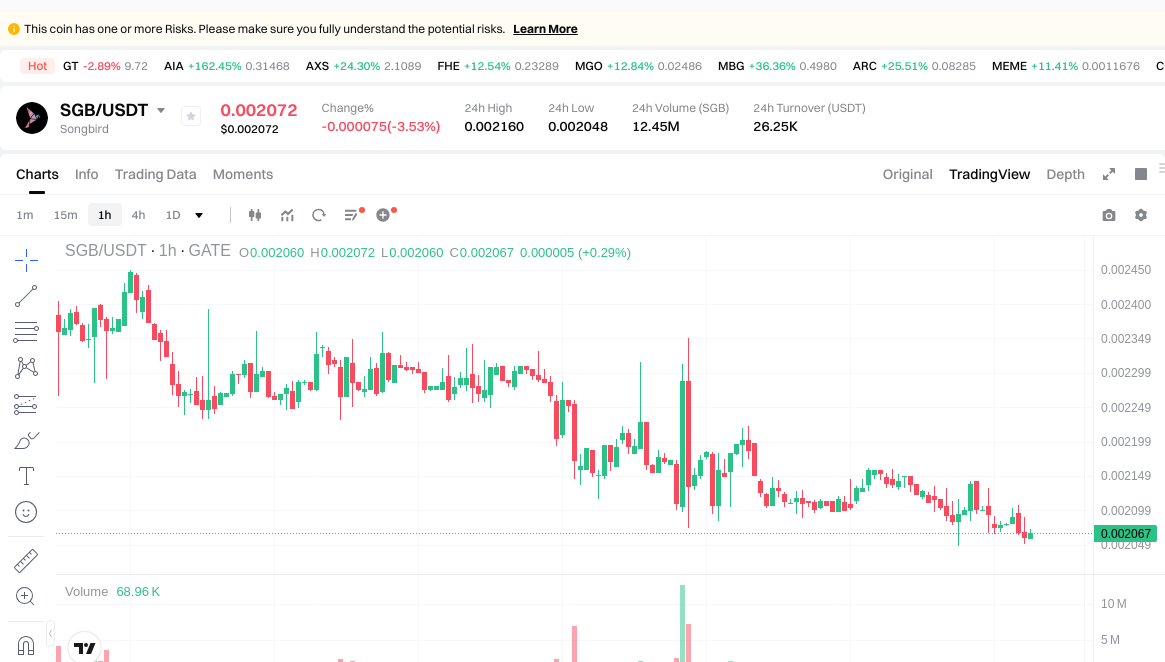
- SGB current price: $0.002066
- Market sentiment (Fear & Greed Index): Data not available in provided materials
- 24-hour trading volume: $26,291.26
- Institutional investor holdings: Data not available in provided materials
Click to view real-time SGB market price
II. Core Factors Affecting Whether SGB is a Good Investment (Is Songbird(SGB) a Good Investment)
Supply Mechanism and Scarcity (SGB investment scarcity)
- Unlimited maximum supply mechanism → affects price volatility and investment considerations
- Current circulating supply of approximately 16.04 billion SGB, representing about 84% of total supply
- Investment consideration: The unlimited supply model may influence long-term scarcity dynamics compared to capped-supply assets
Institutional Investment and Mainstream Adoption (Institutional investment in SGB)
- SGB serves as the Canary network for the Flare ecosystem, testing governance-driven changes
- The network has demonstrated growth with over 1.5 million blocks processed and more than 200,000 registered addresses within its initial period
- Integration with Flare Time Series Oracle (FTSO), StateConnector, and F-Asset systems provides technical infrastructure for potential ecosystem expansion
Macroeconomic Environment's Impact on SGB Investment
- As a smaller market cap asset (approximately $33.13 million), SGB may exhibit different sensitivity patterns to macroeconomic conditions compared to larger cryptocurrencies
- Market share of 0.0012% indicates positioning within the broader digital asset landscape
- Cryptocurrency market dynamics and regulatory developments may influence investment attractiveness
Technology and Ecosystem Development (Technology & Ecosystem for SGB investment)
- Functions as a testing environment for Flare network innovations before mainnet deployment
- FTSO and F-Asset protocols operational on Songbird network
- Designed to test governance changes including new F-Asset integration and system modifications
- Network architecture serves dual purpose: pre-launch testing for Flare and long-term independent development pathway governed by token holders
- Available on 5 exchanges with 24-hour trading volume of approximately $26,291
III. SGB Future Investment Forecast and Price Outlook (Is Songbird(SGB) worth investing in 2026-2031)
Short-term Investment Forecast (2026, short-term SGB investment outlook)
- Conservative forecast: $0.00169904 - $0.002072
- Neutral forecast: $0.002072 - $0.00234136
- Optimistic forecast: $0.00234136 and above
Mid-term Investment Outlook (2027-2029, mid-term Songbird(SGB) investment forecast)
- Market stage expectation: During this period, SGB may experience moderate growth, with projected average prices rising from $0.00220668 in 2027 to $0.002547391392 in 2029, reflecting gradual adoption within the Flare ecosystem.
- Investment return forecast:
- 2027: $0.0015667428 - $0.0026921496
- 2028: $0.002351438208 - $0.002645367984
- 2029: $0.00224170442496 - $0.00336255663744
- Key catalysts: Continued development of Flare Time Series Oracle (FTSO), StateConnector, and F-Asset systems; governance-driven protocol upgrades; and broader integration within the Flare network ecosystem.
Long-term Investment Outlook (Is Songbird a good long-term investment?)
- Base scenario: $0.001773870901036 - $0.003150150048392 (assuming steady ecosystem development and sustained testing activities)
- Optimistic scenario: $0.003058398105235 - $0.003150150048392 (assuming accelerated adoption of Flare network features and increased market participation)
- Risk scenario: $0.001595685967948 - $0.001773870901036 (in case of prolonged bear market conditions or slower-than-expected ecosystem growth)
Click to view SGB long-term investment and price forecast: Price Prediction
2026-01-21 - 2031 Long-term Outlook
- Base scenario: $0.001773870901036 - $0.003058398105235 (corresponding to steady progress and gradual mainstream application)
- Optimistic scenario: $0.003058398105235 - $0.003150150048392 (corresponding to large-scale adoption and favorable market conditions)
- Transformative scenario: Above $0.003150150048392 (in case of breakthrough ecological developments and mainstream popularization)
- 2031-12-31 forecast high: $0.003150150048392 (based on optimistic development assumptions)
Disclaimer: The above forecasts are based on historical data and predictive models. Cryptocurrency markets are highly volatile and subject to numerous unpredictable factors. This content does not constitute investment advice. Investors should conduct their own research and consult professional advisors before making investment decisions.
| Year |
Predicted High Price |
Predicted Average Price |
Predicted Low Price |
Price Change |
| 2026 |
0.00234136 |
0.002072 |
0.00169904 |
0 |
| 2027 |
0.0026921496 |
0.00220668 |
0.0015667428 |
6 |
| 2028 |
0.002645367984 |
0.0024494148 |
0.002351438208 |
18 |
| 2029 |
0.00336255663744 |
0.002547391392 |
0.00224170442496 |
23 |
| 2030 |
0.00316182219575 |
0.00295497401472 |
0.001595685967948 |
43 |
| 2031 |
0.003150150048392 |
0.003058398105235 |
0.001773870901036 |
48 |
IV. Songbird Investment Strategy and Risk Management (How to invest in Songbird)
Investment Methodology (Songbird investment strategy)
Long-term Holding (HODL Songbird)
For conservative investors seeking stability, a long-term holding strategy may be considered. This approach involves acquiring SGB tokens and maintaining positions through market cycles, focusing on the fundamental development of the Flare ecosystem and Songbird's role as its Canary network. Given Songbird's function in testing governance changes and protocol upgrades before implementation on Flare mainnet, long-term holders may benefit from network maturation and adoption growth.
Active Trading
For traders comfortable with market volatility, active trading strategies based on technical analysis and swing trading may be employed. With 24-hour price fluctuations currently showing -4.09% movement and 7-day changes of -12.97%, short-term trading opportunities may present themselves. However, such strategies require constant market monitoring and technical analysis skills to identify entry and exit points based on price patterns, volume indicators, and market momentum.
Risk Management (Risk management for Songbird investment)
Asset Allocation Ratios
- Conservative investors: Consider allocating 1-3% of crypto portfolio to SGB, focusing on capital preservation
- Moderate investors: May allocate 3-7% depending on risk tolerance and conviction in Flare ecosystem development
- Aggressive investors: Could consider 7-15% allocation while maintaining diversification across multiple assets
Risk Hedging Strategies
Implementing a multi-asset portfolio approach can help mitigate concentration risk. Investors may consider:
- Diversifying across different blockchain ecosystems and use cases
- Maintaining exposure to established cryptocurrencies alongside experimental networks
- Utilizing stablecoin positions for liquidity and opportunity capture
- Setting predetermined stop-loss levels to limit downside exposure
Secure Storage Solutions
Given the importance of asset security, investors should consider:
- Cold storage solutions for long-term holdings to minimize online exposure
- Hardware wallets from reputable manufacturers for enhanced security
- Hot wallets only for active trading amounts, maintaining minimal balances
- Multi-signature wallet setups for institutional or large holdings
- Regular security audits of wallet configurations and backup procedures
V. Songbird Investment Risks and Challenges (Risks of investing in Songbird)
Market Risks
Songbird exhibits considerable price volatility, with 1-year performance showing -72.71% decline. The 24-hour trading volume of approximately $26,291 indicates relatively limited liquidity compared to major cryptocurrencies, which may result in higher price slippage during large transactions. The current price of $0.002066 represents a substantial distance from its historical high of $0.71334 recorded on September 30, 2021, demonstrating the asset's susceptibility to broad market movements.
Regulatory Risks
As with all cryptocurrency investments, regulatory uncertainty across different jurisdictions presents ongoing challenges. Changes in regulatory frameworks, particularly regarding experimental networks and Canary testing environments, could impact Songbird's operational capacity and market accessibility. Investors should monitor regulatory developments in their respective jurisdictions and assess potential compliance requirements.
Technical Risks
As a Canary network designed for testing purposes, Songbird inherently carries technical experimentation risks. Network upgrades, protocol changes, and governance modifications tested on Songbird may occasionally encounter unexpected issues. While this testing function serves to enhance Flare's eventual security, it means Songbird participants may experience temporary network disruptions or protocol adjustments. Additionally, smart contract vulnerabilities or consensus mechanism challenges could affect network stability.
Ecosystem Dependency
Songbird's value proposition is closely tied to the Flare ecosystem's development and adoption. Changes in Flare's roadmap, delays in implementation, or reduced interest in F-Asset systems and FTSO (Flare Time Series Oracle) could impact Songbird's utility and market perception.
VI. Conclusion: Is Songbird a Good Investment?
Investment Value Summary
Songbird presents a unique value proposition as the Canary network for Flare, serving as a testing ground for governance changes, protocol upgrades, and new features before mainnet deployment. While the project demonstrates technological innovation through its FTSO and F-Asset systems, the token has experienced substantial price decline over the past year (-72.71%), reflecting broader market conditions and the inherent volatility of experimental networks. The current market capitalization of approximately $33.13 million and ranking of 670 indicate a relatively small market presence with corresponding liquidity considerations.
Investor Recommendations
✅ Beginners: Consider dollar-cost averaging (DCA) strategy with small, regular purchases to mitigate timing risk. Prioritize secure storage solutions using hardware wallets and thoroughly research Flare ecosystem fundamentals before investing.
✅ Experienced Investors: May explore swing trading opportunities based on technical analysis while maintaining core long-term positions. Consider portfolio allocation within broader Layer-1 and oracle-related investments, monitoring Songbird's governance proposals and network development milestones.
✅ Institutional Investors: Could evaluate strategic positions based on Flare ecosystem adoption metrics and F-Asset protocol development. Assess Songbird's role in the broader oracle and cross-chain liquidity landscape while implementing comprehensive risk management frameworks.
⚠️ Disclaimer: Cryptocurrency investments carry substantial risk, including potential total loss of capital. This analysis is provided for informational purposes only and does not constitute financial advice. Investors should conduct independent research, assess their risk tolerance, and consider consulting with financial professionals before making investment decisions. Past performance does not indicate future results.
VII. FAQ
Q1: What is Songbird (SGB) and how does it differ from other cryptocurrencies?
Songbird (SGB) is the Canary network for Flare, designed specifically as a testing environment for protocol changes, governance upgrades, and new features before their deployment on the Flare mainnet. Unlike typical cryptocurrencies that function as standalone networks, Songbird serves a dual purpose: it operates as both an experimental testing ground for the Flare Time Series Oracle (FTSO), StateConnector, and F-Asset systems, while also functioning as an independent blockchain governed by its token holders. This unique positioning means SGB holders participate in testing cutting-edge features while contributing to the security and development of the broader Flare ecosystem.
Q2: What accounts for Songbird's significant price decline from its all-time high?
Songbird experienced a substantial price decline of -72.71% over the past year, with its price falling from an all-time high of $0.71334 on September 30, 2021, to approximately $0.002066 as of January 21, 2026. This decline reflects multiple factors: broader cryptocurrency market corrections during 2025-2026, the inherent volatility of experimental Canary networks, relatively limited liquidity with 24-hour trading volume around $26,291, and the market's reassessment of early valuations. As a testing network rather than a primary production blockchain, Songbird's price movements are influenced by both general market conditions and the specific dynamics of its role within the Flare ecosystem.
Q3: How does Songbird's unlimited supply model affect its investment potential?
Unlike Bitcoin and other capped-supply cryptocurrencies, Songbird employs an unlimited maximum supply mechanism, with approximately 16.04 billion tokens currently in circulation representing about 84% of total supply. This unlimited supply model has important implications for long-term scarcity dynamics and price appreciation potential. While capped-supply assets benefit from built-in scarcity, Songbird's value proposition relies more heavily on utility, adoption within the Flare ecosystem, and governance participation rather than supply constraints. Investors should consider that ongoing token issuance may create different inflationary pressures compared to deflationary or fixed-supply assets when evaluating long-term holding strategies.
Q4: What are the main risks associated with investing in Songbird?
Investing in Songbird carries several distinct risks: (1) Market risks including high volatility, limited liquidity with relatively low trading volumes, and substantial distance from historical price highs; (2) Technical risks inherent in its role as an experimental Canary network, where protocol testing may occasionally encounter unexpected issues or temporary disruptions; (3) Ecosystem dependency risks, as Songbird's value is closely tied to Flare's development trajectory and adoption of F-Asset systems and FTSO features; and (4) Regulatory uncertainty affecting experimental networks and testing environments across different jurisdictions. The current market capitalization of approximately $33.13 million and ranking of 670 indicates relatively smaller market presence, which may amplify these risks compared to more established cryptocurrencies.
Q5: What investment strategy is most appropriate for Songbird tokens?
The appropriate investment strategy for Songbird depends on individual risk tolerance and investment objectives. Conservative investors may consider a long-term holding (HODL) approach with 1-3% portfolio allocation, focusing on fundamental ecosystem development rather than short-term price movements. Moderate investors could employ dollar-cost averaging (DCA) to accumulate positions over time while allocating 3-7% of their crypto portfolio, mitigating timing risk in volatile markets. Experienced traders might explore active trading strategies based on technical analysis, given the asset's significant short-term price fluctuations (-4.09% in 24 hours, -12.97% over 7 days). Regardless of strategy, implementing proper risk management through diversification, secure storage solutions, and predetermined stop-loss levels is essential given Songbird's experimental nature and market characteristics.
Q6: How does Songbird's price forecast compare to current valuations?
Price projections for Songbird suggest potential recovery from current levels, though with considerable uncertainty. Short-term forecasts for 2026 range from $0.00169904 (conservative) to $0.00234136 (optimistic), representing relatively modest movements from the current price of $0.002066. Mid-term projections (2027-2029) anticipate gradual appreciation with 2029 averages around $0.002547391392, while long-term forecasts (2030-2031) range from $0.001595685967948 to $0.003150150048392 depending on ecosystem adoption scenarios. These forecasts suggest potential returns of 23-48% by 2029-2031 under base scenarios, though investors should note that cryptocurrency price predictions carry substantial uncertainty and depend on multiple variables including Flare ecosystem development, market conditions, and technological advancement.
Q7: What role does Songbird play in the broader Flare ecosystem?
Songbird functions as an integral component of the Flare network architecture, serving as a pre-production testing environment where governance-driven changes are validated before mainnet implementation. The network has already demonstrated operational capacity by processing over 1.5 million blocks and registering more than 200,000 addresses within its initial period. Through testing FTSO (Flare Time Series Oracle), StateConnector, and F-Asset protocols, Songbird provides critical infrastructure for ensuring security and functionality before features deploy on Flare. This Canary network model allows token holders to participate in governance decisions while contributing to the overall security and innovation of cross-chain liquidity and oracle solutions that form the foundation of Flare's value proposition.
Q8: Should beginners invest in Songbird given its current market position?
For beginners considering Songbird investment, a cautious approach is recommended given the asset's experimental nature and market characteristics. New investors should prioritize education about the Flare ecosystem, understanding Songbird's specific role as a Canary network, and recognizing the inherent volatility of smaller market cap cryptocurrencies. A dollar-cost averaging strategy with small, regular purchases can help mitigate timing risk while building position exposure gradually. Beginners should allocate only funds they can afford to lose entirely, implement secure storage solutions using hardware wallets, and consider Songbird as part of a diversified cryptocurrency portfolio rather than a concentrated position. Most importantly, beginners should conduct independent research, understand that past performance does not guarantee future results, and potentially consult with financial professionals before making investment decisions in experimental blockchain networks.
* The information is not intended to be and does not constitute financial advice or any other recommendation of any sort offered or endorsed by Gate.