This comprehensive analysis evaluates Tharwa (TRWA) as an emerging DeFi governance token with a current market cap of $6.98 million and 8,320 holders. The article examines TRWA's price history showing over 1,200% annual returns, detailed risk-reward assessment across market, regulatory, and technical dimensions, and investment forecasts spanning 2026-2030. Core investment considerations include token supply mechanics (70% circulating), ERC-20 Ethereum infrastructure, and utility expansion across vaults and staking mechanisms. The analysis provides tailored investment recommendations for novice, experienced, and institutional investors, incorporating portfolio allocation strategies, risk management frameworks, and technical analysis guidance. Comprehensive risk assessment addresses price volatility, regulatory uncertainties, and smart contract vulnerabilities, while FAQ sections clarify governance participation, tax implications, and exit strategies. This guide serves crypto investors seeking informed decision
Introduction: Tharwa (TRWA) Investment Position and Market Outlook
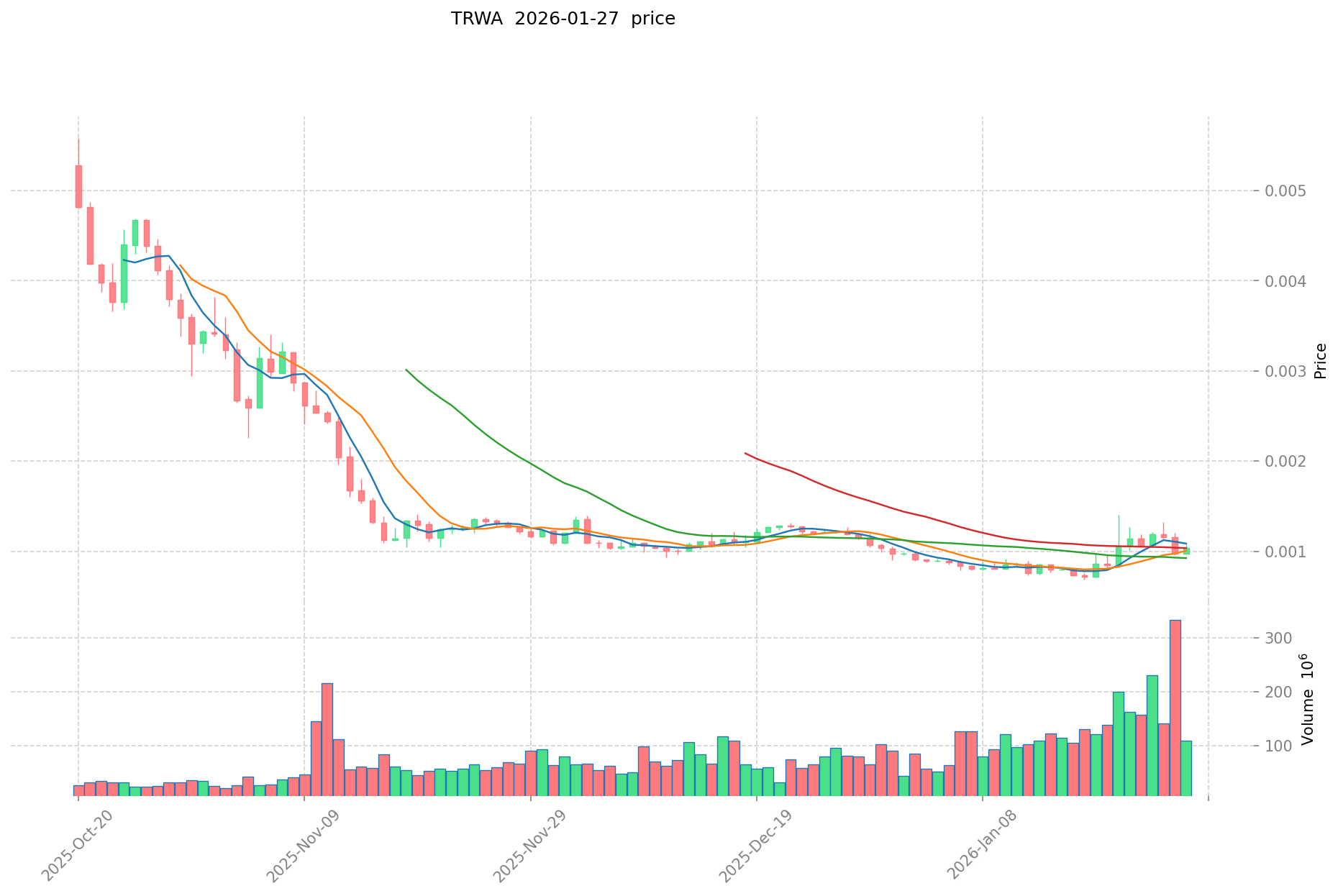
Tharwa (TRWA) represents an emerging crypto asset in the decentralized finance ecosystem. As of January 28, 2026, TRWA maintains a market capitalization of approximately $6.98 million, with a circulating supply of 7 billion tokens out of a maximum supply of 10 billion tokens. The token currently trades at $0.000997, positioned at rank 1369 in the cryptocurrency market with a market dominance of 0.00031%. The project operates on the Ethereum blockchain through an ERC-20 token contract, serving approximately 8,320 holders. TRWA offers holders participation rights aligned with protocol performance, unlocking utility across vaults, staking, and governance mechanisms. The token has demonstrated significant volatility since its launch, with year-over-year performance showing substantial fluctuations. This article examines TRWA's investment characteristics, historical price movements, future projections, and associated risks to provide analytical reference for market participants evaluating "Is Tharwa (TRWA) a good investment?"
I. Tharwa (TRWA) Price History Review and Current Investment Value
- 2025: TRWA demonstrated significant price appreciation, with the token reaching $0.0128 on September 15, 2025 → Early investors experienced substantial gains during this period
- 2026: Market correction phase → TRWA declined from previous levels to $0.0006851 on January 17, 2026, reflecting broader market volatility
- Past year performance: From approximately $0.000075 to current levels → The token showed a notable increase of over 1,200% in annual returns
Current TRWA Investment Market Status (January 2026)
- TRWA current price: $0.000997
- 24-hour trading volume: $210,317.22
- 24-hour price range: $0.000987 - $0.0010439
- Circulating supply: 7,000,000,000 TRWA (70% of total supply)
- Market capitalization: $6,979,000
- Fully diluted valuation: $9,970,000
- Number of holders: 8,320
- Trading availability: Listed on 6 exchanges
Click to view real-time TRWA market price
II. Core Factors Affecting Whether TRWA is a Good Investment
Supply Mechanism and Scarcity (TRWA investment scarcity)
- Total supply cap of 10,000,000,000 tokens with current circulating supply of 7,000,000,000 (70% circulation ratio) → impacts price dynamics and investment considerations
- TRWA price experienced notable fluctuations, with movements from lower price levels toward higher valuations during certain periods, though market conditions showed considerable variation
- Investment consideration: The token's supply structure and distribution may influence long-term holding dynamics
Institutional Investment and Mainstream Adoption (Institutional investment in TRWA)
- Current holder base stands at approximately 8,320 addresses
- TRWA is listed on 6 exchanges, indicating a developing market presence
- The protocol emphasizes participation rights and governance utility, which may affect adoption patterns among various user segments
Macroeconomic Environment's Impact on TRWA Investment
- Broader cryptocurrency market conditions and regulatory developments continue to shape the investment landscape for digital assets
- Market volatility patterns observed across the sector may influence TRWA's price movements and investor sentiment
- Economic uncertainties and shifts in global financial conditions could affect allocation strategies toward emerging crypto assets
Technology and Ecosystem Development (Technology & Ecosystem for TRWA investment)
- ERC-20 standard implementation on Ethereum network provides established technical infrastructure
- Protocol features include vault functionality, staking mechanisms, and governance participation → these utilities may contribute to ecosystem engagement
- The project's roadmap focuses on expanding AI product integration, enhancing user experience, and developing its yield-bearing stablecoin offering → these developments represent ongoing technical and ecosystem initiatives
III. TRWA Future Investment Forecast and Price Outlook (Is Tharwa(TRWA) worth investing in 2026-2030)
Short-term Investment Forecast (2026, short-term TRWA investment outlook)
- Conservative estimate: $0.000707 - $0.000893
- Neutral estimate: $0.000996 - $0.001176
- Optimistic estimate: $0.001355 - $0.001470
Mid-term Investment Outlook (2027-2028, mid-term Tharwa(TRWA) investment forecast)
- Market phase expectation: TRWA may enter a gradual growth phase, with price performance potentially influenced by protocol adoption, governance participation, and broader DeFi market sentiment. Sustained engagement within vaults and staking mechanisms could support valuation stability.
- Investment return forecast:
- 2027: $0.000893 - $0.001470
- 2028: $0.001256 - $0.001534
- Key catalysts: Expansion of protocol utility across vaults and staking, community governance developments, potential integration with broader DeFi infrastructure, and overall market recovery trends.
Long-term Investment Outlook (Is TRWA a good long-term investment?)
- Base scenario: $0.000848 - $0.001625 (assumes steady protocol growth and moderate market conditions)
- Optimistic scenario: $0.001766 - $0.002597 (assumes accelerated adoption, enhanced utility features, and favorable crypto market environment)
- Risk scenario: Below $0.000685 (under adverse market conditions or limited protocol traction)
Click to view TRWA long-term investment and price forecast: Price Prediction
2026-01-28 - 2030 Long-term Outlook
- Base scenario: $0.001354 - $0.001766 (corresponding to steady progress and gradual mainstream application improvement)
- Optimistic scenario: $0.001990 - $0.002597 (corresponding to large-scale adoption and favorable market environment)
- Transformative scenario: Above $0.002597 (if the ecosystem achieves breakthrough progress and mainstream popularization)
- 2030-12-31 forecast high: $0.001990 (based on optimistic development assumptions)
Disclaimer: The above predictions are based on historical data, technical analysis, and market trends. Cryptocurrency markets are highly volatile and subject to various risks. These forecasts should not be considered as investment advice. Please conduct thorough research and consider your risk tolerance before making any investment decisions.
| Year |
Predicted High Price |
Predicted Average Price |
Predicted Low Price |
Price Change |
| 2026 |
0.001354968 |
0.0009963 |
0.000707373 |
0 |
| 2027 |
0.0014695425 |
0.001175634 |
0.00089348184 |
17 |
| 2028 |
0.00153420237 |
0.00132258825 |
0.0012564588375 |
32 |
| 2029 |
0.0016569385596 |
0.00142839531 |
0.0009855927639 |
43 |
| 2030 |
0.001990040345892 |
0.0015426669348 |
0.00084846681414 |
54 |
| 2031 |
0.002596539851308 |
0.001766353640346 |
0.001625045349118 |
77 |
IV. Tharwa Investment Strategy and Risk Management (How to invest in Tharwa)
Investment Methodology (Tharwa investment strategy)
Long-term Holding (HODL Tharwa)
For conservative investors, a long-term holding strategy may be considered for TRWA tokens. This approach involves acquiring tokens and maintaining positions over extended periods, potentially benefiting from the protocol's utility expansion across vaults, staking, and governance features. The token's design emphasizes increased value correlation with active participation, which may align with patient capital deployment strategies.
Active Trading
Active trading strategies rely on technical analysis and swing trading techniques. Given TRWA's recent price movements—including a 7-day decline of 7.68% and 30-day decrease of 13.99%—traders may identify potential entry and exit points through chart pattern analysis and momentum indicators. The 24-hour trading volume of approximately $210,317 suggests moderate liquidity for tactical position management.
Risk Management (Risk management for Tharwa investment)
Asset Allocation Ratios
- Conservative investors: May consider allocating 1-3% of crypto portfolio to TRWA, maintaining primary positions in established assets
- Aggressive investors: Could allocate 5-10% depending on risk tolerance and portfolio diversification
- Professional investors: May incorporate TRWA within sector-specific DeFi allocations, typically 3-7% of specialized portfolios
Risk Hedging Approaches
A diversified portfolio approach combines multiple asset classes to mitigate concentration risk. Investors may consider pairing TRWA positions with:
- Established cryptocurrencies for portfolio stability
- Stablecoin reserves for liquidity management
- Uncorrelated assets across different blockchain ecosystems
Secure Storage Solutions
Cold and Hot Wallet Management:
- Hot wallets: Suitable for actively traded portions and staking participation
- Cold storage: Recommended for long-term holdings to minimize security exposure
Hardware Wallet Recommendations:
For ERC-20 tokens like TRWA (contract address: 0x7b10d50b5885be4c7985a88408265c109bd1eec8), hardware wallets supporting Ethereum network provide enhanced security through offline private key storage.
V. Tharwa Investment Risks and Challenges (Risks of investing in Tharwa)
Market Risks
Price Volatility: TRWA has demonstrated significant price fluctuations, with a 1-year performance showing substantial variation. The token reached an all-time high of $0.0128 on September 15, 2025, followed by an all-time low of $0.0006851 on January 17, 2026—representing considerable intra-period volatility. Current price movements show a 24-hour range between $0.000987 and $0.0010439.
Market Liquidity Considerations: With a market capitalization of approximately $6.98 million and trading across 6 exchanges, liquidity depth may vary across different trading platforms. The holder count of 8,320 addresses suggests a developing user base that may impact price stability during periods of concentrated trading activity.
Regulatory Risks
Jurisdictional Uncertainty: Regulatory frameworks for DeFi governance tokens remain in development across multiple jurisdictions. Different countries maintain varying approaches to cryptocurrency classification, taxation, and permissible use cases. Investors should monitor regulatory developments in their respective jurisdictions that may affect TRWA token utility, trading availability, or legal status.
Compliance Evolution: As regulatory standards evolve, protocols utilizing governance tokens may face adaptation requirements affecting token economics or operational structures.
Technical Risks
Smart Contract Vulnerabilities: As an ERC-20 token deployed on Ethereum, TRWA inherits both the security characteristics and potential vulnerabilities of smart contract architecture. While the Ethereum network provides established infrastructure, smart contract code requires ongoing security assessment to identify potential exploit vectors.
Protocol Development Risks: The token's utility across vaults, staking, and governance features depends on continued protocol development and maintenance. Technical implementation challenges, development delays, or architectural modifications may affect anticipated utility expansion.
Network Dependency: TRWA's functionality relies on Ethereum network performance, including transaction throughput, gas fee economics, and potential network upgrades that may require token contract adaptations.
VI. Conclusion: Is Tharwa a Good Investment?
Investment Value Summary
Tharwa (TRWA) presents characteristics of an emerging DeFi governance token with utility integration across multiple protocol functions. The token's value proposition centers on participation-aligned incentives, where holder engagement correlates with utility expansion. Recent price performance indicates significant volatility, with a 70% circulating supply representing 7 billion tokens of the 10 billion maximum supply. The market capitalization to fully diluted valuation ratio of 70% suggests moderate token distribution relative to maximum supply.
Investor Recommendations
✅ Novice Investors:
- Consider dollar-cost averaging approaches to mitigate entry timing risks
- Prioritize secure wallet storage using hardware solutions or reputable software wallets
- Allocate only capital designated for higher-risk investments
- Conduct independent research on protocol mechanics and token utility
✅ Experienced Investors:
- Evaluate swing trading opportunities based on technical indicators and market structure
- Implement portfolio diversification strategies across multiple DeFi protocols
- Monitor protocol development milestones and governance participation opportunities
- Establish predetermined position sizing and risk parameters
✅ Institutional Investors:
- Assess strategic allocation within broader DeFi sector exposure
- Evaluate protocol fundamentals, development team capabilities, and competitive positioning
- Consider governance participation as value-add component
- Implement comprehensive risk management frameworks including scenario analysis
⚠️ Disclaimer: Cryptocurrency investments involve substantial risk, including potential complete loss of capital. This analysis provides informational content only and does not constitute investment advice, financial guidance, or recommendations to buy, sell, or hold any asset. Investors should conduct thorough due diligence, assess personal risk tolerance, and consult qualified financial advisors before making investment decisions.
VII. FAQ
Q1: What is the minimum recommended investment amount for TRWA?
There is no universal minimum investment amount for TRWA, as it depends on individual risk tolerance and portfolio size. However, conservative investors typically allocate 1-3% of their crypto portfolio to emerging tokens like TRWA, while more aggressive investors may allocate 5-10%. For practical considerations, ensure your investment amount justifies transaction costs (Ethereum gas fees for ERC-20 token transfers) and meets minimum trading requirements on your chosen exchange. Dollar-cost averaging strategies can help mitigate timing risks, allowing investors to start with smaller positions and gradually build exposure over time.
Q2: How does TRWA's 70% circulating supply affect its investment potential?
TRWA's current circulating supply of 7 billion tokens (70% of the 10 billion maximum supply) represents a moderately high circulation ratio, which has both positive and negative implications. On the positive side, this reduces concerns about significant future token unlocks that could create selling pressure, providing relative predictability in supply dynamics. However, the remaining 30% (3 billion tokens) still represents potential future supply that could impact price appreciation if released. This supply structure suggests less dramatic dilution risk compared to projects with lower circulation ratios, but investors should monitor token release schedules and vesting timelines to understand potential future supply impacts on valuation.
Q3: What are the key technical indicators to monitor before investing in TRWA?
Key technical indicators for TRWA investment decisions include: (1) Trading volume trends - current 24-hour volume of approximately $210,317 indicates moderate liquidity; sustained volume increases may signal growing market interest; (2) Support and resistance levels - the recent 24-hour range of $0.000987-$0.0010439 provides short-term trading boundaries; (3) Moving averages - comparing current price against 50-day and 200-day moving averages helps identify trend direction; (4) Relative Strength Index (RSI) - useful for identifying overbought or oversold conditions; (5) Market dominance changes - current 0.00031% dominance shifts may reflect broader market positioning. Additionally, monitor holder count growth (currently 8,320 addresses) as increasing participation can indicate strengthening network effects.
Q4: How does TRWA's Ethereum-based infrastructure impact investment considerations?
TRWA's implementation as an ERC-20 token on the Ethereum network presents both advantages and considerations for investors. Advantages include: (1) Established infrastructure and widespread wallet compatibility; (2) Access to Ethereum's extensive DeFi ecosystem for potential integrations; (3) Proven security standards and auditing frameworks. However, investors must also consider: (1) Ethereum gas fees that can significantly impact smaller transactions, potentially making frequent trading or small position adjustments cost-prohibitive; (2) Network congestion during high-activity periods may affect transaction speed and costs; (3) Dependency on Ethereum network upgrades and protocol changes that could require token contract adaptations. Investors should factor these operational costs and dependencies into their overall investment strategy and holding period decisions.
Q5: What differentiates TRWA from other DeFi governance tokens in terms of investment risk?
TRWA's risk profile differs from established DeFi governance tokens in several key aspects: (1) Market maturity - with a market cap of approximately $6.98 million and rank #1369, TRWA represents a smaller-cap, emerging project with higher volatility compared to top-tier governance tokens; (2) Liquidity depth - trading on only 6 exchanges with 8,320 holders indicates developing liquidity that may result in larger price impacts from significant trades; (3) Utility integration - TRWA's participation-aligned model connecting token value to vault, staking, and governance activity creates unique value dependencies on protocol adoption rates; (4) Historical volatility - the token's movement from $0.0006851 to $0.0128 within the past year demonstrates substantial price swings exceeding many established tokens. These characteristics suggest TRWA carries higher risk-reward potential suitable for investors comfortable with early-stage protocol exposure and significant short-term volatility.
Q6: What are the tax implications of investing in TRWA?
Tax treatment of TRWA investments varies significantly by jurisdiction, and investors should consult qualified tax professionals for specific guidance. Generally, cryptocurrency transactions trigger taxable events in most jurisdictions, including: (1) Capital gains/losses when selling TRWA for fiat currency or exchanging for other cryptocurrencies; (2) Income recognition for tokens received through staking rewards or governance participation; (3) Potential classification differences depending on whether tokens are treated as property, securities, or other asset categories in your jurisdiction. Important considerations include: holding period requirements for favorable long-term capital gains rates, record-keeping requirements for cost basis calculations, and reporting obligations for foreign exchange transactions. Some jurisdictions impose specific DeFi-related tax treatments for governance token rewards. Maintain detailed transaction records including dates, amounts, values in local currency, and transaction purposes to facilitate accurate tax reporting.
Q7: How should investors approach TRWA's governance participation as part of their investment strategy?
TRWA's governance utility represents both an investment feature and strategic consideration. Active governance participation may: (1) Provide insights into protocol development direction and risk factors affecting token value; (2) Enable voting influence on decisions impacting tokenomics, treasury management, and feature prioritization; (3) Potentially unlock additional utility or rewards aligned with active participation according to the protocol's participation-aligned model. However, governance engagement requires: (1) Time commitment to review proposals and understand technical implications; (2) Ongoing monitoring of protocol developments and community discussions; (3) Gas fee costs for on-chain voting transactions. Investors pursuing long-term holding strategies may benefit more from governance participation, gaining both strategic influence and deeper protocol understanding. Short-term traders may find governance participation less cost-effective given transaction costs and time requirements. Consider governance engagement as a value-add component for strategic allocations rather than a primary investment driver.
Q8: What exit strategy should investors consider for TRWA positions?
Effective exit strategies for TRWA investments should incorporate multiple scenarios: (1) Profit-taking approach - establish predetermined price targets based on investment thesis; consider partial position exits at milestone levels (e.g., 25% at 50% gain, 25% at 100% gain) to secure returns while maintaining upside exposure; (2) Time-based exits - set review periods (e.g., quarterly or semi-annually) to reassess investment thesis against protocol developments and market conditions; (3) Stop-loss mechanisms - implement downside protection at acceptable loss thresholds (e.g., 20-30% below entry for risk-conscious investors); (4) Fundamental trigger exits - identify specific protocol developments or market conditions that would invalidate the investment thesis, such as prolonged holder count decline, development team departures, or regulatory restrictions. Given TRWA's liquidity profile across 6 exchanges, consider executing larger exits gradually to minimize price impact. Maintain awareness of gas fee costs when executing multiple smaller transactions versus single larger exits.
* The information is not intended to be and does not constitute financial advice or any other recommendation of any sort offered or endorsed by Gate.